Egypt: Mass revolt forces Mubarak regime to the brink
From www.socialistworld.net, website of the committee for a workers’ international, CWI
Hundreds of thousands remain on streets defying repression – For an indefinite general strike!
David Johnson, Socialist Party (CWI England & Wales) and Niall Mulholland, CWI
* Update: Egypt in revolt
Egypt: masses arise
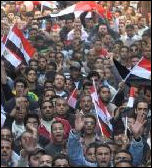
Mubarak’s rotten regime is tottering on the brink. Six days of mass protests have grown into a nation-wide revolutionary wave of defiance.
The first demonstrations were mostly young people organised through on-line social networks. But they swelled as the mass of Egypt’s urban poor and middle classes joined in.
This is a magnificent mass revolt that is an inspiration to workers and youth everywhere.
Today, 31 January, sees tens of thousands of people gathered again in central Cairo for a seventh day of protest and independent unions have called a general strike.
“I had never joined any protests before. I didn’t believe in the people leading them,” said Adef Husseini, a call centre worker in Cairo who took to the streets on Tuesday.
“Now, though, the people are the leaders.” (Guardian 28.1.11)
The middle classes, students, workers and the urban poor have all joined the tidal wave of opposition to Hosni Mubarak’s rule. Even judges joined the protesters in Tahrir Square on Sunday 30 January.
Police disappear
Standing up to vicious brutality from the riot police and large numbers of plain-clothes police and security forces, hundreds of thousands of Egyptians have sent a clear message – “Go! Go! Go!” Older people have passed down water from their flats to demonstrators in the streets below.
Police charges with batons, mass arrests and beatings, tear gas, water cannon, rubber bullets, shotguns and live ammunition have all been used on the demonstrators.
Over 150 have been killed by bullets, beatings or suffocation from tear gas used at close range. One Cairo hospital dealt with over 1000 injured on Friday night (28 January).
In the past two days the police appear to have disappeared. In many areas there has been an outbreak of looting and violent robbery.
But according to many independent reports most of the culprits have been police in plain-clothes and convicts deliberately released from prison. Two police informants were caught attempting to rob a bank in Alexandria.
Tunisia
Just as in Tunisia, the regime has attempted to give out a message that if it falls it will be followed by greater instability and chaos, to try to scare people back to tolerating its continued existence.
As in Tunisia, people have organised protection of their own homes and neighbourhoods, forming local committees to patrol streets and control traffic, armed with wooden clubs and knives.
While some of these may be in richer areas it is clear that elements of ‘dual power’ are emerging, where the state is no longer in full control and the masses are starting to gather power in their hands.
But this is an unstable situation that cannot last indefinitely; either the working class and youth will strive to take power, or the ruling class will strive to re-establish itself, as it is attempting in Tunisia, probably around a new cobbled together regime and at the cost of more bloodshed.
The masses no longer fear the regime. Instead, it is the regime – and all its wealthy and international backers – that fears the masses.
The riot police, which failed to suppress the demonstrations, were withdrawn off the streets and replaced by the army. But the soldiers showed no appetite to turn their guns onto the crowds.
As army trucks rolled into Tahrir Square, in central Cairo, protesters jumped on and hitched a ride. Many clambered over the tanks, embracing the soldiers.
Class appeal
A clear class appeal to the troops as ‘workers in uniform’, with a programme of democratic and trade union rights and election of officers could get a huge response from the ranks of the armed forces.
They could be convinced that the old regime’s hours are numbered and that their place was with the working masses – their families, relatives and friends.
Terrified of such developments, it is reported that army generals, who are closely linked to Egyptian big business interests, discussed in the last days ‘advising’ Mubarak to leave power.
Better to keep their state machine, privileges and interests intact, they reason, than risk the mass movement sweeping all before it.
But the situation remains highly volatile and fluid. The close of 30 January saw reports that the riot police had taken up positions again on some streets and that the army was brining in its heavy armoured vehicles and water cannons.
General strike
During the day, army jets flew threateningly over the crowds in Tahrir Square. This may be Mubarak’s last throw of the dice, as he attempts to intimidate the masses back into their homes.
This desperate effort can backfire, provoking the masses further on the offensive until they win their objectives. Several hundred demonstrators remained camped out in Tahrir square in central Cairo early on Monday morning, defying a curfew that has been extended by the army.
A general strike call was made by independent unions on Monday 31 January and the April 6 Movement said it plans to have more than a million people on the streets of the capital Cairo on Tuesday.
In a potentially very significant development, independent union leaders announced on 30 January the organization of the new ‘Federation of Egyptian Trade Unions’.
The statement called for “the formation of committees in all factories and enterprises to protect, defend them and to set a date for a general strike.
“And to emphasize that the labor movement is in the heart and soul of the Egyptian Peoples’ revolution and its emphasis on the support for the six requirements as demanded by the Egyptian People’s Revolution.
“To emphasize the economic and democratic demands voiced by the independent labor movement through thousands of strikes, sit-ins and protests by Egyptian workers in the past years.”
Mubarak may succeed in forcing back the mass movement in the blood of protesters. Even then, Mubarak could go, sooner or later.
Perhaps he will be forcefully ‘advised’ by his allies in Washington to depart and a new regime cobbled together, as they fear the possible social and political consequences should Mubarak insist on clinging on to power beyond his usefulness to imperialism and the Egyptian ruling class.
Mubarak’s backers in the ruling classes around the world face the same problem. He has made Egypt a good place for them to do business, with privatisation, poverty pay and without decent public services.
Workers’ rights, including to organise in independent trade unions and to strike to win better living standards, are severely restricted. The day after the protests began on ‘Police Day’, 25 January, Hussein Megawer, head of the slavish, state-controlled Egyptian Trade Union Federation, issued a statement congratulating the Interior Ministry! He has tried to stop any union demonstrations during the past week.
Under Mubarak, democratic rights have been cynically brushed aside – to organise political parties, to freely assemble and demonstrate, and to take part in free elections to an assembly with real powers to improve the living standards of workers and the poor.
Imperialist hypocrisy
The regime has been the biggest recipient of US aid in the region, apart from Israel, financing the monstrous security forces that have been used against workers and youth for so long.
Egypt has the 10th largest army in the world. Spent tear gas canisters and rubber bullet cases have been found with US markings – a ‘gift’ to the Egyptian masses from US imperialism.
Suddenly Western capitalist governments are discovering the plight of the Egyptian people! Many are viewing these revolutionary developments from their conference in the Swiss luxury resort of Davos, where they dine and ski with big bankers and industrialists.
US Secretary of State Hiliary Clinton, who described the Egyptian regime as “stable” just a few days ago, now calls for “an orderly transition” of power.
President Sarkozy of France, German Chancellor Merkel and British Prime Minister Cameron issued a joint statement: “The Egyptian people have legitimate grievances and a longing for a just and better future.
“We urge President Mubarak to embark on a process of transformation which should be reflected in a broad-based government and in free and fair elections.” Cameron and Obama – who previously backed the despot Mubarak to the hilt – never fail to call for protesters to refrain from “violence” – as if the Egyptian masses, risking their lives to resist the murderous regime, are on the same level playing field as the well-armed riot police!
Laughably, King Abdullah of Saudi Arabia said his government, “declares it stands with all its resources with the government of Egypt and its people.” The Egyptian government and the people are completely opposed to each other, but there is no doubt whose side the King and every other corrupt ruler in the region supports.
The Egyptian rich elite and friendly imperialist powers now nervously look into the future and wonder who can continue to protect their interests in Egypt.
Gamal Mubarak’s chances of following in his father’s footsteps and becoming the next president are now less than a snow storm falling on Tahrir Square.
Mubarak’s appointment of his Head of Internal Security, 74-year old Omar Suleiman, as vice-president convinced no-one that the regime will reform itself.
Sulieman is no democrat. He has a record of brutal oppression of Muslim Brotherhood supporters and other oppositionists.
Already the streets of Cairo are filled with protesters denouncing his name.
Nothing less than the dismissal of the entire ruling National Democratic Party will satisfy the demonstrators. That would leave a massive vacuum of political power, which the pro-capitalist forces would hurriedly seek to fill.
A ‘provisional government’ could be cobbled together with various leaders of small opposition parties, such as Ayman Nour of Ghad and Mahmoud Abaza of Wafd.
The leaders of Tagammu, once a workers’ party, postpone the idea of socialism until the dim and distant future, after the mirage of a stable capitalist democracy develops.
But the history of the 20th century in Egypt and the region shows that real democracy and change in living standards cannot be met by the ‘native’ reactionary capitalist ruling classes or sections of them.
The tail-ending of Left and popular movements to the so-called ‘progressive’ national bourgeoisie led to setbacks, betrayals and defeat of the masses in country after country.
None of the pro-capitalist parties in Egypt today have mass support and none will challenge the root cause of the desperate lives of Egyptian workers and youth – the capitalist system.
Mohammed el-Baradei hurried to Egypt from his home in Austria after the protests began, with only a few supporters greeting him at the airport. “We want to build a new Egypt founded on freedom, democracy and social justice,” he said.
“The main demand is that President Mubarak announces clearly that he will resign, or that he will not run again.” El-Baradei is not even firm on the need for Mubarak to go now!
The largest organised political movement, the Muslim Brotherhood, also held back from supporting the protests at first, although their youth section did eventually support the 25 January ‘Day of Anger’.
The following day, the Brotherhood issued a statement “on the importance of the cooperation between all political and partisan forces to maintain a unified national stance.” On 30 January, Essam el-Eryan, a leading Brotherhood member, said, “Political groups support el-Baradei to negotiate with the regime.”
When Muslim Brotherhood members chanted, “Allah Akbar”, the crowd stopped them, chanting louder, “Muslim, Christian, we’re all Egyptian.” One 22-year old student in Cairo told the Guardian, “This is a revolution without individual leaders; the Egyptian people are leading it.
“This is nothing to do with el-Baradei or the Muslim Brotherhood or any of the other political parties; they are absent. We are all just Egyptians, and we are standing together.” (28.1.11) Workers and youth can have no confidence in any of these politicians to defend their interests.
Their aim is to maintain the capitalist system that causes poverty and repression.
Working class alternative
Increasingly it is clear that Mubarak’s days are numbered. Late on 30 January, after talks between President Obama, British leader Cameron and King Abdullah of Jordan, the British government announced: “The Prime Minister and President Obama were united in their view that Egypt now needed a comprehensive process of political reform, with an orderly, Egyptian-led transition leading to a government that responded to the grievances of the Egyptian people and to their aspirations for a democratic future”.
Their talk of an “orderly” change means one which safeguards imperialism’s interests and the continuation of capitalism, and they will try to achieve this using el-Baradei or some other figure to head a transitional, but still pro-capitalist, government.
The fact that the mass revolt has clearly shown that class demands predominate, and not divisive religious ideas, is highly significant and progressive.
It shows the potential for a working class, socialist alternative, leading the oppressed. But this must be built and in its absence, other forces, including the Muslim Brotherhood, which for all its rhetoric is pro-capitalist, can start to make bigger gains, stepping into the political vacuum.
To prevent different capitalist politicians or army generals replacing the dying Mubarak regime, workers and youth must organise their own alternative.
Democratic workplace and neighbourhood committees would organise safety and security and, joining together at city, regional and national level, would lay the basis for a government of workers and the poor, the real alternative to the rule of the military and capitalist elites.
Al Jazeera reported on 29 January that 1,700 public workers in Suez had gone on an indefinite strike demanding Mubarak’s ousting. This is a highly significant development that must be emulated across Egypt.
A call for a general strike by protesters was made on 30 January by “independent Egyptian trade unions of workers in real estate tax collection, the retirees, the technical health professionals and representatives of the important industrial areas in Egypt” .
Indeed, a general strike is needed, uniting all sections of the working and middle classes with the youth and the street protests. The protests on 30 January, the start of the Egyptian working week, shows the potential huge support for such a strike.
Indeed, such decisive action – paralysing the whole of the country and organised democratically through local, regional and national linked committees in the workplaces, colleges and elsewhere – could already have seen off Mubarak and his regime.
“Tunis-ami” of popular mass struggle
Removing Mubarak from power would be a huge step forward for Egyptian working people. But on its own it will not be enough to meet their class needs and aspirations for a better standard of living.
A socialist programme of nationalisation of all the big corporations and banks under democratic workers’ control would lay the basis for planning the use of Egypt’s resources to meet the needs of all those who are denied a decent life under Mubarak’s corrupt and cruel regime.
The potential of a mass movement across the region that can win democratic rights and make sweeping social change is indicated by the fire that was lit by the Tunisian revolution.
Despots across North Africa and the Middle East are terrified of domestic mass protests and already demonstrations are taking place in Yemen, Sudan, Jordan, Syria, Libya and elsewhere.
One regime after another is forced to rush to make concessions to the stirring masses, particularly over high food prices. But this will not save them from the onrush and consequences of the “Tunis-ami” of popular mass struggle for real democratic rights and a transformation of living standards.
Socialists celebrate the unfolding mass uprising in Egypt and which are developing across the region- which is a damning refutation of all those cynics and apologists of the system that argued the working masses would not resist, let alone take revolutionary action! The Arab masses are taking matters into their own hands, removing “native tyrants” allied with the Western imperialist powers, first in Tunisia and to be followed, sooner or later, in Egypt and elsewhere.
They will not accept the dictates of local despots and imperialism. These are inspiring movements for working people and youth everywhere.
Socialists call on workers’ internationally to take solidarity action with the Egyptian masses until they have removed Mubarak and his cronies from power!