North Africa/Middle East
Region-wide revolution of the Arab people
To fully succeed, revolutions need to go beyond framework of capitalism
Peter Taaffe, from The Socialist, newspaper of the Socialist Party
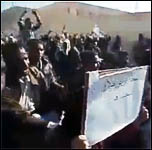
Protests in Libya
“Ten days that shook the world” (Guardian). From Tunisia, to Egypt, to Bahrain, to Libya, to Yemen, to Djibouti and Morocco, the revolution that was sparked by the self-immolation of the desperate and heroic street seller in Tunisia has erupted throughout the Middle East.
And it is yet to complete its work, as the bloody carnage of the desperate Gaddafi regime in the last few days indicates. With the vast majority of the population seemingly against his regime, a one-sided civil war is unlikely to succeed.
This is truly a region-wide revolution of the Arab people.
The super-exploited, impoverished workers and farmers have had their fill of the dictatorial regimes of all persuasions, from ‘kings’ to just ‘plain’ dictators.
Like the masses in the French Revolution over two centuries ago, their refrain is “tremble you tyrants the people are coming”. A Bahraini father on BBC News was asked whether the murder of his son was necessary to defeat the regime.
He replied: “Yes, and the death of my other four sons and myself if it benefits future generations.” As in all revolutions the masses have lost their fear of even the most brutal dictatorships.
And when that happens, no amount of repression can stop the wheel of history turning.
This is graphically underlined by the uprising in Libya which has split the army. It seems to indicate that even the tribes, who were the main prop of the Gaddafi regime, have now gone over – as have some of the army – to the side of the revolutionaries.
Commonality of conditions
It is true, as Robert Fisk of the London-based Independent newspaper has indicated that each of the countries infected by the virus of revolution is different.
But there is a commonality in the social conditions, the denial of basic democratic rights and the consequent feeling of insufferable and unacceptable humiliation in all the countries affected and those that are about to be drawn into the maelstrom.
A pattern – revealing the laws of revolution and counter-revolution – is evident in all the movements so far.
The dictatorships – including the kings, allegedly but falsely dubbed less ‘authoritarian’ – faced with mass opposition on the streets, threaten to unleash terrible force against the population.
But this only emboldens the revolution and drives it forward. Each attack by reaction deepens the crisis, and widens the circle of protest and those involved in the revolution.
In Bahrain – where the monarchy favours the 30% of the population who are Sunni and viciously discriminates against the 70% who are Shia – many Shia were reluctant initially to join the protest.
But the massacre in the capital Manama massively increased the number of protesters, who emulated the occupation of Tahrir Square. “We don’t care if they kill 5,000, the regime must fall,” declared one demonstrator.
Instinctively opposing sectarianism – which is a danger in the aftermath of the ‘Bloody Sunday’ type massacre of predominantly Shias – the masses went out onto the streets shouting “No to Sunni! No to Shia! We are all Bahraini! Down with the Khalifa royalty!”
If anything, the situation is more intense in Bahrain and elsewhere in the Gulf, both because of the rottenness of the feudal and semi-feudal regimes, but also the repressive role and reliance on foreign mercenaries.
Also in Libya, the 42-year-old regime of Gaddafi is alleged to have relied on foreign mercenaries from Chad and elsewhere. This will not save Gaddafi or his demented son, who threatened civil war unless the protesters ended their opposition.
Events have gone too far; not only Benghazi but now Tripoli has been affected, with the TV station attacked and demonstrators also beginning to lose their fear, although the lingering dread of the vicious Gaddafi regime means that they are only prepared to come out at night, avoiding government sharpshooters and snipers during the day.
The ‘contagion’ has spread in one form or another to all or almost all of the 22 Arab regimes in power. In Algeria, in its capital Algiers, 30,000 police were mobilised against the demonstrations.
The bloody civil war of 14 years ago still weighs heavily on the consciousness of the masses of Algeria. But even here President Bouteflika’s regime is under siege.
In Morocco, whose King Mohammed, up to recently, had boasted that the country was much more stable because of the ‘democracy’ that exists, mass discontent has broken out.
18% of graduates are unemployed and there is a 44% illiteracy rate in the country.
Process of revolution
Therefore, the process of revolution – with some delays in some countries, perhaps – will continue throughout the region. It has revived the confidence of the downtrodden Palestinian people and consequently undermined the Israeli ruling class and their backers in London and Washington.
Despite British foreign secretary William Hague’s attempt to distance Cameron’s government from Gaddafi and the Bahraini monarchy, it is British arms which have been deployed against the revolution.
The collaborationist Palestinian Authority – whose leaders wanted to prop up Mubarak – will come under pressure from the masses both in the West Bank and in the other Palestinian areas in the next period.
The Hashemite Jordanian regime is also under ferocious pressure despite the so-called ‘liberal’ credentials of King Abdullah. As in the rest of the Middle East, corruption is rife – stretching right up to the royal household, particularly the Queen – and there is a clamour by a new resurgent movement for fundamental change in the situation which could challenge the very existence of the monarchy in Jordan.
Nor is the Syrian regime – despite the seeming lack of challenge to it on a visible level at least – entirely comfortable and confident it can ride out the present revolutionary wave.
In the past the regime could resort to mass terror to cower the population. Ten thousand members of the Muslim Brotherhood were massacred in the city of Aleppo in 1979, an event which has lain heavily on the consciousness of the Syrian masses.
But as Egypt, Bahrain and Libya have shown, terror alone will not succeed in the changed situation gripping the region. This is a movement for democratic rights, but also to change the living conditions of the workers and small farmers in particular, as well as the middle classes who are ideologically and materially stifled by the straitjacket of the dictatorships.
In Bahrain, a Sunni leader, although a member of the secular left-wing of the Wa’ad party, declared: “We will definitely have more demonstrations and I’m sure we’ll have a general strike.
“Bahrain will not be the same as it was before” (Financial Times).
Nor can the repressive Iranian regime sit comfortably with the Middle East revolution, although it pretended initially that it was an echo of the Iranian revolution of 1979.
When the Iranian masses march out to confront the Iranian dictatorship, it is greeted with the same heavy-handed brutality as all the other regimes facing a mass movement.
Pro-government MPs have called for the execution of opposition leaders. The government and revolutionary guards have a material stake in the maintenance of the Iranian regime.
They have been amongst the beneficiaries of the massive privatisation of state assets and will fight alongside Mahmoud Ahmadinejad to retain this. There are perhaps still some reserves for the regime among sections of the population who fear that western imperialism-backed forces, backed up by American imperialism, can yet make a comeback.
But the Egyptian army had big links to the ownership of industry and banks too. The Mubarak regime had not completely exhausted every basis of support but it was not enough against the majority of the people who were determined to effect change.
Astonishing and encouraging
Therefore, the Middle East revolution – because that is what it is – still astonishes and encourages us, the workers and poor everywhere. The mighty movement of US workers in Wisconsin has been inspired by the Egyptian and other revolutions.
The overthrow of the dictatorships is just the first stage. The achievement of democratic rights would represent a big step forward.
But remnants of the old regimes remain – particularly of the former state machine – as is evidenced by the continuing influence and repressive measures of the police and army in Egypt as well as in Tunisia.
The revolution will only fully succeed if it goes beyond the framework of capitalism and landlordism, and poses the social issues of the eradication of unemployment, the destruction of all elements of corruption, and democratic rights.
This can only be established through a socialist confederation of the Middle East.
This movement has inspired workers everywhere. We don’t have an open dictatorship in Britain.
But the regime of Deputy Prime Minister Clegg and Prime Minister Cameron is, in effect, an ‘elected dictatorship’. Moreover, increasingly there is a bosses’ ‘dictatorship’, in effect, in the factories and the workplaces.
They are conducting an offensive against the working class here to repress and hamper trade unions, backed up by unelected courts and judges.
We must do everything in our power to support the heroic struggling workers and farmers of the Middle East to complete the big changes in society that they yearn for.
We must do the same here in Britain, Europe and the rest of the world until all aspects of the brutal, greedy capitalist society, that can offer nothing but unrelieved misery in the future, is abolished.