TUC demonstration biggest in decades
On 26 March 2011 the British working class rose like lions and took to the streets in an immense show of strength. The massive TUC demonstration against public spending cuts was well over half a million strong, possibly 700,000 or more.
Hannah Sell
The capitalist media has attempted to completely downplay the importance of the demonstration, concentrating overwhelmingly on the clashes with the police at far smaller protests on the same day.
And the turnout on the main demo was far bigger than has been reported. The BBC, for example, claims there were just 250,000 attending.
Unfortunately, the leadership of the TUC itself has also underplayed the turnout as between a quarter and half a million.
This was the biggest trade union organised demonstration in decades.
It had widespread support from the working class and from wide sections of the middle class.
As a TUC-commissioned poll showed, a majority of the population – 52% – support the aims of the demonstration, with only 31% opposing them. Several Socialist Party members got free or reduced price taxi rides to catch early trains from sympathetic cabbies.
On the journey to London even first class passengers bought copies of the Socialist out of sympathy with the demonstration.
The potential power of the trade union movement was graphically demonstrated as a tidal wave of humanity flooded the streets of London. Among the protesters were pensioners, community campaigners and students, the latter veterans of their own movement before Christmas.
The overwhelming majority of marchers, however, were trade unionists, many taking part in their first ever demonstration. The Unison contingent alone took an hour to pass and it seemed as if every trade union – from the largest to the smallest – had its own lively and colourful contingent.
All of those capitalist commentators that have written off the trade union movement today as a spent force were decisively answered by this demonstration. The power of the trade unions was undisputedly established.
But the question on demonstrators’ lips was ‘what next?’ How can the trade union movement use its power to stop the cuts?
Clearly rattled by the size of the demonstration, Lib Dem business secretary Vince Cable has declared that marching will not stop the government, which he laughably described as “one of the strongest the country has ever had”.
In reality this is a weak coalition government, far weaker than the Tory governments of Maggie Thatcher – the Iron Lady. Yet the Iron Lady was reduced to iron filings by a mass movement of 18 million people refusing to pay the flat rate tax (poll tax) that her government had introduced.
That movement ended the tax and brought down Thatcher. Len McCluskey, general secretary of Unite, was right when in his speech he called the anti-cuts movement the Con-Dem’s poll tax.
This government is already rattled and can be decisively beaten by the huge power of the organised working class. Nonetheless, few demonstrators imagined that this savage government of millionaires will be stopped in its tracks by one demonstration, no matter how big.
Correctly, it was widely understood that the demonstration needed to be a springboard for further action.
What alternative?
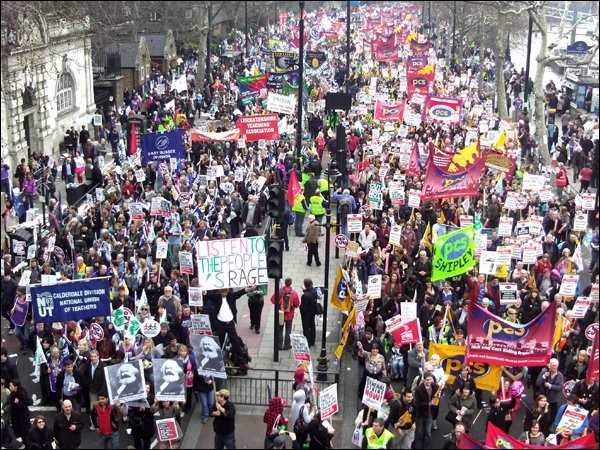
TUC demo 26 March, photo by Peter Knight (Click to enlarge: opens in new window)
Alongside the vital question of how to stop the cuts, the other issue of the day was what the alternative to cuts is. The march was officially called the ‘march for the alternative’.
For some right wing trade union leaders ‘the alternative’ is code for New Labour.
Labour leader Ed Miliband spoke at the demonstration. A small minority booed him, but in the main he was politely received.
He was very careful, however, not to put Labour’s real programme, of supporting massive cuts in public services albeit carried out at a slightly slower pace than that of the Con-Dem government. Instead he made an empty speech.
He made no concrete promises that a Labour government would reverse cuts. He compared the anti-cuts movement to the struggle of the suffragettes, anti-apartheid and civil rights movements without once mentioning the history of trade union struggle in Britain, or for that matter the anti-war movement against the New Labour government.
Unsurprisingly, the man who has said he “opposes irresponsible strikes” did not say a word about what action workers should take to defend their jobs and services from attack.
Many workers on the demonstration will undoubtedly vote Labour in the elections on 5 May in the hope that Labour will, at least, cut more slowly. A significant minority, however, are too angry at New Labour’s record in government and the way Labour councils have willingly implemented government cuts at local level to vote Labour again.
The Trade Unionist and Socialist Coalition (TUSC) – which is standing anti-cuts candidates across the country in the May elections – received a good response.
And those that will vote Labour understand that doing so will not stop the cuts and that therefore further strikes and demonstrations are essential.
All the platform speakers were in the main greeted warmly by the crowd, but the loudest cheers came for those who called for the demonstration to be followed up by strike action.
Len McCluskey declared that the demonstration would have to be followed by coordinated industrial action. Mark Serwotka, general secretary of PCS, summed up the mood of many demonstrators when he said: “Today we’ve marched together; next we’ve got to strike together”.
The Socialist Party’s call for a 24-hour public sector general strike as the next step in the battle to stop the cuts received wide support from the crowd.
At the National Shop Stewards Network (NSSN) stage many hundreds of workers stopped to hear speeches about how such a strike could be made a reality. If the TUC was now to start seriously building for a one-day public sector general strike it would receive enormous support from trade unionists.
It would also attract millions of non-unionised workers and sections of the middle class towards the trade union movement, as the force in society with the power to stop the cuts.
Such a strike would terrify the Con-Dems and give enormous confidence to the working class. Unfortunately, other trade union leaders speaking from the main platform did not put forward a strategy for strike action to defeat the government.
Dave Prentis, general secretary of Unison, put forward local demonstrations against cuts. While such demonstrations can be an important part of the movement they are not a substitute for strike action – both locally and sectorally and coordinated on a national basis.
Brendan Barber, general secretary of the TUC, rightly declared that the trade unions would not allow public services to be destroyed but did not make any concrete proposals on what the next step should be.
Before the demonstration he had emphasised the role of “peaceful civil disobedience”. As the Socialist Party warned at the time, we agree, but not if community campaigns and civil disobedience are used as an excuse to avoid strike action, rather than as an addition.
Civil disobedience
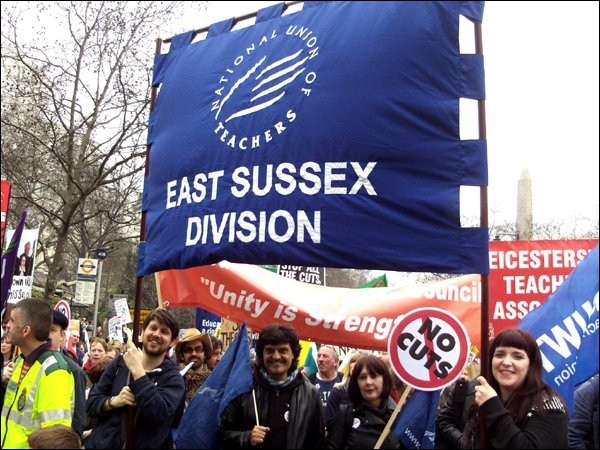
TUC demo 26 March, photo by Peter Knight (Click to enlarge: opens in new window)
It should be added that Barber’s call for civil disobedience does not seem to have translated into supporting it when it took place on Saturday. It was only a small minority of Saturday’s demonstration, mainly young people, who organised sit-ins in shops and other civil disobedience.
Such actions were secondary to the huge power shown by the main demonstration, despite the capitalist media’s inevitable concentration on them.
However, unfortunately the TUC has been reported in the media as just giving a blanket condemnation of ‘violent protesters’, without a word about the role of the police.
We do not support the smashing up of shops as a method of protest, and unfortunately it gives the government, the media and others a way of trying to detract from the magnificence and size of the main demonstration.
But in the main it was the police, not the demonstrators who were violent on Saturday. It seems that the majority of civil disobedience which took place around the demonstration was peaceful, but faced kettling and arrests.
The Guardian website shows film of young people – many singing the international revolutionary workers’ song ‘the Internationale’ – being kettled and manhandled by the police for taking part in an entirely peaceful protest.
Len McCluskey was right when he supported the student protests and demanded “the police keep their grubby paws off our kids”. The fact that so many students attended the TUC demonstration shows that they are rightly looking to the trade union movement to take the lead in the fight against the cuts.
If that is to remain the case it is essential that the trade unions support the youth’s struggle, including against police repression, but also take decisive action against the cuts.
Opposition to cuts in pensions is one issue around which there is a clear prospect of coordinated strike action. The UCU have already taken strike action and is considering more, and the civil servants union, PCS, is discussing balloting for strike action on pensions to take place in May or June.
The NUT is also discussing action before the summer. To have these three unions – one million workers – strike together over pensions would be an important step forward in the battle against cuts.
However, we need more. Unison has also promised national action over pensions, but unfortunately Prentis made no mention of it in his speech.
Unison members, however, want to see action on this issue. There was support among Unison members and others on the demonstration for the Socialist Party’s call for a national midweek demonstration on the day of the next national strike against cuts and attacks on pensions in order that workers from across the public sector can show their support for strike action and to increase the pressure on other public sector unions to build for a one-day public sector strike.
The political alternative
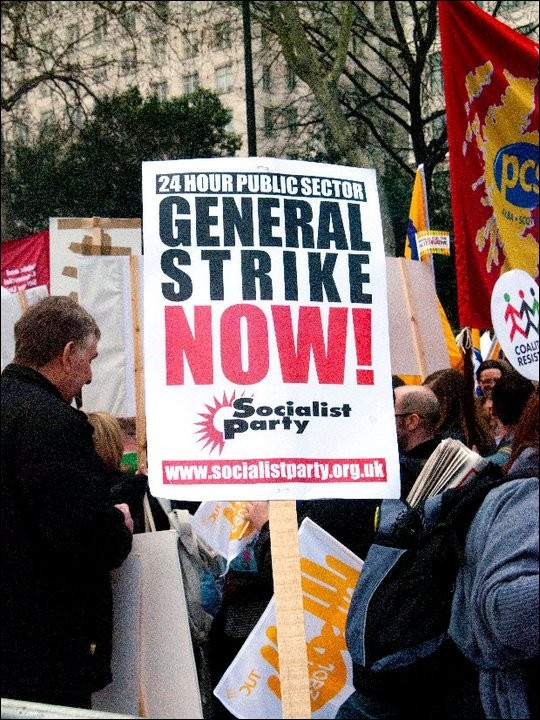
TUC demo 26 March 2011, photo by Sarah Mayo (Click to enlarge: opens in new window)
From the platform there was little explanation of the economic alternative to cuts. Much emphasis was put on the need for job creation but without explanation of how that can be achieved.
Almost every speaker criticised the bankers although from the most right wing, like Usdaw general secretary John Hannett, this was no more than a plea for the bankers to “lead by example”.
This is like asking Dracula to lead by example in refraining from drinking blood!
Several speakers called for a Robin Hood tax on the finance sector which is estimated would raise around £20 billion a year. Mark Serwotka rightly opposed all cuts and very effectively pointed out that tax avoidance by the rich is equal to £120 billion a year, which is almost as much as the total government budget deficit, £143 billion, to be eliminated over four years.
Therefore, at one fell swoop, it should be possible to cut the deficit!
The problem that was not addressed is how to collect the money. As the unpaid £120 billion indicates, the capitalist class is not prepared to pay even the puny levels they are currently taxed.
To collect the money is virtually impossible unless the government uses wide economic powers. This poses the question of the complete nationalisation of the banks and finance houses under workers’ control and management.
Even this would need the cooperation of workers throughout workplaces and industry with the powers – workers’ control – to really open the books, discover the scale of tax avoidance taking place and bring offenders to book.
In other words, socialist measures are needed even to eliminate tax avoidance and evasion, which the overwhelming majority of ordinary working people would support.
Unfortunately, speakers at the main platform did not raise the case for socialism; for a society run in the interests of the millions rather than the billionaires.
However, more than 50 Socialist Party campaign stalls put the case for socialism to the demonstrators. For many of them, on their first demonstration, socialism was a completely new and very interesting idea.
Hundreds wanted to join the Socialist Party, several thousand went away with a copy of the Socialist and many tens of thousands went away determined to struggle, alongside the socialists, to go in the coming months from a massive demonstration to a massive public sector general strike.