Paris commune 1871: When workers “stormed heaven”
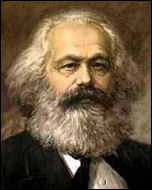
Karl Marx
The mass struggles against dictatorships and poverty sweeping North Africa and the Middle East encourage workers and young people in the region and internationally to seek to learn from previous revolutionary movements.
This year marks the 140th anniversary of the Paris commune, when for a brief but heroic few weeks the working class took power for the first time. In the immortal words of Karl Marx, the masses “stormed heaven”.
In extremely hazardous circumstances, Parisian workers attempted to re-organise society, to abolish exploitation and poverty, before falling beneath a vicious counter-revolution.
Niall Mulholland explains the events.
The background to the commune, as with the Russian revolutions of 1905 and 1917, was war. Faced with economic decline and an increasingly militant labour movement, the desperate and corrupt regime of Louis Napoleon Bonaparte – the self-declared emperor of France – declared war on Prussia in July 1870.
Battlefield defeats soon followed, leading to a revolt of the Paris masses. A new Third Republic was declared and a Provisional Government of National Defence (GND) established. The formation of the 200,000 strong national guard meant that the Paris masses were now armed. The pro-capitalist ministers of the GND feared the potential for class conflict with these forces much more than the Prussian enemy.
A 135-day siege of the French capital by two Prussian armies, further big defeats for the French army and news that the GND was negotiating surrender terms with the Prussians led to a revolt by sections of workers and the national guard.
Headed by the veteran revolutionary, Louis Auguste Blanqui, and his followers, they seized the Hotel de Ville on 31 October and set up a Committee of Public Safety.
Blanqui had a strong influence amongst the Left and worker-activists in Paris, and was respected for his courage. Blanquism, however, was a utopian socialist ideology, which argued that secret groups of conspirators could act as a substitute for the mass action of workers. The majority of workers were not yet ready to rise up against the GND and the insurrection was mistimed and isolated.
Class struggle
The terrible siege of the city continued but so did the class struggle and state repression. In late January 1871, government troops fired on demonstrators outside the Hotel de Ville. Soon afterwards, the GND finally did what they had long planned and announced they were prepared to surrender to the Prussian military leader, Otto von Bismarck. The Prussians insisted on draconian concessions, including the loss of two territories, Alsace and East Lorraine, and huge war reparations.
Elections in February saw the reactionary Adolphe Thiers lead a new national assembly packed with monarchists and rural reactionaries. The assembly antagonised Parisian workers and small businessmen by threatening to cancel the wages of many national guards and demanding that rent arrears and all debts be paid immediately. This threat of bankruptcy, along with the danger of a monarchist restoration and Prussian reprisals, led to a new radicalisation amongst the poor and middle layers in society.
When a central committee of the Federation of the National Guards was democratically elected, Thiers decided to put an end to the emerging alternative government and sent in 20,000 French troops to capture the strategic canons at Montmartre, above the city. However, the troops disobeyed orders to shoot into large crowds of workers and executed two generals.
This was precisely the time for the national guard to go on the offensive. Thiers and his government had fled from Paris to Versailles. The army was disintegrating along class lines. But the central committee, dominated by conservative, procrastinating figures and without a clear socialist programme and worked out tactics and strategy, failed to win over the retreating troops and to end resistance at Versailles.
The leaders of the national guard organised elections for a commune, based on universal male suffrage in each locality, which came into being on 26 March. The commune, or city municipality, recalled the commune formed during the French Revolution, in 1792, which was regarded as a body of popular control.
The members of the 1871 commune were elected and open to recall at any time. Nearly half of the elected members were skilled workers, while the others included radical middle class doctors, accountants and journalists. Karl Marx commented: “This was the first revolution in which the working class was openly acknowledged as the only class capable of social initiative…”
The 90-member commune was made up of various Left republicans, but also a significant number who were members of the International Workingmen’s Association – the First International.
Proudhon
As well as Blanquists, there were followers of Pierre Joseph Proudhon. He argued against big business and called for small property ownership, for people’s co-operatives and exchange banks. This way, workers would “acquire the means of production” and could operate in a “just market”.
Within the First International Karl Marx fought against Proudhon’s anarchistic ideas and the illusion that capitalism could be overturned through reforms. Proudhon did not understand the historic role of the working class in abolishing capitalism – because of its size, strength and collective consciousness – and he rejected the democratic rule of the working class in the transition to socialism and a classless society.
Despite the limits and confusion of the commune leaders, far-reaching social and economic reforms were decreed. The conscript army was abolished and replaced with the national guard of armed citizens. Wages for commune members were limited to help prevent careerism and bureaucracy. The inherent internationalism of the communards was indicated by the popular slogan: “the flag of the Commune is the flag of the world Republic”.
Church and state were separated, religion would no longer be taught in schools, and church property was abolished.
Economic reforms included the abolition of workers’ registration cards and night work for bakers. Pawnshops were closed down. Debts were cancelled for a period. Factories abandoned by their fleeing owners were to be taken over by workers’ associations as co-operative societies. It was hoped to organise the workplaces into one “great union”.
However, the revolution stopped halfway. Decisive sectors of the economy were left untouched. The commune leaders failed to nationalise the Bank of France. Nor did they introduce an eight-hour working day, as a first step to allow workers the time to begin to participate in the running of a new society.
As it was, the commune had little time to put its policies into practice. Terrified that revolution could spread throughout France and Europe, the French and Prussian ruling classes now united against their common enemy – working people in revolt.
The French army laid siege to Paris with a continuous bombardment. Thiers faked a wish for negotiations to buy time to prepare for his final assault. Against this onslaught, the commune leaders underestimated the class enemy and adopted a defensive attitude.
Following some heavy losses in early April, the French army, given free passage by the occupying Prussian army, finally entered Paris on 21 May. Eight days of terrible massacres ensued.
Around 30,000 men, women and children were murdered, 38,000 were imprisoned, and up to 15,000 deported. Thiers was determined to destroy physically the most advanced sections of the working class and to wipe out the living memory of the commune.
Concerning the latter, Thiers and the capitalist ruling class failed completely. Marx and Friedrich Engels studied in great detail the dynamics of the commune – a “new point of departure of worldwide significance” – pointing out that the working class in coming to power could not rely on the capitalist state apparatus – they would have to defeat it and create their own.
Lenin and Leon Trotsky, co-leaders of the successful 1917 Russian revolution, concluded that, above all else, the Paris commune failed because it lacked a revolutionary party of the working class. Such a party sinks deep roots amongst the working class and youth, and by studying the lessons of international movements, prepares in advance for the struggle for power.
Today, the working class is inestimably stronger in France, Europe and internationally than it was in 1871 or 1917. The overthrow of Ben Ali and Mubarak in Tunisia and Egypt this year, was accomplished with the decisive intervention of the working class.
But these revolutions have, so far, met only part of their aims, without guaranteeing real, lasting democratic rights or winning fundamental economic and social change.
As with the heroic Paris commune, building mass, independent organisations of the working class, armed with socialist policies, is vital to realise the aspirations of working people in North Africa and the Middle East and across the world.
Socialist Books
Civil War in France and The Paris Commune
Three essays by Marx, plus an article by Lenin