After the superb 30 June strikes, Hannah Sell, Socialist Party deputy general secretary, addresses the question everyone is asking.
“They thought we wouldn’t do it, they thought we’d lie down and let them walk all over us. They were wrong”. This is how Mary Bousted, general secretary of the most ‘moderate’ union taking part in the 30 June strike – the ATL, summed up the mood of the strikers, to huge applause, at the London rally.
Those who took part in the strike action are now walking a head taller. A new generation has been imbued with the confidence that comes from taking part in effective collective action.
If the huge TUC demo on 26 March was a powerful show of strength by the trade union movement, on 30 June battle with the government was engaged for the first time.
This was the biggest single day of strike action since the 1980s. The strikes were overwhelmingly solid – decisively answering the government propaganda that a majority in the unions taking action did not support the strike. Overall at least 200,000 – 84% of PCS members – took strike action, far more than the 70,000 who voted in the ballot.
As Mark Serwotka, general secretary of the PCS civil service union put it: “It is not voting in the ballot that matters, it is voting with your feet.” PCS members in Downing Street even took strike action, as did 90% of all civilian police support workers, who are organised by the PCS.
For the first time in five years PCS members from the Cabinet Office organised and ran a picket line outside the main entrance to their department. The teachers’ strike was just as solid, with more than 11,000 schools closing for the day.
And this was definitely not a ‘duvet day’ strike. In London a third or more of all NUT members participated in the demonstration. The same could be said of the marches and rallies that took place in virtually every town and city in Britain.
While all the major capitalist parties in Westminster attacked the strikes, with only a handful of MPs – who really do have ‘gold-plated’ pensions – refusing to cross the PCS picket lines, it is a different story with the population as a whole.
It is widely understood that the strikes were about defending all public services from the Con-Dems’ slaughter, as well as the right to a decent pension. The picket lines and rallies were deafened by the constant sound of drivers honking their support for the strike.
Support
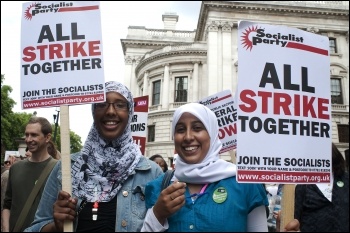
Click for gallery. 30 June coordinated strike action by the PCS civil service union and NUT, ATL and UCU teaching unions, photo Paul Mattsson (Click to enlarge: opens in new window)
The latest opinion polls show the Con-Dems have lost the argument on public sector pensions, with a clear majority opposing the government’s proposals. There have been desperate attempts by the capitalist press to whip up anti-strike hysteria – including the Daily Mail trying to blame the strike for the tragic death of a school student who was killed by a falling branch.
But the polls show opinion as being evenly divided. A new Guardian/ICM poll found 41% support the strike, as opposed to 42% who did not, with YouGov finding similar. However, among women, young people, and those in the North and Midlands a majority supported the strikes.
The government looks, and is, very weak as it scratches around to find a justification for its wholesale attack on pensions. As the pressure mounts on the government the cracks in the coalition are beginning to widen over a whole number of issues.
The latest divisions to be revealed could lead to another u-turn. Cracks are forming between sections of the Tory Party over the consequences of their brutal attacks on benefits. A letter written by the private secretary of Eric Pickles, Tory communities minister, to Cameron in January has come to light. It pointed out the glaringly obvious; that 40,000 or more families will be made homeless as a result of the government’s housing benefits cuts.
It is clear that Eric Pickles is driven by the fear of the electoral consequences of 40,000 families living on the streets – and the economic cost of keeping them in hostels, which would be greater than the current housing benefit bill. This government is very weak and its vicious cuts agenda can be defeated.
Just as workers were given confidence by the 30 June strike, the government was frightened, it felt the earth shake beneath its feet. However, one day’s action will not be enough to force the government to retreat from its attack on public sector pensions, which is driven in large part by the desire to ‘prepare’ the public sector for future privatisation.
This was the first such action many of the strikers, particularly the teachers, had taken. Inevitably, there were hopes that a one-day strike might make the government ‘listen’. Others, however, understood that the government is listening; the Con-Dems know the pain they are inflicting, but are determined to drive through the destruction of public sector pensions in the interests of big business. And there was widespread determination among the strikers – to escalate the strike action if the government didn’t retreat.
Next step
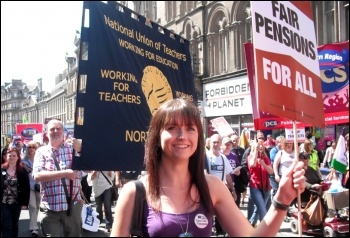
Click for gallery. Newcastle: 30 June coordinated strike action by the PCS civil service union and NUT, ATL and UCU teaching unions , photo Elaine Brunskill (Click to enlarge: opens in new window)
The Socialist Party’s call for a 24-hour public sector general strike, received overwhelming support. At the London rally, Mark Serwotka’s call for four million to strike in October – “including Unison, Unite and the GMB” was met with a standing ovation.
A massive campaign now needs to be built within all those unions who have not yet balloted for action. Those trade union leaders must be pushed to organise ballots immediately in order to be able to join the strike action in the autumn. The government must not be allowed to divide public sector workers.
The National Shop Stewards Network (NSSN) is planning a rally and march to the TUC conference in London on 11 September, in order to exert pressure on the trade union leadership to coordinate a strike of the whole public sector in the autumn.
It was not only on industrial strategy, however, that the Socialist Party’s programme got a warm response. Mary Bousted of the ATL, again summed up strikers’ fury when she said: “I am glad that the ATL is not affiliated to any political party; Ed Miliband is a disgrace.” She went on to ask: “What has he and his shadow cabinet, which is laughingly called an opposition ever done? Sisters, and brothers, we’re doing it for ourselves.”
The potential for trade unionists to create a new party – that stands in the interests of working class people – has been made crystal clear in the last week.
Even if trade union candidates were to initially stand on a limited programme – opposition to all cuts in jobs, pensions, services and benefits, and repeal of the anti-trade union laws – it would mark a significant step forward.
However, the struggle that public sector workers are currently fighting goes beyond those immediate issues. The pension reform is one aspect of the government’s assault on workers’ living conditions.
The government’s pension reforms are estimated to ‘save’ £2.8 billion. The mass movement against the poll tax forced the then Tory government to scrap it at a cost of around £7 billion in today’s prices. Faced with a determined mass movement the government can also be forced to retreat on pensions.
However, pensions are only one part of the £81 billion that the government is planning to cut from public services, the biggest cuts in 80 years. New Labour supports cuts on only a slightly smaller scale. While we can force the government to retreat on different aspects of the cuts, the struggle against them all is, in reality, a struggle against the consequences of capitalism today and therefore poses the need for a socialist alternative.
“Public sector workers are being asked to pay again for the £850 billion that was used to bail out the banks.” Mary Bousted was correct in this, but it is not only public sector workers, but all workers, who are being made to pay for the economic crisis.
As Mervyn King, governor of the Bank of England, put it, workers in Britain are facing the longest period of wage restraint since the 1920s. Meanwhile the financiers and speculators, the capitalist wolves, are enjoying as big a bonanza as they did during the boom. In the last year the wealth of the richest 1,000 people increased by 18%.
Capitalist crisis
The crisis of capitalism goes beyond bailouts of the banks. The crisis in the financial system was the fault line along which all the underlying contradictions of capitalism have been laid bare. Capitalism has always been a blind profit-driven system based on the exploitation of the majority – the working class – for the profits of a few at the top.
There was a brief period – from around 1950 to 1973 – when capitalism developed rapidly. At least in the more economically developed countries, including Britain, working class people were able to win a few crumbs from the capitalists’ table. In Britain a National Health Service and a mass council house building programme made a real improvement in workers’ lives.
However, when that post-war period ended, capitalism set about restoring its profits by driving down the share of the wealth taken by the working class.
Production was moved abroad to countries with worse workers’ rights and cheaper labour, wages were driven down, and spending on public services was cut back. Of course these processes were taking place even during the last boom.
As the Financial Times reported last week, wage restraint is not new: “Fork-lift truck drivers in Britain could expect to earn £19,068 in 2010, about 5% lower than in 1978, after adjusting for inflation. Median male real US earnings have not risen since 1975. Average real Japanese household incomes after taxation fell in the decade to the mid-2000s. And those in Germany have been falling in the past ten years.”
During the last boom profits reached an all-time record. However, the bosses had difficulty finding profitable fields to invest in. Investment in science, technique and production remained at an historic low. Why? Not because they were not needed but because working class people lacked the means to buy the goods that could potentially be produced.
This is the terrible reality of capitalism. It didn’t matter that two billion people are without the most basic necessities of life – they are not ‘a market’ because they lack the money to buy what is produced. Improving education or health care is only in the interests of capitalism if a profit can be made from it.
Instead of investing in industry the capitalist class made its profits in the last boom by gambling on the world’s stock markets in a speculative frenzy. The financial crisis was the inevitable result.
Socialists, like growing numbers of people, argue that the rich should be the ones who pay for the crisis – via dramatically increased taxes for the super-rich and the big corporations.
For most of the 1970s the tax rate for the highest band of income was 83%. Back then big corporations paid 52% of their profits in tax, but that percentage has been reduced step-by-step ever since. It is currently just 28%, with reductions for the next three years planned by the Con-Dems.
Even with the existing low levels of taxation for the rich, the PCS union points out that more than £120 billion goes uncollected, evaded and avoided every year.
But while we favour taxing the rich, we also recognise that the ‘markets’ – either the big corporations or the bond traders who are holding whole countries such as Greece to ransom – will never meekly accept dramatically increased regulation and taxation.
So what is the alternative to this market madness? The starting point is to oppose all the cuts. Faced with a determined and organised working class, big business will be forced to retreat. However, in its relentless pursuit of profit, capitalism would then come back with other ways of making the working class pay for the crisis, for example by using inflation. That is why we need a socialist solution.
For a start we call for the nationalisation of the big banking and finance companies. Compensation should be paid on the basis of proven need – but without one penny going to the speculators who are demanding that the working class pay for the crisis for which they – the speculators – bear responsibility.
It would then be necessary to introduce a state monopoly of foreign trade – so that it would be a democratically elected government – not the market – that controls imports and exports including capital.
Nationalisation
A socialist nationalised banking sector would be democratically run by representatives of banking workers and trade unions, the wider working class, as well as the government. Decisions would be made to meet the needs of the majority, for example offering cheap loans and mortgages for housing and for the planned development of industry and services and ending all repossessions of people’s homes.
However, that would only be the start. Capitalism has led to enormous economic destruction. In Britain around 10% of wealth has already been lost as a result of the recession, due to factories and workplaces closing. This has resulted in 2.5 million, and rising, officially unemployed. Nor is there any prospect of a return to healthy growth. The best prospect that can be hoped for under capitalism is a prolonged period of economic stagnation.
That is why a crucial step towards solving the economic crisis would be to take the big corporations that dominate Britain’s economy into democratic public ownership. This would then allow for production to be planned for need and not for profit.
It would be possible to enormously expand the education system and the health service. Building workers, for example, could be put to work building and refurbishing high quality, environmentally friendly affordable social housing for the five million people who want it.
Huge resources could be put into the development of environmentally friendly technologies. The retirement age could immediately be reduced to 60, or even less, for all those that wanted to retire. The working week could be cut, without loss of pay. This measure, combined with an expansion of public services, could quickly eliminate unemployment.
All of these, and much more, would be possible on the basis of a democratic socialist plan of production.
Of course, capitalism is an international system, and any alternative could not stop at the shores of Britain. However, if a democratically elected socialist government in any country was to begin to implement the kind of programme outlined here it would act as an enormous inspiration to workers in the rest of the world struggling against capitalism’s devastation of their living standards.
Even more so than the revolutions across North Africa and the Middle East, the ideas of genuine democratic socialism would spread like wildfire.