

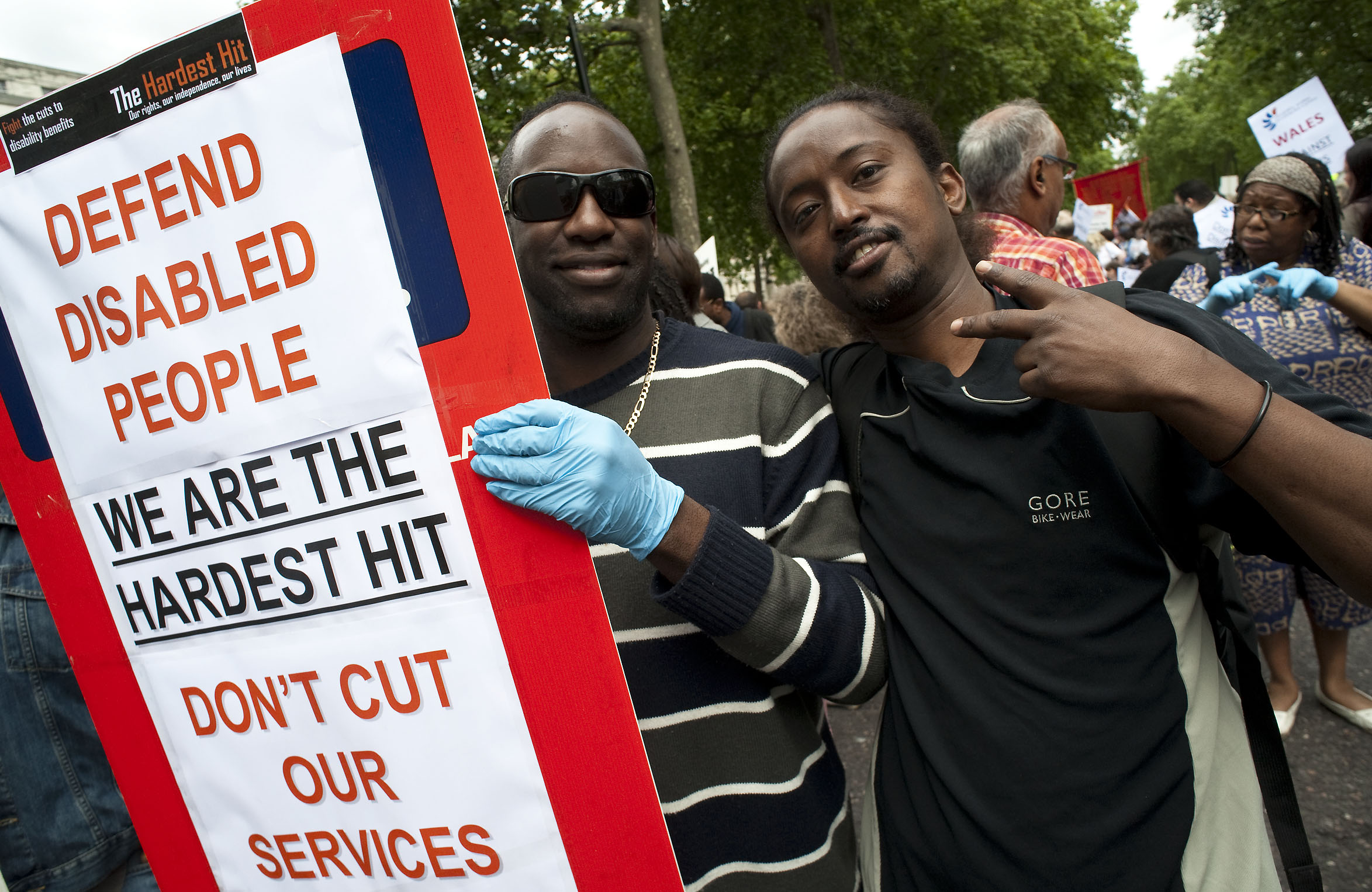
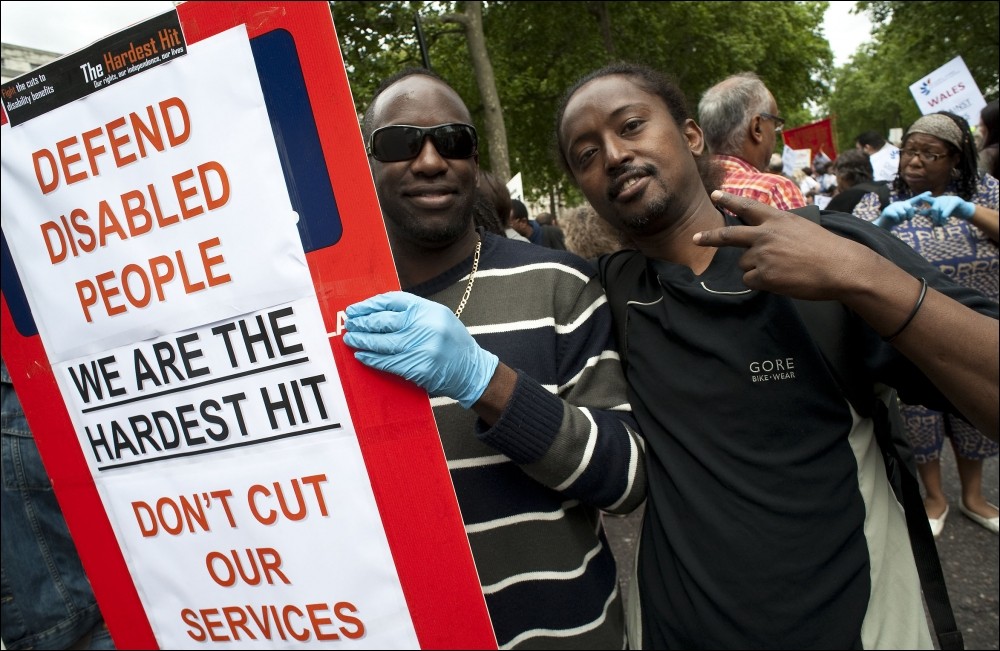
Hardest Hit Protest: Disabled people and their families protest in central London against government spending cuts, photo Paul Mattsson (Click to enlarge: opens in new window)
Fighting for disabled people’s rights
A contribution to debate on campaigning, by a Socialist Party member who is active in the disabled people’s movement
Too little, too late – The Hardest Hit campaign’s Christmas card to Cameron and Clegg
Following The Hardest Hit campaign’s dozen regional marches and rallies on 22 October where more than 5,000 disabled people, family carers and supporters demonstrated against the Con-Dem’s Welfare Reform Bill, its next ‘action’ on Tuesday 13 December is to send a giant Christmas card to David Cameron and Nick Clegg.
The card has been illustrated by Gerald Scarfe, partner of Jane Asher who as president of Arthritis Care was prominent on The Hardest Hit’s London demo on 11 May.
About 20,000 signatures or messages will be included in the card, double the original target.
The card reads:
“Dear David Cameron and Nick Clegg,
While we don’t expect gifts this Christmas, we do want our basic rights protected and the support to enable us to live independently and with dignity.
Please make the New Year something disabled people can look forward to by:
- Not bringing in an arbitrary time-limit on Employment and Support Allowance for those who’ve paid into the system and still need support.
- Making sure that those who rely on Disability Living Allowance continue to receive the financial support they need through Personal Independence Payment.”
Those disabled people who have signed the card physically or online did so because they support its message, but what is noticeable is both the limited demands and ambition of the charity directors and disabled activists running this campaign.
The Welfare Reform Bill is a continuation of neoliberal policies that have been promoted by successive Tory and New Labour governments since the 1980s, only the scope of this one is much broader as Cameron, Clegg and Osborne attempt to do what Thatcher, Major, Blair and Brown never dared and cut the welfare budget by £18 billion.
If passed in its present form, the bill will:
- Introduce Universal Credit which on paper promises a simpler benefits system but will witness caps on housing benefit and other payments. 133,000 households in London will soon be unable to afford their rent, many of whom will be disabled people or carers.
- Introduce a much stricter sanctions regime with the loss of benefits for up to 3 years, a risk particularly to people with learning disabilities or mental health needs who find it difficult to cope with the demands of looking for work at the same time as having little prospect of finding employment.
- Replace Disability Living Allowance (DLA) with Personal Independence Payments (PIPs) with the explicit aim of cutting entitlement by 20%.
- Time limit contributions-based Employment and Support Allowance (ESA) to one year, therefore from April 2012 people who were assessed even by the brutal Work Capability Assessment (WCA) as being unfit for work could find themselves on Jobseekers Allowance.
- Abolish the discretionary Social Fund, Community Care grants and most crisis loans, with responsibility being placed on local authorities to provide alternative support.
Combined with the current programme to abolish incapacity benefit for 1.5 million, cuts in housing, social care and health services, the closure of the Independent Living Fund and huge increases in the cost of utility bills and essentials, the future for disabled people and their families looks bleak if the Welfare Reform Bill becomes law.
Limited Demands
The Hardest Hit campaign has for some months called upon the coalition government to: improve the WCA run by Atos Origin; abandon the plans to time-limit ESA; ensure Universal Credit recognises the additional costs of living with an impairment or disability; and make sure no disabled person loses his or her independence when PIPs are introduced.
It also confusingly combines these with a list of four things it wants to achieve: no cuts to services vital to disabled people; and the government to ensure that changes to DLA do not make disabled people worse off, that ESA works by improving the assessment process, and for the welfare system to support people with the additional costs of living with a disability.
What is striking about the two demands in the Christmas card is they are even more limited than the ambitions above.
Following an independent review by the peer Lord Low that was funded by Mencap and Leonard Cheshire Disability, the government has announced that mobility allowances will not be taken away from those disabled people living in residential care when PIPs are introduced.
But more significantly, following a second review of the WCA by Professor Malcolm Harrington, employment minister Chris Grayling has accepted its recommendations.
These include giving more discretion to Department for Work and Pensions (DWP) officers when making benefit decisions following the WCA ostensibly to reduce the number of successful appeals, ‘improved support’ for people pushed onto Jobseeker’s Allowance, and working with disability groups to help develop guidance for Atos Origin staff and DWP decision-makers.
It is vital the organisations involved in The Hardest Hit campaign distance themselves from any measures that support the continuation of the WCA.
The fear for activists is that the failure to even mention the limited demand of improving the WCA in their Christmas card is because The Hardest Hit campaign believes Harrington’s recommendations satisfy this.
Given that the simplistic, function-based questionnaire that makes up the WCA was introduced by New Labour as part of a policy to drive one million off incapacity benefits, and the WCA process will be used as a model for the reassessment of mobility and care benefits when PIPs are introduced from 2013, any demand short of the scrapping of the WCA would be a betrayal of both the thousands who marched on 22 October and the million plus whose income will be slashed by it.

Hardest Hit demo, Cardiff, 22.10.11, photo Cardiff Socialist Party (Click to enlarge: opens in new window)
Missed opportunity
Unfortunately, from the start the Hardest Hit campaign has failed to weld the enormous anger amongst disabled people and family carers against the Tory/Liberal coalition’s programme of benefit and public service cuts into a mass campaign to stop the Welfare Reform Bill.
The thousands who demonstrated in London on 11 May and across Britain on 22 October could and should have been organised into campaign groups in towns and cities across Britain.
The Hardest Hit campaign has been top down and focused on trying to amend the Welfare Reform Bill in the House of Lords rather than calling for it to be thrown out.
We have even witnessed in November the widely-respected independent peer Jane Campell arguing for the term Disability Living Costs Allowance to be used instead of Personal Independence Payments, instead of using her authority to condemn the Tory/Liberal proposals outright.
Whatever name is used won’t change the fact that hundreds of thousands will lose mobility and care benefits to achieve a 20% cut.
In its publicity material for their Christmas card, The Hardest Hit campaign says: ‘The Welfare Reform Bill is now making its way through the final stages in Parliament.
The next month provides us with our last real opportunity as a sector to influence the bill and we need to make our next action BIG and LOUD.’
Whilst some further concessions may be won in the next week, unless a mass campaign is built now to stop the Welfare Reform Bill, what will be introduced from next April will have a profound impact on the lives of disabled people and their families.
If it becomes law, the one thing though that will be BIG and LOUD will be the questions asked by many disabled people and family carers as to why more was not done to oppose such an obscene piece of legislation.
The Hardest Hit campaign
Some left-wing disabled activists have refused to take part in The Hardest Hit demonstrations, primarily because of the involvement of the Leonard Cheshire Disability (LCD) charity.
But this position ignores the central role played by the United Kingdom Disabled People’s Council (UKDPC) in The Hardest Hit campaign, with a new generation attending their first demonstrations becoming aware of UKDPC’S existence for the first time.
The opposition to LCD’s involvement stems from its role in developing and maintaining residential homes for disabled adults over the last sixty years.
A small layer of activists in the 1970s and 80s who were influential in the development of the disabled people’s movement in Britain were themselves residents in Leonard Cheshire homes because there were no alternatives in the community for people with complex conditions at the time.
Their long struggle to live independently forged for themselves and the broader movement they influenced a very strong opposition to the segregation of disabled people in social care, education and broader society.
While there are historical roots to the opposition to LCD’s involvement, it was mistake for some disabled activists and their organisations not to participate in The Hardest Hit demonstrations for this reason.
This isolated them from a new layer of disabled people on their first demonstration that they could have influenced with leaflets and other political material.
We do though need to recognise that at a national level the directors and leading trustees of some large disability charities see public sector cuts and the privatisation of services as an opportunity to expand their business side.
However, many thousands of disabled people and family carers who are members of these charities also currently look to them and The Hardest Hit campaign as the best option to defend their benefits and services against cuts.
It is vital the disabled people’s movement builds a bold, energetic campaign against both welfare ‘reform’ and the public sector cuts.
Particularly by developing a programme that articulates the day-to-day concerns and issues facing family carers and disabled of all ages and impairments.
But it is essential that such a campaign explains the neoliberal origins of welfare reform, the privatisation of public services, and attacks on pay, pensions and conditions.
In particular, the way the capitalist class are increasing their wealth at the expense of the working class and middle layers in society, producing contradictions such as 25,700 excess deaths of older people due to cold weather in 2010/11 whilst the top 1% enjoy their rich lifestyles.
Such an approach will help disabled people and family carers to develop the confidence to challenge those in both the impairment based charities and the disability movement who prefer to compromise or openly collaborate with the Tory/Liberal coalition’s agenda rather than face up to the task of building a mass campaign against cuts to services and benefits.
The disabled people’s movement must also be wary of being used by Ed Miliband’s Labour Party and as a minimum it should demand it drops its support for welfare reform and commit itself to opposing all benefit and public sector cuts.
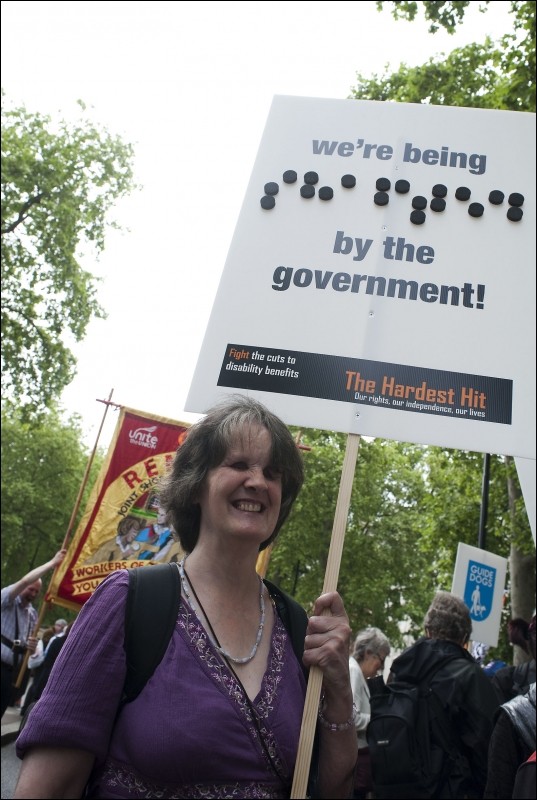
May 2011 Hardest Hit Demonstration, photo Paul Mattsson (Click to enlarge: opens in new window)
But the natural allies for the disabled people’s movement are the millions of public sector workers who are moving into action to defend public services and their pay and pensions.
If the full resources of the trade union movement had been mobilised in support of The Hardest Hit demonstrations on 22 October they could have been many times larger.
It is also vital for disabled activists to develop links with trade unions at all levels if a movement to stop welfare reform is to be built.
Although The Hardest Hit campaign is likely to continue in some form after the Welfare Reform Bill is passed, it is questionable whether it will be more than just publicity stunts or a vain attempt to convince the better nature of MPs of all persuasions that their support for the worst aspects of welfare reform and public sector cuts is wrong.
Disabled people’s movement
However if the Welfare Reform Bill is passed largely in its current form it is likely to lead to a serious debate about the role played by disabled people’s organisations since the government coalition came to power.
Some organisations at a local level such as Inclusion London and the Norfolk Coalition of Disabled People have opposed the Con-Dem’s cuts from the start, and used their resources to both explain in detail the implications for disabled people and mobilise support for The Hardest Hit demonstrations.
The strong opposition of disabled people’s organisations at a local level certainly influenced the decision of the United Kingdom Disabled People’s Council to call the meeting in January that initiated The Hardest Hit campaign.
Unfortunately, while thousands have been mobilised on The Hardest Hit demonstrations, the UKDPC made a serious mistake by allowing this campaign to develop a limited set of demands based on a strategy of amending the welfare reform bill in the House of Lords.
It also maintains a misguided confidence in the role the Human Rights Act can play in defending disabled people’s rights – when in July the retired prima ballerina Elaine McDonald lost her Supreme Court case to defend her need for overnight care arguments in support of her human rights were a very blunt weapon.
The UKDPC is faced with considerable financial pressures and has historically relied on project grants from charitable trusts and government programmes.
Increasingly this kind of funding is linked to support for neoliberal policies and practices, placing considerable pressure on the ability of disabled people’s organisations to maintain principled rights-based work.
But the UKDPC is still seen by a majority of disabled activists as the national representative organisation for the disabled people’s movement.
It is vital though that it develops a programme independent of those charities and disability organisations that are prepared to support the privatisation of public services.
While funding itself and conferences to encourage debate amongst disabled people will always be a challenge, the UKDPC can potentially play a historical role in helping to build mass opposition to the Con-Dem cuts.
But the UKDPC needs to develop stronger links with the trade union movement at all levels and look to its considerable resources for support.
RADAR/Disability Rights UK
Whilst the UKDPC has emerged from The Hardest Hit campaign with increased authority, the opposite is true of RADAR, the Royal Association for Disability Rights.
At the same time as disabled people and family carers were becoming aware of what the Con-Dem cuts would mean for them and marching in their thousands on 11 May, RADAR’s chief executive Liz Sayce was carrying out an ‘independent’ review of supported employment services.
This was commissioned by the Tory/Liberal coalition as part of George Osborne’s Autumn 2010 spending review, and Sayce had the support of a team from the DWP.
When published in June 2011, the Sayce Review disgracefully included proposals to remove government funding from residential training colleges and the closure of the Remploy factories that could lead to more than 2,500 disabled workers being thrown on the dole.
Sayce’s review “is supportive of the direction of travel towards a simplified welfare state and the introduction of a new Universal Credit” and therefore supports a key component of the welfare reform bill.
So when thousands marched on 11 May to oppose this legislation, Sayce and RADAR were already giving it their tacit support. With a friend like Liz who needs enemies?
Sayce is now the chief executive of Disability Rights UK, a recent merger of RADAR, Disability Alliance and the National Centre for Independent Living.
When minister for disabled people Maria Miller announced on 13 December 2010 the closure of the Independent Living Fund on the grounds it was “financially unsustainable” – news to its 21,000 disabled users – she said the government had “consulted informally with disability organisations”.
The fact that representatives of NCIL and Disability Alliance were among these, and met Miller on the day of her statement, doesn’t suggest they will temper RADAR/Disability Rights UK’s cosy relationship with the Con-Dem government.
Disability Rights UK will continue to support Radiate, a network of disabled ‘high-flyers’ set up by RADAR.
While Disability Rights UK will attract support from the 1% of disabled people trying to break through the ‘glass ceiling’, the 99% who are locked in the basement and don’t know what the glass ceiling looks like will develop a deep mistrust of Disability Rights UK or any other organisation for that matter that fails to fight against cuts to benefits and public services.
Disabled People Against Cuts
One positive development in the last year has been the emergence of Disabled People Against Cuts (DPAC) and campaign groups such as Black Triangle in Scotland.
While DPAC was mistaken in its decision not to participate in The Hardest Hit campaign, it has been important in the organisation of demonstrations that have successfully highlighted the impact of the brutal WCA run by Atos Origin for both New Labour and the Tory/Liberal governments.
DPAC’s first conference in October was attended by about 65 activists and demonstrates the potential this group has to organise not just dozens but hundreds of disabled people if it can successfully establish local campaigning groups across Britain.
As well as electing a steering committee and establishing a number of working groups, DPAC is developing a Charter of Rights for Disabled People.
This will articulate a broad range of demands that reflect the many issues arising from disabled people’s day-to-day experience of discrimination, exclusion and poverty.
It is vital that this Charter also sets out an explanation as to why neoliberal policies such as welfare ‘reform’, the privatisation of public services and the contraction of social care have been adopted by successive Tory and New Labour governments.
In particular, it needs to argue that the defence of services, benefits and what few rights disabled people have in the ‘age of austerity’ is inextricably linked to the success or failure of the anti-cuts movement – a struggle disabled people and family carers should play a central role in.
Finally, for socialists within both the trade union and disabled people’s movements, a key task in the next period is to link the defence of family carers and disabled people’s services, benefits and rights to the need to fight for a socialist society based on meeting social need rather than creating profit for a greedy minority.
The Socialist Party calls for:
- No cuts in benefits, jobs and public services.
- Mobilise now to stop the Welfare Reform Bill through a united campaign involving disabled people and carers’ organisations, trade unions and the anti-cuts movement.
- Decent benefits, education, training or work for all, without compulsion.
- No privatisation of services. Take back in-house all privatised services.
- Sack Atos Origin and scrap the Work Capability Assessment.
- A living wage and provision of respite services for all family carers.
- Provide free health and social care services to all who need them.
- Central government and councils to stop using children and family members as a substitute for professional social services.
- A national campaign to save the Independent Living Fund.
- Oppose the closure of the Remploy factories – expand them to create employment for both disabled and non-disabled people.
- Massive investment in social housing, services and infrastructure to create jobs and meet need
- A mass movement against all cuts and further coordinated trade union action to oppose cuts in pensions, jobs and pay if needed.
- For a socialist society that puts the needs of the millions before the profits of the millionaires.