|
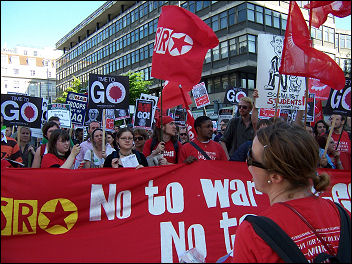
International Socialist Resistance demonstrate against war |
RIDING PILLION behind Bush, Blair has embroiled Britain in disastrous wars in Iraq and Afghanistan. Now, as part of his ‘legacy’, he wants to commit us to paying for a brand new Trident missile system. Brown supports this too, and New Labour ministers flock behind them like sheep. Every one of the 160 nuclear warheads will be capable of wiping out over half-a-million people.
The bill for these weapons of mass destruction is likely to be around £25 billion for the system. But the total expenditure will be around £76 billion when running costs over 30 years are included. Why aren’t Blair and Brown proposing to spend this money on improving health, education, pensions and other vital, life-support services?
The new system, like the current version, will consist of US-made Trident missiles, based on four British-built submarines. The nuclear warheads will be manufactured at the Atomic Weapons Research Establishment (AWRE), Aldermaston. This nuke factory is already being modernised. The cost is secret, but estimated to be over £4 billion.
Why does Britain need these grotesque weapons? Blair claims we need nuclear missiles as the “ultimate insurance policy” in an “uncertain and dangerous world.” Britain, he claims, could be threatened by a “re-emerging threat” from a major nuclear power. This, presumably, means Russia or China.
Or Britain could be threatened by “new states [that] will emerge that possess a more limited nuclear capability”. We can guess Blair means states like North Korea and Iran. Such threats, says Blair, are “not non-existent.” Yet for this remote threat he wants us to pay for a £76 billion insurance policy.
Fantasy deterrent
WHAT IS Britain’s “independent nuclear deterrent” meant to deter? Nuclear threats do not come out of the blue. A threat from Russia or China, or from North Korea (which may have one of two crude nuclear bombs), would only arise as part of an extreme global crisis.
British imperialism’s “deterrent” (under 200 warheads) would be a minor factor compared to the US super-power’s massive nuclear arsenal (over 10,000 warheads). In any case, can we imagine a British government acting independently? When was the last time Britain acted without the approval of US imperialism?
In 1956, Britain, secretly conspiring with France and Israel, invaded Egypt after Nasser nationalised the Suez Canal. Eisenhower, the US president, immediately exerted economic pressure on Britain, which forced the Eden government to retreat. The adventure ended in humiliating defeat for British imperialism.
Another nuclear risk, claims Blair, is that rogue states could sponsor nuclear terrorists operating from their territory. Again, Blair himself weakly admits, “it’s improbable but no one can say it’s impossible.” So we need a £76 billion insurance policy?
The existing Trident system did not deter the 7/7 London tube and bus attacks in 2005. How would it stop nuclear terrorists? Britain’s deterrent, for example, did not prevent the exiled Russian, Litvinenko, being murdered in London last year by means of highly toxic radioactive polonium, somehow smuggled into this country. No doubt his assassins were sponsored by a rogue state, or rogue state-security elements, or a criminal organisation. How can nuclear weapons deter this kind of attack?
Global anger
IMAGINE A horrific scenario: An unidentified terrorist group explodes a portable nuclear device in one of our major cities. It might be a ‘dirty bomb’, using conventional explosive to scatter highly toxic radioactive waste material.
Against whom would the government unleash a nuclear strike? What would nuclear retaliation achieve, apart from revenge? It would inevitably provoke more terrorist attacks. How many innocent civilians would the British government be prepared to kill? Even one Trident warhead has eight times the destructive power of the Hiroshima bomb that killed over 100,000 in 1945.
Use of a single warhead – and Trident missiles carry multiple warheads – would trigger a wave of global anger internationally, with mass protests on every continent. It’s a fantasy to believe that nuclear weapons can deter rogue states or nuclear terrorists.
|
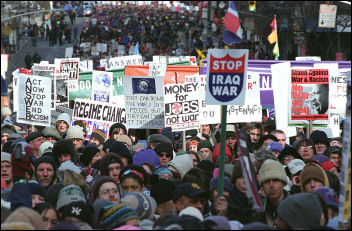
New York demonstates against the war in 2003 – photo Paul Mattsson |
US imperialism has a huge, advanced-technology nuclear arsenal, with over 10,000 nuclear warheads. This didn’t deter the 9/11 attacks on the Twin Towers and the Pentagon. It hasn’t enabled the NATO powers to dominate Afghanistan or the US superpower to avoid defeat in Iraq. If the world is a more “uncertain and dangerous” place, it is mainly because of the military intervention of US and British imperialism and other powers in Afghanistan, Iraq and elsewhere.
Instead of fostering stability and security, the upgrading of nuclear arsenals will give a new twist to the nuclear arms race, making the world even more unstable and dangerous. It’s like taking out an expensive, comprehensive insurance policy on a car – while filling the boot with crates of gelignite.
Power and prestige
BLAIR’S ARGUMENTS for an “independent nuclear deterrent” are false, from beginning to end. Owning a nuclear arsenal has nothing to do with the security and well-being of Britain’s people. The real reason for nukes, nowhere admitted by Blair or his ministers, is the power and prestige of the ruling class and the political elite.
Blair is determined that British imperialism, now a second- or third-rate power, should continue to ‘punch above its weight’, remaining part of the nuclear, great-power club. Surprisingly, perhaps, Blair’s phoney arguments are exposed by the Financial Times, a mouthpiece of big business. “What exactly…is it for?” asked an editorial (Unanswered Questions, 5 December 2006).
“Put simply: do we need Trident as ‘the ultimate insurance’ as Mr Blair says? Or are we clinging to the ultimate vestige of the great power delusions to which this prime minister seems especially prone?”
One of the Financial Times’ columnists, Philip Stephens, is even more scathing. In an article headlined The High Price of Nuclear Prestige (4 December 2006), he writes: “The government cannot argue that a strategic nuclear capability is vital to Britain’s future security. Had it not already possessed the bomb it is inconceivable that any government would now seriously contemplate its acquisition.”
Inconceivable! Yet Blair is determined to bequeath us a £76 billion bill for an invalid nuclear insurance policy. He said he wanted a debate about the renewal (and why not the abolition?) of Britain’s nuclear ‘deterrent’. But he presented only one option: a new Trident system. This was rubber-stamped by Blair’s tame cabinet after the briefest of discussions.
It’s probable that (sometime in March) Parliament, with Tory support, will also rubber-stamp Blair’s plan. The Labour Party has swung so far to the right that only about 50 Labour MPs are expected to oppose Trident. If there was to be a real debate, with all sides of the issue put to the public in mass meetings up and down the country and through the media, there is little doubt that a big majority would be against this phenomenally wasteful, dangerous project.
Even if Parliament votes for Trident, the campaign should be stepped up to reverse such a shameful decision.
- No to any new nuclear missile system.
- Scrap the existing Trident system.
- Radioactive material from warheads should be permanently disposed of as safely as possible.
- Workers now employed in nuclear weapons systems, together with scientists and engineers, should be redeployed on projects of real benefit to society.
- The £76 billion planned for new nuclear weapons should be spent on the needs of the majority, not the prestige of the ruling elite.
Nuclear weapons – dire threat to humanity
|
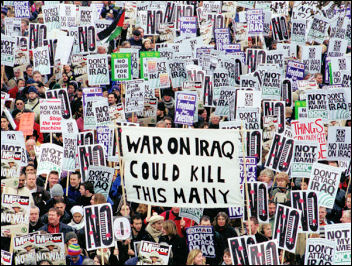
Huge anti-war demonstration in London in 2003 – photo Paul Mattsson |
THE NEW Trident system, Blair boasts, will have ‘only’ 160 warheads, compared with the existing 200. New Labour’s white paper, The Future of the UK’s Nuclear Deterrent, claims: “We stand by our unequivocal undertaking to accomplish the total elimination of nuclear weapons.”
What utter hypocrisy! Building a new Trident system sends out the opposite signal. As the nuclear scientist, Joseph Rotblat, says: “If some nations – including the most powerful militarily – say that they need nuclear weapons for their security, then such security cannot be denied to other countries which really feel insecure. Proliferation of nuclear weapons is the logical consequence of this nuclear policy.”
The big five powers have always tried to maintain an exclusive nuclear club. Under the 1968 Non-Proliferation Treaty (extended indefinitely in 1995), the other 182 signatories agreed to renounce nuclear weapons in return for assistance with peaceful nuclear energy programmes, subject to international inspection. At the same time, the big five committed themselves to reducing and eventually eliminating their own nuclear arsenals.
In reality, the big five have never had any intention whatsoever of giving up their nukes. Since the early 1990s they have reduced their stockpiles of nuclear warheads, while modernising their arsenals and developing new ‘tactical’, battlefield weapons.
Currently, about 40 countries have nuclear weapons or the capacity to rapidly produce them. Worldwide, there are around 27,600 nuclear warheads – more than enough to destroy the planet and pollute surrounding space.
The policy of the imperialist powers towards proliferation is completely hypocritical. The US and the Western powers have threatened North Korea and Iran with sanctions – with the implied threat of military intervention – unless they abandon their nuclear programmes.
Nuclear arms race
Yet since the early 1960s, the West has secretly helped the state of Israel to build up a nuclear arsenal. Last year, the US signed a pact with India, which will help it to build up a sizeable nuclear arsenal. When the Musharraf regime in Pakistan became an ally in Bush’s ‘war against terrorism’, the US dropped sanctions that had previously been imposed on Pakistan because it is developing nuclear weapons.
The North Korean regime of Kim Jong Il is an obnoxious, Stalinist-type dictatorship. But it has developed nuclear weapons mainly as a defence against US-imposed isolation and the threat of ‘regime change’. However, this month, agreement was reached between North Korea, South Korea, China, Russia, and the US for progressive de-nuclearisation of North Korea in return for a $300 million package of economic aid. Whether this agreement will hold up remains to be seen (see page 9).
The Iranian regime claims it is interested only in peaceful nuclear energy, but it is not unlikely that it aims to produce nuclear weapons. Iran is surrounded by nuclear powers: Israel, Pakistan and Russia. Iran, too, has been threatened with regime change.
Iranians have not forgotten, moreover, that the Western powers supported Saddam Hussein during the 1980-88 Iran-Iraq war – when Saddam used chemical weapons against Iranian forces.
The nuclear arming of North Korea and possibly Iran is stimulating regional nuclear arms races. In East Asia, right-wing nationalist parties in Japan and South Korea are pushing for nuclear arms. In the Middle East, Turkey, Saudi Arabia, Egypt and other Sunni regimes are threatening to develop nuclear weapons to counter a potentially nuclear-armed Shia regime in Iran.
This is the result of US imperialism’s attempt to impose a new world order by means of military power.
Hypocrisy on nuclear proliferation
THE NUCLEAR arms race took off after the second world war (1939-45). The war closed with the US superpower obliterating Hiroshima and Nagasaki with atomic bombs. The West – the US, Britain and France – raced to develop H-bombs and long-range nuclear missiles. The Eastern Bloc – Russia and China – strove to match the West’s arsenals.
During the “Cold War”, from 1945 to 1989, capitalist leaders put forward a simple case for nuclear weapons – as a deterrent against aggression by the totalitarian “Communist” bloc.
Two rival blocs competed for global economic, strategic and political influence: the Western capitalist bloc, dominated by US imperialism, and the Eastern bloc, dominated by the Soviet Union. The so-called “Communist” bloc was based on non-capitalist, centrally planned economies, but ruled over by bureaucratic dictatorships – a grotesque Stalinist distortion of socialism.
Both sides poured enormous resources into more and more sophisticated and destructive nuclear weaponry. ‘Mutual Assured Destruction’ (MAD), the capacity of one side to retaliate to a ‘first strike’ by the other, ruled out nuclear war as a rational choice. Launching a nuclear strike would be the equivalent of suicide for the regime concerned – not to mention the annihilation of humanity.
The two super-powers, the US and the Soviet Union, enforced a relatively stable system of rival international alliances. Even so, the world came dangerously close to nuclear destruction on several occasions, notably during the Cuban missile crisis of 1962.
The nuclear arsenals of the big five did not prevent a whole series of ‘small’ wars, like the Korean and Vietnam wars and a series of civil wars (e.g. Angola, Zaire, Nicaragua) in which rival powers intervened by backing warring protagonists.
During the “Cold War”, hot, conventional wars claimed the lives of between 20 and 30 million people. The Cold War ended with the collapse of the Stalinist states after the fall of the Berlin wall. The big five marginally cut the size of their arsenals, though they are still developing more advanced warheads and missiles.
Intensified rivalries
HOWEVER, THE end of the bi-polar world and the break-up of the former Western and “Communist” blocs has produced intensified rivalry between the major powers and rival regional powers. More and more regional powers have acquired nuclear weapons or are now striving to produce them.
Through their militaristic policies, the major powers have provoked further proliferation. Above all, Bush’s policies of pre-emptive war and regime change have persuaded threatened regimes to develop nuclear “deterrence”.
The superpowers may regard nuclear weapons as an absolute last resort. But what about unstable regimes like North Korea or Pakistan? In a situation of regional conflict and internal crisis, can it be ruled out that they could launch a nuclear strike against an enemy?
Socialists are opposed to all nuclear weapons. But the total failure of the United Nations and numerous international arms control treaties to stop the spread of nuclear weapons shows that nuclear disarmament is a utopian dream under capitalism.
There is an organic competitive drive by national capitalist states for their own spheres of influence, markets and resources. Regimes based on capitalist and landlord exploiters strive for power and prestige. This makes arms accumulation and wars inevitable.
For as long as they exist, nuclear weapons will pose a dire threat to humankind. But the elimination of nuclear weapons requires a world-wide change in the social system: Democratic economic planning instead of the anarchy of the market. Socialist democracy instead of the predatory rule of capitalists and landlords.
Only the democratic control of society by the working class can provide the basis for real international cooperation and global planning. A new Trident system for Britain will not be the ‘ultimate insurance policy’, as Blair claims. It would help make the world more dangerous. The alarming proliferation of nuclear weapons makes socialist change even more urgent.
Trident resolution
SOCIALIST PARTY councillors will move the following motion on 27 February at Coventry city council, trying to get Coventry to follow Lewisham which became the first local authority to oppose replacement of Trident after a motion was moved by Socialist Party councillors.
“This council believes that the £20 billion earmarked for a Trident replacement, plus the annual running costs of £1.6 – £1.9 billion would be better spent on improved public services; and calls upon Coventry’s three MPs to vote against replacing Trident when the matter comes before Parliament.”