

TWO HUNDRED years after the Abolition of the Slave Trade Act was passed in Britain’s Parliament, Hugo Pierre asks:
Reform or revolt?
How was the slave trade abolished?
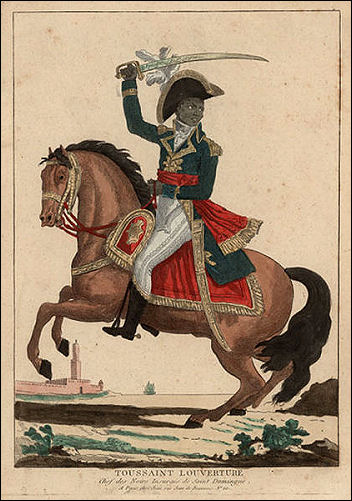
|
L’Ouverture led a successful uprising of black slaves |
THE SLAVE trade between the west coast of Africa and the Americas over a period of 300 to 400 years was probably one of the most barbaric periods of exploitation in history. The capture and sale of Africans made the traders and their sponsors wealthy; the buyers used the labour of their slaves to make themselves rich.
The accumulation of this wealth played a major part in the development of capitalism in Europe. But the suffering inflicted on the slaves was immense and the legacy of this trade is still with us today. This brutal forced migration was very different from the forms of slavery that existed in Europe and Africa in the middle ages or even in ancient civilisations.
There is evidence that the slave markets that existed in different parts of Europe and Africa at that time were primarily used as a method of punishment, particularly of debtors, or for prisoners of war. In the Caribbean, European slaves were first deported to work on the plantations that produced crops and commodities for European consumption.
This proved very problematic for their owners as they would escape and not be found or would not work. Even the use of indentured servants, people who would exchange a debt or their release from service for a period of work in the Americas, proved to be a problem for their ‘owners’ as often the contracts were broken.
The use of slaves from West Africa by the Portuguese was almost accidental, but during the 17th century this turned into the preferred method of providing labour for the plantation system in the Americas.
The plantation owners developed a system of violence to suppress the spirits of their already disorientated and easily identifiable captives and an ideology, racism, to confer on themselves superiority and justification for their actions. It is estimated that the British slave merchants made £12 million in profits (the equivalent of £900 million today) on the sale of 2.5 million Africans.
The lives of the captured Africans were seen as perishable ‘goods’ by the traders and the plantation owners. Many died in the ‘middle passage’ between Africa and the Americas, in some cases as many as 45% perished on a single ship but on average it was 30%.
Life expectancy on the plantation was little better. In 1764 Barbados claimed 70,706 slaves and 41,840 more were brought on slave ships up until 1780. The count of slaves in 1783 was 62,258 less than it was nearly nine years earlier.
Deadly trade
THIS HUMAN trade was not universally supported in Britain even in the 18th century, but the wealth created powerful advocates for its continuation. As a result of this trade it is said that Bristol became a city of shopkeepers.
Liverpool was transformed from a fishing village into an international commercial city with a population of 5,000 in 1700 growing to 34,000 by 1779. In a period of sixty years 229,525 Africans were enslaved by ships from this port. Ownership was often not just by single wealthy individuals but by share ownerships of small traders and merchants eager for a piece of these profits.
The trade was not without perils for those who took part in it. The captives themselves did not take enslavement lightly. There were many reports of ships being sacked by slaves, in one case capturing a whole ship and throwing the crew overboard.
The slave system practised on the plantations required the formation of local militia to keep it in check and often the use of the Navy to stop serious disturbances. One of the earliest slave revolts in Barbados in 1683 included a written appeal in English for other slaves to unite in rebellion.
In Jamaica hardly a decade went by without a rebellion that often threatened the entire plantation system. On some occasions, peace had to be made with the rebels by allowing them to run their own communities.
For the successful overthrow of slavery, the fight-back of the slaves had to be reinforced by other class forces back in the imperial centre. In this, the 200th year since the abolition of the slave trade, much will be made of the role of William Wilberforce as the campaigner who abolished the slave trade through tireless and diligent parliamentary work. Recently BBC broadcaster Melvin Bragg proclaimed him as the greatest English politician because of this work.
Arguments were made to him by his close friend, William Pitt the Younger, the Prime Minister, that the trade should be abolished especially as it was more expensive than using workers. Pitt argued this case as a student of the original free market economist Adam Smith, following the loss of Britain’s colonies in America after the War of Independence.
In reality, Pitt’s immediate concern was that British slave traders were selling a large percentage of their slaves to French colonies, particularly Saint-Domingue (now Haiti), thereby strengthening a rival power. Wilberforce joined the campaign already in existence, the Abolition Society in 1787, essentially a pressure group.
Wilberforce spent most of his energies drafting parliamentary legislation. The mood of the early working class and poor was for radical change. Among them were approximately 10,000 blacks – ex-slaves, servants and runaways. Pitt’s government had failed to bring forward reforms of the constitution, particularly electoral (at that stage only a small minority of the population had the right to vote) – he saw abolition as a diversionary reform.
But within a year the launching of a petition coupled with mass meetings in towns and cities to hear the first-hand experience of ex-slaves such as Olaudah Equiano articulated the general concerns of the working masses and the poor.
In Manchester 10,000 men (women were not encouraged to sign the petition although they often sought to) signed – over half the adult male population. Despite this, Wilberforce’s first motion to parliament was defeated in the commons in 1789. But greater events would intervene.
French revolution
BY THE 1780s the French colony of Saint-Domingue had become the most prosperous of the Caribbean islands. It produced more sugar, coffee and tobacco than any other not just in terms of quantity but also quality. This enriched France and those traders involved with the island.
Just as Liverpool, Bristol and London had grown out of the slave trade – so too had Nantes, Bordeaux and Marseille. By 1789, the underlying tensions between the wealth of this new class of merchants and the monarchy was exploded by the masses with the storming of the Bastille and the beginning of the French Revolution.
The revolution signalled the end of feudalism in France and laid the basis for a modern capitalist society. This was a bourgeois, not a socialist, revolution but it was the poor masses, the sans-culottes, who drove the revolutionary process forward again and again.
In the colonies, the revolution broke the whites into different camps. The free and sometimes wealthy Saint-Dominguans of mixed race (known at the time as mulattoes) took sides and pressed for their rights. The whites unleashed terror and violence against them and the majority population of blacks. But the white splits gave all others the opportunity to grab the banner of liberty.
The ‘mulattoes’ in particular appealed to the Constituent Assembly in France to be treated as equals with whites at the end of 1789. They still wanted labour on the island and therefore did not call for rights for the blacks.
The Assembly was dominated at that time by the right-wing of the revolution, who wanted to gain rights for the new wealthy capitalists but were terrified of the potential of the masses who had stormed the Bastille. After much procrastination only a tiny minority of those of mixed race were granted rights.
But the splits between the ruling classes – royalty and the aristocracy against the new emergent capitalists – as in all revolutions would give confidence to the masses. This was true both for the workers and peasants of France and the blacks in Saint-Domingue, who had the self-belief to press for their demands but this time to the very end.
By 1791 Saint-Domingue exploded and a class war, which also separated whites, blacks and those of mixed race, began. Very quickly Toussaint L’Ouverture emerged as the leader of the slaves. His army took many different routes and sides to fight for their emancipation.
But revolutionary France was also under attack internationally. In particular British imperialism, which vied for supremacy in the Caribbean with the French, launched war for the colonial possessions of France and in particular Saint-Domingue. Pitt, Britain’s Prime Minister, had second thoughts about abolishing the slave trade when he could see the potential for a captured British Saint-Domingue.
With Saint-Domingue effectively split under the control of three forces and facing capture by the British the new governor faced no option but to declare the total abolition of slavery in 1793 and bring Toussaint L’Ouverture’s army under his control. The masses in France too had moved to defend their interests and the Assembly in 1794, now controlled by the left-wing Jacobins, abolished slavery.
Caribbean in revolt
REVOLUTIONARY DRAMA was played out in Saint-Domingue. But the effects of the French Revolution shook the entire French Caribbean: slave revolts took hold in Martinique, Guadeloupe and Tobago. The banner ‘Liberty, Fraternity and Equality’ inspired the slaves.
In Saint Lucia between 1795 and 1796 the slaves took over the island after expelling the British troops. When the British eventually took control again they made ‘peace’ by agreeing to form the slave’s army into a West African regiment. The Marseillaise was still sung by youth in the villages in the 1930s and 1940s!
British workers and radicals also took up the banner of the French revolution and supported Tom Paine who wrote the Rights of Man.
The war with France weakened the parliamentary support for abolition. Then as now, parliament brought in repressive legislation in order to suppress opposition to the war amongst the working class and poor. In 1795 three demonstrations in the space of three weeks of over 150,000 each marched to the slogans of ‘Down with Pitt!’, ‘No War!’, ‘No King!’
Wilberforce backed Pitt’s foreign policy against France and his home policy of repression. During this time he only went through the motions in keeping the abolition debate in parliament.
The revolution in France had not ended its twists and turns. Ten years after it began, Napoleon Bonaparte came to power. Many of the gains of the revolution for the sans-culottes were reversed, but the change from a feudal property system to a capitalist one remained.
Napoleon re-established slavery, but Toussaint L’Ouverture had predicted the reaction of the slaves of San Domingue as early as 1797 in a letter to the French Directory:
“Do they think that men who have been able to enjoy the blessing of liberty will calmly see it snatched away? They supported their chains only so long as they did not know any condition of life more happy than that of slavery. But today when they have left it, if they had a thousand lives they would sacrifice them all rather than be forced into slavery again.”
The black masses of Saint-Domingue began an insurrection that would lead to the end of French rule and independence. The colonial jewel of France, which Britain tried to steal, would remain free from slavery.
The radical movement in Britain moved back on to the parliamentary road. By 1806 more radical MPs (although of a capitalist variety) were elected to parliament. British imperialism, without the competition of Saint-Domingue increasingly turned to making its riches in India rather than the Caribbean.
Furthermore the French navy, decimated in Saint-Domingue, no longer posed the same threat to British policy or interests. In the Caribbean, it was clear that the constant threat of revolt would be increased by the continuing import of new slaves from Africa. The Abolition of the Slave Trade Act was passed in 1807 to be implemented by 1808.
Legacy of movement
TENS OF thousands of Africans continued to be captured and traded for decades more. Loopholes in the Act were found and illegal activities; smugglers, foreign fronts for British traders and a host of other devices were used to fulfil the colonists’ desire for plantation labour.
But the slave trade and slavery itself was finally abolished in Britain in 1833 by the activity of the working class and the continued uprising and resistance of blacks held as captive labourers.
Today, the ruling class cannot even bear to apologise for the atrocities of slavery for the fear of being caught up in claims for reparations.
Back in 1833 £20 million (equivalent to £1.5 billion today) was given in compensation to the slave-owners. Slavery’s devastating legacy – racist ideology, the destruction of African civilisation and communities, the death or transportation of between 10 and 30 million people, the destruction of black family life in the colonies – has left its mark today.
However, the legacy of the abolition movement is that the masses, particularly the working class and the poor – black and white – can struggle together for decisive change. Now only the socialist control, distribution and democratic use of the enormous wealth of the world can decisively end their exploitation and division.
“Falling victims to avarice”
“AT LAST, when the ship we were in had got in all her cargo, they made ready with many fearful noises, and we were all put under deck, so that we could not see how they managed the vessel. But this disappointment was the least of my sorrow.
“The stench of the hold while we were on the coast was so intolerably loathsome, that it was dangerous to remain there for any time, and some of us had been permitted to stay on the deck for the fresh air; but now that the whole ship’s cargo were confined together, it became absolutely pestilential.
“The closeness of the place, and the heat of the climate, added to the number in the ship, which was so crowded that each had scarcely room to turn himself, almost suffocated us.
“This produced copious perspirations, so that the air soon became unfit for respiration, from a variety of loathsome smells, and brought on a sickness among the slaves, of which many died, thus falling victims to the improvident avarice, as I may call it, of their purchasers.”