TUC conference – public-sector pay
Workers defy Brown
 |
|
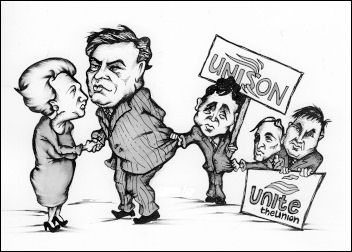
Brown dashed from the TUC to meet the hated Margaret Thatcher |
At last week’s TUC conference, Gordon Brown used his speech to kick public-sector trade unionists in the teeth by repeating his demands for pay “discipline”. But as Bill Mullins explains, public-sector workers are getting organised against low pay and deteriorating working conditions and to defend jobs and services.
Brown went on to tell mainly low-paid public-sector workers that they were responsible for inflation. As ever he didn’t utter a word against the unparalleled greed of the fat cats in the city.
Just in case workers didn’t get the message that he is a pro-big business, anti-worker prime minister, he dashed back to London to welcome the hated Margaret Thatcher into No 10.
However, despite Brown’s attempts to cow workers into submission, the conference almost unanimously backed a motion moved by the civil servants’ union, PCS, and seconded by the teachers’ union, NUT. This calls on the TUC to organise united action across the public-sector against Gordon Brown’s 2% pay limit for public-sector workers.
Public-sector pay is such a key issue that even Gordon Brown’s defenders on the TUC general council are forced to accept that wage restraint has caused huge anger from below against New Labour.
The strike by prison officers (the first in 63 years) was a direct response to Brown’s pay policies. This, together with the strike by Metronet workers on the London Underground, which brought the city to a standstill, changed the atmosphere at the TUC.
More importantly it gave confidence to many workers around the country; who saw with their own eyes the effectiveness of collective action. And as we go to press it is probable that postal workers will once again be taking action, as the talks produced little of substance from the Royal Mail management.
The burning anger of ordinary trade unionists is never fully reflected at the TUC conference. But this year there was a glimpse of it in the fighting speeches of some delegates, particularly representatives from the PCS, Bob Crow, general secretary of the RMT, and Brian Caton, general secretary of the Prison Officers’ Association.
However, the most graphic illustration of workers’ anger was given by the Remploy workers (see article here) who threw their redundancy notices over the head of government minister Peter Hain.
It was against this background that the motion on public sector pay was passed by the TUC conference. As usual the PCS motion that reached the TUC agenda was composited (merged) with other resolutions.
In previous conferences the right-wing trade union leaderships have sought to remove any commitment to action as part of the compositing process. But such is the anger amongst public-sector workers against the government’s pay freeze that the TUC leadership did not feel able to do this.
The composite motion called for the TUC to “convene an immediate meeting of interested unions to discuss co-ordinated industrial action”. It is true that the general council also issued a statement on public-sector pay at the same time as the motion was being debated but essentially it said the same thing, even going as far as to say: “including, where appropriate, industrial action”.
The idea of united action across the public sector is completely obvious, a ‘no-brainer’, for most workers. If the government, through the Treasury, is instructing public-sector workers in all sectors – from teachers, to civil servants, to postal workers, to local authority workers, to health workers, to prison officers – to accept 2% or less this year, in reality a pay cut, the logic of acting together is unarguable.
Unfortunately, this is not the approach of some of the national trade union leaders, whose priority has been defending Gordon Brown rather than their members’ pay.
It is no coincidence that Bob Crow, general secretary of the RMT and rightly seen as a leader who stands up for his members, was voted off the TUC general council, to be replaced by a member of the Musicians’ Union. The right-wing trade union leaders are working might and main to find an excuse to avoid a united struggle and don’t want their inaction to be exposed by Crow and others.
It is true that some practical obstacles to united action exist. But if the will is there all obstacles can be overcome and a strategy for united action built.
According to Seamus Milne in The Guardian, two million workers are lining up for action. However, there is still no guarantee this will happen. For example it was not an accident that the leadership of the biggest public-sector union, Unison, had almost nothing to say on this issue at the TUC conference.
When the Unison delegation met before the conference to discuss which two resolutions it should put forward onto the agenda it was only the intervention of Unison general secretary Dave Prentis that stopped them promoting one opposing Brown’s pay freeze.
Role of PCS
The tactics of the left-led PCS has been a key element in the situation.
The PCS has a dual strategy. In arguing for joint strike action it is has shown that its members recognise the advantage in a united public-sector struggle. At the same time it has made clear that it will continue to fight by itself if necessary in defence of its own members’ jobs, pay and conditions.
It has being consistently calling for the TUC to organise joint industrial action by convening a “council of war” with the other public-sector unions. In doing this it invoked the spirit of the pensions battle in 2005, when it led the charge to defend public-sector pensions. The government wanted to increase the retirement age for public-sector workers from 60 to 65.
It is worth remembering that in 2005 Brown, then Chancellor, justified the attack on pension rights by arguing that private-sector workers who had lost their pension rights should not have to pay for the pensions of public-sector workers via their taxes.
Yet the reason many private schemes went bust was because the employers took a pension holiday and had stopped paying into the schemes. This was when stocks and shares were kept artificially high by the dot com bubble. Of course, like today’s pay freeze, Gordon Brown had nothing to say about the bosses’ pensions; which for the average CEO are worth about £1 million per annum.
In 2005 it was only the threat to take joint strike action which in the end forced the government to concede that existing members of the pension schemes across the public sector would have their pension right protected. Unfortunately this did not include the new generation of public-sector workers. Nevertheless the government was forced into a significant retreat.
The PCS, with a left leadership, including Socialist Party members, has sought to use this experience as a means of galvanising the public-sector unions against the pay freeze. There are extra difficulties with pay as opposed to pensions. The pay negotiations are different for different sectors and have different starting dates, and last for different lengths of time. Some are for twelve months; some for longer. For many of the leaders this has been used as an excuse to delay concrete arrangements for joint action.
In addition to calling for action across the public sector, the PCS asked for bilateral talks with other public-sector unions about common issues. This has meant the PCS explaining to other union leaderships what they are doing about pay, privatisation, and fighting against jobs cuts. Then they ask the other unions what could they do jointly over the same issues.
Up until now this has met with a limited response. Unfortunately, it is clear that some union leaders see these talks as a trap. For example Unison has yet to reply to the invitation from the PCS for talks.
Rank-and-file Unison local government workers, however, have repeatedly demonstrated their willingness to strike over pay. Since the Local Government Association (LGA) made their first offer in April this year Unison members have rejected it on at least three separate occasions.
The national Unison leadership has been desperate to stop their members taking action on pay because of the effect this would have on their relations with the New Labour government.
Despite this, the Unison Local Government Service Group Executive last week voted for a motion put by Socialist Party member Glenn Kelly to go for an industrial action ballot in October, with a timetable for national strike action in mid-November.
This has now to be approved by another committee of the union. The leadership has attempted to place one obstacle after another in order to prevent action but the pressure from below means action remains on the cards.
While it still cannot be ruled out that the delays so demoralise the membership they reluctantly settle this year’s pay increase without a fight, this is looking less likely after recent action by other public-sector workers, particularly the prison officers.
Nonetheless, this is, in reality, what has happened in the NHS. Each time the NHS bosses added a miserly little bit more to the pay increase it was met with cries of delight by the full-time officials.
All that has been offered in the NHS is a very minor improvement in the previous offer, which only affects the very lowest paid in the NHS.
Incredibly the Unison bureaucracy forbade any Unison health branch from campaigning against the offer. The not unexpected result was that the deal was accepted by the membership, though on a very low turnout of 20%.
The urge for unity is one of the most important moods amongst workers, particularly when they see that it is collective action that moves the bosses more that all the honeyed words of their leaders. The PCS, the POA and the RMT have proved this, and have pledged to continue fighting for their members come what may.
However, inherent in the whole situation is a one-day strike of all the major public-sector unions. Even if this was partly accomplished it would shake the government to its roots. The retreat on pensions was brought about by the preparedness to take united strike action. Brown’s pay freeze can be defeated in just the same way.