

Striking workers in Greece and Portugal show the way
On 7-9 April, representatives from European sections of the Committee for a Workers’ International (CWI) met in London. As well as discussing the present world situation and economy, the discussions included recent events in Europe, with particular focus on Greece, Germany and France. A thesis on the world economy and workers’ struggles across Europe (available on www.socialistworld.net) had been written to aid preparation for the meeting. Following the discussions, some amendments will be added.
In this article on the current workers’ movements in Europe, Hannah Sell presents some extracts from the thesis and summarises some of the points made during the 7-9 April meeting.
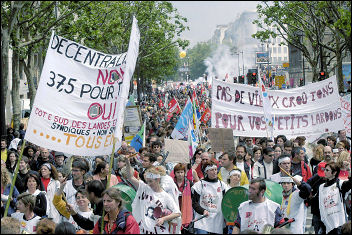
On the fortieth anniversary of the European upheavals of 1968, the working classes of Europe are once again flexing their muscles. Struggle today is not yet on the scale of the mighty revolutionary movements of the late 1960s and early 1970s, crowned by the events of May 1968 in France when ten million workers occupied the factories.
 |
|
French workers demonstrate in 2003, photo Paul Mattsson |
Nonetheless, it is absolutely clear that the declared aim of the French president, Nicolas Sarkozy, to “liquidate the legacy of May 1968” is doomed to failure. On the contrary, the experience of the brutality of twenty first century capitalism will drive a new generation to rediscover its legacy.
Already, in the ten months since Sarkozy came to power, his poll ratings have plunged. In last month’s local elections, Sarkozy’s ‘centre-right’ received only 47.5% in the second round while the Socialist Party (PS)lists got 49.5%. This, with the array of town and city councils they have captured, does not denote support for the PS but is a ‘vote of censure’ for the government.
The worsening economic situation played a key role in the election result. There was enormous anger that, while Sarkozy preached wage restraint for the millions, the chief executives of the major French corporations granted themselves wage rises of, on average, 40%.
Rising food and fuel prices, pay restraint, deregulation, pension cuts, and longer working hours are the norm for workers in every country of Europe – even before the effects of the US economic crisis really hits the shores of Europe. There is no doubt that this economic ‘tsunami’ is coming.
When Britain’s chancellor, Alistair Darling, stopped bleating for a moment about Britain’s economic fundamentals being ‘sound’ and admitted that the world is facing the “biggest economic shock” seen since the 1930s Great Depression, it was clear that the coming crisis will be severe.
Every country will be affected, although not all equally or at exactly the same speed. Italy, of which the Financial Times recently said, “if it was a company it would be declared bankrupt”, is facing zero growth this year. Five to six million Italians are forced to have two jobs in order to make ends meet.
Spain, which has carried out a massive house building programme in the last decade now faces a particularly sharp economic crisis. A measure of the scale of the construction boom there, is that in the last few years Spain has used half of the cement used in buildings in Europe. The Spanish housing crisis is more akin to the US, with a significant plunge in house values because of ‘oversupply’, than it is to Britain, for instance, at this stage. Ireland is in a similar position to Spain. Its high growth rate is set to collapse to 1.6% this year.
Recession
The coming economic storm will have an effect on the consciousness and combativity of workers across Europe. This will not be uniform, but will vary both according to the severity of the economic crisis in different countries, but also the experience of the working class over the previous period.
For example, a sudden deep recession could have a temporary stunning effect on the working class, at least as far as industrial struggle is concerned. Fear of unemployment, and the desperate struggle to survive, can temporarily drown out the possibility of struggle. The role of right-wing trade union leaders across Europe in holding back struggle, could add to this effect. Tied to neo-liberal capitalism, they are unwilling to resist the onslaught of the employers.
However, it is also possible that recession will be met by a wave of militant resistance. This is what happened in Britain in the 1974/75 recession, for example. This is particularly likely in the many countries of Europe where, prior to economic crisis, workers are already entering the field of battle.
In the epicentre of the fightback at present, are workers in southern Europe; particularly in Greece and Portugal. In Portugal, a massive strike wave is developing against changes to the ‘labour code’ which will make it easier to fire workers.
Greece has been shaken by the biggest strike wave in fifteen years as workers attempt to prevent the government’s attacks on pension rights. Opinion polls show that 85% of the population opposes the government’s plans on pensions. There have been three general strikes since December 2007. The last one, on 19 March, was one of the greatest strikes in Greek history.
It was preceded by three weeks of widespread industrial action across many sectors including the dockers, dustbin, transport and electricity workers. The latter were on strike for three weeks. When the management of the electricity company took legal action, the courts said that the strike had to stop and that the trade union would have no right to strike again against the pension cuts! However, in an illustration of how workers in Britain will sweep aside our anti-trade union laws in the future, the strike continued, with the local unions taking responsibility for the struggle. The following week, the bosses tried to take other groups of striking workers to court. They were stymied, however, because the lawyers were on strike!
 |
|
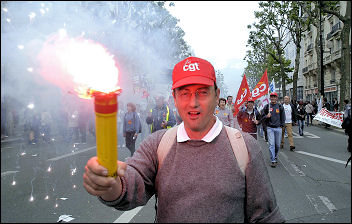
French workers demonstrate in 2003, photo Paul Mattsson |
Greece and Portugal may be at the forefront of the struggle at the moment, but they do not stand alone. In France, tens of thousands of school students have taken to the streets to struggle against education cuts. Belgium has seen a wave of spontaneous strikes.
Germany
Germany has been convulsed by a series of mass warning strikes, which in an opinion poll enjoyed 74% support of the general population, part of the ‘shift to the left’ that even capitalist observers comment on.
These strikes have been motivated by the intense class hatred of workers for the super-profits piled up by the bosses and have taken place before the real effects of an economic crisis hit Germany. While the boom still appears to be continuing, albeit against the background of redundancies and wage cuts in some industries, the prevailing view of the working masses is ‘we want our share’.
Britain is not yet ‘a Germany’ never mind ‘a Greece’. However, the righ-wing trade union leaders are finding it increasingly difficult to prevent struggle on the question of public sector pay restraint.
On 24 April the teachers, many civil servants, Birmingham local government workers, and FE lecturers, will all be taking action on pay in the broadest single day of strike action since New Labour was elected. This strike will result in members of Unison, the biggest public sector trade union, putting phenomenal pressure on their right wing leadership to follow suit.
In every country where the tide of struggle is rising, the need for a mass political voice for the working class is sharply posed. This process could be speeded up by economic crisis. At the same time, it will be necessary to argue for socialist ideas in these parties, not least because capitalist state intervention, quasi-Keynesian ideas, will lay the foundation for the beginning of reformist trends.
Even in those countries where the working class initially holds back industrially, this will not prevent them searching for a political solution to their problems. In a number of countries there are important developments in this direction.
In Germany, Die Linke (the ‘Left Party’), has recently entered three more regional parliaments, and have a presence in ten overall – a symptom of the changed situation. It is now on 14% in the opinion polls.
In France, in the first round of the local elections, the lists put together by the Ligue Communiste Révolutionnaire (LCR) got 4% in the polls and the small forces of Gauche Révolutionnaire (the French section of the CWI) were successful in winning a similar figure in the cantonal election in Rouen. The LCR is presented with a big opportunity now if it avoids the mistakes of the past and lays the basis for a new significant party of the working class. Its leading public figure Olivier Besancenot is the fifth most popular public spokesperson in France. However, they are uncertain about what kind of party, including what kind of appeal, they will make.
In Greece, the industrial struggles have been reflected in political developments. Syriza, a recent political formation, is an amalgam of various left groups and parties, the biggest one of which is Synaspismos – a party that reached 3% in polls previously. Syriza received 5% of the vote in the September 2007 general election, and has shot up to over 15% in the last opinion polls.
The fundamental reasons for this are the lack of any alternative policies to the government from the main opposition party, (so-called ‘socialist’) Pasok, on the one hand, and, on the other hand, the fact that Syriza is taking steps to the left, and comes close to voicing the demands and struggles of workers and youth.
The ruling class is worried that the two-party system, which previously secured its interests, is in real danger. Based on the polls over the last couple of months, it would be impossible to have a majority government. Pasok used this fact to call on Syriza to ‘work together’ for a ‘common’ government but Syriza rightly refused.
The Greek section of the CWI, Xekinima, closely collaborates with Syriza and called for a vote for Syriza during the last election. Since last autumn, Xekinima has discussed working closer with Syriza.
Consciousness
Across Europe the decline of capitalism, combined with mass struggles, will reshape the consciousness that in past years was still affected by the collapse of Stalinism, the ideological campaign of the capitalist class and the economic boom. However, radicalisation will not be the only trend in the coming period. The danger of an increase in divisions in the working class, particularly increased racism and nationalism, will also exist. In some countries at least, we could see the growth of racist, nationalist, anti-immigration far-right parties.
The existence of left parties which are seen by the working class as an alternative can cut across the growth of far-right parties. In Germany, for example, growth in electoral support for the far right has been held back, at least for now, by the growth of the Left Party.
However, where over a period of time, such parties fail to provide a real alternative for the working class, as has been the case with Rifondazione Comunista (Prc) in Italy, it can temporarily strengthen the feeling that ‘all parties are the same’.
While the Prc may still retain some electoral base, its role in the last government and its continuing swing to the right has lead to a deep seated disillusionment with it. This leaves the Italian working class with no political channels through which to channel its enormous anger. However, this is unlikely to prevent workers from meeting the ‘shock therapy’ that a Berlusconi government would like to implement, with a mighty movement.
The CWI is involved in the day-to-day struggles of the working class across the continent. At the same time we welcome every potential step towards mass political representation for the working class; while advancing a socialist programme that would ensure that new parties are actually capable of meeting the aspirations of workers.
We are confident that, in the stormy struggles of the coming years, there will be an enormous growth in support for genuine socialism in Europe, as the European working class once again finds its voice.
Greece: Extracts from a speech by Andreas Payatsos of Xekinima (CWI), made to the national conference of Syriza on 14-16 March 2008.
“Dear comrades, I’d like to give sincere greetings from my organisation that has openly and clearly moved towards Syriza in the last months…[and] to share our enthusiasm with you about the big steps forward in the left, and the rapid rise in the echo Syriza finds in society. This strong blow which the two party system has had to accept today, has panicked the two parties of capital: New Democracy and Pasok.
For the first time in two decades, the left has returned onto the stage and sends society a strong message: to offer resistance, to fight, and that policies can be overturned – that the battle has not been lost, the game is not decided yet and circumstances can change.
The soaring support for the left and Syriza in recent polls, strengthens in an indirect but clear way the morale of ordinary people. It gives workers a perspective to fight against the policy of capital.
They are beginning to recreate a vision, the vision of an alternative society, which was ‘lost’ in the last period. This vision is, in our opinion, totally necessary, to give the workers’ movement a perspective, and totally necessary to raise its morale, aims and to win objectives.
All these developments change the conditions on the level of class struggle in a positive way, in favour of the workers’ movement, the youth and the ordinary layers of the population.”
“At the same time this enthusiasm is accompanied by problems … concerning the feeling of responsibility and duty. The responsibility for winning 3% (elections 2004) or even 5% (elections 2007) is really small compared to the responsibility for 17-18% that is given by the recent opinion polls.
In society there are questions about Syriza – not only amongst the people who are active in the movement – but also in the broad layers of the population. Will Syriza maintain its percentage in the polls or will it decline again? … If Syriza can maintain its echo in society, will we finally have something new, something different?”
“We have the opinion that Syriza should have high targets. The possibilities exist to strengthen the left and left ideas, and are – from an objective view – unlimited. The question is: will the left in general and Syriza in particular use these possibilities? … In particular, we have to focus the discussion on: What are the conditions for success in the next steps?
For us, the first condition is that the moves to the left that were shown in Synaspismos in the last two to three years and that were reflected in Syriza, not only have to go further, but also have to be deepened and consolidated.
…”The reason why the percentage for Syriza could soar, is the move to the left of Synaspismos and Syriza in the last period; without it, the upswing in the left was impossible and unthinkable.”
“Will the left, if it is called into power, renationalise the privatised companies? Nationalise all strategic economic units, that are controlled by altogether 50 families – to ensure that the economy works for people’s needs and not for the profit of big capital?”
…”The explosive increase of Syriza puts before it big duties and puts it under strong pressure. Pressure from the capitalist class, from Pasok, from the mass media and so on. But also the pressure of society, the workers’ movement. … Content has to be given to the words: “Socialism with Freedom and Democracy” in a concrete, practical and understandable manner … to become a programme of how to act.
“Only in this way can we prepare for the big struggles that will come. Only in this way can the left prepare for the future… Only in this way can the cynicism caused by past defeats and disappointments be ended.”