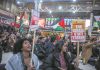

THE MASS protest movements against neo-liberal policies that swept
Bolivia with strikes and demos have ousted president Carlos Mesa.
Roadblocks on 80% of Bolivia’s roads cut off the capital La Paz and
three other major cities. In several places protesters occupied oil
wells.
Marcus Kollbrunner
The movement’s main demand is nationalisation of the oil and gas
sector – to expel multinational oil and gas companies like Repsol
(Spanish), Total (French), British Gas and British Petroleum (British),
Petrobras (Brazilian), Enron (US), Shell (Dutch/British) that control
around $100 billion-worth of oil and gas resources.
Poverty hits two-thirds of the population, and an even bigger
proportion of the indigenous people who are 65% of the population. Many
movements demand a new government of workers and peasants and a break
with neoliberal capitalism.
The new president, Eduardo Rodriguez, may have reached a truce
agreement with COB (Bolivia’s militant trade union organisation) and
Fejuve (Federation of Neighbourhood Associations – that organises poor
city dwellers in El Alto, La Paz’s poor neighbour) but Bolivia’s ruling
class is far from in control of the situation.
The movement of miners, coca growers, peasants, indigenous groups,
teachers etc, has shown willing to fight again and again. If the new
government takes no steps towards nationalising the oil and gas sector
the movement can resume. Few trust the corrupt political system.
Riches robbed
For hundreds of years Bolivia’s riches have been robbed by foreign
powers, helped by a small domestic elite. But the experience of
privatisation has sharpened awareness of the injustices. Bolivia today
has Latin America’s biggest natural gas reserves outside of Venezuela.
These resources are estimated to be worth $100 billion – 12 times the
country’s GDP.
Lowering the royalty (tax) on exploitation of gas and oil (from 50%
to 18%) and privatising the state oil company were central to the
neo-liberal policies implemented in the 1990s. Exploitation of gas and
oil became extremely cheap and gave big profits for foreign companies –
but nothing came to the poor masses of the country.
In 2003 President Sanchez de Lozada was ousted after just 14 months
for his plans to export gas to the USA. His vice-president, Mesa,
assumed the presidency. He promised a referendum about nationalisation
of gas and oil, action against corruption and a constituent assembly.
The ambiguous referendum led to the new "carbon-hydrate
law", with a new tax on oil and gas extraction that would give very
little new tax income. Resources would still be in the international oil
and gas giants’ hands. This led to mass protests in March 2005.
Although there were still widespread demands for nationalisation, the
debate focused for some weeks on taxation of oil and gas. Many saw
increased taxation as a step towards nationalisation.
The MAS (Movement Towards Socialism), led by Evo Morales demanded
that the tax should be 50%. The mass movement forced congress to adopt
the new tax on a level close to MAS’ demand. Increasingly isolated, Mesa
announced his resignation twice, but that was not accepted by the
congress.
President resigns
AFTER A pause, the movements came back even stronger – not satisfied
with the new tax, they built new roadblocks. On 23 May, hundreds of La
Paz teachers joined the roadblocks. They struck for higher wages but
also joined the struggle to nationalise the gas and oil industry.
The same day, a new general strike was declared in El Alto. A 48-hour
transport strike, demanding nationalisation and a constituent assembly,
brought La Paz to a standstill.
On 31 May, 40,000 protesters prevented the parliament restarting
their negotiations, occupying Plaza Murillo outside the congress. COB
threatened to burn down the congress building if parliament didn’t vote
to nationalise. The protests continued even after that.
Then on 2 June, Mesa announced there would be an election to a
constituent assembly and a referendum on greater autonomy for the
provinces on 16 October. But even if the movements wanted a constituent
assembly, they saw this as a manoeuvre to divert attention from the
nationalisation issue.
The autonomy referendum was a concession to the right, especially the
rich elite of Santa Cruz, the richest province. The elite however don’t
want to be forced to make concessions to the poor highlands of western
Bolivia.
Mesa was left without support and announced his resignation on 6
June. Parliament accepted his resignation, although they had to meet in
Sucre because of the mass protests. Hundreds of thousands took part in
the movement at that stage – Bolivia was really on the edge.
Hundreds of thousands
The movements feared that the speaker of the senate, Hormando Vaca
Diez, would claim the presidency and use the army to clamp down on the
movement, possibly leading to a civil war. Under the constitution, Vaca
D’ez would be able to be president for the rest of Lozada’s original
mandate (until 2007).
But most of the ruling class instead supported the position of MAS
and the Catholic Church, to let the president of the Supreme Court,
Eduardo Rodriguez, assume power on 9 June. Rodriguez wants to make
constitutional changes to allow new parliamentary elections to be
called, not only elections to president and vice-president. He also
wants to call a constituent assembly and the referendum on autonomy.
He invited the COB and Fejuve leaders for negotiations in the
government building, but they refused. Instead, the meeting was held in
El Alto, with live broadcasting and translation into indigenous
languages. COB and Fejuve spoke of giving the new president a few days
of truce to nationalise oil and gas.
COB leader Jaime Solares dismissed the new president as a new pawn of
the US embassy. But at the negotiations they agreed to join commissions
to discuss nationalisation and a new constitution. They also agreed to
lift the roadblocks and to allow supplies into the cities.
Protesters also ended the occupation of seven Repsol and BP oil wells
in eastern Bolivia and of Enron/Shell’s pumping station, which had cut
off the export of oil to Chile. But protests are still going on, even if
on a smaller scale. The new president’s tactic is to try and buy time,
while giving no promises.
Dual power
THIS YEAR’S movements show two different trends. Morales’ MAS has
been holding back the protests. MAS was originally based on the
movements of coca growers and Morales was only 45,000 votes short of
beating Lozada in the 2002 presidential elections.
MAS took part in the current protests but, under the influence of
Lula’s PT party in Brazil, it took a more "moderate" stance.
After Lozada’s resignation in 2003 Morales gave support to Mesa,
which led to his expulsion from the COB. It was only after all the
pressure of the movement that he supported Mesa’s resignation and the
demand for nationalisation. Morales’ strategy is to guarantee his
election in 2007. He stresses a "constitutional way out of the
crisis", rather than that the movements should take control.
Other movements, like COB, Fejuve, the miners’ union and the
teachers’ union in La Paz, not only demand nationalisation of oil and
gas, but also the closure of parliament. Instead COB and Fejuve called
for the building of a "Popular Assembly" in a mass meeting
with 400,000 participants on 6 June.
On that day the COB leadership decided to set up a "Peoples’
Revolutionary Command", with the task of gathering unions, popular
movements, political and student organisations around the "strategy
of power to the workers, peasants and impoverished middle-class
layers". But this strategy still needs to take on flesh and blood.
There are elements of dual power (where an alternative power
structure competes with the established power), especially in El Alto,
but also parts of La Paz, where local committees have organised food and
fuel supplies during the blockage.
It is right to call for the setting up of local assemblies with
representatives of the different movements, and for those to be linked
up in a national assembly.
The assemblies must be built on unity around a socialist programme.
We call for the formation of a workers’ and peasants’ government that
would nationalise oil and gas, the banks and other major companies,
which would be subjected to the democratic control and management of the
working class and its allies.
The assemblies’ delegates must be subject to recall and have no
privileges, to avoid a new bureaucracy building up.
The movement must also have a strategy for dealing with the armed
forces. The army have been reluctant to step into the conflict, but that
can change if the capitalist system is under threat.
Soldiers’ committees must also be set up, demanding democratisation
of the army, with the election of officers. The assemblies must organise
self-defence, something that COB has raised.
What has been lacking to bring the movement together around a
revolutionary socialist programme is a mass socialist party with clear
strategy, perspectives and programme.
This movement must spread the revolution to other countries,
particularly in Latin America. The building of such a party is a central
task for socialists in Bolivia.