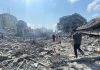
THE STATEMENT by the US ambassador to Baghdad, Zalmay Khalilzad that
the Iraq invasion had opened up a ‘Pandora’s Box of sectarian conflict’,
has focused attention on the prospect of a slide towards open civil war
in Iraq.
Is this the most likely development in Iraq? And, therefore, is it
light-minded to call for the ‘immediate end to the occupation’?
KEN SMITH addresses these crucial questions.
Is Iraq really sliding into a sectarian civil
war? And if so, is it a divide and rule tactic of imperialism?
SOME IN the anti-war movement argue that the occupying powers are
exaggerating the threat of civil war in order to justify the
continuation of their brutal subjugation of Iraq.
They correctly point out there has been a long secular tradition
alongside ethnic and religious tolerance inside Iraq. And that, in
recent years, despite the attempts to stir up inter-ethnic and sectarian
conflict there have been many mass displays that have cut across
divisions in society.
This, however, reflects only one side of the reality now existing in
Iraq. The other side is increasingly bloody sectarian conflict. There is
no doubt that the occupation itself, and the divide-and-rule policies of
the US and Britain, are the major reasons for the slide towards civil
war. However, the increased ethnic and religious divisions are real, and
very far from being under the control of the occupying powers.
Iraq, like the other countries of the Middle East, was created by
British imperialism, the barbaric occupying power of the time. It
created an artificial state which suited its interests. Just as the
US-led coalition acts today, it used a divide-and-rule policy of
balancing between the different ethnic and religious forces in the
country and playing one off against the other. Inevitably ethnic and
religious tensions have been a feature of Iraq ever since.
On the other side there have been united national movements of
Iraqis, including the struggle that led to the forcing out of British
imperialism. Most importantly were the development of mass struggles of
the working class and poor – leading to the growth of a mass Communist
Party (CP) in Iraq in the 1950s. More recently, there were many examples
in the aftermath of the first Gulf War of class unity between Sunni and
Shia Arabs and Kurds, against the Saddam regime.
However, events in the latter part of the twentieth century severely
weakened independent workers’ organisation.
The Saddam dictatorship, with the backing of US imperialism, crushed
the mass workers’ organisations. This was made easier by the mistaken
policies of the leadership of the CP. Combined with the collapse of the
Stalinist regimes in Eastern Europe (which were falsely equated with
genuine socialism by capitalism worldwide) it meant that when Saddam was
toppled the idea of recreating a mass united movement of the working
class and poor was not present.
This reflected the ideological collapse of the leaders of the former
workers’ parties and left a vacuum. This has been mainly filled in the
post-Saddam era by political groupings that are based on fostering
religious divisions in society or appealing to one side of the sectarian
divide or the other.
The support for these groupings is not just based on religious
affiliation but is also based on the geographical division of the
economic wealth of the country. In particular, Sunni Arabs – who formed
much of the elite under Saddam – now find themselves a minority in the
country and in areas outside of where the oil wealth is based, which are
controlled by Kurdish and Shia organisations.
Imperialism has deliberately fostered sectarian division, in order to
maintain power, by leaning on different ethnic and religious-based
militias, including bringing them into the state forces. One senior US
government official had to admit that the US-backed Shia-dominated
government was fuelling the civil war, particularly by the Interior
Ministry’s use of death squads and secret prisons against Sunnis.
It is now well documented that the US deliberately used Shia troops
to do all the most brutal jobs during the flattening of Najaf,
inevitably fuelling religious divisions. But while it is imperialism
that has fanned the flames, it is also now the case that a Frankenstein
monster has been created that imperialism cannot control or wish away.
Although sectarian division is not prevalent in all areas of Iraq,
nevertheless there is a rising trend of sectarian conflict which is
becoming more predominant, especially in major urban areas.
Imperialism’s dreams of a compliant regime in Iraq which would allow
it to withdraw its troops as soon as possible are in tatters. They would
have preferred to avoid the break-up of Iraq, given its consequences for
the whole region, but the reality is that the continuation of the
occupation means that a full-blown civil war or even the break up of the
country into religious or ethnically based enclaves is increasingly
likely.
Will withdrawing the troops end strife?
The presence of the occupying powers is undoubtedly intensifying the
level of conflict and violence inside Iraq. The Socialist Party calls
for the immediate withdrawal of the troops and supports the right of the
Iraqi people to defend themselves and to resist and drive out the
occupying powers.
However, this does not mean we give unqualified backing to every
action claimed to be in the name of the resistance. The anti-war
movement also needs to put forward an alternative to the threat of
sectarian civil war.
In Ireland, for example, the Socialist Party and its forerunner,
Militant, supported a united Ireland and the removal of British troops.
But we did not support the methods of the IRA or Sinn Fein which also
wanted a united Ireland and the troops out.
We argued that the methods of individual terrorism were divisive and
cut across the possibility of united working-class action by Catholic
and Protestant workers. Ultimately, we correctly argued, these wrong
methods could not build a united struggle capable of removing British
forces.
Instead, their methods, along with the methods of Protestant
paramilitaries, entrenched the sectarian polarisation of society in
Northern Ireland. And, although there has been a decrease in the number
of British troops in Northern Ireland, with them mainly confined to
barracks, sectarian conflict remains with an increasingly sectarian
demographic division of the population.
The continuation of the occupation in Iraq is a disaster for the
peoples there. The withdrawal of the troops must remain the central
demand of the anti-war movement worldwide. However, alone, this demand
is inadequate
One of the key questions to be addressed by the anti-war movement is:
‘if you are successful in withdrawing the troops what force in society
can avoid a descent into chaos?’.
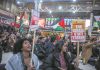
The millions who marched on 15 February 2003 will undoubtedly want to
see an end to the occupation and the troops withdrawn. But at the same
time – as shown by the smaller turnouts on recent anti-war
demonstrations – many will also question can they can achieve this just
by marching. They will want to be convinced that the long-suffering
Iraqi people will not face a worse situation through the withdrawal of
the troops.
To argue simply that withdrawing the troops will end the sectarian
conflict will not convince this mass of people whose sympathies are with
the anti-war movement, particularly given the experience of Ireland over
many decades. Indeed, many will observe that the only thing that unites
many of the groups inside Iraq at present is they all want the troops
withdrawn.
And once the troops are withdrawn a power vacuum could open up which
would lead to sectarian conflict on a much bigger scale. So the anti-war
movement needs to put forward a programme that would mean that the
withdrawal of the troops and a struggle by the Iraqi people for
self-determination would not end in bloody civil war or an Islamic
regime which will drive the rights of working-class people, women and
minorities back centuries.
A mass anti-war movement in Britain and the USA, seriously
campaigning for an end to the occupation and removal of the Bush and
Blair regimes, would need to build a struggle linked to the workers’
movement that caused their ruling elites more problems at home than they
experienced abroad.
Such a movement, combined with an unwinnable conflict that led to a
collapse in morale of US troops, forced the US withdrawal from Vietnam.
In Vietnam, however, there was a united mass resistance against the
occupying powers, which led to the overthrow of the pro-US regime in
South Vietnam and the unification of the country under communist rule.
In Iraq, regrettably, the resistance is divided along religious and
ethnic lines each trying to win control of different parts of the
country. A descent into a fragmented – or ‘Balkanised’ – country with
contending factions competing for power and territory is an increasingly
likely scenario.
The occupying powers have withdrawn to bases in many areas and are
more and more reliant on brutal aerial bombing, combined with using
Iraqi forces that are often aligned with the various groupings
controlling the sectarian militias.
Already, many areas of the country are controlled by sectarian-based
militias. There may be genuine resistance fighters involved in these
organisations but in the main they are led by disparate elements –
including former elements of the Baathist regime, criminals and
gangsters and reactionary religious ideologues.
Some Shia leaders, like Moktada al-Sadr, whose base is in Shia-Sunni
areas, such as Baghdad, the South and even in parts of the ‘Sunni
triangle’, have put forward a mixed message.
On the one hand they have called united demonstrations of Shia and
Sunnis: "After all, we are one united people whether we are Sunnis or
Shiites, Kurds or Arabs", proclaimed a prominent Sadr supporter.
(Associated Press/IHT 20 August 2005).
On the other hand it has been reported that members of Al-Sadr’s ‘Mahdi
Army’ have taken part in attacks on Sunni mosques. Al-Sadr’s Islamic
aims and support for clerical rule, and the Shia make-up of his
supporters, severely limit his movement’s ability to appeal to broad
layers of workers and the oppressed.
Is there any force capable of uniting the
opposition to imperialism on non-sectarian lines?
Socialists believe that the only basis upon which the Iraqi people
can freely decide their future is liberation from both the foreign
occupation and the forces of the Iraqi state and militias. Concretely,
this means striving to establish a non-sectarian defence force, made up
of Arab Shias, Sunnis and Kurdish workers, youth and all the Iraqi
peoples, that is controlled by democratically elected committees of
workers, students, the unemployed and peasants.
The formation of these sorts of bodies would be part of building a
genuine movement of ordinary working Iraqis, forming democratic
independent labour unions and other mass organisations. It is essential
to unite workers and the rural poor with a programme that cuts across
religious, communal, and ethnic divisions.
A revived workers’ movement is required to fight to end the
occupation and imperialist domination of the economy, particularly the
sweeping programme of privatisation which is placing Iraqi assets into
the hands of multinational corporations.
A fight for democratic and trade union rights has to be combined with
a struggle against capitalism, landlordism, and tribal fiefdoms, which
provide the basis for oppressive feudal practices. Given the explosive
character of the national question in Iraq, it is vital that the
workers’ movement puts forward a socialist programme. This should be
based on the right of the national groups to self-determination, while
guaranteeing the rights of minorities.
Such a programme, however, has to be linked to the idea of a planned,
socialist economy – the only way of avoiding a divisive struggle over
scarce resources.
Given the current weakness of the working class in Iraq, such a
revival of workers’ organisations and socialist ideas may seem somewhat
distant. Working-class solidarity and socialist policies, however, offer
the only way of avoiding civil war and bloody ethnic clashes.
Without a powerful initiative from the working class, Iraq faces the
prospect of a vicious cycle of bloody national conflicts, ethnic
cleansing, and so on, along the lines of the former Yugoslavia in the
early 1990s.
So how should the anti-war movement be taken
forward?
THE RECENT events inside Iraq and the complicated mood in Britain
following the 7 July suicide bombings have required a more thought out
approach from the anti-war movement in Britain and internationally.
Whilst the aim of removing the troops and ending the occupation is
still the primary unifying goal of the anti-war movement, the question
of how to achieve this now is more complex than simply organising
demonstrations or repeating yesterday’s slogans; or worse advocating
slogans and solutions which are confusing and simplistic and ultimately
could serve to weaken the anti-war movement’s effectiveness.
The Socialist Party (which has been part of the Stop the War
Coalition and on its steering committee since its foundation), has
argued recently that "it is necessary for the STWC to link its call for
withdrawal of troops to an appeal for a solution which emphasises the
importance of unity across non-sectarian lines against the occupying
powers."
We believe the leadership of the Stop the War Coalition are
underestimating the degree of sectarian conflict in Iraq. For example, a
recent Stop the War bulletin stated that: "There is a civil war in Iraq
right now… between those who oppose the occupation and those who are
collaborating with it. The US occupiers want to replace that civil war
with a civil war which sets Iraqi against Iraqi on sectarian grounds."
They have also gone too far in giving unqualified prominence to the
al-Sadr movement – in a way that could have given the impression that
the anti-war movement was uncritically backing the al-Sadr movement –
and dangerously repeating statements by Muslim commentators which were
divisive in blaming all "Europeans" for Islamaphobia.
The Socialist Party has argued that there need to be slogans and
demands which unite the majority rather than give undue emphasis to
issues which could potentially divide the anti-war movement. In
particular, given the unpopularity of Blair and the Labour government’s
attacks on education, we suggested the slogan "Education not
occupation".
In the USA the anti-war movement has undergone a big resurgence
following Hurricane Katrina, where the stark contrast between the over
$1,000 billion spent on the war and occupation compared to the miserable
government response in the aftermath of Katrina graphically exposed all
the seeping class divisions in US society.
There also had to be transmitted from the leadership of the Stop the
War movement a belief that going on a demonstration could make a
difference and the troops could be withdrawn and the occupation ended.
As explained above this requires an explanation of the complicated
situation inside Iraq and taking an internationalist position which
advocates a class-based, non-sectarian alternative to take the struggles
of the Iraqi people forward.
If the anti-war movement showed that there is a way of ending the
occupation of Iraq – in particular, by linking it in to the anger and
desire of working-class people to remove the hated Blair regime – which
represented a genuine step forward for the majority in Britain, Iraq and
internationally, then a movement mobilising the millions, like in
February 2003, could once again emerge.
Iraq
Torture policies stem from occupation
ABU GHRAIB, the US torture prison camp in Baghdad, is finally to be
shut down. 4,500 inmates are to be moved to other prisons and the
buildings handed over to the Iraqi government.
Paula Mitchell
George Bush said two years ago that Saddam’s favoured place of
torture and execution would be destroyed as a "symbol of Iraq’s new
beginning".
Instead, it has continued to be used as a place of abuse and
humiliation – a real symbol of Iraq under occupation.
Bush claims that the torture and degrading treatment of prisoners was
the fault of a handful of troops, not US policy.
But the US military provides manuals detailing "enhanced
interrogation techniques" allowed by US personnel, which in anyone
else’s book would be called by their right name – torture.
In fact, until December, when he was forced to concede to new
legislation banning torture, Bush’s regime explicitly exempted the US
state and military from the UN treaty on torture.
In any case, these horrors are the inevitable consequence of
occupation. Treat your troops like cannon-fodder, force them into
intolerable conditions, dehumanise and brutalise them, and they in turn
will dehumanise and brutalise others.
Beatings of young unarmed Iraqis by British soldiers, captured on
video and exposed just a few weeks ago, are simply the latest in a
predictable catalogue of terror. In Afghanistan, prisoners have been
tortured to death.
And what about Guantanamo Bay? Even top judges – hardly known for
their liberal views – say the US is carrying out torture.
Following a UN report condemning the treatment of detainees, held for
over four years without charge, Mr Justice Collins said that the US’s
idea of torture "doesn’t appear to coincide with that of most civilised
countries".
250 medical experts condemned the violent force-feeding of prisoners.
Yet, even though British residents are being held there, Tony Blair
won’t even call for Guantanamo Bay to be closed.
What kind of Labour Party is it that can’t even speak out against
torture?
What clearer demonstration can there be that we need a new workers
party that will stand up to the worst horrors perpetrated by this
capitalist system?
‘Security’ bosses profit from war
OVER 60 British companies have gained from at least £1 billion worth
of contracts and investment in Iraq since Saddam Hussein was toppled in
2003.
The biggest winners have been British private security firms. One of
them, Aegis, has gained £246 million from a three-year contract with the
Pentagon to oversee all private security operations in Iraq.
Aegis’ chief executive is Lt Col Tim Spicer, former SAS man who
founded Sandline along with Simon Mann – recently jailed for plotting a
coup in oil-rich Equatorial Guinea. Spicer and Sandline became involved
in military operations in Sierra Leone, importing weapons seemingly in
violation of a UN arms embargo, and in Papua New Guinea.
Sandline no longer exists but Spicer claims Aegis’ Iraq deal is the
biggest security contract ever awarded by a US government. It may also
be the biggest corporate military group ever assembled.
Field Marshal Lord Inge, former Britain’s Chief of Defence Staff and
former member of the whitewashing Butler committee on intelligence
forces and weapons of mass destruction, is Aegis’ non-executive
chairman.
Another non-executive director is Tory former Armed Forces Minister
Nicholas Soames.
Reid’s phoney withdrawal
BLAIR’S DEFENCE secretary John Reid has announced the withdrawal of
800 British troops – about one in ten – from Iraq.
Reid did not pretend this was part of a complete pull-out from Iraq.
He talked about it being the "end of the beginning" of British
involvement rather than the beginning of the end.
In fact, only two months earlier, Reid announced a huge increase in
the number of troops being sent to the other area made unsafe by Bush
and Blair’s ‘war on terror’, Afghanistan.
British troops there are planned to rise from the present 900 or so
to 5,700 over the next three years.
The financial cost of this is estimated at £1 billion; the human
costs can hardly be guessed at.