Price inflation – the sickness of capitalism
THE PRICES of food and fuel are soaring, as are household gas and electricity bills. No one disputes that the main cause is the explosion of world oil, food and other commodity prices. Workers’ pay is lagging behind, and living standards are taking a severe hit. Yet Brown, Darling and other New Labour ministers are calling for “pay restraint”! But why should workers pay for inflation? LYNN WALSH looks at the causes and consequences of this sickness of free market capitalism.
 |
|
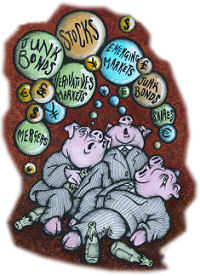
Bubbles: the cover of Socialism Today, May 2007, anticipated the bubbles bursting. Cartoon by Suz |
ACCORDING TO a House of Commons research paper (08/51 June 2008), “Earnings growth of 4.5% is thought to be consistent with the government’s inflation target of 2%.” Yet for the last five years at least, wages (according to government figures) have grown at a lower rate, ranging from 3.5% to 4.3% for the economy as a whole. In the public sector, wages grew by an average of 4.3% a year between 2004 and 2006, and since then at a lower rate, between 3% and 3.8%.
In May, over 90% of workers in Britain received pay rises below the rate on inflation. According to Industrial Relations Services, the headline rate of pay awards in May was 3.2%, when the Retail Price Index (RPI) was 4.3%. (Birmingham Post, 17 June 2008)
As in other European countries, the share of wages in national income (GDP) has fallen. According to the European TUC, the wage share of GDP in the 27 EU countries fell from 59.6% to 57.1% between 1995 and 2007. (Workers Want a Bigger Slice of the Pie, The Guardian, 26 March 2008)
So workers cannot be blamed for the recent acceleration of inflation. On the contrary, the exploitation of workers generally has intensified. The share of profits in national income has risen to record highs as the wage share has declined.
In his letter (16 June) to the chancellor, Alistair Darling, explaining why inflation had risen above the 2% target, the governor of the Bank of England, Mervyn King, recognised that “Pay growth has remained moderate.”
King stated that the price surge is overwhelmingly due to increases in energy and food prices. “There is not a generalised rise in prices and wages caused by rapid growth in the amount of money spent in the economy.”
Yet, despite this, King calls for pay restraint. “It is crucial that prices other than those of commodities, energy and imports do not start to rise at a faster rate. That would happen if those making decisions about prices and pay began to expect higher inflation in the future and acted on that. It could also happen if employees respond to the loss of real spending power that results from higher commodity prices by bidding for more substantial pay increases.”
In other words, workers, who are not responsible for the surge in prices, are being told that they have to accept a cut in real wages (wages adjusted for inflation), a reduction in their living standards. Why?
In his Mansion House speech (18 June) to City bankers and speculators, chancellor Alistair Darling, too, accepted that “pay growth has remained moderate.” The current inflationary pressures, he explained, are not coming from the domestic economy, as they did in some past episodes. Inflation is explained by “the dramatic increases in the price of food, fuel, gas and electricity…”
So, even according to Darling, workers are clearly not to blame for inflation. Yet New Labour’s chancellor still asserts that “continued restraint on pay is required from both the public and the private sector”. Why is it “required”? By whom?
“To return now to inflationary pay settlements would undermine rather than raise people’s living standards with a damaging circle of wage increases eroded by steadily rising prices.” Therefore, Darling told the City bankers and speculators, “the government has agreed a number of multi-year pay deals that now cover 1.5 million public-sector employees”.
If they get away with it, the government’s three-year, less-than-inflation pay policy for the public sector will mean a severe cut in living standards for millions of workers and their families.
All government and big-business economists know that the current inflation is being caused by the surge in world energy and commodity prices, now feeding through to prices in Britain. They know very well that wage increases generally follow price increases, as workers struggle to catch up.
But the bosses fear what they call “second round effects”, that workers will demand wage increases to cover higher living costs, and then businesses will attempt to cover higher wage costs by increasing their prices.
New Labour’s aim is to protect the profits of big business while passing the burden of curbing inflation onto the working class. Past experience, however, shows that such pay policies don’t work. Prices continue to accelerate, profits continue to rise, while workers are worse off.
1970s wage restraint
The Labour government of Harold Wilson and James Callaghan in 1974-79 attempted to implement a prices and incomes policy. It was a colossal failure. Wages were curbed for a time, mainly because trade union leaders collaborated with the government in policing the policy. But the bosses found ways of evading curbs on top pay. Inflation continued to accelerate, reaching a devastating 27% (according to the RPI) in the summer of 1975. This was mainly due to the huge increase in world oil prices.
Despite Labour’s incomes policy, inflation was still between 10% and 17% during 1979. The deep erosion of living standards provoked an explosion of industrial militancy, with a series of public-sector strikes. This became known as the ‘Winter of Discontent’. It destroyed the credibility of the Callaghan government, which had tried to control inflation at the expense of working people.
Despite Callaghan’s pro-business policies, the bosses turned against Labour as incapable of ‘controlling the unions’. Labour was defeated in the May 1979 election, and the disastrous Thatcher government came to power.
Today, Gordon Brown’s government, which has embraced ultra-free-market policies, makes no pretence of wanting to restrain top people’s pay or of being able to control prices. Yet public-sector workers are being told to accept a cut in living standards.
Earlier this year, around 4,000 City speculators received bonuses of over £1 million each. More recently, top BBC executives, funded from the licence fee, have been awarded massive pay rises, bonuses and pension packages. Senior executives are getting a 14% raise, while average staff members are getting only 4% (and 1,800 are threatened with the sack). Jane Bennett, director of BBC Vision, is getting a 24% pay rise, taking her salary to £536,000 a year. At the same time, Jenny Abramsky, retiring director of Audio and Music, is being sent off with a pension package of £4 million, giving her a pension of £190,000 a year.
Yet Brown and Darling are determined to impose wage restraint on six million public-sector workers. “In New Labour’s Britain,” comments Dave Prentis, general secretary of the public sector union, Unison, “the working poor are taking the hit for a free-falling economy, while the rich get richer. … Six million workers are enduring four years of draconian pay policy that applies only to them.”
Dave Prentis warns Brown that the message from the recent Unison conference was: “Don’t take our support for granted”. In reality, there was a strong demand for Unison to break the link with Labour.
Despite New Labour’s pro-big business, anti-working class record, Prentis is still appealing for Brown and company to turn back to working people and social justice. But it is far too late for this kind of appeal.
Under the leadership of Kinnock, Blair and Brown, New Labour has become through and through a party of big business, devoted to ultra-free market policies, including the wholesale privatisation of public services. It is time for unions like Unison to break the link with Labour and begin to take on the task of building a new mass party of the working class.
Policies
Apart from his general appeal for Labour to turn back towards public services, Prentis makes only two clear demands: for a windfall tax on BP and Shell (which made £7.2 billion profits in the last quarter), and measures to tackle the tax-evading property portfolios of the super-rich. These would be welcome measures, but they would not begin to solve the urgent problems facing the working class.
We need policies to defend the working class against the effects of a crisis in the anarchic, free-market capitalism. Workers are not responsible for inflation (as even Brown and company admit). Workers are not responsible for the credit crunch, the payback for reckless financial speculation, which is now strangling economic growth. Nor are workers responsible for the collapse of the housing bubble, which was linked to financial speculation.
We cannot accept that the burden of the crisis is thrown onto the working class.
- As a first step in fighting inflation from a working-class standpoint, set up popular committees, including trade unions and consumer groups, to monitor prices and measure the real cost of living increases for working people.
- Open the books of companies, especially the big companies that dominate the economy, to determine their real costs, profits, executive pay and bonuses, etc.
- Implement a sliding scale of wages to automatically compensate workers for increased living costs. Immediately raise the minimum wage to £8 an hour, with regular increases to cover price rises. Substantially increase pensions and other benefits to compensate for inflation.
- Immediately implement a windfall tax on the oil and gas companies that have made huge profits out of recent price increases. This should be a first step towards the nationalisation of the assets of the big oil and gas companies, to be run as public companies under workers’ control and management, to meet the needs of the majority of society.
- Re-nationalise the electricity, gas, and water utilities, to be democratically run under workers’ control and management to serve the needs of society.
- Nationalise the banks and financial institutions, to provide cheap credit for the planned development of industry and services, and to provide cheap credit for housing and small business.
- Nationalisation should be carried out with minimum compensation, on the basis of proven need of shareholders.
These measures, together with international cooperation with workers in other countries, would be steps towards the democratic socialist planning of the economy, the only answer to the profit-dominated chaos of capitalism.
The real cost of living
WHY IS there an acceleration of inflation in Britain? The main reason is undoubtedly the surge in global oil prices, which have doubled over the last year, now hovering between $140 and $150 dollars a barrel. This has worked through to pump prices, with unleaded petrol costing around £1.20 a litre and diesel £1.30.
The increase in oil prices over the last two or three years reflected growing demand from fast-growing economies like China, India and, until its recent slow-down, the United States.
Demand reached the limits of existing capacity in oil production, transportation and refining. This reflected lack of investment in new production facilities.
When oil was a mere $10 a barrel in the 1990s, the big five oil companies that dominate global distribution were not interested in investing in more refineries, tanker fleets, or renewable energy sources.
Behind the recent phenomenal surge in oil prices, however, has been an orgy of speculation on oil futures markets. Since the subprime mortgage crisis and the credit crunch, super-rich speculators have not been able to make such big profits from trading shares or home mortgage debt. So they have turned to oil, minerals, food and other commodities.
Everyone depends on these vital commodities in their daily lives. But the speculators, gambling on commodity exchanges, have turned them into financial assets, pushing up their prices, and fuelling world-wide inflation.
Natural gas prices, which under European Union (EU) policy are linked to oil prices, have also soared 160% over the last year. Together, oil and gas price increases have contributed to a 10% increase (at least) in household gas and electricity bills. At the same time, the five big global companies that dominate the privatised utilities, are making enormous profits. Water charges – unrelated to oil prices – have also gone up sharply.
Biofuels
World food prices have shot up 60% over the last year. Again, the increased cost of oil is a big factor, as it affects the cost of farm inputs like fertilisers and transport, a major part of food prices in the shops. Officially, retail food prices are up 8%, but the true figure is much higher.
The recent rapid growth of biofuels has also had a severe effect on food prices. This is a side effect of dearer oil. Claiming that biofuels are a green alternative to fossil fuels (oil, gas, coal, etc), big business diverted agricultural resources to the production of fuel. This has led to a shortage of food crops, especially grains (wheat, maize, etc) and vegetable cooking oils.
Capitalist leaders at the recent G8 summit have now admitted that this short-sighted policy has created food shortages and pushed up prices. Tragically, the worst impact is on some of the world’s poorest people, already suffering from malnutrition if not starvation.
Another thing pushing up prices in Britain is the devaluation of the pound over recent months. Although it has kept its value against the US dollar, which has also been falling, the pound has fallen 12% against other major currencies (especially the euro) since its peak last July.
Since the credit crunch began to bite, overseas investors and speculators have begun to lose confidence in the faltering British economy. A weaker pound means that prices of many imported goods are higher in terms of pounds. This especially affects food imports from the euro-zone countries.
Figures and fiction
According to the government’s Consumer Price index (CPI), the official measure of inflation, prices increased by 3.8% in the year to June (up from 2.1% in December 2007). Most of this was caused by food, fuel and gas prices. At the same time, the Retail Price Index, which measures a wider range of prices, including housing costs, rose to 4.6% in June (up from 4% in December last year).
The soaring price of food and fuel will particularly hit pensioners and low-paid workers. Recent figures show that the number of pensioners living in poverty increased by 300,000 in 2006-07 to 2.5 million.
The figure is even higher when housing costs are taken into account. At the same time, the number of children living below the poverty line increased by 100,000 to a shameful 2.9 million.
For most people, the government’s inflation figures are a sick joke, fantasy land compared to the reality of the current cost of living. One reason is that the ‘baskets’ of goods and services on which the CPI and RPI are based are not really representative of average spending, especially for the lower income groups.
For a start, the CPI (unlike the RPI) does not include mortgage interest payments, rent, council tax, or the BBC licence fee.
Real prices
Another distortion is that the CPI includes some goods (like plasma TVs, electrical goods, etc) that have fallen in price but are more and more becoming luxuries. For low-paid workers, pensioners, and others on benefits, food, housing, gas and electricity, and transport costs are taking up an increasing share of their incomes.
Two newspapers, the Daily Mirror and the Mail, have recently published price surveys of their own. They both arrived at roughly the same figures. The Mirror reported that overall inflation in the year to May is 15.6%, over five times the official rate. Food prices are soaring at 15% and fuel at 22%. The Mail’s cost of living index shows that families are having to find an extra £1,200 a year just to stand still.
Compared to 2003/04, fixed monthly household costs have risen by 45%. Petrol costs are 29.4% higher, while average energy bills are up 110%. Average council tax is up 25%.
After paying for essentials, the big accountancy firm Ernst and Young found, the typical family has less than 20% of its gross income remaining, compared with 28% in 2003/04. They warn that with possible increases in interest rates and even higher fuel costs, “the worst could be yet to come”.
The squeezing of consumer spending, already signalled by Marks and Spencer (with a 5.5% drop in UK sales in the last three months) and other stores, will push the British economy closer to a serious recession.
Once again, there is the threat of ‘stagflation’: slow or even negative growth combined with higher inflation. Neither Gordon Brown nor big business have any answers.
Higher interest rates, traditionally the main government weapon against inflation, would not immediately curb world oil and food prices. (In time these prices will fall anyway as the world economy sinks into a recession.)
But when there is already a severe credit crunch, higher interest rates would curb consumer spending and business investment, deepen the housing crisis, and aggravate the recession.