

 |
|
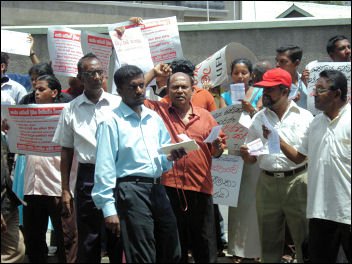
Strikers, joined by Siritunga (centre of picture) rally outside the Ministry of Health in Colombo, photo by CWI |
The Sri Lankan government, continuing to bombard the north of the country in the 25 year long civil war, has been faced with a new challenge. On Thursday 10 July, a warning general strike was held demanding increased wages to cover massive price rises.
Siritunga Jayasuriya, Secretary, United Socialist Party, CWI Sri Lanka
The strike was called by the unions which are run by the pro-war People’s Liberation Front (the predominantly Sinhala chauvinists ‘Marxist’ JVP). It was also supported by other unions and by the United Socialist Party (USP).
The strike was not 100% supported for a number of reasons, including lack of preparation.
The government and their coalition partners – the Communist Party and the Lanka Sama Samaja Party – did everything possible, including using government machinery and the armed forces, to sabotage the strike.
At the same time, the government said that this strike was to support the Liberation Tigers of Tamil Eelam, against whom they are fighting the war.
All the media gave big publicity to the government’s statements. But, in spite of government suppression, the strike was a partial success.
On the day, the streets of Colombo had a holiday feel about them. Expecting a major stoppage, very few people even tried to travel.
At the government printing works, where the USP share the union leadership and where there were preparatory mass meetings to mobilise support, the strike had a 90% turnout. As secretary of the USP, I was invited to speak at their strike day rally.
Later we went to a mass picket, of around 1,500 strikers, outside the health ministry. The strike was roughly 50% successful in the hospitals, schools, postal service, tea plantations and bus services.
Almost all the trade unions in Sri Lanka have been supporting the capitalist communal government of Rajapakse. Now, with prices rising faster than in any other Asian country – on average around 30% – and because of the pressure from workers, the union leaders have been compelled to go for strike action.
Some trade unions did not support the strike call because they are against the JVP politically. Workers do not have much confidence in the JVP because it fully supports the war and votes with the government every month to renew the anti-working class emergency provisions. Under these measures, the army was deployed in hospitals and on public transport during the strike. These provisions were also used to try to stop our picket meeting at the government printing works.
 |
|
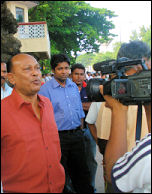
Siritunga outside the Ministry of Health in Colombo, photo by CWI |
Speaking at the rallies and to the media, the USP said this strike was a beginning. Now there is a realisation that independent action must be taken. We are calling for bigger action, organised in a more collective way.
On 10 July, the second biggest Sinhala daily paper – Lakbina – had front page headline news on the strike with statements from the JVP and the USP. The government say they cannot afford a 5,000 rupee (£25) monthly rise for one million state employees.
We said they could start by cutting the number of cabinet ministers. There were 110 ministers, with another one appointed the day before the strike. Each of them, with their fat salaries, cars, staff, subsidised housing and fuel, consumes at least 200,000 rupees a month of public money. We were also interviewed for many TV channels.
The USP are now calling on all unions to summon a national convention of factory level leaders to prepare for the next stage of action.
