

1989 – the battle to defeat the Tory poll tax begins in earnest
 |
|
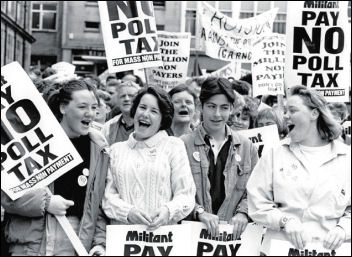
The Battle to defeat the poll tax, photo Steve Gardiner |
TWENTY YEARS ago the Conservative government of Margaret Thatcher introduced the hated poll tax, first in Scotland to be followed one year later in England and Wales.
After her re-election in 1987 Thatcher confidently declared that the poll tax was to be the ‘flagship’ of her government. In fact, it turned out to be her Titanic as it collided with the formidable obstacle of working class resistance, with Militant supporters (the forerunner of the Socialist Party) playing a leading role in the struggle.
As soon as Thatcher announced the imposition of the tax, the Militant newspaper denounced it as a general onslaught on the working class, and members of Militant in Scotland and in Britain as a whole began immediately to organise against it.
With mass non-payment by millions of people, huge demonstrations and jailings, the tax became unworkable. Many Militant members were imprisoned for defying the tax, including Tommy Sheridan in Scotland, and the Labour MP for Liverpool Broadgreen, the late Terry Fields – who refused to pay the tax and was sentenced to 60 days in prison in July 1991. Terry was expelled from the Labour Party by the party leadership in December 1991. Dave Nellist was expelled in 1992.
The Tory party was forced to ditch Thatcher, being an electoral liability, in November 1990 and the tax was unceremoniously dumped and replaced by the council tax in 1993.
In the following article, International Socialist member Ronnie Stevenson from Glasgow (in 1989 a leading activist in the Scottish Anti-Poll Tax Federation) explains how the mass movement of working class opposition to the tax was built. Below, Tommy Sheridan, now co-convenor of Solidarity – Scotland’s Socialist Movement, recalls his experiences of the great poll tax struggle.
A landmark in working class struggle
A RESIDENTIAL school setting in West Linton in Lothian outside Edinburgh seems a weird place to start the story of the Poll Tax: but given the history of its demise it is as good a place to start as any.
Ronnie Stevenson
At a Militant (the forerunner of the Socialist Party in England and Wales and the International Socialists in Scotland) conference there, called to discuss resistance to the poll tax, Labour councillor Chic Stevenson moved that we begin to organise for total defiance of the imposition of the poll tax, arguing for all councillors to refuse to implement it and arguing for a mass non-payment campaign should it be implemented.
The decisions which were taken shaped the campaign over the next few years. The ideas of a mass campaign against the poll tax, for building anti-poll tax unions, for mass organised non-payment and non-compliance by local authorities and council trade unions, and for industrial action to defend those victimised for non-payment or non-implementation were brought together in a Militant pamphlet in April 1988.
Militant began to set up anti-poll tax unions in the localities. These attracted thousands to meetings, many to find out about its implications for them and their families but many about how to fight it. Federations of anti-poll tax unions were set up with democratically elected delegates from the unions and executive committees for the Federations.
The Strathclyde Federation was set up in July 1988. The words of Glasgow Labour councillor Chic Stevenson, the vice-chair of the Strathclyde Federation, became its watchword: “I’m having nothing to do with Thatcher’s poll tax. I am voting against Glasgow district council setting its part of the tax at £92 per person, along with five other councillors. A mass non-payment campaign will still have to be organised. It has the support of local Labour Parties and the mass of people in the housing schemes. With that support, Labour councils could make the poll tax inoperable if they called on people to refuse to pay. It is not the job of Labour councils to do the Tories’ dirty work. I was elected to fight Thatcher, not to bow the knee to her poll tax.”
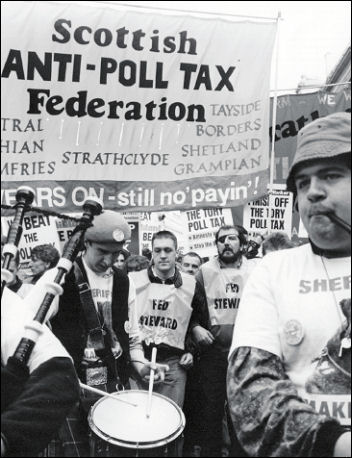
Against this background the Scottish Anti-Poll Tax Federation was set up. Later in the struggle it promoted the successful creation of the All Britain Anti-Poll Tax Federation in November 1989.
The initial community meetings consisted of explaining the tax and the collection methods, including the use of force, and then moving on to how to defeat the tax. When the difficulties were explained that the state would face in collecting the tax if the mass of the people refused to pay, then support for non-payment gathered apace.
Unfortunately one by one the councils in Scotland began to bow the knee and when people did not pay, sent in the Sheriff’s Officers to get the debts paid. This was Labour at its worst – all talk and posing, but no action other than sticking the boot into the poor.
To prepare for mass non-payment the Scottish Federation of anti-poll tax unions organised a demonstration in Glasgow on 18 March 1989. More than 10,000 people attended. The ‘Can’t Pay, Won’t Pay’ poll tax movement was here, and we were determined to build it further.
There were street stalls to inform and recruit to the non-payment army. A play by Peter Arnott and Peter Mullen, which caught the mood of the time, performed over all of Scotland in the community centres. Its theme of ‘Can’t Pay, Won’t Pay’ reflected what was going on.
There were marches and demonstrations – large and enormous. There were many innovative features of the campaign – including occupations of council offices and Sheriff’s Officers’ [bailiffs’] offices – the terrorists were being forcibly resisted.
One of the most famous involved an occupation lasting a few days with food parcels being transferred from an adjacent building, much to the annoyance of the watching police. Sheriff’s Officers’ cars became well known and they were constantly hounded.
Defiance
There was a week long hunger strike in George Square, Glasgow, to highlight the plight of the poor having to choose between paying the tax or feeding their bairns [children]. There were mass demonstrations outside the homes of people threatened with ‘poindings’ (labelling of possessions for selling to pay the debt) by the Sheriff’s Officers.
One of the first was outside the house of Jeanette McGinn (widow of Matt McGinn, the Calton folksinger and activist). The Sheriff’s Officers based in Lanarkshire made special efforts to carry out ‘poindings’ of possessions and there were regular mass demos outside people’s houses over the years. There was one outside the home of George Galloway, then a Labour MP.
Very few ‘poindings’ took place and the actual sale of the possessions became the scene of one of the most famous episodes in the poll tax struggle.
The Sheriff’s Officers had given up even trying to arrange the sales in their normal salerooms and they set up a sale in the courtyard of the St Andrew’s District Court where there was always a police presence. A young Tommy Sheridan, who was secretary of the Scottish Anti-Poll Tax Federation and had built up a very strong base in Pollok, south-west Glasgow, was served with court papers – an interdict – banning him from doing anything to stop the sale.
In defiance he organised hundreds to be there and ripped up the interdict as he led them into the courtyard. The police read the writing on the wall and instructed the Sheriff’s Officers to cancel the sale.
That way of recovering the debt became unworkable and arresting bank accounts, wages and benefits became the weapon of choice of the state. It was much easier to carry out those actions from the computers and phones in their warm offices rather than facing the direct wrath of the people. Funnily enough, that led to files disappearing and computers stopping working after a visit from the anti-poll tax occupiers!
There was a consequence of Tommy’s action on that day. He was brought to court for breaching the interdict and jailed for six months which he spent in Saughton Prison in Edinburgh. From there he stood for the council and parliament. He achieved a fantastic vote in the Parliamentary election and was elected as Glasgow’s first Scottish Militant Labour councillor. This was another first for the campaign, the first councillor elected from jail.
The mass defiance spread to England and Wales where Militant spearheaded the mass non-payment campaign. Many others were jailed including the late Terry Fields, the member of Militant who was the Labour MP for Liverpool Broadgreen. As defiance spread, the Tories realised that the poll tax was finished. There was mass demo after mass demo and on 31 March 1990 the biggest of all the demos took place. 50,000 marched in Glasgow and after speaking in Glasgow, Tommy flew down to London to address the 200,000 strong demo there. Much was made of the violence in London but it was the size and working-class composition of the demo and above all the growing mass defiance, that was the real reason for the Tories backing down.
There were further demonstrations directed at defending those jailed for non-paying and those jailed for ‘violence’ on 31 March. The 40,000 strong demo in London in October 1990 greeted many young marchers who had marched from all over Britain spreading the message.
In November 1990 Thatcher was forced to resign as Prime Minister, a victim of the campaign to abolish the tax she had introduced. The fight to defend the non-payers continued for many years after that. The last two large demos in March 1991 in Glasgow (15,000) and in London a few weeks later (50,000) were an indication of that determination to continue. The Tories brought forward plans for a new local government tax.
Labour’s response to this victory was to attack those who resisted. Having worked hard to implement the poll tax, even though it was almost universally hated, they began to expel those in Militant who had led the fight to get rid of it. When the question was posed: Whose side are you on? Labour made it clear – the bosses and the Tories.
The struggle against the poll tax is a landmark in the long history of working-class activity in Britain. It is full of stories of innovative actions, heroism and solidarity which makes me proud to have been part of a working class capable of such a mass act of defiance. It brought down a notoriously unyielding prime minister and we, in the International Socialists, are proud of the part we played in leading such a resistance.
THE POLL tax, or Community Charge, was a piece of Tory legislation devised by the right-wing Adam Smith Institute. It blatantly redistributed the cost of paying for local government services away from the wealthy onto the shoulders of the working class.
As a per capita charge, it replaced the rates which had been levied on the value of people’s notional rental value of a house. This meant that a family of two adults in a council flat for instance would pay more than a millionaire living in a mansion!
Or, as the Militant pointed out before the tax’s introduction: “The Thatcher family in Dulwich will save £2,300 per year… an average family in Suffolk will pay an extra £640.”
 |
|
The Battle to defeat the Poll Tax, photo by Phil Maxwell |
A mass army of non-payment
“YE CANNAE beat her son, she’s faced doon Galtieri [the Argentine general during the Falklands war] and beat the miners. She’s the iron lady”.
Tommy Sheridan
This was a common response at the early anti-poll tax meetings organised in housing schemes across Scotland in 1988. A battered and bruised working class had witnessed a rampant and brutal Prime Minister, in the shape of Margaret Thatcher.
Her victories over Argentinian conscripts and the proud National Union of Mineworkers emboldened her to implement even more assaults on the welfare state, trade union rights and the very concept of ‘society’. “There’s no such thing” she declared at a Royal Geographical dinner to the applause of the rich and powerful throughout the land – who welcomed her determination to destroy socialism, human solidarity and the collectivist spirit which renders a society worthy of the description.
Sure, the odds seemed stacked against us at first but Thatcher’s arrogance and intoxication with power led her to make a crucial mistake. Up until the poll tax the ruling class tactic of ‘divide and rule’ had been applied with distinction. The steelworkers, nurses, printers and then the miners were all taken on separately.
 |
|
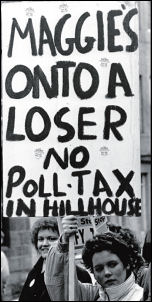
The battle to defeat the Poll Tax, photo by Dave Sinclair |
To their shame the Labour Party and Trades Union Congress leaders never united the movement in opposition to her assaults. But the poll tax was different. Here the whole of the working class were being attacked at once.
The fact it was an ‘unfair, unjust and immoral’ tax, the most common description at the time, was compounded by the decision to introduce it in Scotland a year before England and Wales. They ignored petitions, protest marches and rallies and the ballot box. All we had left was the right to defy: civil disobedience through mass non-payment.
People were understandably worried, even scared. Disgracefully, Labour councils voted to implement this ‘immoral’ tax and thus dispatched sheriff officers to harass and intimidate non-payers. The dreaded warrant sale threat was used to frighten families across Scotland.
What the authorities didn’t reckon with was the size and determination of the grassroots movement to stand up and be counted. We refused to be cowered. We would not allow non-payers to stand alone. Poverty was undoubtedly the most demanding recruiting sergeant to our cause but through the network of housing scheme anti-poll tax unions and the regional and all-Scotland Federation we gave strength and solidarity to those under threat.
Scotland was in revolt against the tax and the grassroots nature of the uprising left the politicians out of step and the authorities in despair. By the end of 1989 the non-payment army approached the one million mark. Marches and rallies involved tens of thousands. Council chambers were occupied. Sheriff officers were barred entry to non-payers’ homes and often returned to find their own offices under siege.
The tax was fatally wounded and when we spread the campaign to England and Wales the 13 million new recruits to the non-payment army rendered the poll tax a dead duck. Or as John Major was forced to admit in Parliament in 1991 it was being repealed because it had become “uncollectable”.
The anti-poll tax campaign made it “uncollectable” and its unbreakable spirit rested in its grassroots character – the thousands of ‘ordinary’ people who became extra-ordinary campaigners. Well done to each and every one of the anti-poll tax campaigners on the 20th anniversary of our almighty struggle.
The above is a shortened version of Tommy’s original article.
Tommy was secretary of Pollok Anti-Poll Tax Union and chair of the Scottish and All Britain Anti-Poll Tax Federation. He was sentenced to six months imprisonment for defying a court order to help prevent a warrant sale in October 1991. He served four months in Saughton Prison between March and July 1992 from where he was elected as a Scottish Militant Labour councillor for Glasgow Pollok in the May elections of that year and secured 20% of the vote and came second in the Westminster election of April 1992. Tommy is now the co-convenor of Solidarity.
For further reading on the struggle to defeat the poll tax and the role that Militant played in the campaign, see www.militant.org.uk
Also available online is the book The Rise of Militant by Peter Taaffe, the story of Militant, forerunner of the Socialist Party, from its birth in 1964.
£10.99 p&p. Published 1995. 570 pages paperback.
Available from Socialist Books PO Box 24697, London E11 1YD. 020 8988 8789. bookshop@socialistparty.org.uk
A detailed account of Tommy Sheridan’s 1992 election campaign, fought from prison, can be found in his book A Time to Rage; 176 pages, paperback. Published by Polygon
