

Marxists and the Second World War
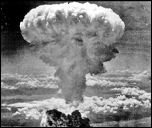
Hiroshima and Nagasaki were meant as a warning to Russia – Japan was already suing for peace
The seventieth anniversary of the outbreak of the Second World War fell on 3 September. Nuclear weapons were first obscenely deployed at the very end of the war on the people of Hiroshima and Nagasaki. Since then a massive stockpile of weapons has hung like a terrible sword of Damocles over us, threatening to bury humankind and probably all animal life, under nuclear rubble.
PETER TAAFFE asks why and how did we arrive at this situation, what were the causes of the Second World War, how did it differ from the First World War and, crucially, is it possible today to avoid the nightmare that our parents and grandparents endured during this catastrophe?
Capitalist historians and politicians, in seeking to explain the causes of the war, identify this or that diplomatic or military ‘error’, whether it be of Chamberlain, Hitler, Stalin or Roosevelt, the main actors on the stage of history at that time. In reality the roots of the Second World War, as in the First World War, fundamentally lay in the clash between different imperialist powers.
The First World War signified that capitalism had outgrown the straitjacket of private ownership of industry and the narrow limits of the nation state. German imperialism had attempted to supplant the old colonial powers, but ultimately this could only be settled through the mightiest armed clash in history.
16 million perished in that war; at least five million were either killed or injured in Russia alone. Its main outcome was, however, a revolutionary wave in Russia, Germany and other countries, which threatened the very existence of the system that had caused the carnage.
The Russian revolution effectively ended the First World War. It only became violent after the dispossessed landlords and capitalists, with the support of 21 armies of imperialism, attempted to overthrow it. Compared to the costs of the war, and weighed on the scales of humanity and history, the Russian revolution was the least violent means of advancing a society stuck in the blind alley of capitalism.
In contrast, what is the balance sheet of the two capitalist world wars? 16 million killed in the First World War and 60 million in the second. Could this have been avoided? Yes, particularly the Second World War if the revolutionary explosions of the working class, in Germany in 1918 to 1923, in China from 1925 to 1927 etc, had been successful.
Rise of Hitler
The inevitability of a new world war was rooted in the Versailles Treaty that followed the First World War. This helped to stoke up German nationalism and led to the rise of the Nazis and fascism, which the leaders of the German workers’ organisations allowed to come to power “without a pane of glass being broken”. They failed to mobilise the masses in a united front that could have barred the way to Hitler.
British capitalism armed and financed Hitler, partly because of the threat of revolution in Germany and also in the hope and expectation that German imperialism could be unleashed against Russia. A different, more progressive social system to capitalism existed there, a planned economy, albeit dominated by a bureaucratic elite personified by Stalin.
Stalin himself pursued a policy of manoeuvring between the capitalist ‘democracies’ and Nazi Germany. This was done, not in order to gain time and space for the deformed workers’ state Russia, as the Putin government has recently stated, but to protect the power, privileges and incomes of the bureaucratic officialdom that Stalin represented.
Stalin’s purges of the late 1930s and the massacre of the military general staff enormously weakened Russia. This was at a time when it was clear that Hitler, having dealt with Anglo-French imperialism, would inevitably turn on Russia, as proved to be the case in 1941 when Hitler unleashed his ‘Operation Barbarossa’.
Marxist tactics
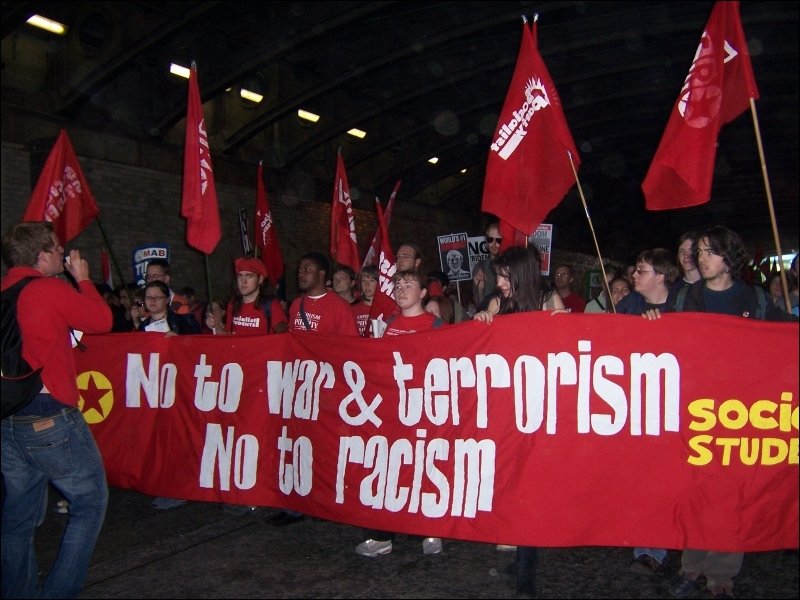
Young people protest against war and terrorism in Manchester 2006, photo Manchester Socialist Party (Click to enlarge: opens in new window)
The tactics employed by Marxists during the Second World War were determined by the specific features of this war. On the one side, it was a continuation of the First World War. It was a struggle between Anglo-French imperialism on one side, supported by the new giant of US imperialism, and the Axis powers led by Hitler’s Germany, Mussolini’s Italy and Japan for the redivision of the world in their own interests.
At the same time, however, the fact that a Nazi regime threatened dictatorial occupation – and did so in the cases of France, Belgium, most of eastern Europe and parts of Russia – meant that the consciousness of the working class was different once the war had begun. There was none of the enthusiasm for the war which had existed in some countries at the onset of the First World War. Then, with brass bands playing and banners unfurled, workers marched to war. Having no experience of what world war would be like, many workers and youth went enthusiastically. It appeared to represent a change from their humdrum existence.
But the experience of the horror of actual war meant that this mood did not exist in 1939. Yet fear of occupation by the Nazis and what this would mean in terms of the democratic rights and the living standards of the working class meant that there was support for armed resistance to a Hitler-led invasion of Britain.
Once the war commenced, the masses were prepared to be drawn into the military. This, in turn, determined the tactics of the genuine Marxists, the Trotskyists, to go into the armed forces with their class and their generation. This did not mean a change in policy or support for the capitalist governments conducting the war or their military elites, but a determination to resist fascism. It meant a continuation of the class struggle through the adoption of skilful tactics.
The starting point was that what should be ‘defended’ were the interests of the masses, pointing out at the same time that the ruling class was incapable of doing this, as the experience of the defeat of France demonstrated. The French ruling class capitulated to the Nazis rather than arm the working class.
In industry, while the communist parties of Britain and elsewhere accepted an industrial ‘truce’, the Trotskyists continued the struggle in favour of the working class. They led a significant number of strikes in Britain of apprentices, electricians, etc, in the teeth of opposition from the bosses and the government, as well as threats of imprisonment and actual jailings.
In the army, Trotskyists in Britain and Europe counterposed to the top brass the feelings of the troops, sick of the carnage and the suffering of the war, and determined not to go back to the poverty, unemployment and class-ridden capitalism of the 1930s. They therefore gained significant support.
The Trotskyists were successful in the soldiers’ parliaments set up during the war – in Cairo, for instance, among the Eighth Army. Churchill was “disgusted” when he was informed that most of the troops in the Far East intended to vote Labour in the post-war election. Soldiers and sailors were also in the majority in the crowd that booed Churchill, the so-called ‘victor’ of the war, in Walthamstow Greyhound Stadium during the 1945 general election campaign.
War to end all wars?
Like the First World War, the Second World War was supposed to be a ‘war to end all wars’. A brighter and better future was promised. However, the masses, as Trotsky had predicted, did not take the promises of capitalist politicians at face value. Even before the war had finished, the Italian masses rose against the fascists in 1943 and established workers’ committees in parts of northern Italy.
In Britain, the Tories were booted out and the first majority Labour government was elected, which under the pressure of the working class, carried through ‘a quarter of a revolution’ in the nationalisation of a number of industries. There was mass pressure on them to go a lot further in order to guarantee jobs, housing and increased living standards in a devastated and wrecked Britain.
The same radical revolutionary wave swept through France with the emergence of mass communist and socialist parties, while even the middle-class Gaullists adopted socialist rhetoric.
In the mid-1940s the opportunity was presented to carry through a socialist overturn and the establishment of a democratic united socialist states of Europe. But once more, as in the aftermath of the First World War, the social democratic leaders but also the communist parties this time – which had also degenerated into agencies of capitalism – saved capitalism.
The two strongest powers emerging from the Second World War were US imperialism on the one side, now a military, economic and industrial colossus, and Russian Stalinism strengthened through the extension of the planned economy in eastern Europe and also by the victory of the Chinese revolution.
This meant that no sooner had the Second World War ended than a new antagonism arose, which dominated world relations for the next forty or more years. The Hiroshima and Nagasaki atomic explosions were nothing to do with defeating Japan but were meant as a warning to Russia of what to expect if it did not bow to the power of American imperialism. Japan, which had suffered a minimum of three million dead by these events, was already suing for peace.
Continual war
Despite the promise to ‘end all wars’, there has not been one day of real peace throughout the world since the end of the Second World War. True, there has not been an outright conflict between major powers in a ‘new world war’. Wars largely took the form of conflicts in the neo-colonial world, some of them proxy wars between the US and Russia.
In fact, since 1945, it is estimated that over 40 million people have been killed, largely in the neocolonial world. This was the result of imperialism’s attempt to hold the peoples of Africa, Asia and Latin America in chains. Direct control of colonies has been replaced by indirect control, which means an even greater economic stranglehold, as well as an enhanced military presence, particularly by US imperialism. An ‘imperialism of bases’ with over 700 US military establishments deployed throughout the world, has replaced direct military intervention.
War – endemic to capitalism
This has been accompanied by the ‘privatisation of war’ with companies like Blackwater receiving $1 billion to carry out military tasks, including assassinations, for the US government. Obama, for the time being, has resorted to a more hands-off approach, less of a unilateralist and more of a ‘multilateralist’ policy, drawing other imperialist allies of US imperialism into any action seen as necessary, such as Afghanistan.
The lesson of the Second World War is that war is endemic to capitalism and will be a threat as long as it exists. A new generalised world war is not posed today because this would inevitably mean a nuclear holocaust. The capitalists would not favour this. It would mean the destruction of the working class – which is the source of economic power for the capitalists – the goose that lays the golden eggs of profits. Also, a nuclear conflagration would destroy the ruling classes as well.
A nuclear ‘accident’ cannot be ruled out and even a nuclear ‘exchange’ in the Middle East or in South Asia. But if there was an attempt to move towards a nuclear conflict, this would be opposed by majorities in the peoples of the world and in particular by the organised working class through their organisations such as trade unions. This is the most powerful factor which seeks to stay the hand of the capitalists in their drive towards, even ‘local’ wars like the devastating Iraq war and Afghanistan.
War has not been abolished but has assumed a different form today as these seemingly endless conflicts indicate. The only way ultimately to avoid war is to overthrow the ruling classes, who worldwide are based upon a market whose raison d’être is profit and profit alone. To safeguard this they will take the most drastic and inhuman measures. There can be local wars, not just for oil as Iraq demonstrated, but for other precious resources such as water and food in the future.
The anniversary of the Second World War therefore is the occasion to affirm that the only way to carry through real disarmament is to disarm the ruling classes and establish a socialist world.
See the September issue of Socialism Today for further explanation of the causes of the Second World War and the attitude of Marxists towards it.
www.socialismtoday.org
Revolutionary approach to war
The heroic Russian masses – with the memory and the lessons of the October revolution, and its gains in the form of nationalised property relations still present – saved the day and not the military ‘genius’ of Stalin or his generals.
The masses turned back the Nazi war machine, then moved onto the offensive which drove back the German army to the gates of Berlin. This was at a terrible cost with at least 27 million Russians killed.
The number of victims could have been considerably lower but for the tactics employed by Stalin and his generals. There was no attempt to fraternise with the ordinary German soldiers while at the same time showing no mercy to the SS scum.
In the Russian civil war, the Bolsheviks made a revolutionary appeal to and won over the troops of even the Whites – the armies of the dispossessed landlords and capitalists – and the imperialist armies. It was this and the support of the international working class which managed to defeat the counter-revolution.
Such a policy of revolutionary fraternisation was foreign to Stalin. Instead he invoked Russian nationalism and defence of the ‘motherland’ rather than the appeal of a military-revolutionary policy.
The communist parties also did not put forward a policy of revolutionary fraternisation, as the Trotskyists did. By differentiating between the SS gangsters and the ordinary German soldier, the Trotskyists, despite their small numbers, were able to have an effect by producing newspapers, for instance, in German for the ordinary German soldiers in some of the ‘occupied’ countries.
Weapons of mass destruction
The US’s atomic and nuclear programme, the Manhattan project, was conducted completely in secret, the money for this hidden in fake accounts of the War Department and never made public to the US Congress or people. The consequence of this was the cold war and the mad race to amass, in a new ‘Dr Strangelove’ world, huge stockpiles of nuclear weapons.
Even after the end of the cold war – and its replacement by a ‘chilly war’ in the recent period between Russia and the US – there are still enough stockpiles of nuclear weapons to annihilate the world, all civilisation and life in general from this planet many times over. In 2002 there were at least 20,000 active nuclear weapons in the world.
This madness has now spread to the neo-colonial world with India, Pakistan and the ‘rogue state’ of North Korea possessing nuclear weapons and, in the case of the latter, threatening to use them in the recent conflict with the US.
It is true that, unlike the unrestrained military regime of Bush and Cheney, Barack Obama declared even before he was elected that he intended to “work with Russia to take US and Russian ballistic missiles off hair-trigger alert [and] seek dramatic reductions in US and Russian stockpiles of nuclear weapons material”. Yet unbelievably, it is Henry Kissinger, who on Obama’s behalf, has been discussing with both the US and Russia to reduce nuclear inventories. This latter-day ‘peacemonger’ was the architect of the monstrous bombing of Cambodia, the butchery of the Chilean people in the US-supported coup against Salvador Allende in 1973 and the suppression of the Timorese people where 200,000 were killed, when he ratified Indonesia’s crushing of the movement for self-determination.
There is today widespread support for the abolition of nuclear weapons. There can be reductions, but this will not completely eliminate the possibility of a future nuclear ‘exchange’. The example of the rapid rearmament of Germany under Hitler demonstrated that even if nuclear weapons were significantly reduced or even eliminated by the major powers, this would not reduce the threat of nuclear war in the future.
Japanese capitalism, despite Hiroshima and Nagasaki, is considering a nuclear weapons programme because of fear of China. Israel now has the capacity to devastate Iran and other ‘enemy states’ in the Middle East. Where there is existing nuclear technique it is quite easy to improvise nuclear warheads; even from material provided by ‘peaceful’ nuclear power stations.