EVEN US President Bush has to admit that his “war against terrorism” could be a long affair. US imperialism lost the last extended war it faced – in Vietnam from 1964 to 1973.
Roger Shrives
For decades after, the American people’s fear and hatred of war and governments’ panic about getting involved in bloody conflicts paralysed US imperialism.
The US was defeated largely by the Vietnamese people’s heroic determination and fighting spirit. At least two million Vietnamese died in wars against Japanese, French and US imperialisms between 1945 and 1975 when Americans evacuated their embassy in Saigon.
But the US was also beaten by a huge anti-war movement at home after American war aims lost their popular support.
US imperialism saw its Cold War mission as stopping the spread of ‘communism’. Even the bureaucratically distorted planned economies of the Stalinist regimes that arose in many ex-colonial countries were seen as a threat to capitalism.
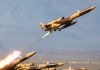
For years US planes – with the most sophisticated weaponry – flew over Vietnamese villages trying to make the people submit. They dropped eight million tons of bombs on Vietnam, more than in all world war two. Chemical warfare too – 20 million gallons of defoliant Agent Orange spread dioxin throughout the country’s food chain.
US imperialism destroyed 70% of North Vietnam’s villages and left huge areas barren. Northern capital Hanoi was totally destroyed. US governments spent $150 billion and sent 2.8 million troops to fight in Vietnam. 57,000 of them died there.
By 1972 a quarter of US world forces had mutinied or defied military orders; units refused combat, fragging (shooting of their own officers) was widespread and almost a quarter of US troops had become heroin addicts.
The peasant-based National Liberation Front prevailed against this technologically advanced but demoralised army, literally going underground at times to escape intensive bombing.
Ho Chi Minh, North Vietnam’s Stalinist leader, was seen as leading the people to independence against French imperialism in 1954. The Communists could only take over the north of a country partitioned under the 1954 Geneva agreements, but in the south the National Liberation Front (NLF) expropriated the landlords and give the land to the peasantry.
This policy won them considerable rural support when war came, although both Ho’s regime and the NLF opposed a genuine Marxist policy of workers’ democracy in the towns.
The US by contrast supported dictators in the third world who kept their population in semi-feudal subjugation. South Vietnam, under pro-American military regimes, backed the landlords in their rural class struggle. They took fright at communist land reform. So did US imperialism which also wanted to protect its regional interests including access to mineral rights and oil.
Manufactured attack
IN AUGUST 1964 the US entered the war against North Vietnam after manufacturing an attack on American patrol ships in the Gulf of Tonkin. The US started air strikes against the North.
At first patriotic indignation at the “attack” kept US public opinion quiet. Both Johnson’s Democratic government and the Republican opposition backed the war.
The US anti-war movement started with sit-ins and demonstrations in the colleges but the war’s social and economic effects triggered a far bigger, more effective opposition.
For instance, American blacks played a huge front-line role in the armed forces at a time when the black population was in ferment.
Civil rights leader Martin Luther King drew parallels between black deprivation in the US and imperialist violence in Vietnam. He said that black people “are dying in disproportionate numbers in Vietnam. Twice as many Negroes as whites are in combat.”
In 1970, 13% of the army was black, about the same percentage as in US society but 28% of those with combat assignments were black and 22% of the casualties.
The radical Black Panthers identified with the colonial revolution, their programme demanding that “all black men be exempt from military service.”
President Johnson abandoned many of his “Great Society” anti-poverty plans to pay for the war. Opposition grew rapidly, most of all amongst students. By 1969 34,000 people refused to be inducted into the army – burning of draft cards became commonplace.
Protests grew throughout the world. In Britain – a slavish follower of US imperialism since world war two – 100,000 marched in London in 1967. Growing working-class opposition led a minority of US labour union officials to break from Johnson’s ‘coalition’.
When the NLF launched the Tet offensive in February 1968, the US’s military policy – basically to wear down the enemy in a war of attrition – was exposed. Revolutionary NLF forces attacked all South Vietnam’s major cities, including 36 of the 44 provincial capitals.
When units acting as suicide squads attacked the US embassy in Saigon, 40,000 NLF forces died but the mood in the USA changed. TV viewers saw US soldiers coming home in body bags, victims in a war they couldn’t win against a people who wouldn’t surrender.
Saturation bombing
IN NOVEMBER 1968, days before the Democrats lost the presidential election Johnson ordered a total halt to the bombings of North Vietnam.
Republican victor Richard Nixon had promised to scale down the war. But Nixon’s administration more than doubled the number of reconnaissance flights and saturation bombing levelled North Vietnamese cities.
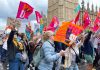
Anti-war feeling reached unprecedented intensity. In Washington half a million marched, led by 500 uniformed GIs. Opinion polls said that most people thought the war had been wrong from day one.
Then in 1970 Nixon decided to invade and flatten Vietnam’s neighbour Cambodia, ostensibly to cut off NLF bases and supplies. In fact North Vietnamese troops had been driven into Cambodia by months of ferocious US bombing.
This attack did to Cambodia what US General Le May wanted to do to Vietnam in 1964 – bomb it back to the Stone Age. This unbelievable destruction prepared the way for Pol Pot’s totalitarian horror later in the 1970s; it also destroyed any illusions in ‘peacemaker’ Nixon.
Students struck in over 400 US colleges. The Ohio National Guard shot dead four student protesters at Kent State university. Infuriated US students held thousands of demonstrations at universities nationwide.
Workers, whose sons and brothers were coming home in coffins, joined anti-war marches even though their union leaders opposed the demonstrations.
Incidents such as the My Lai massacre, where 500 civilians were murdered by US soldiers, helped reduce army morale further. Vietnam Veterans against the War was formed and told the US about atrocities they committed. Radical anti-war literature circulated.
The drug addictions and fraggings continued, as did the protests, By 1973, a shell-shocked, demoralised US Army withdrew and two years later the NLF entered Saigon. US imperialism’s plans had been ruined on the home front as well as in revolutionary war.
Support undermined
Since the Stalinist states collapsed over a decade ago, US imperialism is now the world’s only superpower. Before that, however, Stalinism could not develop the revolution even amongst the Vietnamese working class.
Eventually the ‘Communist’ Party’s lack of workers’ democracy internally and the lack of an internationalist socialist policy, which led to wars with Cambodia and China, derailed the revolution.
After Stalinist governments fell throughout eastern Europe, Vietnam submitted to another invasion – by US multinationals such as Nike eager to exploit its workers with low wages and long hours.
The US’s present main enemy, the reactionary Taliban regime and Al-Qa’ida guerrilla leaders cannot build the social support which the NLF’s land reforms managed amongst the peasants in Vietnam. It certainly can’t provide any alternative for most people in the Western world.
But Vietnam should warn Bush and Blair that war’s explosive mixture of death, destruction and political and economic havoc can rapidly undermine any feelings of support for their war aims. We should aim to give this opposition a socialist direction.