
Handheld users: view this page better on http://m.socialistparty.org.uk

Socialist Party

 |  Mobile  |  10 February 2012 | 

Archive article from The Socialist Issue 339


Home   |   The Socialist 20 March 2004   |   Subscribe   |   News 

Join the Socialist Party   |   Donate   |   Bookshop   |   Print

One year since the start of the war in Iraq

Ending the US-led occupation

Is it possible and what will follow?

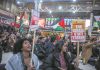
MILLIONS OF people protested worldwide against the imperialist occupation of Iraq on 20 March. 
They want to see an end to bloodshed in the country and for the Iraqi people to decide their own affairs.
 However, many working people are also worried that an end to occupation will lead to a bloody conflict and the break-up of Iraq. 
NIALL MULHOLLAND considers this and other key questions.
Q: Would an end to occupation lead to civil war?

This is the scenario put forward by the occupation forces and their local puppets in the 'Governing Council'. It is used to justify the imperialist presence in Iraq and to argue that the US led forces cannot leave until a new regime to their liking is imposed.

Iraq suffers from sectarian tensions between the Shia and Sunni Muslims. Horrific bombings, like the recent attacks on Shia worshippers in Karbala and Baghdad, have led to hundreds of deaths. There are also national and ethnic differences in Iraq, including the Kurds in the north.

Despite the racist language of Western politicians and the media, however, these differences are not the result of some inherited bigotry amongst Iraqis. The ethnic and sectarian tensions that exist are, at root, due to the role of imperialism in the region.

Yet, time and again, Iraqi working people have shown they will unite across religious and national lines and struggle for a better life. Middle East correspondent, Robert Fisk, recently commented: "There never has been a civil war in Iraq. I have never heard a single word of animosity between Sunnis and Shias in Iraq," (The Independent, 3 March 2004).

Iraq was an artificial creation, carved out by British imperialism in 1920, after the collapse of the Ottoman Empire. In order to rule, the British fostered sectarian and national divisions, using their old policy of 'divide and rule'. Imperialism leaned on the minority Sunni Muslim population to govern.

But the Iraqi masses were far from passive. A mass uprising against imperialist rule took place in 1923 in Southern Iraq and the Kurds in the north fought for self-determination.

The Iraqi Communist Party's (ICP) anti-imperialist and pan-Arab message was popular across ethnic, religious and tribal boundaries. By the late 1950s, the ICP could have led a successful socialist revolution. Tragically, due to the ICP leadership's wrong policies, the chance was lost and a Ba'ath Party coup in 1963 lead to the murder of many communists.

Ba'athist leader Saddam Hussein mainly based his rule on the Sunnis and he banned Shia religious festivals. But at different times Saddam also leaned on different religious and ethnic sections of the population, playing one off against another.

United workers' struggles

MASS UNEMPLOYMENT, poverty and a lack of basic utilities for many people will mean the conditions continue to exist for demagogues to play on sectarian, national and ethnic differences. In the post-Saddam Hussein era, a wide range of religious, ethnic and nationalist groups are making claims to national and local political power. These local right-wing forces use religious and national differences for their own class interests.

But a descent into civil war is not inevitable. There is a rich tradition of united workers' struggles that cuts across religious and national differences. With its own independent class organisations and a socialist programme, the Iraqi working class can unite all religious and national minorities and oppressed groups against imperialism and capitalism.

Socialists call for the immediate end to the occupation and for the removal of imperialism from Iraq and the Middle East. However, as with Northern Ireland in the 1970s and 1980s, we also called for the organised working class to provide a solution, to prevent reactionaries turning the political vacuum in society into a civil war.

Socialists also support the right of self-determination for the Kurdish people. It is wrong to believe that the US, United Nations (UN) or any capitalist constitution or government will liberate Kurds. Under capitalism, the Kurdish areas are condemned to economic and social stagnation. The Kurds are oppressed by several states. In Iraq, Kurds live under the burden of the PUK and KDP, who represent a pro-capitalist and reactionary elite.

Imperialism will not allow the creation of a genuine, independent Kurdish state, fearing it would act as a pole of attraction to all the Kurds of the region and other oppressed minorities. To achieve self-determination requires the socialist transformation of society, so ending poverty, tribal divisions, and sectarianism.

Socialists support efforts to build independent working class organisations in Iraq and applaud recent movements of the unemployed and for women's rights. We also support the right to self-defence against US imperialist forces, thugs and reactionaries. All arms should be under the control of elected committees of workers in the districts, factories and workplaces.

Along with a socialist programme, which includes democratic workers' control and management of industry and the economy, such an alternative to the bigots and reactionaries would get a huge response from working people.

Q: Does the new Iraqi Constitution represent the best 'democratic model' in the Middle East'?

THE IRAQI Governing Council was appointed by the head of the Coalition Provisional Authority (CPA) in July 2003. Those holding council seats are reactionary, right wing politicians. One of of them, Ahmed Chalabi, a close ally of the US, is a convicted fraudster.

The council oversaw the creation of a new Iraqi interim constitution, which is due to take effect from July, this year. US officials and the media say the constitution is the "most democratic in the Middle East". National elections are set to follow on 31 December 2005.

Leaving aside the fact that most Iraqis are more interested in getting electricity and clean water than constitutions, the interim constitution is a "major fudge" between the interests of the different communities and nationalities. It is not clear if separate groups will have a veto over new government decisions.

The constitution states that federalism will not be based on ethnicity but it also says that Kurdish self-government will continue. The Sunni Muslims felt largely ignored during negotiations, leading to fears of a "Sunni backlash".

Many Kurds believe the new interim constitution represents democracy, a federal state and the first step towards independence. But the Kurdish people have often been betrayed by local and imperialist powers.

The constitution does not rule on majority Kurdish cities like Kirkuk, and surrounding areas, which have vast oil reserves. Given this, the reactionary leaders of the Kurdish parties, the PUK and KDP, which collaborate with imperialism, are trying to dampen down aspirations for independence.

Under the interim constitution, Islam will be the official state religion and a "source" of legislation. This will be used by the right-wing Islamists as a way of trying to introduce their strict Islamic codes. This makes a mockery of the "equal rights for all" enshrined in the constitution. Women and young people, especially, will find their rights and liberty under attack.

Without real economic development and a transformation of people's living standards, capitalist rule in Iraq will always be unstable. The ruling class and imperialists will use whatever means they decide are necessary to rule. This can mean, at times, introducing a veneer of 'democracy', while real power lies with the armed forces.

The interim constitution, in theory, guarantees freedom of speech and assembly, but the occupation forces have shown they will put down protests, including attempts to organise unions, using brute repression. (see opposite)

Socialists demand real democratic rights in Iraq, including the right to assembly, freedom of speech and to organise unions. We say no to the stooge Governing Council. Working people in Iraq should decide their own future. We call for the immediate convening of a democratically elected constituent assembly, representing the working class, the rural poor and the genuine organisations of the women and youth. A majority workers' and peasants' constituent assembly would immediately move to introduce a socialist programme.

Q: Would life get better for Iraqis if the Democrats win the US presidential race?

MANY WORKERS in the West hope that if the US Democrats win the 2004 presidency the situation in Iraq will improve radically. Of course, there are differences between the Republicans and Democrats, on domestic and foreign policy. Essentially, however, both parties represent the interests of US big business and imperialism.

The majority of Democrats, including Kerry, supported the Iraq war and, before that, the war against Afghanistan. (see page 4) A John Kerry administration in the White House would act to defend the interests of imperialism in the Middle East and Iraq.

Kerry has only attacked Bush's war because he knows it is hugely unpopular with many US voters. However, the Democrats are no strangers to imperialist adventures. The Clinton Presidency created many of the conditions for today's world of terror and wars. Clinton was a fervent advocate of globalisation and neo-liberalism; policies that increased the exploitation and suffering of the people of the Middle East and neo-colonial world.

He also was a close ally of the Israeli regime and of many reactionary Arab regimes. These policies cause huge anger and resentment across the world, and helped to feed right wing political Islam.

Therefore the conditions facing Iraqis will not be in any way fundamentally better if the Democrats win the Presidential elections.

Neither would the UN play a progressive role in Iraq. The UN is an organisation that is dominated by the big nation states, whose governments, in turn, are dominated by their national ruling class. For over a decade, the UN was responsible for sanctions against Iraq that led to the deaths of an estimated one million people. The UN runs countries like Bosnia and Afghanistan in an autocratic manner, implementing capitalist policies.

Q: Who can end imperialist occupation and really liberate the Iraqi people?

THE ARMED resistance to imperialist occupation comes from a variety of sources, including ex-Ba'athists and Sunnis. Reportedly, increasing numbers of Shias are getting involved, as their situation fails to get any better.

The West accuse Sunni and al-Qa'ida forces for mounting indiscriminate attacks to foster sectarian and national divisions and to provoke civil war.

Socialists condemn attacks on innocent Iraqis. Right-wing Islamists may be fighting imperialist forces but they are completely reactionary. They would impose an anti-working class and clerical dictatorship if they came to power. But it is also possible that supporters of the Iraqi puppet regime are behind some of the bombing outrages.

The spectre of all-out sectarian war is used by the occupation forces to try to justify their presence. Imperialism has a bloody and long history of using atrocities to divide and rule, from Algeria to Ireland.

Whoever is behind the indiscriminate bombings, their clear aim is to cut across Iraqi's history of strong national identity and united class struggle. The main political parties in Iraq have the same aims. They represent religious and national groupings and also foment division.

There is no mass socialist alternative. The Iraqi Communist Party, repeating its past mistakes, is part of the US puppet regime.

Only the working class and poor can show a way out. Many Iraqi women felt that with the arrival of US troops, they would gain more rights. But women have had to fight for their own interests, against the occupation and the fundamentalists, as have the unemployed and trade unionists.

The fight for democratic rights is a fight against US imperialism and its pro-capitalist puppets inside Iraq. Imperialism will use repression against all opposition to its rule and especially against the potentially powerful working class. Advances by the working class will threaten imperialist profits and prestige, and the continued existence of the neighbouring Arab dictatorships.

Therefore the fight for democratic rights is fundamentally an anti-capitalist fight. To safeguard and to extend democratic rights in Iraq means a battle for an alternative system - socialism.

See also, CWI statement: One year on from US led war: Iraq suffers under imperialist occupation, at www.socialistworld.net


Iraq's Workers Get Organised

IN IRAQ, Ba'ath Party law and Ba'ath Party institutions supposedly are being rooted out and democracy brought in. But one of Paul Bremer's first actions, as head of the occupation, was to ratify Saddam Hussein's 1987 law banning strikes in the public sector.

Mariam Kamish

Three months into the occupation, Bremer announced a new wage table, with wage cuts for everyone - except the tops of the administration. The bottom rung of the wage table was set at less than half the sweatshop wages in the free trade zones in Iran and Jordan - and that was in the context of runaway inflation in Iraq.

Not surprisingly, trade unions started springing up and strike action wasn't far behind.

The US Bechtel Corporation, (which got its fingers burned when it tried to privatise the Bolivian water industry a few years ago) was handed the Iraqi Railways among other enterprises. In response, 600 railworkers in the Baghdad Railway Works held a mass meeting, elected representatives and sent them to stop management dealing with the 'yellow' (scab) union and to get recognition for the new, genuine union.

US troops pointed their guns at the delegation but the railworkers stood firm, gaining recognition.

These were workers who'd stayed behind in the sheds with their trains during the bombings - to put out fires and protect their industry. No-one was going to bully them in their own workplace.

Workers in the oil refineries also know their own power. In late January 2004, Southern Oil Company workers won a battle over wages and conditions that had been going on for three months.

First, they won in negotiations with their own management. And only then did they take on Bremer and the occupation. Their fear was that the British Army would be brought in to operate the oil pumps. The union announced that if that happened, oil workers would join the armed resistance. The occupation authority caved in, pretty quickly!

The electricity sector workers in Basra had supported the oil sector workers. In late January, they went on strike themselves. At one power station, they stormed the administration building and seized their brutal boss.

He'd been paying slave wages and paying women less than men. He'd refused to recognise the union and he'd closed the creche. He'd discontinued health and safety equipment and he'd cut the old annual bonus.

At all the power stations, management said they were only carrying out occupation authority policy. The workers told them that they'd either accept the union's wage rates - plus equal pay for women, maternity pay and creches at all workplaces - or they'd turn off the lights all over Iraq!

Unsurprisingly, the Energy Minister agreed terms. The effect of these victories on the confidence of working class people and their willingness to struggle has been electric.

So, it's not surprising that the US authorities see the trade unions and trade unionists as a threat to their plans to privatise and super-exploit a new 'Iraq plc'.

The offices of the Iraqi Federation of Trade Unions have been raided and ransacked by the US army. So have the offices of the Workers' Communist Party and the Union of Unemployed.

Through his "Public Notice Number One", Bremer has given the occupation authority broad powers to detain anyone inciting civil disorder as prisoners of war. And this covers leaflets and speeches promoting strike action. But, he hasn't dared to use those powers. The working class is too powerful.

These are critical times in the Iraqi labour and trade union movement. The Iraqi working class is moving into action - and they need strong support from the organised working class internationally.


Home   |   The Socialist 20 March 2004   |   Subscribe   |   News 

Join the Socialist Party   |   Donate   |   Bookshop   |   Print

In this issue

Capitalism Means War and Terror: Build The Socialist Alternative

Madrid Bombings Unleash Anti-War Anger

Ending the US-led occupation


What we think

Building An Alternative To Blair And Capitalism

Campaigning To Change Society


International socialist news and analysis

Support Nader's Campaign


Workplace news and analysis

A Teachers' Leader On A Teacher's Salary


Socialist Party and CWI

Committee for a Workers' InternationalThe Socialist Party is part of the Committee for a Workers‘ International (CWI) which fights for socialism world wide. www.socialistworld.net.


Youth and student

Click here for our youth and student pages

- See also:

Youth Fight for Jobs

Youth Fight For Jobs website

Socialist Students website


Share on Facebook
Share on Twitter
Visit us on Youtube

Socialism Today

Socialism Today 155 - February 2012

Socialism Today is the monthly magazine of the Socialist Party
Click here to subscribe

- In this month's issue:

Dithering in Durban

Pensions: the fight continues

The year of all risks


Phone our national office on 020 8988 8777


Locate your nearest Socialist Party branch Text your name and postcode to 07761 818 206


Regional Socialist Party organisers:

East Mids: 0116 223 0534

London: 020 8988 8786

North East: 0191 421 6230

North West 07769 611 320

South East: 07894 716 095

South West: 07759 796 478

Southern: 023 8057 5649

Wales: 02920 440571

West Mids: 02476 555 620

Yorkshire: 0114 264 6551


Members’ resources

Pay in The Socialist sales

Pay in Fighting Fund

Leaflets

Bulk book orders


Legal   |   RSS feed RSS


Marxist guides

Karl Marx Communist Manifesto by Marx and Engels

Communism, grotesque caricature: see Soviet Union. See also What About Russia?

Cuba

Dialectical materialism

Genuine communism: see Marxism, What is it?

Historical materialism


How would a socialist economy work?

Lenin Lenin: On Marxism

Marxism: What is it?

Philosophy, Marxism

Russian Revolution

The State and Revolution


Socialism: What is it?

Socialist Countries?

Socialist Party manifesto

Soviet Union

State, The

Terrorism: Marxism Opposes Terrorism

Trotsky Trotsky: On the Russian Revolution

What about Russia?

What is Marxism?

What is Socialism?


How a fightback can stop the cuts

How a fightback can stop the cuts

Online: Lessons from how Thatcher was defeated. This pamphlet outlines how we can stop the cuts


Women and the Struggle for Socialism

Women and the Struggle for Socialism

It doesn't have to be like this - What consequences will the economic crisis and its aftermath have for women?


The Case for Socialism

The Case for Socialism by Hannah Sell

Online: The case for socialism in a period when capitalism is in deep crisis. By Hannah Sell, Socialist Party deputy general secretary


The Masses Arise

The Masses Arise, by Peter Taaffe

The Masses Arise: The Great French Revolution 1789-1815 by Peter Taaffe. New edition out now.


Socialism in the 21st Century

Socialism in the 21st century by Hannah Sell

Online: An essential read for anti-capitalists, trade union activists and socialists.


Videos:


N30 - Millions strike

N30 - Millions strike back at Con-Dem government on 30 November 2011, photo  Socialist Party

N30 - Millions strike back at Con-Dem government on 30 November 2011, photo Socialist Party


Socialism 2011

Socialism 2011

Socialism 2011: Crucial preparation for the fightback


Jarrow marchers march into history

Jarrow Marchers 2011

Jarrow marchers march into history


NSSN lobby of TUC 2011

NSSN lobby of TUC 2011: Open the floodgates of mass action

Successful NSSN lobby called for a one day public sector strike


TUC demo 26 March 2011

Half a million march through central London against the ConDem cuts on TUC demonstration, photo Socialist Party

Half a million trade unionists marched against the ConDem cuts in central London


Day X student demo against fee rises

Ian Pattison addresses 9 December Day X student demo against fee rises

9th December 2010: what the students said


London firefighters second strike day

Fire Brigades Union (FBU) in Poplar, London, on strike

Firefighters speak, as all firestations picketed


On this site:

Categories

1-9 

1-9 


Select articles from month:

February 2012

January 2012

December 2011

November 2011

October 2011

September 2011

August 2011

July 2011

June 2011

May 2011

April 2011

March 2011

February 2011

January 2011

December 2010

November 2010

October 2010

September 2010

August 2010

July 2010

June 2010

May 2010

April 2010

March 2010

February 2010

January 2010

December 2009

November 2009

October 2009

September 2009

August 2009

July 2009

June 2009

May 2009

April 2009

March 2009

February 2009

January 2009

December 2008

November 2008

October 2008

September 2008

August 2008

July 2008

June 2008

May 2008

April 2008

March 2008

February 2008

January 2008

December 2007

November 2007

October 2007

September 2007

August 2007

July 2007

June 2007

May 2007

April 2007

March 2007

February 2007

January 2007

December 2006

November 2006

October 2006

September 2006

August 2006

July 2006

June 2006

May 2006

April 2006

March 2006

February 2006

January 2006

December 2005

November 2005

October 2005

September 2005

August 2005

July 2005

June 2005

May 2005

April 2005

March 2005

February 2005

January 2005

December 2004

November 2004

October 2004

September 2004

August 2004

July 2004

June 2004

May 2004

April 2004

March 2004

February 2004

January 2004

December 2003

November 2003

October 2003

September 2003

August 2003

July 2003

December 2001

November 2001

October 2001

September 2001

August 2001

July 2001

June 2001

May 2001

April 2001

March 2001

February 2001

January 2001

December 2000

November 2000

October 2000

September 2000

August 2000

July 2000

June 2000

May 2000

April 2000

March 2000

February 2000

January 2000

December 1999