

Review
The Tragedy of the Chinese Revolution by Harold Isaacs
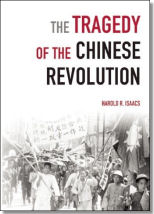
Tragedy of the Chinese Revolution by Harold Isaacs
The Chinese revolution of 1925-27 represented one of the most gigantic and splendid movements in human history. Kept at the level of pack animals, the multi-millioned Chinese masses – led by the magnificent Chinese working class – gathered in the urban areas of Shanghai, Guangdong, Wuhan, etc and battered at the foundations of Chinese and imperialist landlordism and capitalism in their quest for liberation and a new society. With a more favourable position than existed even in Russia in October 1917, a successful revolution was entirely possible.
Peter Taaffe, Socialist Party general secretary
However, a major obstacle standing in the way of the success of the revolution lay in the false policies recommended by Stalin and his circle at the head of the Communist International at the time. They stood for an alliance of the working class and the exploited peasantry with the so-called ‘national capitalists’ in a ‘bloc of four classes’ in China.
This was the failed policy of the Mensheviks in Russia, transferred to Chinese soil. Isaacs’ book demonstrates brilliantly that this was the ‘tragedy’ of the revolution. This has been disputed endlessly by the apologists for Stalin and Stalinism since. But Isaacs answers them with an abundance of facts and descriptions of the march of the masses which completely undermines their arguments and reinforces those of himself and Trotsky.
But this book is also much more than this, as it evokes with great literary brush strokes the magnificent panorama of the heroism, self-sacrifice and determination to change the world of the terribly exploited Chinese workers and peasants.
This edition has the added advantage as it appears as it was in the original version, which contains the illuminating introduction by Leon Trotsky, which was excised from the ‘abridged’ edition. As Isaacs moved towards the right, following Trotsky’s death, he only allowed this ‘abridged’ version of his book to be published. This was still useful and, despite the author’s change of mind, vindicated Trotsky’s analysis of the revolution.
But it was not as effective as this restored full version. Trotsky himself remarked: “Isaacs’ book represents a scientific work from beginning to end. It is based on a conscientious study of a vast number of original sources and supplementary material.”
It must be added that Trotsky discussed with the young Isaacs, who was 28 when he wrote this book, and went over it line by line before its publication. Despite Isaacs’ later recanting of his Trotskyist and Marxist past, and the ideas of Trotsky himself, the book is nevertheless a brilliant demonstration of Trotsky’s ideas, particularly on the key question of the permanent revolution as applied to China.
This theory holds that the capitalist bourgeois-democratic revolution in what is now the neo-colonial world, which involves thoroughgoing land reform and the purging of society of all feudal and semi-feudal land relations, the solution of the national question, democracy, election of parliament, etc., is only possible if the working class becomes the leading force in such a revolution. It, in turn, is only capable of leading the revolution to a victorious conclusion if it leads the peasantry – particularly its lower layers – in the struggle.
Uneven development
The opening chapter – ‘Seeds of Revolt’ – is a minor literary masterpiece as it describes, through the lives of the Chinese masses, the law of ‘combined and uneven development’ the essence of which is an integral point of Trotsky’s theory of the permanent revolution. It begins:
“On the fringes of big Chinese cities the shadows of lofty factory chimneys fall across fields still tilled with wooden ploughs. On the wharves of seaports modern liners unload goods carried away on the backs of men or shipped inland on primitive barges.
“In the streets great trucks and jangling trams roar past carts drawn by men harnessed like animals to their loads. Sleek automobiles toot angrily at man-drawn rickshaws and barrows which thread their way through the lanes of traffic. Streets, lined with shops where men and women still fashion their wares with bare hands and simple tools, lead to huge mills run by humming dynamos. Aeroplanes and railways cut across vast regions linked otherwise only by footpaths and canals a thousand years old. Modern steamers ply the coasts and rivers, churning past junks of ancient design.
“Throughout the towns and villages, and on the tired land of the vast river valleys that stretch from the sea to the heart of Asia, these contradictions and contrasts multiply. They embody the struggle of nearly half a billion people for existence and survival.”
It is regrettable that the author retreated from his Marxist-Trotskyist position later. His son, Arnold Isaacs, in his new introduction, tries to explain his reasons. He concedes his father was at one ideologically with Trotsky when he wrote the book but then goes on to state: “His [Harold Isaacs] position on Trotsky’s underlying beliefs is a different matter.”
Yet Isaacs’ son concedes that the book was written by the young Isaacs as a ‘revolutionist’, as Trotsky approvingly noted in his foreword but “those views fairly quickly changed”. Thirteen years later, however, in a new abridged edition – which did not give the full scope of this present book – “he [Harold Isaacs] no longer agreed with the fundamental Leninist principles that Trotsky held until his death in 1940” [foreword by Arnold R. Isaacs].
The change of heart by Isaacs is explained by the fact that he disagreed with “the principle that a proletarian dictatorship led by a single revolutionary party must exercise sole power in a revolutionary state”. This is a quite false conclusion attributed to Trotskyists and also to Marxists today.
A single party state in Russia, exercising the ‘proletarian dictatorship’ (which had a quite different meaning then than it does today, in the sense that it really represented workers’ democracy) did not arise from Trotsky’s ideas but the exigencies, the difficulties of the Russian revolution.
As Trotsky and we have explained many times, only one party was originally banned by the Bolsheviks, the reactionary Black Hundreds. All other parties – Mensheviks, Social Revolutionaries, anarchists, etc. – were allowed to continue as long as they exercised political opposition to the Bolsheviks in a peaceful, democratic manner. Only after many had resorted to armed insurrection against the Bolsheviks – as did the Social Revolutionaries in 1918 – with the Mensheviks and others supporting different tsarist or White generals, were they suppressed.
Later, some members of these parties did adhere to the October 1917 victory but their parties as a whole were originally on the other side of the barricades. Isaacs, as his son explains in the introduction, later sought to argue that the “soviet experience taught us that the contradiction between authoritarianism and democratic socialism is complete. The one-party monopoly of political life developing into bureaucratic oligarchy, an outcome that clearly arose out of some of the basic premises of bolshevism.”
This is the familiar tale which argues that Stalinism, ‘authoritarianism’, originated in the Bolsheviks and their methods. In reality, Stalinism had to consolidate itself by destroying all elements of Bolshevism.
Bolshevism
Lenin’s Bolshevik party was the most democratic mass party in history. Stalinism had to annihilate this party in a river of blood in the terrible purges of the 1930s. The one-party regime flowed from the isolation of the Russian revolution and not the original aims of Bolshevism.
The hope was that after the civil war that soviet democracy would be restored. Instead the isolation of the revolution led to the crystallisation of a bureaucratic caste which succeeded 73 years after the revolution in returning Russia to capitalism.
These issues, in any case, are not central to this book, dealing as it does with the mighty Chinese revolution of 1925-27. The mainsprings of this mighty movement were rooted – as in the Russian revolution itself, which inspired the Chinese masses – in the incapacity of capitalism to take society forward.
We would urge all those who are able to buy this book or at least buy it in combination with others to do so. Reading it will allow the younger generation in particular to understand the full character of the revolution of 1925-27.
It will also allow them to see that the forces involved in the revolution of 1944-49, led by the Red Army and Mao Ze-Dong, were entirely different to those present in 1925-27, which was a classic working-class revolution that led the mass of the Chinese nation in the struggle to change society.
This book also has a contemporary relevance because the problems of the incomplete capitalist-democratic revolution – which the Chinese workers and peasants confronted – are still colossal barriers to real liberation in those parts of the world which comprise two thirds of humankind. We therefore urge readers to buy it and discuss it, hopefully as a means of understanding what will take place in the neo-colonial world.
Note: the book is online on the Marxists.org website here
