

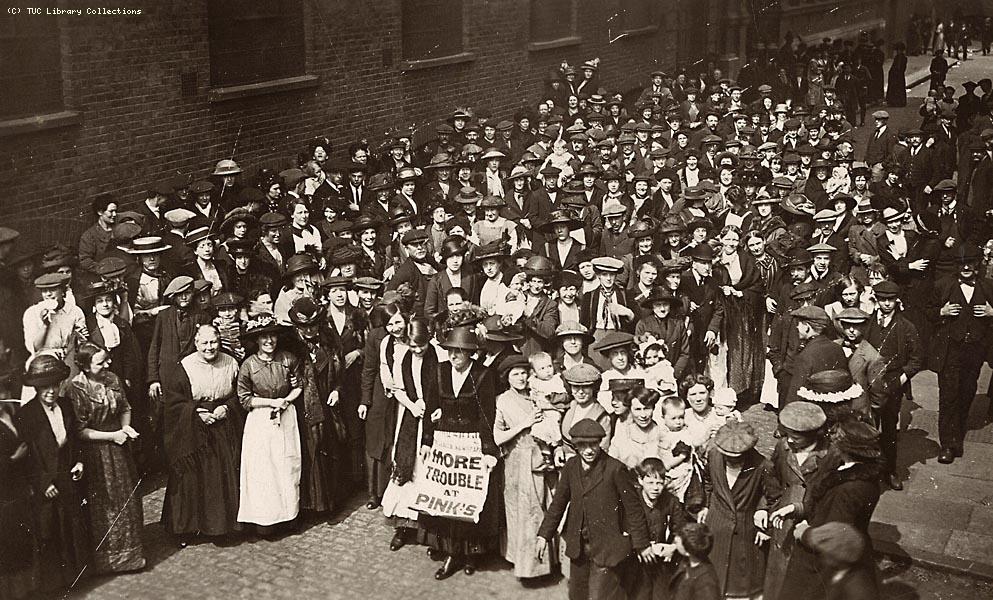
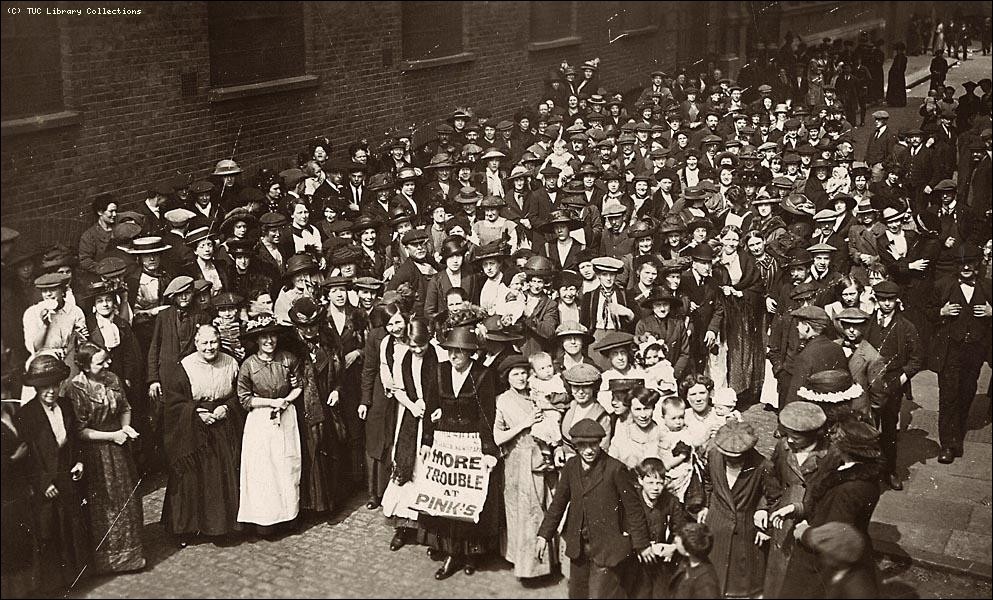
Women workers striking against povety wages at Pink’s in Bermondsey in 1911 , photo TUC library collections (Click to enlarge: opens in new window)
A century ago, women in the trade unions numbered only a few thousand. Many working class women worked in the most appalling conditions in sweatshops and were outside the trade unions’ ranks.
In periods of industrial ‘peace’, unskilled workers, especially unskilled women, can be hard to unionise – many view the unions as having little to offer them.
Why spend hard-earned money on trade union subscriptions when you work long hours, in often appalling conditions, for little financial reward?
However, in a period of struggle, the low-paid, believing they have something to gain, can be transformed into the best militants.
We should see this again on 30 November 2011 when millions of people, including millions of low-paid women, will take a leading part in a mass working class protest against Con-Dem cuts.
Jack Palmer looks back at an inspiring example of militancy from 1911.
In the summer of 1911, there were waves of industrial action: maritime workers, dockers and transport workers. Inspired by the revolutionary character of the struggle by dockers and transport workers and their promise not to return to work until all the wage claims were settled, many low-paid workers joined battle to win themselves better wages.
That year, low-paid women workers struck in Millwall, St Pancras and Clerkenwell in London; Ware in Hertfordshire; Swansea in Wales; Leith and the Vale of Leven in Scotland; but the most important was in Bermondsey, south London.
Enthused by the other strikes, 21,000 low-paid women workers took up the cudgels – their struggle became known as the Bermondsey Women’s Uprising. Not even union members but driven by acute poverty, women walked out of their factories without even formulating a claim. They just demanded more money.
‘Reign of terror’
The women struck on 15 August. A young woman outside a chocolate factory summed up their determination to win: “We are striking for more pay, mister, and we won’t go in till we get it”. The manager at Peak Frean, the biscuit manufacturer, when 2,300 of his employees joined the picket lines, declared: “I don’t know of a single business that is working in the district… It is what one might call a reign of terror”.
Another boss blamed the strikes on intimidation because his “workers were well contented” but had been “called out by the mob”. Outside his jam factory, Pinks, the striking women raised a massive banner stating: “We are not White slaves – We are Pink”.
The women marched around Bermondsey shouting “are we downhearted?” and answering “no!”, then to Southwark Park to hear Mary Macarthur, leader of the National Federation of Women Workers (NFWW), and Ben Tillett, dockers’ leader, speak. Within weeks, this park was an army camp for the Cameron Highlanders and the Norfolk regiment, part of the 25,000 troops moved into the capital’s parks, to help the police maintain order.
Bermondsey was a black spot for poverty – 1,500 people lived in local workhouses. 40% of London’s population lived in dire poverty but in the dock areas it climbed to above 80%.
One woman working in a big factory toiled away week after week, month after month, year after year for five hours daily, carrying jars often weighing up to 56 pounds. Then when dinner time arrived, she had to feed her baby – the infant being brought to the factory to meet her. Her meal was poor in quality and small in quantity.
Before the strike some women earned less than six shillings a week and those under 16 as little as three shillings a week. The Morning Post claimed these firms could only exist by employing low-paid labour, as many who oppose a decent living wage claim today.
The NFWW distributed 4,000 cards in one week, when the strike ended 8,000 women had joined the union. A general union, open to unskilled women workers, it had a low subscription rate and no strike fund. As the employers would not take the women’s union or its women members seriously, its only weapon was to strike.
The NFWW came to international attention by leading the 1910 women chain makers’ strike, raising £4,000 from supporters. All strikers, union members or not, would receive support. Lack of funds never deterred the Federation. An appeal for the Bermondsey strikers raised £500 in one week and a donation of six barrels of herrings!
Of 21 factories on strike, 19 won substantial wage increases. At Pinks the weekly rate rose from nine shillings to eleven shillings. Little enough, but it was considered a massive victory. Mary Macarthur estimated the strike gained £6,000 to £8,000 for the women each year in total. Militancy paid off and the union increased its membership.
Solidarity
The women won through determination and solidarity. They felt part of the wider movement for wage increases. 36 riverside unions had combined to organise the strike – their constitution had a clause saying no group was to return to work until all groups were satisfied.
Also, Tillett had assured them that the dockers would not resume work until the women won their demands. This was why the previously unorganised Bermondsey women took their action. They believed these promises and the dockers delivered on their pledge.
Today women are a majority in TUC-affiliated unions. The government’s cuts programme will force many women workers to lead the struggle. The Bermondsey women’s struggle is an inspiration for the battles developing now and for renewed determination to organise low-paid women into the unions’ ranks.