

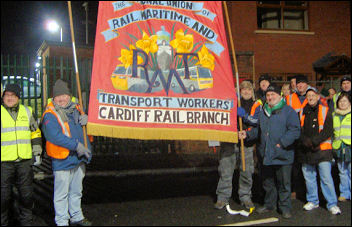
South Wales RMT signal workers on strike , photo Socialist Party Wales
The appeal court in London has overruled a previous high court judgement that blocked the RMT calling its members from the Dockland Light Railway (DLR) out on strike. This was almost at the same time as the workers at the BP Hull biofuel plant construction site took unofficial action in response to the management’s breaking of the national agreements.
Bill Mullins
What links these two incidents are the lessons that flow from them for the trade union movement which stands on the brink of the biggest struggle in this country for decades.
The construction workers, working on a site that is time critical, had the upper hand over their bosses. In this instance this was because they acted immediately rather than waiting for their union leaders to call official strike action.
If they had waited it would have meant, at the minimum, waiting for 28 days whilst the union put in place all its legally defined procedures. This includes drawing up a list of potential strikers and showing it to the employers.
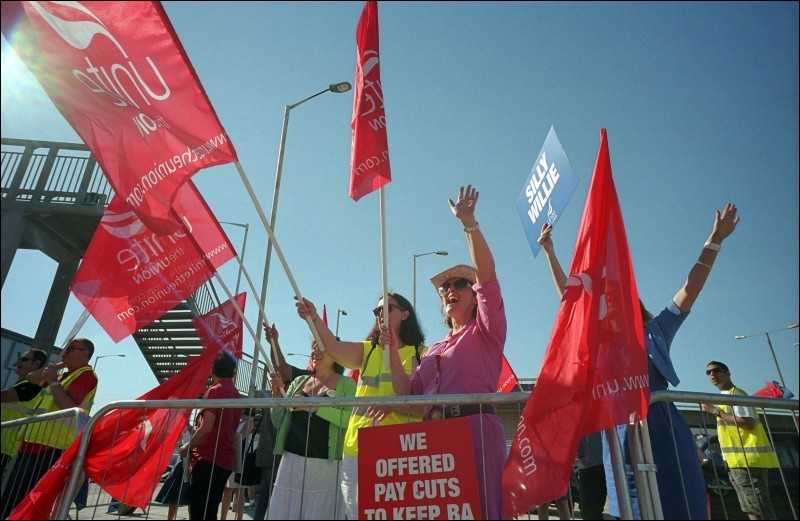
British Airways cabin crew on strike at Heathrow airport, photo Paul Mattsson (Click to enlarge: opens in new window)
The unions also have to catalogue where the workers work and what grade they hold. They then have to show the ballot paper to the bosses, then give seven days notice of the strike, once the result is in. At any stage in this process the bosses can challenge the union in court asking for an injunction to stop the action, as happened at BA and in RMT disputes.
The construction engineers knew that going down this route just plays into the hands of the bosses, who would be free to make workers redundant without any interference from the union. But their prompt action meant the employers had to rapidly retreat.
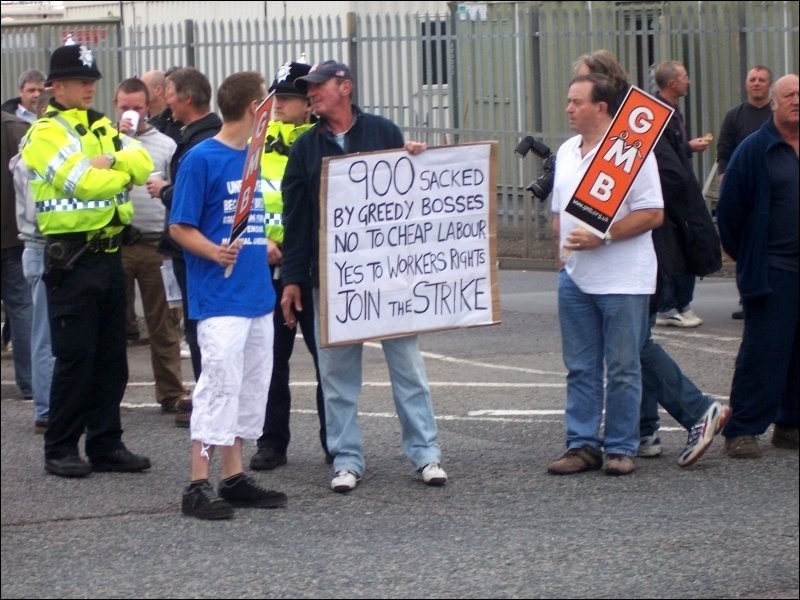
Lindsey Oil Refinery workers strike, photo Sean Figg (Click to enlarge: opens in new window)
This is what happened in 2009 in the Lindsey oil refinery workers’ strike, which involved some of the same workers who took action last week at BP Saltend.
The RMT, one of the most militant unions in the land, won their battle in the appeal court. The court accepted that the union had acted legally in the way it conducted its ballot of its DLR members.
The difference this time to the original court findings was that the judges knew that if they continued down this road, blocking nearly all the legal roads to strike action, then the workers would begin to draw the same conclusion as the construction workers did – if we can’t take legal action then we’ll take unofficial action.
It might not have been the DLR workers this time but sooner or later that is what other groups of workers will do.
Anti-union laws
The RMT points out that British trade unions are restricted by some of the worst anti-union laws in the western world. Whilst not unnecessarily jeopardising union finances, painfully built up over previous decades by members’ sacrifices, the union leaders need to be flexible and be prepared to act when required.
The RMT does not make a fetish of the law and does not use the law to block their members taking action if it can help it. But that is not the case in many other unions.
Unison does not allow its branches to initiate strike ballots, maintaining that only the regional officers can do so. Far too often the result is that branches either never get the ballot authorised, or it takes so long that the original reason for it has long been forgotten and the employer gets away without opposition from the union. This leads to demoralisation and members’ lack of confidence in their own union.
But this will not always be the case. Tens of thousands of workers in the public sector, in councils and the health service, face massive attacks on their jobs and conditions.
They will not stand idly by whilst the employers do what they want. If the union leaders do not give a lead and organise official strike action from above then it will happen from below, without the union backing and despite the anti-trade union laws.
