

The long march in Bangladesh
Interview with a march organiser
Introduction
The long march in Bangladesh (Click to enlarge: opens in new window)
The people of Bangladesh are among the poorest in the world. Wages are so low that they undercut those of China in many industries. This has provoked determined struggle this year, notably by around three million textile workers, the majority of whom are women.
Another issue of fundamental importance is that of energy. Bangladesh has reserves of oil, gas and coal. Clearly, there are big issues to resolve over developing sustainable energy sources, minimising the use of fossil fuels and not using them at all, if possible.
But the only way to resolve them would be on the basis of a logical plan of production which took into account resource exploitation and environmental degradation as part of improving the quality of life for all the people in Bangladesh.
That would require moving away from the corrupt, profit-driven system run from the top by unaccountable elites to a genuinely democratic, socialist society where decision making is made by and in the interests of working-class people and the impoverished majority.
The long march in Bangladesh (Click to enlarge: opens in new window)
That is the last thing on the mind of the government of Bangladesh, however. Instead, it is continuing with the ruinous policies of previous administrations: aiming to open up natural resources to exploitation by western-based multinational corporations.
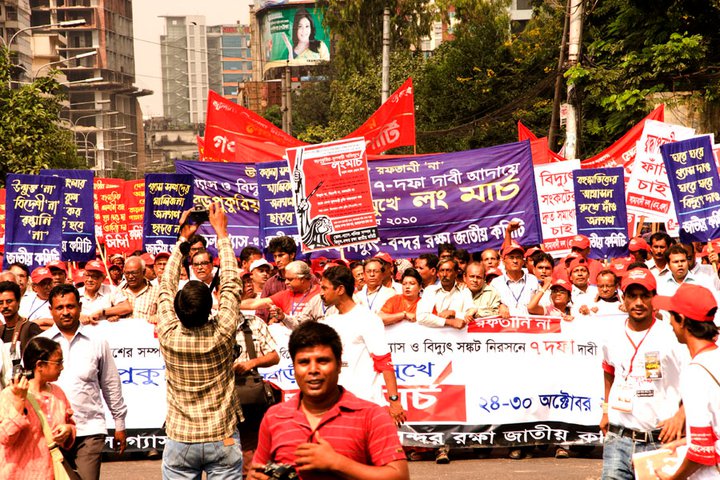
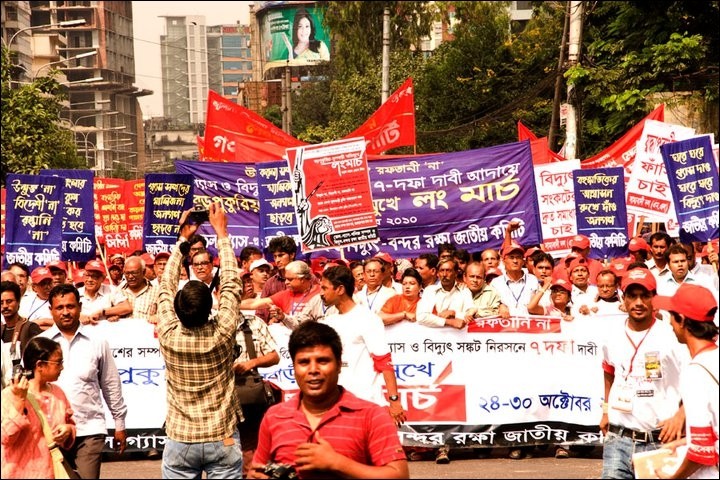
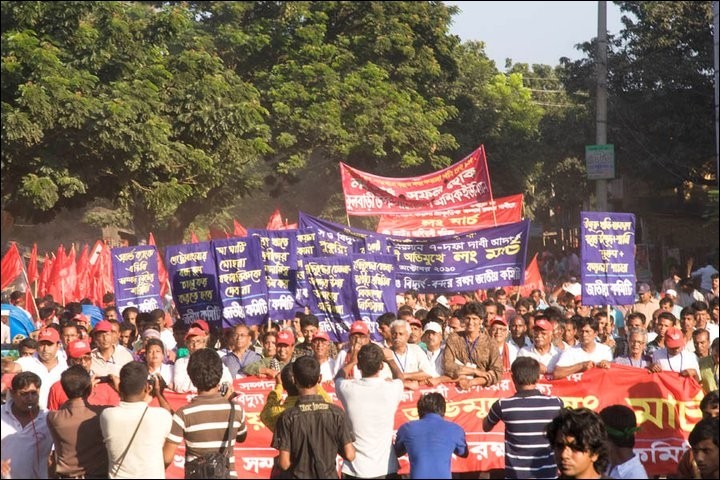
In response, a movement, backed by left-wing groups, student organisations and environmentalists, is embarked on a long march.
It was called specifically to highlight the plight of people in the Phulbari region of Bangladesh. Here, four years ago, a mass campaign stopped moves by Britain-based Asia Energy from developing a huge 6,000 hectare open-cast coal mining operation.
Forty thousand people were under threat of eviction from their land and livelihoods as a direct result.
The long march in Bangladesh (Click to enlarge: opens in new window)
Although initially successful, three young people – Tariqul (aged 21), Salekin (20) and Amin (13) – were shot dead by security forces firing into a demonstration.
Hundreds of others were injured and arrested. The scale of the resistance movement and outrage at the state-sponsored violence forced the government – then headed by the Bangladesh Nationalist Party – to sign an agreement which included the expulsion of Asia Energy from Bangladesh, cancellation of the open-cast mining plan, and the punishment of those responsible for the Phulbari deaths.
At that time, the main parliamentary opposition was the Bangladesh Awami League (BAL). Playing the populist card, it promised that it would ensure that the agreement was fully implemented.
BAL went on to win a landslide in the general election in 2008 but has failed to honour its commitment.
In fact, it is now pursuing deals with other multinational corporations, such as US-based ConocoPhilips, which is seeking to explore hydrocarbons in the Bay of Bengal.
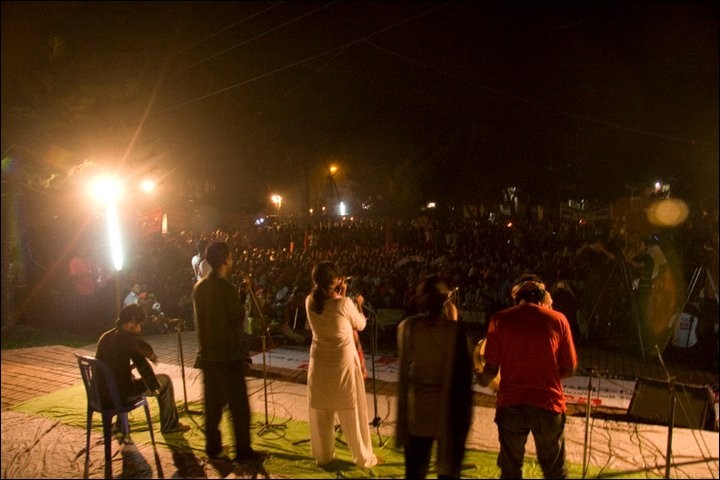
The long march in Bangladesh (Click to enlarge: opens in new window)
The long march started from the Bangladesh capital, Dhaka, on 24 October and finished in Barapukuria on 30 October.
Its aim was to demand the full implementation of the Phulbari agreement. Before the march began, Manny Thain of East London Socialist Party in Britain (author of the above introduction) sent some questions to Anu Muhammad in Bangladesh, a leader of the National Committee to Protect Oil, Gas, Mineral Resources, Power and Ports, which organised the long march.
His replies are below.
Q: Would you like to add anything to my introduction [above] as background to the situation in Bangladesh?
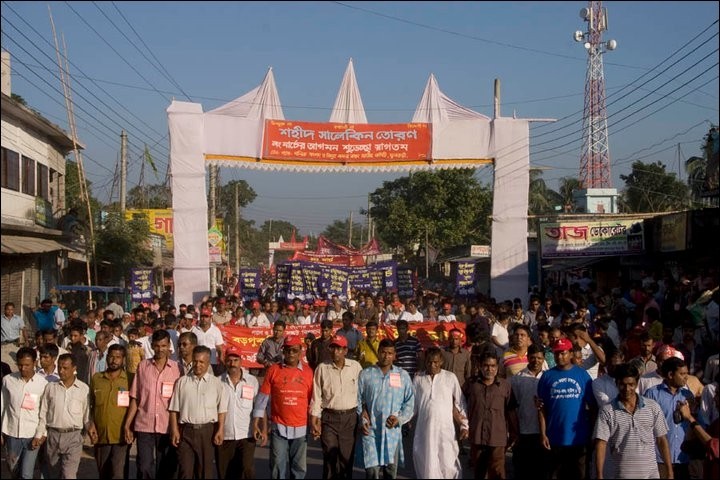
The long march in Bangladesh (Click to enlarge: opens in new window)
A: This was a very good summary, thanks. Only one point: the number of 40,000 people under threat was actually Asia Energy’s (presently known as Global Coal Management – GCM) calculation.
But later the expert committee estimated the number and that was not less than 120,000. If we consider the devastation and its impact in surrounding areas the number of people under direct threat of eviction could rise to 500,000.
Q: What groups are involved in the long march?
A: Several left political parties, different mass organisations working with students, peasants, workers, women, indigenous people, artists, singers, theatre groups, study circles, teachers, writers, individuals, experts and journalists are taking part.
Q: How did they come together?
A: They came together in the process of campaigning, publications, discussions, debates, demonstrations, consultations with different sections of people in the last ten years by the National Committee.
National support and solidarity from different sections of people with the National Committee’s movement significantly increased during and after the Phulbari uprising.
This support expanded further during a series of protest programmes against deals with US oil company, ConocoPhillips, and mobilisations against police repression on the protest march.
Q: Have you got links with workers’ organisations in the mining/oil exploration industries?
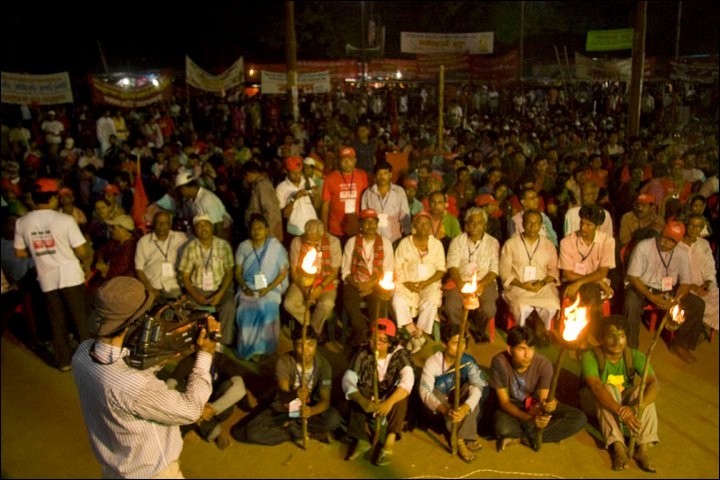
The long march in Bangladesh (Click to enlarge: opens in new window)
A: In Bangladesh we have only one coal mine in Barapukuria, Dinajpur. It is a state-owned mine, operated by a Chinese contractor. We have very close links with the workers’ organisation there, where workers live on very low wages, and also suffer from job insecurity and lack of safety in the workplace.
They have participated in various programmes of the National Committee in the last two years. They are going to join us in the long march when we will reach Barapukuria.
Q: What form will the long march take and are there events planned along the way?
A: People from different parts of the country will march towards Phulbari from different points. The main procession will start from the heart of Dhaka, the capital city. It will start on 24 October at 11am and will continue for 7 days to reach Phulbari on 30 October at 2pm.
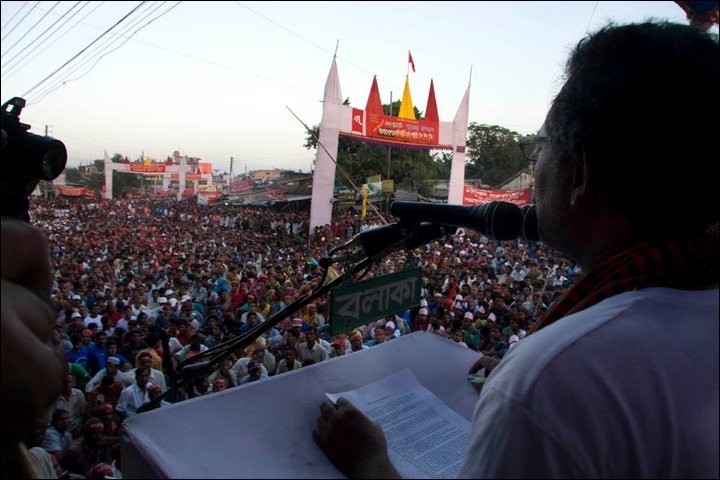
It will end with a massive gathering of hundreds of thousands of people from all over Bangladesh. On the way to Phulbari there will be at least 40 public meetings during the march. There will be also street drama, singing, film shows and poetry recitations. Hundreds of colourful banners and festoons will be there to display the messages and slogans of the long march.
Q: Clearly, the Phulbari mining plan involved a British-based company, and the Bay of Bengal issue, involves a US-based company. So, are there any plans to spread the campaign to those countries? We would, for example, support protests/petitions, etc, of these companies.
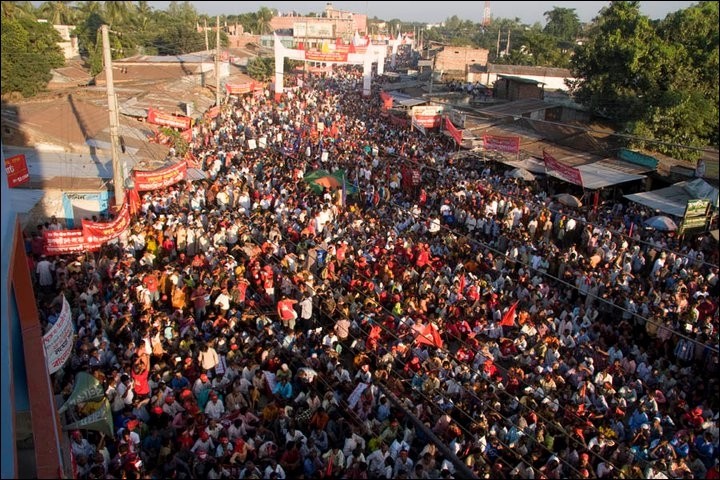
The long march in Bangladesh (Click to enlarge: opens in new window)
A: Absolutely. We are struggling against global corporations and it requires global struggle. Our friends in Europe and America extended their support and worked hard to spread the campaign. They include Bangladeshi and international human rights activists. A number of international human rights organisations, including London Mining Network (LMN), Mines and Communities (MAC), World Development Movement (WDM), Both End, International Accountability Project (IAP) and Banktruck, have expressed their full solidarity to our struggle, especially against the disastrous opencast mining project in Phulbari.
The experts based in Europe and America have also challenged the environmental impact assessment of GCM.
We need to do more to spread and strengthen our campaign. Our struggle is not reduced to any locality. Together with our international friends and colleagues, we stand against imperialism. We see the corporations are the real faces of the imperialists and the corporate cage serves the corrupt political elites, business groups, consultants and bankers.
They exploit the rights of the mass of the population by offering low salaries for the hardest work and plunder natural resources, while keeping people in a permanent state of poverty and humiliation.
We believe the Socialist Party and people in the UK will come forward to take this campaign to a larger area.
Q: What links do you have with Bangladeshi campaigners around the world?
A: We have very good connections with Bangladeshi campaigners in London, New York and Holland. Our friends based in these countries are working very closely with the National Committee in Bangladesh.
In May 2009, our Bangladeshi colleagues submitted evidence of killing and human rights violations by GCM Plc to the Joint Committee of Human Rights in the UK.
The report was considered by the committee but, unfortunately, the report’s authors and our activists in London experienced harassment, including house break-ins, email and phone abuse as a consequence of the submission.
All of this led to a heightened feeling of insecurity in their lives. They also organised an online signature campaign against police repression of the National Committee following the hydrocarbon deal with the US company.
Q: What should be done with Bangladesh’s natural resources? How should they be run and used?
A: Our position is that, Bangladesh’s natural resources are the common property of the people of Bangladesh.
This cannot be privatised for making business for the few by depriving people’s rights over them. We won’t allow the extraction of natural resources for the profit of multinational companies (MNCs).
These resources should be extracted only for people’s use and needs. To ensure the best utilisation of the natural resources, we demand: (i) 100% national ownership of natural resources; (ii) no MNC involvement; (iii) no energy exports; (iv) the best use of coal depends on selecting the method appropriate for Bangladesh.
There should be no displacement of populations, and no destruction of biodiversity, water resources and fertile land; (v) the development of a national capability to ensure that every drop of energy resources goes to the people of the country, and also to develop the use of renewable resources, of which there is great potential in Bangladesh.
Q: What is the next stage in the campaign after the long march?
A: It will open a new phase of national mobilisation against the grip of the MNCs over the natural resources and the economy as a whole.
We will initiate a larger campaign to build greater unity of people against global/local plunderers.
Q: What about the political situation? Is there a political alternative to the establishment parties which can really represent working-class and poor people?
A: If we look at the ruling-class parties, the political situation appears very frustrating and indeed violent.
The ruling party as well as the main oppositions are equally corrupted and class-based. This has been a long-standing problem in Bangladesh. There are a number of left political organisations working hard for bringing a change in the political situation in Bangladesh.
However, the capacity of these organisations is relatively inadequate to represent the working-class and poor people.
But the National Committee has brought a new hope among people in general and also emerged as a new form of people’s alliance to unite pro-people parties as well as a large number of poor and youth looking for real alternative.