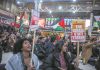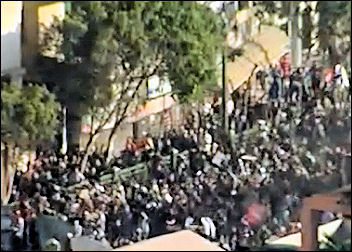
Egypt: protestors battle with Mubarak supporting state thugs for possession of the streets while the army watches
Workers and young people in Britain and across the world are watching events in Egypt closely. The revolt against mass unemployment, grinding poverty and corrupt dictatorship, which started last month in Tunisia, has now gripped Egypt – threatening the 30-year old repressive regime of president Hosni Mubarak. Big protests have also taken place in Jordan and Yemen and could spread across much of the Middle East.
Western governments try to distance themselves, seeing friendly regimes teetering on the brink – having propped up these rotten dictatorships and armed them to the teeth.
What hypocrisy to hear people like the US secretary of state Hillary Clinton calling on Mubarak to ’embrace democratic reforms’ when the US, along with the rest of Western imperialism, has for decades turned a blind eye to fraudulent elections and the torture of political opponents in Egypt, Tunisia, Jordan and elsewhere.
In contrast, socialists stand in solidarity with the courageous struggles of the workers and poor people throughout North Africa and urge them to overthrow, not only the dictators, but the system of capitalism which has exploited and oppressed them.
Enormous demonstrations have taken place this week in Cairo, Alexandria and other Egyptian cities, as protesters moved to finally force President Hosni Mubarak and his rotten regime from power.
The week-long continuous mass revolt has shut banks and businesses. Much of the economy has come to a halt.
At the time of writing there are reports of over one million assembling in Cairo in a show of strength against the regime. The protesters were bolstered by the statement by Egypt’s powerful army – the tenth largest in the world – saying that it will not use force against the protesters and that it regards their demands as “legitimate”. The statement was a huge blow for Mubarak, who relies heavily on the army.
The US distanced itself from its long-standing ally, calling for an “orderly transition” and “free and fair elections”.
A retired US ambassador to Egypt was quickly dispatched to Cairo by Washington to urge Mubarak’s regime to “embrace broad economic and political change”. He may well have privately ‘advised’ Mubarak to leave office and allow a new, military backed government to take over.
Mubarak desperately reshuffled his cabinet again on Monday 31 January to try to head off the protests. His new vice president Omar Suleiman said he will hold cross-party talks on “constitutional reform”. But for the masses, this was too little and too late.
As a young protester demanded: “We want Mubarak and his men to get out. Anything other than that is just not enough” (Guardian 01/02/11).
Egypt is at a decisive turning point. For over a week, mass protests have taken place on the streets of Cairo, Alexander, Suez and elsewhere, demanding an end to Hosni Mubarak’s 30-year presidency. The demonstrators are fighting for democratic rights, jobs, affordable food, and an end to corruption and state oppression. They shook the Mubarak regime to its core and caused huge alarm in Washington and Downing Street, which regard Egypt as a key regional ally.
The middle classes, students, workers, the urban poor and even judges all joined the tidal wave of opposition to dictatorship. For days, standing up to vicious brutality from the riot police and thuggish plain-clothes police, hundreds of thousands of Egyptians sent a clear message – “Go! Go! Go!” Older people passed down water from their flats to demonstrators in the streets below. In response, the hated riot police deployed tear gas, rubber bullets and live ammunition. At least 150 were killed and thousands injured.
In cities like Alexandria and Suez, the opposition movement reached insurrectionary proportions, with police and security forces retreating from parts of the cities.
There are elements of popular power and control in some areas of the country. The protesters instinctively fraternise with the rank and file soldiers. Yet, at the time of writing, Mubarak still clings to power. It is not excluded that a desperate Mubarak may still try to order a bloody crackdown, a last desperate throw of the dice, perhaps using his despised riot police and security police. But the consequences of doing so would be incalculable for Egypt and the region, provoking mass outrage and deep splits and even conflicts within the Egyptian state apparatus.
The statement by the army tops indicates they are trying to present themselves as ‘arbiters’ between Mubarak and the masses, to oversee an ‘orderly transition’, maintain the state machine, and ensure the continuation of the overall interests of the ruling class probably without Mubarak.
The rank and file of the army, who are largely conscripts with close ties to workers and the poor, can be decisively won over to the mass movement on a clear class and socialist programme. This would include the call for full trade union and other democratic rights, a living wage, the setting up of democratically run committees of rank and file soldiers and for the election of officers.
The masses are pushing to remove Mubarak and his cronies from power while the ruling elite is attempting to re-establish itself, probably around a new cobbled together ‘government’.
Cat and mouse
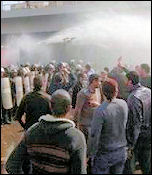
Egypt: riot police use watercannon
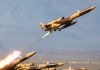
The regime tried to play ‘cat and mouse’ with the demonstrators, taking riot police and soldiers on and off the streets and ordering military jets to make intimidating displays above central Cairo. It may hope that such tactics will see the demonstrators become exhausted, lose momentum and start to fall away. Although this is a real danger in the absence of a powerful working class political alternative, to date the protests are getting much larger. The call for “millions strong” demonstrations and a general strike this week could have the potential to force not just Mubarak from office but other cronies of his as well.
The regime attempted to give out a message that if it falls, it will be followed by greater instability and chaos, to try to scare people back to tolerating its continued existence. In some areas, there has been an outbreak of looting and violent robbery. Dispossessed social layers could be involved but also, according to independent reports, so too are police in plain-clothes and convicts deliberately released from prison.
People have organised protection of their own homes and neighbourhoods, mainly in more wealthy areas, forming local groups to patrol streets and control traffic, armed with wooden clubs and knives.
In this situation, democratically elected committees of mass struggle and defence, against state repression and looting, need to be established, in all the neighbourhoods, workplaces, schools and colleges, and linked on local, regional and national scale.
The Mubarak regime has been the biggest recipient of US aid in the region, apart from Israel. This has gone to financing the monstrous security machine used against workers and youth for so long. Mubarak has been a slavish follower of US policy in the Middle East, including acting as prison guard over Palestinians in the Gaza Strip and as an ally against Iran. Washington fears a post-Mubarak Egypt could see US policy in the region unravel, with the coming to power of the Muslim Brotherhood or another regime not prepared to be as obsequious as the last one.
While the Western powers recognise that change is now unavoidable in Egypt, they are loath to see Mubarak removed by mass revolt, given the message it sends to the oppressed masses throughout the region. US Secretary of State Hillary Clinton, who described the Egyptian regime as “stable” just a few days ago, now calls for “an orderly transition” of power – meaning one which safeguards the interests of the Egyptian ruling class, as well as that of imperialism in the region.
Under the ‘guidance’ of Washington, a ‘provisional government’ could be thrown together, even including various leaders of small pro-capitalist opposition parties, none of which have mass support. Attempts could be made to keep Mubarak formally in power for some time, while real influence would reside with Suleiman or another leading figure from the regime. If Mubarak is forced out, Mohammed el-Baradei, a Nobel peace laureate and former head of the UN’s nuclear watchdog, or some other figure can be used to head a “transitional” but still pro-Western and pro-capitalist government.
Muslim Brotherhood
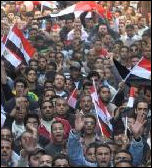
Egypt: masses arise
The largest opposition political force, the Muslim Brotherhood, held back from supporting the protests initially. “At first the movement showed little interest in the protests and announced they weren’t going to participate; later they were overtaken by events and forced to get involved or risk losing all credibility”, wrote Khalil al-Anani, an expert on Egypt’s political Islamists (Guardian, 01/02/11). Muslim Brotherhood leaders mandated el-Baradei to negotiate with the Mubarak regime and then to talk to the army about forming a “national salvation government”.
The fact that, so far, the mass movement is largely a “secular protest against dictatorship” (Guardian, 31/01/11) shows the potential for a non-sectarian, working class, socialist alternative, leading the oppressed. But this alternative on a mass basis needs to be built. In its absence, other forces, including the Muslim Brotherhood – which for all its rhetoric has a pro-capitalist agenda – and despite its limited popular support in recent mass protests, can start to make bigger gains, stepping into the political vacuum.
The mass movement has displayed features of popular revolt. In its first stages, following decades of dictatorship, the protests are understandably mainly centred on democratic demands and slogans. As yet, the working class has not decisively and clearly put its stamp on unfolding events. To do this fully requires a mass party of the working class, with an independent class and socialist programme.
Al Jazeera reported on 29 January that 1,700 public workers in Suez had gone on an indefinite strike demanding Mubarak’s ousting. Independent union leaders announced on 30 January the organisation of the new ‘Federation of Egyptian Trade Unions’, calling for the “formation of committees in all factories and enterprises to protect, defend them and to set a date for a general strike”. At this stage, however, the scale of the forces represented in these developments is not clear.
A general strike could unite all sections of the working and middle classes with the youth and the street protests. Such decisive action – paralysing the whole of the country, which could spell the end of Mubarak and his regime – requires planning and organisation, through democratically-run committees in the workplaces, colleges and elsewhere.
Removing Mubarak from power would be a huge step forward for Egyptian working people. But on its own it will not be enough to meet their class needs and aspirations for a better standard of living. A socialist programme of nationalisation of all the big corporations and banks under democratic workers’ control would lay the basis for planning the use of Egypt’s resources to meet the needs of all those who are denied a decent life under Mubarak’s corrupt and cruel regime.
The potential of a mass movement across the region that can win democratic rights and make sweeping social change is indicated by the fire that was lit by the Tunisian movement. Despots across North Africa and the Middle East are terrified of domestic mass protests and already demonstrations are taking place in Yemen, Sudan, Jordan, Syria, Libya and elsewhere.
One regime after another is forced to rush to make concessions to the stirring masses, particularly over high food prices. The repercussions of the “Tunis-ami” of popular mass struggle for real democratic rights and a transformation of living standards will continue for a long time.
We call for:
- Mass workers’ action, including a general strike, to overthrow Mubarak and the whole rotten, brutal regime
- Full democratic rights immediately, including the right to assemble, to strike and to organise democratic independent trade unions
- The creation of democratically elected committees of mass struggle and defence against state repression
- No trust in any new ‘national unity’ regime based on the interests of the ruling class and imperialism
- Immediate and free elections to a revolutionary democratic constituent assembly. For a majority workers’ and rural workers’ government
- A living minimum wage, guaranteed jobs, a massive programme of house building, education and health
- End the Egyptian blockade of Gaza. For self-determination for Palestine and for workers’ unity and mass action to overthrow dictators across the region
- Nationalisation of Egypt’s big corporations, the banks and large estates and their democratic planning to meet the needs of the masses not an elite
- A socialist Egypt and a socialist confederation of the region, on an equal and voluntary basis
See socialistworld.net for updates.