Ireland
Elections see collapse of Fianna Fail, the traditional establishment party
www.socialistworld.net, 01/03/2011, website of the committee for a workers’ international, CWI
Socialist Party wins two parliament seats
Kevin McLoughlin, Socialist Party (CWI Ireland), Dublin
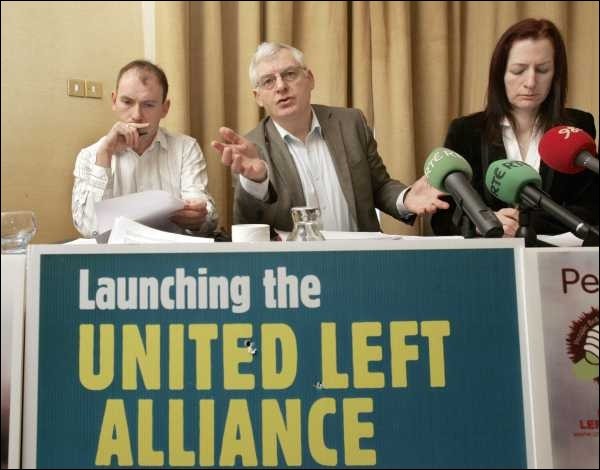
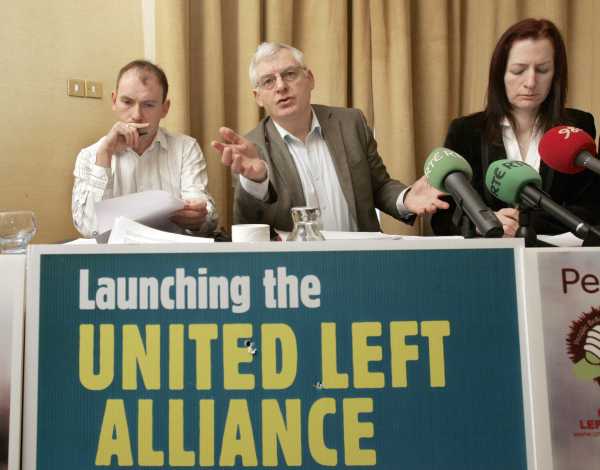
Joe Higgins and Clare Daly at the lauch of the United Left, photo by Socialist Party Ireland (Click to enlarge: opens in new window)
The general election in Ireland was historic but not for the reasons being stressed by the would-be new government partners of Fine Gael and Labour. It is that true both parties achieved unprecedented successes at the polls but these are pyrrhic and temporary victories.
The election was historic mainly because it saw the near collapse of Fianna Fail, the dominant party of the capitalist establishment in Ireland since the foundation of the state and one of the most successful capitalist parties in Europe over the last eighty years.
The election results are also extremely significant because it marked the emergence of the United Left Alliance, which won five seats.
The Socialist Party, who initiated the process that led to the formation of the United Left Alliance, got two TDs (members of the Dail – the Irish parliament) elected.
Clare Daly was elected for the first time to the Dail in the Dublin North constituency (with 7,513 first preference votes or 15.2%). Joe Higgins was returned to the Dail representing Dublin West (8,084 or 19%).
Both excellent results also represent the outlook of many working class people throughout the country, who see Socialist Party TDs as representatives of the working class generally not just for their particular constituencies.
In Cork North Central, Socialist Party candidate Mick Barry had an outstanding campaign, polling 4,803 (9.2%) first preference votes, nearly three times the vote he got in 2007.
This puts the Socialist Party in a very strong position to challenge for a Dail seat whenever the next general election takes place.
The party also has a very good platform to challenge in Dublin South West, where our candidate Mick Murphy got 2,461 votes or 5.25%. In the Dublin Mid West seat, Rob Connolly got 622 or 1.5%.
In Laois Offaly, Ray Fitzpatrick got 561 or 0.8%. In Dublin North East, Brian Greene got 869 or 2%.
Carlow Kilkenny saw Conor MacLiam get 1135 or 1.5% and finally in Limerick City, Socialist Party candidate Cian Prendiville got 721 or 1.7%.
We stood more candidates than ever before and in Dublin Mid West, Carlow Kilkenny, Laois Offaly and Limerick, our comrades where standing for the first time in a general election.
The support base of the Socialist Party has been strengthened in all of these areas as a result.
The United Left Alliance (ULA) is comprised of the Socialist Party, the People Before Profit Alliance, the Workers and Unemployed Action Group (Tipperary) and the independent socialist group in Sligo.
The three other ULA TDs elected were Joan Collins (PBPA) in Dublin South Central, with a first preference vote of 6,574 or 12.9%, Richard Boyd Barrett (PBPA/SWP), in Dun Laoghaire, with 6,206 or 10.95% and Seamus Healy (WUAG) with 8,818 or 21.3%.
The ULA stood in eleven of the twelve Dublin constituencies and got 38,808 first preference votes or 7.6% of the total vote in those constituencies.
Fianna Fail meltdown in the midst of crisis
This election took place in the context of a profound crisis in society and, in particular, was framed by the intervention of the EU/IMF, last year, and the austerity deal that the outgoing Fianna Fail and Green coalition government agreed with them, last November.
The collapse in the vote of Fianna Fail mirrors the collapse of the Irish economy and shows how much the authority and base of the capitalist establishment is being undermined.
In 2007, Fianna Fail got 41.5% of the vote and seventy eight seats.
In the 2011 elections counting is still to be fully concluded in three constituencies but it looks like Fianna Fail will this time get just 17% and possibly 20 seats, in total!
The hatred of the working class towards Fianna Fail could be felt on the door steps during the election campaign and, as expected, Fianna Fail was savaged on election day.
It is an incredible statistic but Fianna Fail now have just one seat in Dublin (they had 20 seats in 2007) compared to the Socialist Party’s two and the ULA’s total of four! Two years ago, the Socialist Party took Fianna Fail’s sole MEP seat in the capital, as well.
Fianna Fail now faces possible extinction in the cities and urban areas. The Greens were not spared either and went from six TDs to zero.
Official opposition parties get ‘loan’ of votes
The main beneficiaries in these elections were Fine Gael (36% up 8.8%), Labour (19.4% up 9.3%) and Sinn Fein (9.9% up 3%). Fine Gael will probably end up with 76 seats, Labour will have around 37 TDs and Sinn Fein 14 or so.
In the context of the swing to these “official” Dail opposition parties, the success of the Socialist Party and the ULA in getting 5 elected was very significant.
There are 166 TDs in total in the Dail, with 84 enough to make up a working majority. Fine Gael and Labour have been coalition partners on many occasions previously but have been out of office for the last 14 years.
It was always likely that they would form the new government but in the middle of the campaign they began attacking each other, to try to maximise their respective votes and therefore their respective strengths and influence in a future coalition government.
Labour said Fine Gael were intent on imposing vicious austerity and that people should vote for Labour to stop this and that they would be a restraining hand on Fine Gael in government.
The idea that Labour is anti-austerity is a cruel joke. However, Labour’s propaganda had a certain effect in pushing some people towards Labour in, hope against hope, that they might make a difference.
This put a certain squeeze on the Socialist Party and other left candidates.
Labour fails to fully seize opportunities due to shift to right
Compared to the 2007 election, Labour did well but in reality this election demonstrated their inability to seize the opportunities that were posed because of their support for the capitalist market and the EU/IMF bail-out.
Some opinion polls in the middle of 2010 put Labour ahead of the rest of the main parties, on more than 30%, and indicated that they could become the biggest party.
The main central poster that Labour produced at the start of the campaign declared “Gilmore for Taoiseach”, referring to their hope that their leader, Eamon Gilmore, could emerge as the new prime minister.
By the end of the campaign, however, these posters were a reminder of Labour’s failure to reach this goal.
The key turning point for Labour came quickly after the EU/IMF bail-out with their acceptance of the basic terms and parameters for the austerity outlined.
Since then, Labour’s polling declined steadily. They may have recovered marginally in the last couple of days of the campaign, on the basis of fears that Fine Gael could get an overall majority, but that was marginal – their bubble had burst.
What kind of new government?
Thirteen Independent TDs were elected, including a number who are rightwing. While there has been some media talk that Fine Gael could form a minority government with the support of some of these independents, such an administration would be unacceptably unstable from the point of view of the Irish capitalist class, who need a vicious programme of austerity implemented.
Fianna Fail is not an option as a coalition partner for Fine Gael, at this point, because they are so toxic, though that might be an arrangement that may be considered in the future.
The overwhelmingly likelihood is that Fine Gael and Labour will agree a programme for government in the next week or so. There may be some posturing on issues during negotiations between the two parties, with even banging of the table by Labour.
But, as a saying in Irish politics goes, “Labour wrestles with its conscience but Labour always wins”. Agreement between Fine Gael and Labour is likely because of pressure from the capitalist class and because the politicians in both parties want to be in power.
They will be an administration of austerity that will become unpopular quite quickly. Fianna Fail has desperately tried to claim that they could recover just as Fine Gael recovered from a terrible election result in 2002.
The continuing crisis is likely to put in tatters the base of support for both Fine Gael and Labour over the next months and years, just as it did to Fianna Fail and the Greens.
Economic crisis will worsen
The new government will have to go straight away to the EU/IMF to try to deliver a renegotiation of the terms and conditions of the EU/IMF deal. That is possible but certainly not guaranteed.
They may get some changes but they will not be able to overcome the economic crisis or the prospects of national bankruptcy.
Investment in the Irish economy dropped by 31%, last year. This type of collapse or strike of investment combined with the draconian austerity programme due over the next four years, are likely to create a deflationary spiral that will puncture any chance of paying back the enormous debts that have been placed around necks of Irish people. Bankruptcy beckons!
A Fine Gael and Labour government may have a huge majority but it will not be stable because of the severity of the economic crisis and because of the effects that the austerity is and will have in destroying people’s living standards and lives.
According to the Memorandum of Understanding on the EU/IMF deal, on top of the €6 billion in cuts, in the first year these institutions want, amongst other things, a review (cuts) of pay agreements covering the private sector; a review (cuts) in social welfare/unemployment payments; a ‘Home Tax’; cuts in employment and pensions in the public service and the preparation for Water Charges (a tax).
The basis is being created for a massive revolt.
The campaign
Standing in nine areas, with limited resources, meant that the Socialist Party election campaigns had different levels of intensity. In the priority areas of Dublin North, Dublin West and Cork North Central, the party went all-out, while the campaigns in the other areas were more limited.
However mass postering, leafleting and canvassing were a feature of all our campaigns.
In our election priority areas, we did a full door to door canvass of all homes in the constituencies, including some ‘double canvassing’. We supplemented the initial mass postering of constituencies with additional billboard posters, and posters with slogans and points addressing the key issues that came up on the doorsteps.
In the key areas for the party, houses had three different leaflets delivered: an initial Socialist Party leaflet outlining the basis of our challenge in the election, our four page manifesto and then final leaflets that addressed key local issues and, in particular, the false claims that Labour would fight against austerity in the next government, an issue that came up on doorsteps.
We found a mixture of responses on the doorsteps. The anger at Fianna Fail was tangible.
The support for our position in the traditional working class districts was strong. In other areas, many people agreed with our analysis of the situation in Ireland and what should be done but they were also hesitant about committing their vote.
The establishment and the media successfully injected fear about the consequences of not paying the bankers and big property builders’ debts. They claimed that the financial system and all credit lines would cease to operate and that there would be dis-investment from the Irish economy.
This had a certain effect in pushing some people behind Fine Gael but also some behind Labour, placing a bit of a squeeze on people who were previously inclined to vote for the Socialist Party or other genuine left candidates.
Dealing with this pressure from Labour was an important issue in the closing stages of our election campaign.
Within the United Left Alliance there are some differences regarding how to respond to Labour, mainly between the Socialist Party and the SWP. It was reported by an Irish Independent journalist who was out on the hustings with Richard Boyd Barrett that the candidate responded to some voters who said they were voting Labour by indicating that he was giving his second preference to the Labour Party, with whom he was involved in a life and death battle for the last seat in Dun Laoghaire.
Such an approach only serves to legitimise people voting Labour and re-enforces illusions that may exist in Labour instead of cutting across them.
In our final election leaflets, we took up sharply Labour and the role they would play. In Dublin West, we produced an additional poster that went up three days before polling, which said: “Like Fine Gael, Labour accepts IMF Austerity – CUTS WILL DESTROY LIVING STANDARDS & JOBS”.
We believe this approach, clearly showing the nature of Labour, helped us resist pressure from Labour and actually won support from Labour voters, as well.
Building the opposition and an alternative – Sinn Fein or a socialist United Left Alliance?
Sinn Fein may have just increased their share of the vote by 3% but they trebled their number of seats from 4, in 2007, to 14 in 2011. The momentum behind Sinn Fein particularly developed when their representative, Pearse Doherty, won a court case that forced the government to hold an outstanding by-election, in Donegal, in the latter party of 2010.
Doherty won the resulting by-election and then Sinn Fein’s five TDs opposed the EU/IMF intervention and austerity deal and used the Dail platform to skillfully oppose the last government’s budget in early December.
It was clear that Sinn Fein were going to increase their number of TDs. This meant that Sinn Fein claims that they would be an opposition in the new Dail had credibility, which further added to their polling momentum.
The Socialist Party/ULA had a more difficult task. We were saying that if people elected us, we would be a fighting opposition and an alternative.
We argued for a real alternative, that there was no solution based on the capitalist market, and outlined the need for democratic public ownership of the economy and socialist policies and planning.
The launching the ULA, in advance of the general election, was crucial. The profile it developed, and now the election of 5 ULA TDs, means that the opposition that will develop to the new government’s austerity policies can have a genuine left and working class reflection.
The ULA has now as many TDs as did Sinn Fein when it went into the election. Clearly Sinn Fein is set to increase its support but the superficiality of its opposition to austerity measures will cut across its potential.
In the North of Ireland, Sinn Fein is part of the governing Assembly Executive and has accepted cuts and is implementing them, as opposed to fighting the attacks from the Tory/Liberal Westminster government.
In the South, Sinn Fein supported cuts in local councils. Such an approach will be a drag on Sinn Fein’s potential.
Crucially if the ULA fights on the key issues facing working people, and if it advocates a distinct left and socialist programme, it can offer a clearer way forward and could become the key force to represent the anger and radicalisation that will grip Irish society in the months and years ahead.
Explosive potential is built into the situation for the ULA but particularly for the Socialist Party, which is a fighting, socialist alternative to the unprecedented crisis of Irish capitalism.