Suez 1956:
When British imperialism hit the rocks
ON 5 November 1956 British and French paratroops occupied Egypt’s Port Said at the entrance to the Suez Canal.
Two months earlier Egypt’s president, Colonel Nasser, announced to a massive cheering crowd in Cairo: “We shall all defend our freedom and Arabism. I announce the nationalisation of the Suez Canal.”
Having Egypt’s request for a loan to finance the building of the Aswan dam hydro-electric project blocked by Britain, France and the US, Nasser declared he would use the $100 million revenues collected by the Suez Canal Company to finance the project.
The nationalisation measure incensed British and French imperialism. Nasser now had control of a strategic waterway through which Arabian oil supplies were shipped to the West. Moreover, he was winning support from the region’s exploited workers and peasants. Their movements threatened to topple the stooge, oil-rich, feudal dictatorships of the Middle-East.
After 1945, workers and peasants throughout the colonial world intensified their anti-imperialist struggles in order to achieve national and social liberation. The days of direct rule by the old colonial powers were numbered.
British PM Anthony Eden, bolstered by his Tory backwoodsmen, hankered to restore the fortunes of the British empire. Despite the accelerated economic and political decline of British imperialism as a consequence of World War Two, Eden believed that Britain could play a pivotal role in world affairs. Similarly, the French ruling class believed in resurrecting France’s former imperial glory. Yet for all their brutality employed in fighting colonial wars, French imperialism received a mauling in Vietnam and Algeria, forcing a withdrawal from these countries.
Western reaction
“WE SHALL build the dam on the skulls of the 120,000 Egyptian workmen who died to build the Canal.” For the working class and unemployed dwellers in the slums of Cairo and Alexandria and for Arabs throughout the Middle-East, Nasser’s proclamation was an electrifying rallying call.
The response in the West was predictably frenzied. Both British and French parliaments likened Nasser’s actions to those of Mussolini and Hitler! The capitalist press and the Tory MPs’ chorus of ‘Nasser-Hitler’ was joined by Labour and Liberal MPs who urged Eden to take punitive measures against Egypt. Eden duly obliged by freezing the assets from the Suez Canal held in British banks. These sterling deposits amounted to two-thirds of the Canal’s revenues.
Labour leader Hugh Gaitskell, while encouraging the Tories to refer the matter to the forum of the United Nations, was careful not to rule out the use of armed force against Nasser. The French PM Guy Mollet promised to “launch a severe counter-strike.”
Overtly, the British government attempted to resolve the crisis diplomatically. They convened a conference of 24 maritime countries in London against the ‘threat to the free movement of international shipping’. Less publicised was the call-up of armed forces reservists and the assembling of a huge naval task force.
Nasser’s response was to call for an international strike of solidarity to coincide with the conference. On 16 August massive strikes gripped Libya, Egypt, Syria, Jordan and Lebanon with smaller actions in Sudan, Iraq, Tunisia and Morocco. Everywhere riots and demonstrations were directed at British and French embassies.
Conspiracy
AMERICAN PRESIDENT Eisenhower was in the middle of a presidential election campaign and would not support an Anglo-French military response. Moreover, US imperialism was locked into an intense rivalry with Britain and France for influence in the Middle East.
The cover for the invasion of Egypt was an Israeli invasion of the Sinai. The British and French forces would then intervene to separate the Israeli and Egyptian armies in order to protect international shipping through the Canal.
Representatives of the Israeli, French and British governments secretly met on 24 October at Sevres near Paris to sign a pact. Sir Anthony Nutting, a Foreign Office minister at the time of the Suez crisis, describes the British government action as “a sordid conspiracy in collusion with France and Israel.”
Using the pretext of cross-border Palestinian raids and the blocking of the port of Eilat by the Egyptians, Israel invaded on 29 October. The next day Britain and France issued a joint ultimatum to Israel and Egypt to withdraw ten miles on each side of the Canal. This was when the main Israeli force was still 100 miles and six days’ fighting from their ceasefire line!
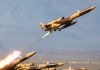
As expected, the Egyptians refused the ultimatum and Israel accepted. British and French forces then pounded Egypt’s airfields followed by an invasion of the Canal Zone on 5 November. 1,000 Egyptians, overwhelmingly civilians, were killed in the storming of Port Said.
Defeat
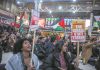
IN BRITAIN the labour movement mobilised opposition to the invasion by staging a huge demonstration and rally in Trafalgar Square. Demonstrators attempting to march on Downing Street clashed with police.
Fortuitously for Eden, a workers’ uprising in Hungary against the Stalinist dictatorship was being crushed by Soviet tanks on the very day that Egypt was being blitzed. Nevertheless, the Tory government was becoming increasingly isolated.
Internationally there were huge repercussions. Most Arab states broke off diplomatic ties with Britain and France. The British-owned oil pipeline across Syria was blown up. Saudi Arabia blocked oil exports to Britain. The US demanded a complete withdrawal from Egypt. The Soviet Union threatened retaliation.
British imperialism’s economic and political weakness was exposed. The Canal was blocked with sunken ships. Within weeks there was petrol rationing. The US refused to provide a loan and blocked Britain’s application to the International Monetary Fund for a loan. The pound plummeted. Foreign currency reserves were rapidly exhausting.
After six weeks British and French forces started withdrawing. The Israelis too were forced out.
Nasser paraded as a victor who had humbled the imperialists. Eden, by now a politically and physically broken man, was forced to resign.
Following the Suez debacle, the Arab revolution was given a new impetus almost in direct proportion to the collapse of British imperialism’s influence.
Dave Carr
Imperialism
IMPERIALISM WAS defined by the Russian revolutionary Lenin as the ‘highest or monopoly stage of capitalism’.
In the 19th century large commercial companies based in Europe and North America exported capital abroad to exploit fresh reserves of cheap labour, raw materials and new markets in the Middle East, Africa, Asia and Latin America.
To secure their investments and profits the western powers militarily occupied and politically controlled these new colonies.
In the late 19th century the European powers embarked on a scramble for African colonies. This intense rivalry led, eventually, to the outbreak of world war one.
After world war two the mass of urban and rural poor fought the colonial powers to gain independence. In some instances this led to the overthrow of the local capitalist class and to alliances with the Soviet Union.
Although forced to relinquish direct rule, imperialism could continue to control the fortunes of the ex-colonies through its domination of world markets; a situation known as ‘neo-colonialism’ and symbolised today by powerful multinational corporations such as ExxonMobil, Coca-Cola, Ford, etc.
‘Nasserism’
NASSER CAME to power in an army coup which overthrew the wealthy and corrupt King Farouk in 1952. Farouk was a puppet of the West and in particular of British imperialism.
At the time, 6% of Egyptian landowners owned 65% of arable land. 72% of the population eked out an existence with just 13% of the land. Millions were landless and unemployed, forced to live in the teeming slums of Cairo and Alexandria. Land occupations and strikes were developing but there was no working-class force to lead the urban and rural poor to power. Into the political vacuum stepped Colonel Nasser.
He introduced limited land reforms but didn’t overthrow capitalism. He wooed the workers with socialist rhetoric but arrested and shot strike leaders. He preferred help from the Western powers but leaned toward the Soviet bureaucracy as a counter-weight to imperialism. This balancing act both at home and abroad cast him in the role of a Bonaparte-like dictator.