

Obama takes power: What change will the Democrats bring?
 |
|
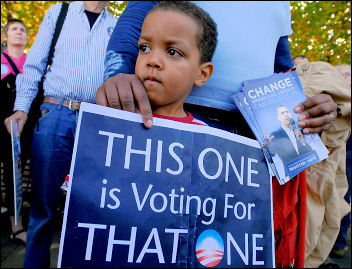
US president Barack Obama supporters, photo Paul Mattsson |
OBAMA’S VICTORY in the 2008 election was historic. It signified a clear rejection of the Bush administration and its war on Iraq and ultra-free market policies. Voters also made history by electing the first black president in a country that was built on slavery and racism.
Ramy Khalil, Socialist Alternative, USA
The Obama campaign mobilised a tremendous amount of support, particularly among young people and African Americans, and aroused massive hopes that change is coming to America.
For the first time since 1994, the Democrats control the White House and both houses of Congress. They won 256 out of the 435 seats in the House of Representatives (59%), and they almost have a filibuster-proof majority in the Senate.
Meanwhile, the Republicans’ defeat has sent their party into a crisis. Party leaders have been quarrelling about how to modify their politics to try to regain public support.
Obama is taking power with 65% of the public expressing confidence in his leadership, according to a January Gallup poll. Against the background of the hated Bush regime, Obama will undoubtedly enjoy a ‘honeymoon’, potentially for an extended period.
At the same time, though, Obama and the Democrats are immediately being put to the test by an incredible array of enormous challenges. Obama is facing the worst economic crisis since the 1930s Great Depression, a federal budget deficit of $1.2 trillion, wars in Iraq, Afghanistan and the Gaza strip, and a global warming catastrophe.
When Obama takes office, he will chart a different course than Bush. He’ll probably begin withdrawing troops from Iraq (while sending more troops to Afghanistan) and attempt to enact a major economic recovery plan. But after these initial measures, what key domestic and foreign policies will Obama and the Democrats pursue?
Obama’s administration
The people Obama has chosen to lead his administration speak volumes about Obama’s plans. Although anti-war voters propelled him to victory, Obama has selected a hawkish foreign policy team that even includes figures from the Bush administration. Obama is keeping on Bush’s defence secretary, Robert Gates, even though Gates is the man responsible for overseeing the troop surge in Iraq.
Obama selected retired marine general and former Nato commander James Jones to be his national security adviser even though Jones is currently a US Chamber of Commerce executive who backed John McCain for president.
And Obama selected Hillary Clinton as his secretary of state even though voters supported Obama in the Democratic primaries in large part because Obama counter-posed his opposition to the Iraq war to Clinton’s support for the war. To this day Clinton has refused to apologise for voting for the criminal invasion of Iraq.
It’s extremely revealing that the outgoing vice president Dick Cheney praised Obama’s foreign policy team, saying: “I must say, I think it’s a pretty good team… I’m not close to Barack Obama, obviously, nor do I identify with him politically. He’s a liberal. I’m a conservative. But I think the idea of keeping Gates at defence is excellent. I think Jim Jones will be very, very effective as the national security adviser… I would not have hired [Hillary Clinton, but], I think she’s tough. She’s smart, she works very hard, and she may turn out to be just what President Obama needs.”
Another very disturbing selection was Obama’s choice of Rick Warren to deliver the invocation at his inauguration. Warren is a far right-wing pastor well known for comparing abortion to the Holocaust and gay marriage to paedophilia and incest.
Obama threw the labour movement a bone by selecting Hilda Solis as his labour secretary, but he also upset workers and environmentalists by nominating Ron Kirk as the US trade representative. Corporate America, in contrast, was delighted with Kirk, an outspoken free trade advocate.
The fact that Obama’s chief of staff, his White House counsel, and his economics, energy and environmental advisers all served in Bill Clinton’s administration clearly shows that Obama’s administration will be part and parcel of the corporate political establishment. “Most members of [Obama’s] economic team are veterans of the Clinton administration who tilt towards Wall Street. In the Clinton era, financial issues routinely trumped labour concerns” (New York Times, 28/12/08).
Obama has clearly assembled an establishment administration that will act in the interests of the business elite, both at home and abroad. However, the underlying economic and political situation has drastically changed from what Bill Clinton faced in the 1990s.
 |
|
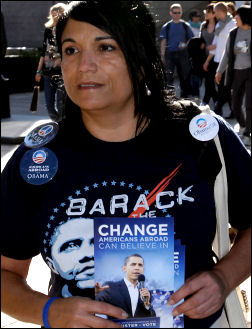
US president Barack Obama supporter, photo Paul Mattsson |
Unlike Clinton and all major governments in the past 30 years who aggressively pursued extreme neo-liberal free-market policies, the deep economic crisis has compelled the ruling class to sharply change their course toward massive state intervention in the economy to shore up the capitalist system.
As hard-working people have lost their jobs and homes, they’ve grown furious at Wall Street executives who fabulously enriched themselves from reckless investments and taxpayer bailouts.
Key sections of the ruling class have recently shifted away from discredited free-market policies toward Keynesian policies that regulate corporations in an attempt to avoid an even worse economic and political crisis.
Obama is responding to these pressures by enacting starkly different policies than Clinton’s and Bush’s free-market policies, but for the same purpose – to further the interests of the profit-driven capitalist system.
Even Bush was recently forced to toss aside his free-market ideology and nationalise or partially nationalise failing banks and financial institutions to save the economy from the brink of collapse. Obama, too, is being forced to intervene to save major sections of the economy, such as the auto industry.
Recovery plan
Obama plans to spend $775 billion to $1 trillion over two years to create or save 3-4 million jobs through public works programmes, green energy technology, aid to states, expanding the length of unemployment compensation, food aid, and other initiatives.
However, 2.6 million jobs were lost in 2008, and some economists estimate another four million might be lost in 2009. So the number of jobs lost from the recession could still end up being twice the number of jobs that Obama creates.
This exemplifies how Obama’s reforms will be designed primarily to stimulate the capitalist economy rather than protecting workers and their families. Obama’s policies will not adequately address the problems workers and young people are facing.
His stimulus package may well soften the blow of the recession, but it won’t be able to prevent the deepest downturn since the 1930s and a sharp fall in the living standards of workers and even sections of the middle class.
 |
|
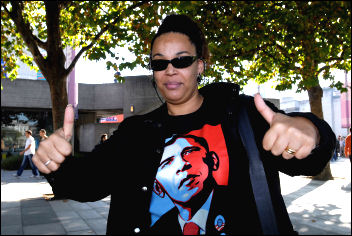
US president Barack Obama supporter, photo Paul Mattsson |
Obama revealed his priorities when he recently announced that, under the cover of the need to deal with the economic crisis, he would put off his more left-wing campaign pledges such as “renegotiating the North American Free Trade Agreement overhauling immigration laws, restricting carbon emissions, raising taxes on the wealthy,… allowing gay men and lesbians to serve openly in the military… [and passing the Employee Free Choice Act] to make it easier for workers to form unions” (New York Times, 11/01/09).
On the issue of tackling racism, while it is certainly an important step forward to have a black president, Obama has not indicated that he is going to do much concretely to improve the worst paying jobs and living conditions that most blacks and people of colour face.
On foreign policy, US imperialist strategists are desperately searching for a way to extract themselves from the untenable, disastrous occupation of Iraq. Reflecting this, Obama is planning to withdraw some US troops, but he still plans to leave 60,000-80,000 troops, military bases, and approximately 140,000 ‘contractors’, many of whom are in reality soldiers hired by private US corporations.
However, he may not even be able to successfully carry out these limited aims given the difficulties US imperialism will encounter in Iraq. A reduction in the US troop levels threatens to trigger an increase in violence and instability in Iraq which could lead to a wider regional war, which the ruling class is desperate to avoid.
Another reason Obama plans to withdraw troops from Iraq is to free up 20,000-30,000 troops to send into the worsening occupation of Afghanistan, practically doubling the US troop presence there.
However, escalating the war in Afghanistan will only plunge the US deeper into a quagmire. Even General Petraeus, director of the troop surge in Iraq, admits that the Afghan insurgency is far more complex and difficult than Iraq’s.
Struggles on the horizon
Compared to Bush’s obviously disastrous policies, Obama will feel like a refreshing breath of fresh air to most people. Obama will be a more intelligent and flexible representative of US capitalism than Bush. For these reasons, Obama will enjoy popular support for a time.
It will take time and experience for wider layers of workers and young people to realise that the Democrats’ reforms are designed primarily to benefit US capitalism and restore faith in the political system, while benefits to working-class communities and the environment will only be of secondary concern.
However, as economic conditions worsen and the volatile occupations of Iraq and Afghanistan unravel, more and more workers and youth will realise that Obama and the Democratic Party are thoroughly tied to corporate interests. They will be compelled to move into struggle to defend their living standards, the environment, and their rights.
The fact that Obama has aroused expectations has already emboldened an important layer of people to get politically active to ensure that their hopes are realised.
In the coming period workers and young people will increasingly draw the conclusion that we need to build our own mass movements – and our own independent party that is prepared to take on Corporate America – to bring about real change. Don’t balance your budget on our backs!
Don’t balance your budget on our backs!
 |
|
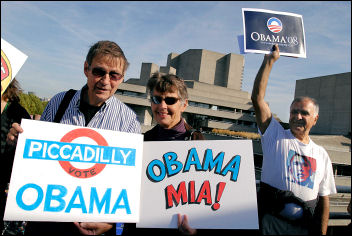
US president Barack Obama supporters, photo Paul Mattsson |
EDUCATION SPENDING in the US is lined up to take a major hit amidst the worst economic crisis since the 1930s. With tax collections declining, local and state budgets are coming up short across the country and more than 40 states are predicting deficits.
Patrick Ayers, Socialist Alternative, USA
The Centre on Budget and Policy Priorities predicts the combined shortfall for all 50 states could total upwards of $350 billion over the next two-and-a-half years, an enormous amount. Federal policy dictates that states have balanced budgets, and education accounts for 46% of all state spending. So you can bet politicians are rehearsing their upcoming apologies for deep, painful cutbacks for schools.
Already, 27 states have announced education cuts. In California, a state that teeters on the edge of bankruptcy, Governor Schwarzenegger has slashed $2.5 billion for K-12 education [the first through to the last grades of free education]. New York is gutting $2.5 billion from public universities and colleges.
State leaders warn they have no choice. But cuts are not the only option. Rather, cuts are the policy demanded by big business. Over recent years, big business has fought for tax breaks and bailouts, inevitably paid for with cuts elsewhere, like in education.
Who pays?
These cuts will hit communities, teachers, and students hard. According to the American Association of School Administrators, nearly half of superintendents across the country are cutting back on hiring, while 20% have issued layoffs and another 31% have considered them (USA Today, 11/11/08).
Local K-12 education could get hit twice, from cuts in state aid and also from declining local property taxes. These schools face larger class sizes, fewer resources, and cuts in programmes like free breakfasts and sports. Schools in poorer districts inevitably suffer more.
Twenty-four states have announced cuts in higher education. Over the past several years, regular cutbacks have contributed heavily to the skyrocketing costs of tuition and fees, up 439% since 1987 according to the National Centre for Public Policy and Higher Education.
Cuts at community colleges are particularly harsh when many people face uncertainty over rising unemployment. These schools traditionally see an increase in enrolment during economic downturns as workers seek job-training programmes. Sixteen states reported that their community colleges lacked resources to satisfy rising enrolments in 2007, before these latest cuts (Newsweek.com, 15/12/08).
Alternatives to cuts
Instead of cuts or tax increases on working people, shortfalls for education should be made up with taxes on the richest corporations and individuals. Working-class communities cannot afford cuts, but the rich can afford to pay more taxes for education. We could start by reversing tax breaks for corporations and Bush’s tax cuts for the wealthy.
More immediately, the federal government should provide a full bailout for all education needs. Washington is certainly responsible for this crisis when they are spending trillions of dollars on the Iraq war and Wall Street.
If students, teachers, parents, and staff are firmly united, organised, and mobilised to win widespread public support, these cuts can be defeated. It’s important that we absolutely reject any notion that we must be ‘realistic’ and accept ‘some’ cuts. The moment we agree with this, we will be forced to compete with each other for crumbs. Instead, we must absolutely support each other’s demands. No cuts! No layoffs! No tuition hikes! Full funding for all education needs!
Ultimately, defeating the cuts means organising a massive grassroots movement in every school and community using demonstrations, rallies, walkouts, and strikes to make the politicians feel the pressure and power of our numbers. Above all, it will take widespread determination to yield not one inch to cuts.
Teachers’ and staff workers’ unions must use their enormous resources to help give a bold lead to organising massive, powerful actions at local, state-wide, and national levels. Rank-and-file union members and students should campaign for the unions to take up fighting policies against cuts if they haven’t already.
We need to fight these attacks. But this will not be the last time we will need to campaign against cuts. US capitalism is facing its worst crisis since the 1930s. As the recession deepens, as is expected, we need to be prepared for even deeper cuts.
Ultimately, this means we need to build a movement that goes beyond this momentary budget crisis and aims to end cuts once and for all by getting to the root of the problem – the very nature of this class system.
