Has globalisation gone into reverse?
Capitalist bailouts or socialist nationalisation?
 |
|
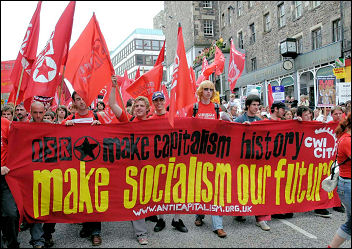
The Committee for a Workers International protesting at the G8 summit 2005, photo Paul Mattsson |
As the world credit crunch and financial crisis spread to the real economy, government leaders gathered at a G-20 summit, last November, agreed not to raise barriers to trade and investment and not to go down the road of ‘beggar thy neighbour’ protectionism. Yet within hours of these solemn pledges, Russia announced planned increases in car tariffs, followed by similar actions by Vietnam, Russia and Brazil and several other G-20 countries.
Niall Mulholland
These developments caused the Economist to declare “globalisation is suffering its biggest reversal in the modern era” and to warn that “economic nationalism” is threatening the world with depression (The Economist, 7/02/09).
Indeed, most countries that are carrying out fiscal stimulus packages include “trade distorting subsidies” for exporters. The original “Buy American” clause to the near $800 billion US stimulus package provoked EU fury and the threat of economic reprisals.
The EU states themselves are carrying out “inherently protectionist” national stimulus plans, conceded Peer Steinbruck, the German finance minister. The EU commission warned its 27 member states that the single market could “disintegrate amid financial protectionism.”
Global trade is shrinking dramatically and conservatively expected to contract by 3% over the next one to two years – the first annual decline since the 1970s.
A February Reuters poll of economists from around the world predicted the credit crunch would last another 6-12 months and that recession was “tightening its grip on the world economy”.
This sees the reverse of the decades-long push for greater global integration-hastened by enormous advances in communications and transportation technology- aimed to vastly increase the profits and markets of the big corporations at the expense of labour standards and the environment.
The policy of untrammeled ‘free markets’ and ‘free trade’ meant the imposition of ‘neo-liberalism’ – an assault on the living and working conditions of working people. This led to greater inequalities, including in the ‘rich’ capitalist West, and catastrophe for millions of people in Asia, Latin America and Africa. By 2007, globalisation meant 500 multinational companies dominated the globe, controlling 70% of world production.
IMF and the World Bank imposed “restructuring” policies led to the destruction of local industries in the poorest parts of the world. Between 1970 and 1998, poverty in Africa rose from 11% to a staggering 66%.
Boom and slump
For the last 30 years, globalisation and neo-liberalism were promoted as the only way forward for society by the defenders of capitalism. But this is not the first time history has seen phases of ‘globalisation’ and all the illusions in the market system that go with it.
Karl Marx described how capitalism created the modern national state and the world market, “with gore from top to toe and oozing blood from every pore”. Capitalism arose historically through the private ownership of the means of production, by the development of industry and by sweeping away feudal restrictions and barriers to its development. But once having accomplished this historic task, capitalism became a fetter on the development of production. The national state and private ownership of the means of production hamper the development of society.
A period of big expansions in world trade and investment – often referred to as the “first globalisation” – occurred in the last quarter of the 19th century. But the growing contradictions of world capitalism led to a breakdown of the economic system and the carnage of World War One.
Capitalism broke at its “weakest link” in Russia, and was swept away, along with landlordism, by the October 1917 socialist revolution. Inspired, European workers rose up in revolt, but the immaturity of the new communist parties and the pernicious role of the social democratic parties allowed capitalism to survive and find a breathing space.
Great Depression
During the interwar years, European capitalism remained stagnant while US capitalism grew at the ‘Old Powers’ expense. With echoes of the today’s boom and bust cycle, the US in the 1920s saw economic fireworks, with shares growing 15 fold, and a huge extension of credit and consumer spending.
However, the 1929 stock market crash led to the collapse of 20% of US banks and millions of workers and the middle class people losing their homes and jobs. The contradictions in the world economy led to the 1930s Great Depression and its horrific consequences – mass unemployment, fascism and world war.
Revolutionary waves shook Europe at the end of the war but the weakness of a genuine socialist leadership meant that capitalism stabilised and the political ground was prepared for the long 1950-1975 post-war economic upswing.
The boom years ended with the oil shocks of the early 1970s and the discrediting of Keynesian policies, which were meant to overcome boom and bust by state intervention and stimulating the economy.
Ruling class warriors like Margaret Thatcher and Ronald Regan unleashed ‘monetarism’ against the working class. This proscribed that the market ‘is always right’, resulting in wage and social spending cuts and mass joblessness. This reactionary policy mutated into ‘globalisation’ and ‘neo-liberalism’, particularly after the fall of the Berlin Wall.
It found widespread ideological expression in such reactionary and completely wrong notions as Francis Fukuyama’s End of History, which, in 1989, announced the “end of mankind’s ideological evolution.” Shamefully, the bosses’ agenda was aided by the sell-out of social democratic leaders to the market ‘god’ and by the conciliatory and often outright capitulation of union leaders.
The boom saw unparalleled speculation and profit-making. Each financial crisis was administered with a medicine of lowering of interest rates and a big increase of credit. Cheap labour from China, India, Eastern Europe and other areas was incorporated into the global economy.
This boom was able to proceed for some time, helped by with all sorts of ‘magical’ financial instruments to create super-bonanzas for the rich. The myth took hold that somehow capitalism could continue to grow indefinitely and the ‘boom and bust’ cycle was gone forever.
Ultimately, however, “capitalism does live by crises and booms, just as human beings live by inhaling and exhaling” as Leon Trotsky pointed out.
The US ‘sub-prime mortgage’ crisis was met with a new bout of massive liquidity into the financial system but the crisis worsened as banks stopped lending to each other. As the financial crisis “went global” at the end of 2008, large parts of the world economy went into “free fall”. All the supposed ‘truth’ and ‘certainty’ of globalisation and capitalism was shattered.
Decades of unprecedented capitalist globalisation means that all parts of the world economy – the US, Europe, Russia, Asia and Latin America -are caught up in the economic conflagration. The credit crunch has been aggravated by a severe “manufacturing crunch”. Industrial production in the US is down 10% year-on-year in January and car production is 50% lower than a year ago.
China, Japan and Germany are suffering badly because they cannot export in a world economy in which demand has collapsed. The eurozone recorded its worst ever manufacturing and services levels in January. Central and Eastern Europen countries face collapsing economies now that their brief “stag party” of credit growth and Western capital inflows has reversed sharply.
Falling oil prices are hammering Russia. Economists at JP Morgan estimated global manufacturing production will have fallen by an annualised rate of almost 20% in the last three months of 2008. Global trade flows, which grew faster than output for decades, are shifting into reverse.
Just as during the 1930s Great Depression and 1980s recession, slowing exports and national debt lead countries to pursue protectionist policies. Protectionism – the restraint of trade between nations, through methods such as tariffs (taxes) on imported goods, restrictive quotas (trade restrictions) and a variety of other restrictive government regulations – is on the rise, in open and disguised forms. This process will, in turn, worsen the decline in world trade and manufacturing output and will means more job losses.
As well as rising import tariffs, ‘economic nationalism’ sees fiscal stimulus packages in countries like the US, Spain and France, encourage spending on domestically produced goods. ‘Financial protectionism’ sees countries bailing out domestic banks over foreign ones.
Protectionism
Another protectionist measure, currency devaluation – using weak currencies to support exports – is being undertaken by many countries. A sharp rebuke by the US Treasury of alleged currency manipulation by China raised concerns of an emerging US/China trade war engulfing the entire globe.
The capitalist classes everywhere are desperate, of course, to prevent a steep world economic recession becoming a depression.
They fear protectionist measures – the “absolute evil”, according to Japan’s finance minister – can provoke retaliatory measures by other countries to protect their domestic jobs and markets, which can spiral out of control into trade wars and a worldwide slump.
But will the enormous fiscal stimulus spending funneled into national economies – China’s $585 billion package or Obama’s $787 billion fiscal stimulus – have a major impact on the world economy?
At best, they can limit the depth of the economic downturn and have a cushioning and relieving effect. But these desperate adrenalin boosts to seriously ailing economies will not in and of themselves turn the situation around and trigger growth in global trade and investment.
For good reason, Japan is the nightmare scenario for the ruling classes. In the 1990s, the second largest economy faced a deep and prolonged recession after the collapse of its property bubble. The government introduced a series of massive stimulus packages, which may have prevented an even worse downturn. But Japan did not revive again until a few years ago, and was aided by boom in the West.
A highly export-dependent nation, Japan has now fallen into severe recession, with the equivalent of a 13% drop in gross domestic product over a 12 month period. January exports were 46% lower than a year ago. “It means depression”, concluded Larry Elliot (Guardian 26/02/09).
The problem is the depth and scale of the crisis of the real economy, which is still in a downward spiral. Wall Street expressed pessimism about the US Treasury’s $2 trillion capital injection into US banks and $275 billion aid for house owners as too little while markets continue to implode, workers are reluctant to spend while fearing job and home losses, and banks record big losses.
Nevertheless, today’s born-again Keynesians argue to kick-start the economy by creating market demand. Of course, the global economic downturn expresses itself in a slump in trade and investment and in the rapid contraction of credit. However, these are not the causes of the crisis, but the most visible symptoms.
Karl Marx
 |
|
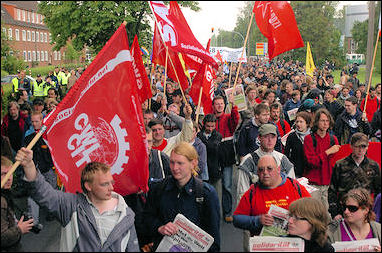
G8 demonstration in Rostock, Germany, photo SAV |
Not so long ago Karl Marx’s ideas were derided by most economists, but his writings brilliantly illuminate the reasons for today’s global crisis of capitalism. Marxism explains that the source of surplus value, or profit, comes from the unpaid labour of the working class.
However, workers’ demand for consumer goods is based on the level of their wages. As workers (the majority of consumers) are only paid for a portion of the wealth they produce, they cannot buy back all the commodities on the market. Ultimately, “the last cause of all real crises always remains the poverty and restricted consumption of the masses,” Marx wrote.
In the last two decades or so, capitalism was able to boost profits through increased workplace exploitation and unprecedented massive borrowing, lending and speculative bubbles. Added to this was the new pool of cheap labour provided by China/Asia, Eastern Europe and other areas.
Yet the globalisation of production only created the conditions for an even worse recession. Markets eventually become saturated and blighted by a crisis of overproduction.
Now the world economy faces steep decline, made worse by the lack of credit. The system’s contradictions have sharpened, along with the class struggle. Millions of workers face sackings, wage cuts, short-time working and home repossessions. To overcome the crisis of overproduction, the bosses throw millions of workers onto the scrapheap of unemployment.
All this means a general reduction in living standards, a new fall in demand, and more closures, unemployment and cuts. Shrinking economic activity means a fall in tax revenue and new social spending cuts. This is the bleak picture across the world. “Quite simply, the great engine of globalisation has gone into reverse” (Larry Elliot, Guardian 26/02/09).
The current crisis represents a turning point; the breakdown of the finance-driven accumulation, globalisation and neo-liberalisation of the last two decades. But this does not mean that the system will just automatically disappear. Until it is overthrown by the working class, capitalism will always find a way out. At some point, the current deep economic crisis will come to an end.
As Marx pointed out, to overcome recession/slump, the ruling class will resort to “enforced destruction of a mass of productive forces” (and the lives of millions of working families) and “by the conquest of new markets, and by the more thorough exploitation of old ones”. New world growth will commence, but it will be feeble in comparison to previous phases. It will most likely be more regularly punctuated by short ‘joyless’ booms and sharp recessions.
The ruling classes today are in disarray. Since WW2, they tried Keynesianism and neo-liberalism and now a ‘pick and mix’ of these measures. Now “quantitative easing” or pumping money into the economy is being introduced. But history shows none of these policies can find a way out for capitalism.
In flailing about, the capitalist class worsens the contradictions of the system and ultimately make matters worse – “paving the way for more extensive and more destructive crises”, Marx wrote – provoking new social and political storms.
We are entering a more volatile and violent period of human history. The “periodic return” of slumps, Marx warned, “put on trial, each time more threateningly, the existence of the entire bourgeois society”. US imperialism is in historic decline and facing stiffer competition from other imperialist powers and a rising China. In a world of shrinking markets and rising protectionism, this will produce new local and regional conflicts.
What is the alternative to globalisation and the profit-hungry system? Despite today’s clamour for more regulation and control of the big banks and financial institutions, and for an unachievable ‘ethical capitalism’, the market system remains irrational, archaic and uncontrolled, driven by an insatiable greed for profits.
The depth of the crisis of the neo-liberal model provokes even pro-capitalist journals like the Economist to write enviously about the perceived advantage of more “closed” and “state controlled” economies, like India’s and China’s, compared to economies that opened themselves up to international capital markets, like bankrupt Iceland.
However, nationalisations and state intervention on behalf of which class? The nationalisation of industries or banks by capitalist governments demonstrates the bankruptcy of ‘private enterprise’ and shows and points towards an alternative to the market.
But Socialists are opposed to state intervention, ultimately paid for by the working class through higher taxes and cuts in social spending, to bail out the big banks and their rich shareholders through guaranteeing toxic loans or nationalise huge losses. We are not in favour of temporary nationalisations of capitalist institutions just so that they can be privatised again later.
Socialist nationalisation
We stand for socialist nationalisation, which would see the big banks and huge multinational companies that dominate our planet brought into democratic public ownership.
The enormous potential of the productive forces can only be fully utilised by abolishing national barriers and establishing a socialist world, which would see the economy democratically planned and managed by working people, in the interests of the majority and the environment.
A genuine socialist alternative needs to be built, fighting for decent jobs, living wages, social housing and welfare. Otherwise, racist, anti-immigrant ideas can grow, and also the electoral support of the populist and far right.
The onset of the latest deep recession and attacks on wages conditions have already provoked mass protests and strikes in the Baltic states, Russia, Italy, Greece, Ireland, and Britain. France saw the power of the organised working class in January when a two million-strong general strike brought society to a halt.
Given the last two decades of rampant neo-liberalism and the lack of fighting union leaders and workers’ parties, mass socialist consciousness will not develop straightforwardly.
Nevertheless, the harsh reality of life under capitalism in crisis will lead the new generation to seriously question the rule of the market. Many will begin to move in a socialist direction.
Notwithstanding the demise of the last phase of ‘globalisation’, capitalism remains a world system. Socialists therefore need to unite workers, youth and oppressed peoples around the globe, to finish once and for all this system of crises, greed, class exploitation and want.