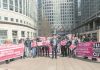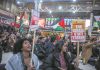
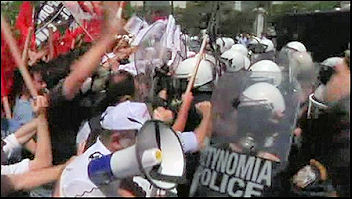
Greek workers battle police during two day strike
What we think
Turmoil reveals limits of European integration
The countries that adopted the euro are facing the most precarious situation for their currency union since they started using the euro in 2002.
The severe debt crisis in Greece is having major repercussions in the eurozone, the European Union (EU) and internationally. The eurozone governments fear daily that the contagion could spread beyond Greece, as a number of other economies have been labelled as being at risk of possibly greater problems, including Spain, Portugal, Ireland and the UK. Although the UK is not in the eurozone, most of its trade is with Europe and so it is vulnerable in the present turmoil.
The immediate prospect of Greece defaulting on its debts seems less likely now that European governments and the IMF have put together a 110 billion euro rescue package. But the crisis has been acute enough to bring into question the survival of the present eurozone, and the dangers are far from over. One or more countries may yet be compelled to abandon the euro in order to have more room to manoeuvre economically (in particular to devalue their currency), a dire scenario for European capitalism that was barely contemplated in the triumphalism of the euro’s creation.
Whatever the eventual outcome, this crisis is a major setback for the ruling classes of Europe. German prime minister Angela Merkel, on behalf of Germany’s ruling class, firstly tried to resist bailing out Greece. Her hardline approach reflected a fear that a bailout would set a precedent; Spain, Portugal and other struggling economies could follow suit in asking for large-scale financial help. The sums involved would be astromonical and viewed as an intolerable burden by the ruling classes of the better-off European countries.
On the other hand, the German government has faced huge pressure from working and middle class people against using taxpayers’ money to bail out the Greek government and multinational financial institutions. Nevertheless, Merkel felt forced to participate in putting together a bailout package, as the alternatives for German capitalism seemed even worse. Allowing Greece to overtly default on its debts (which is inevitable if nothing is done) or kicking Greece out of the eurozone could trigger an even greater political and financial crisis.
French and German banks are estimated to hold around 70% of Greek debt, so they would face massive turmoil and for some, possible bankruptcy. A default or eurozone exit would weaken the overall credibility of the euro (which has already lost 13% of its value since November) and increase the risk of market speculation against the other debt-ridden eurozone states.
This in turn would push up interest rates and threaten the fragile and uncertain economic recovery in Europe. A renewed banking crisis could be part and parcel of this. But a Greek default or one elsewhere could still happen despite the present massive bailout, as could a country leaving the eurozone.
Attacks on workers
In Germany private donors have desperately been sought to make it seem that German workers will not be bearing such a great part of the cost of bailing out Greek and European capitalism. The bailout package that has been negotiated also comes with an insistence on barbaric cuts in living standards for Greek workers and outright lies and exaggerations about their present pension and other entitlements.
The decision to include the IMF in bailing out Greece was a massive blow to the prestige of the eurozone ruling classes. All their options are hugely problematic for them, which reflects the depth of the capitalist crisis they face.
When the euro was introduced, the Committee for a Workers’ International (CWI) predicted that the project would break down at a certain stage, and was derided by other ‘Marxists’ for saying this. The CWI pointed out that it was one thing for it to go ahead while the world economic upswing continued, but quite another when this boom approached its end.
The economic crisis has revealed the obstacles to European integration and the impossibility on a capitalist basis of overcoming the limits of the nation state and the national interests of the ruling class in each country. European capitalist integration has now probably reached its limits in this period, with the process stagnating and even being thrown into reverse.
An illustration of this is the sharp national antagonisms between the ruling classes of Germany and Greece and also France and other EU powers that have come to the fore. They all try to place the blame elsewhere, while they all preside over the capitalist crisis and its spread. In the run up to the recession they all tolerated or encouraged to one degree or another the almost untrammelled pursuit of fast profits by big business and the financial institutions, no matter what the cost, and they still do.
Ordinary people barely benefitted during the boom years that preceded the recession, and now are told to pay extra hard for the profligacy of the rich during those years. Workers everywhere are being told to pay twice over, through their taxes being used to bail out the banks and through direct attacks on their jobs, wages and public services.
There have already been some significant protest strikes and demonstrations across Europe, despite many workers still hoping that the attacks on their living standards will be short term and that the situation will soon improve.
As the economic crisis and its consequences drags on, this hope will inevitably switch to an even greater mood of anger, and a will to resist the human misery that the capitalist classes are seeking to impose.
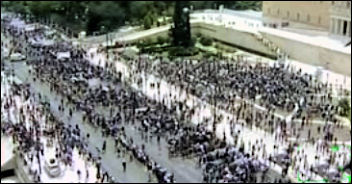
Greek workers take to the streets
Greek workers braced for more draconian attacks
Greek workers are facing further austerity measures – the largest in the country since World War Two. This will entail huge wage and pension cuts and tax rises. The EU, European Central Bank and the IMF agreed to a 110 billion euro bailout in return for the Greek social democratic Pasok government carrying out drastic social cuts.
Andreas Payiatsos, Xekinima (CWI Greece), Athens, and Niall Mulholland, CWI, London
Public sector employees’ wages will be frozen until 2014. Holiday bonuses, which are a crucial ‘wages in kind’ and which were already cut in previous austerity packages by 30%, will be cut further.
Currently 65% of Greek pensioners live on less than 600 euros a month and now they are being targeted for cuts to their measly income. The retirement age is due to increase as will the period to qualify for a full state pension.
VAT will rise to 23% (it was 19% in March). In the private sector, laws will be introduced making it easier for bosses to sack workers and to attack severance payments.
Overall, it is estimated that these attacks will entail cutting the incomes of the average public employee by 25%-30% and by around 15%-20% for private sector workers. Workers are furious that they are being asked to pay for the crisis of the banks and the system.
A 24-hour general strike is planned for 5 May, which could be the largest organised workers’ opposition for a long time.
However, beyond broad opposition to the cuts, the union leaders are not offering anything concrete. There is no clear alternative put forward. Union leaders instead say the cuts should not be carried out in an “unbalanced way” and that the rich should be taxed more. They call for “plans for developing the economy” that would see economic growth and a planned repayment of the debt burden.
The CWI in Greece, Xekinima, demands, ‘Don’t pay the debt!’ and ‘tax the rich’ (ending tax avoidance and corruption). Xekinima calls for an emergency plan of action, including a massive public works programme that would bring huge numbers of jobs and desperately needed investment to the public sector, public transport and infrastructure.
The key industries and utility companies should be taken into public ownership, under democratic workers’ control and management. The banking sector should be the first to be nationalised. A socialist plan of production would utilise the country’s economy and resources for the benefit of all.
However, the lack of an alternative from the union leaders or any bold call for decisive mass action to defeat the Pasok government attacks means that, at the current time, many workers cannot see a way out of the crisis.
Millions of workers will strike on 5 May. But unless this action is developed, with occupations, repeated and longer general strikes, leading to an indefinite general strike if the government does not back down, workers understandably do not see a realistic prospect of stopping the juggernaut of social cuts.
There is a mood of anger mixed with fear and even a sense of shock amongst many workers. Yet the Greek unions are only organising limited rallies and ‘festivals’ for May Day, not the sort of mass protest marches and rallies which the situation demands, as a preparation for the general strike.
Parties of the Left
The main parties of the left, the KKE (communist party) and the coalition Syriza, oppose the cuts but again offer no concrete alternative, plan of action or mobilisations. They do not put forward a clear socialist programme.
If the Pasok government manages to get through its cuts package and once it begins to hit working families, the already combustible mood can become highly explosive. A period of intense class struggles will develop, with more strikes and general strikes on the agenda. There can also be an increase in youth street protests and even riots by angry and alienated youth.
Young people have not decisively entered the struggle so far. This partly reflects the exhaustion and partial defeats suffered by students after months of university occupations in 2007 and the dead-end of the mass youth street revolt at the end of 2008.
It is also the case that young people in education have not yet been hit directly by Pasok’s austerity measures. But with thousands of temporary jobs under threat in education, this situation can change quickly and dramatically.
The leaders of the unions and left parties will come under hard scrutiny from the working class and youth over the next period. A new generation of class fighters will inevitably develop. Mass consciousness will shift to the left, by leaps and bounds, preparing the way for the development of a mass left force, ready to fight against the system and prepare for its overturn and for the building of a just, socialist society, run in the interests of working people.
This is what Xekinima will be fighting for in the next turbulent period.
MEP Joe Higgins’ initiative
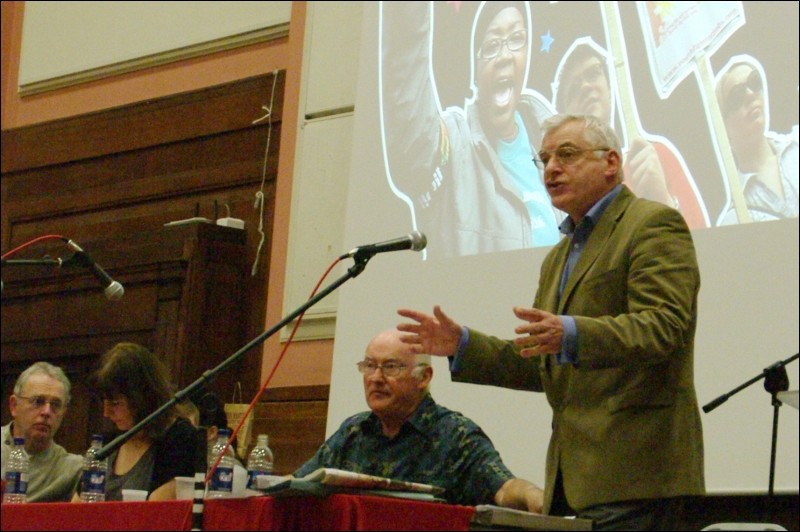
Joe Higgins, Irish Socialist Party MEP addresses Socialism 2009, photo Rob Emery (Click to enlarge: opens in new window)
A statement in solidarity with Greek and all European workers issued by MEPs in the GUE/NGL (United Left) group in the European parliament. The initiative for the statement was taken by Joe Higgins MEP, Socialist Party Ireland (CWI).
While governments in Europe are divided on how to deal with the deepening crisis in the eurozone, they are all united about who should pay for this crisis. The establishment is committed to making working class people right across Europe pay for the capitalist crisis – through cutbacks in public services and a slashing of wages.
Greek workers are currently subject to savage assaults on their living standards. Workers in Portugal, Spain and Ireland all face similar attacks, as do working people throughout Europe.
We want to send out a clear message of solidarity to all European workers, pensioners and young people. We oppose the attempts by the European establishment to whip up nationalist tensions to divide us. As international workers’ day approaches on 1 May, we stress the need for international action to defend the interests of working people.
We call for a united stand of workers across Europe to respond to the IMF, the international financial markets and the neoliberal politicians in Europe with the declaration: “We will not pay for your crisis”.
We support the planned general strike action in Greece on 5 May and call for international solidarity actions on that date as a step towards major European-wide mobilisations against the crisis and the attacks on workers.
- Workers’ solidarity across Europe with Greek workers who are under attack.
- No to the dictatorship of the financial markets, credit ratings institutions and the IMF.
- Unity of all workers across Europe – we will not pay for the bosses’ crisis!
Individually supported by MEPs: Joe Higgins, Socialist Party (CWI in Ireland); Nikolas Chountis, Syriza (Greece); Rui Tavares, Left Bloc (Portugal); Miguel Portas, Left Bloc (Portugal); Marisa Matias, Left Bloc (Portugal); Jurgen Klute, Die Linke (Germany); Sabine Wils, Die Linke (Germany); Sabine Losing, Die Linke (Germany); Kyriacos Triantaphyllides, AKEL (Cyprus); Willy Meyer, Izquierda Unida (Spain); Eva Britt-Svennson, Left Party (Sweden); Jean-Luc Melanchon, Parti de Gauche (France).
Capitalist austerity must be met with workers’ action
Shortened extracts from a joint declaration by Greek, Portuguese, Spanish and German sections and groups of the CWI issued on 29 April 2010. Click here for for the full text from www.socialistworld.net.
The recent period has seen the launching of a brutal offensive by capitalist governments, along with the international money markets, aimed at savaging the public services and living standards of working people to pay for the crisis of capitalism. This situation, described as “war” by Greek prime minister, Papandreou, has seen a new phase in this austerity offensive, particularly in southern Europe, in response to the spreading contagion triggered by the Greek debt crisis.
This week’s downgradings by Standard and Poor of its credit ratings for Greece (to junk level), Portugal and Spain have given further impetus to the crisis. Capitalist institutions like the EU and IMF, as well as capitalist governments, are demanding faster, deeper and more devastating cuts and austerity measures to assuage the ‘gods’ of the market and the credit ratings agencies.
The Portuguese Socrates government has raised the possibility of bringing forward its already savage programme of cuts and privatisations. In Spain, the Zapatero government earlier this year announced an austerity plan to cut €55 billion from public spending. The Greek Pasok government’s plan of attack represents a devastating blow to workers and youth. They are threatened with a decade or more of austerity and declining living standards.
Sections of the ruling classes in Germany and Greece have used nationalist rhetoric aimed at dividing the working class. For example the German ruling class has launched a slanderous campaign against the workers of Greece.
Capitalist governments in Greece and Portugal seek to wholly blame the situation developing in these countries on the international markets.
These nationalist sentiments attempt to mask the fact that it is the capitalist system and logic upheld by these national governments, as well as the international sharks of the financial system, which are to blame. It is clear that governments of the stronger powers, such as Germany, which presently are attempting to force through an assault on the Greek and Portugese working classes, have the same menu of attacks planned for the working class and youth at home.
This raises clearly the need for working class unity and inter-nationalism. Greek trade unions have called a general strike on 5 May. This is an example which should be followed by the trade union leaders in Portugal and Spain and other countries.
The national transport strike in Portugal on Tuesday 27 April, which saw over 95% participation, along with the massive demonstrations in Spain in February against the government’s pension attacks, is a glimpse of the response that would meet the call for general strikes.
In Germany, where the government is gearing up for a whole-scale assault on the health system, the question of a militant escalation of the fightback is posed.
In every country in Europe, similar attacks are either being planned or implemented, which by their very nature, demand a generalised response.
- No to cuts and privatisations! Make the bosses pay for their crisis!
- Victory to the Greek workers!
- No payment of debts to the capitalist vultures in the banks, EU and IMF! No to the dictatorship of the financial markets, credit ratings institutions and the IMF! Nationalise the banks and financial sector under the democratic control and management of working people.
- No to mass unemployment! Share out the work with no loss of pay. For massive state investment in public works’ programmes to create socially useful work for the unemployed millions.
- No to a Europe of the bosses! For a Europe of working people’s solidarity and struggle. For a democratic socialist federation of Europe as an alternative to the capitalist EU.
The CWI links these demands to the struggle for the nationalisation of the commanding heights of the economy, under workers’ control and management, to develop a socialist plan of production to end the crisis and to develop the economy, in the interests of workers, consistent with the needs of the environment.
The only sustainable, viable solution to the current crisis is the socialist transformation of society internationally.