
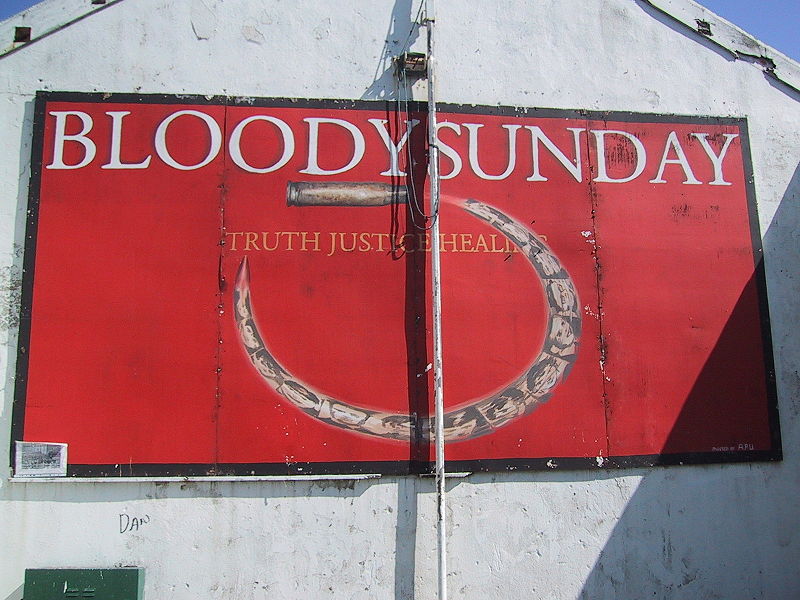
Bloody Sunday: Innocent protesters murdered by the British army in 1972
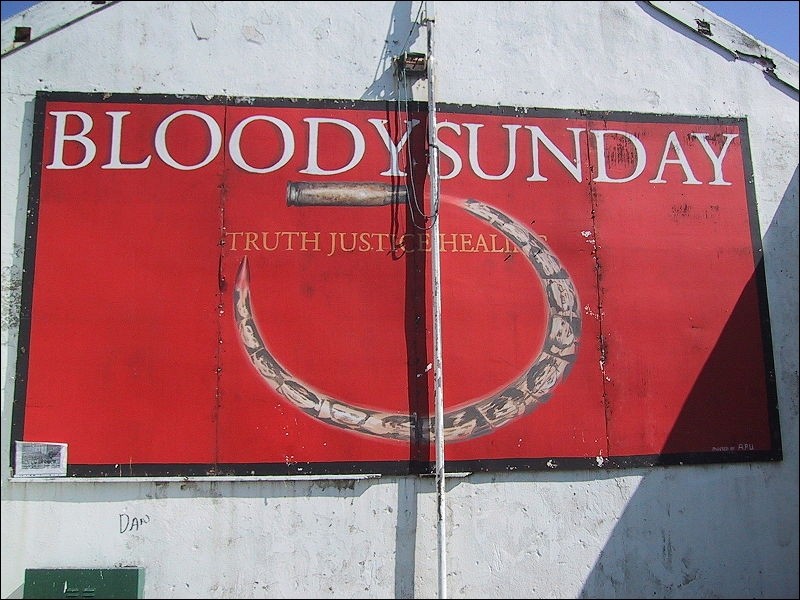
Bloody Sunday Mural in Derry, Northern Ireland, photo Jérôme Sautret (Click to enlarge: opens in new window)
THE PUBLICATION of the Bloody Sunday inquiry report, known as the Saville inquiry, has brought to light, once again, the brutal lengths the British capitalist state is prepared to go in defence of its interests.
Gary Mulcahy, Socialist Party, Belfast
The Saville inquiry, which cost nearly £200 million and lasted 12 years, has officially confirmed what everyone has known all along – that those who were murdered by the British Army on Bloody Sunday in 1972 in Derry, Northern Ireland, were innocent.
What the inquiry has failed to expose, or even attempt to explain is, what was the role of the Edward Heath Tory government and the British army chiefs in the events of Bloody Sunday and in the subsequent cover-up. On these crucial questions, the Saville inquiry is silent and has failed. In that respect, it is another form of an official cover-up.
On 30 January 1972, 27 innocent people were shot on the streets of Derry by British soldiers. Their crime was to march against internment without trial and to demand civil rights. 13 people died that day. A fourteenth died several months later, as a result of a bullet-wound.
A tribunal was quickly established by the Tory Heath government, headed by Lord Widgery. In April 1972 the infamous Widgery report concluded that the soldiers from the Parachute Regiment (Paras) were justified in shooting marchers; that shots were first fired at soldiers from the crowds on the streets in Derry and implied that those killed had been in close contact with weapons.
It also found that both the Unionist government in Stormont – the seat of local power in Northern Ireland – and the British government in Westminster, shared no blame. The Widgery report was a complete whitewash; a cover up for murder carried out by the British state.
Incidentally, four years later, Widgery was to turn down the first appeal by the Birmingham Six – six Irishmen who were framed by police and wrongly imprisoned for 16 years for the IRA (Irish Republican Army) Birmingham pub bombings. From the British ruling class and Unionist establishment point of view the Widgery report was the last word on Bloody Sunday.
For the past 38 years, the families of the Bloody Sunday victims have campaigned tirelessly to uncover the truth of Bloody Sunday and for the British government to recognise the innocence of the victims.
Thousands joined the families on the day the Saville report was released to retrace the 1972 march.
Rising challenge
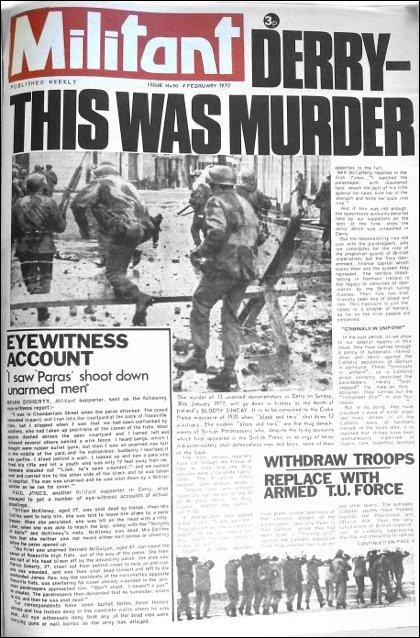
Derry: This was MURDER: Withdraw troops – Replace with Armed Trade Union force: Militant 4th February 1972 (Click to enlarge: opens in new window)
In the weeks leading up to Bloody Sunday, there were signs that the establishment was preparing to shoot protesters. The British army commander for land forces in Northern Ireland, at the time, Major General Robert Ford, was on record supporting the ‘shooting of selected ringleaders of rioters’, to set an example.
It was Ford’s decision to send the Paras to Derry, a city with a large Irish nationalist population, major parts of which were ‘no-go’ areas for the RUC (Royal Ulster Constabulary) police force and the army.
Ford had visited Derry in January 1972 and wrote a confidential memo to the general officer commanding, Sir Harry Tuzo. Ford referred, in particular, to the so-called “Derry Young Hooligans” as a factor in the ‘continued destruction of the city’ and expressed the view that the army was virtually incapable of dealing with them.
The Derry Young Hooligans was a derogatory name given to the young people involved in fighting against state repression, many of whom were members of the Derry Young Socialists, the youth wing of the Derry Labour Party – which grew rapidly in opposition to the Unionist state and the right-wing Nationalist Party.
What deeply concerned the British and Unionist establishment at the time was the rapidity with which socialist ideas and organisations were beginning to grow. Inspired by the revolutionary events in France 1968 and the civil rights movement in the US, they challenged the poverty and class discrimination which blighted not just Catholic areas but also Protestant workers and youth.
Absolving the powers
Militant Irish Monthly, sister paper to the Militant in Britain, (now the Socialist)
One of the soldiers who gave evidence to Saville, known as Private 027, has written in his memoirs that as a 19 year-old soldier in Derry, on the night before Bloody Sunday, a lieutenant told his platoon: “We want some kills tomorrow”. Private 027 also went on to claim that he did not write ‘his’ statement that was given to the 1972 Widgery Inquiry whitewash, but that this ‘account’ was actually written by Crown lawyers and that it was an untrue account.
Yet Saville concludes: “In our view, what is likely to have happened is that Private 027 felt that he had to invent a reason to explain providing a statement for the Widgery inquiry that was inconsistent with his later accounts; and chose to do so by falsely laying the blame for the inconsistency on others.”
Given Private 027’s evidence, it is not a minor flaw but a fundamental flaw of the Saville report that it concludes that neither the Unionist government in Northern Ireland nor the British government in 1972 were directly or indirectly responsible for Bloody Sunday.
Saville claims that Bloody Sunday was the result of several soldiers deciding independently to deliberately kill unarmed peaceful demonstrators, without orders from above. This conclusion lacks credibility. Likewise, there appears to be no comment whatsoever in Saville’s inquiry findings on why the Widgery report, which it strongly contradicts, was supported for so long by the establishment.
No more inquiries?
Unfortunately, while the Bloody Sunday families have succeeded after 38 years to clear their loved ones’ names, the truth behind who ordered the shooting of innocent people with live rounds, how far it went up the command chain and who was involved in covering up Bloody Sunday still remain to be discovered.
Prime Minister David Cameron has stated there will be no more inquiries into the past in Northern Ireland. It is clear the establishment want to bury the questions remaining over Bloody Sunday. You can have an apology but do not ask any more questions!
This does not just include the British government. The Irish Taoiseach (prime minister), Brian Cowen, praised Cameron’s “brave and honest words”. Irish President, Mary McAleese, paid tribute to the families 38 year battle for justice, while she was visiting the butchers of Tiananmen Square, in China, on an official state visit. Sectarian politicians in Northern Ireland, on both sides, will also attempt to cloud the issues with their sectarian poison.
Questions have been raised about why there has been no inquiry into the deaths of other innocent victims of the ‘Troubles’, including many people killed by paramilitaries often for no other reason than they happened to be a Catholic or a Protestant. The families of these victims also deserve to hear the truth.
The issue of victims’ rights to justice and the truth cannot be dealt with satisfactorily by politicians who were part of the sectarian bloodshed on both sides.
The working class in Northern Ireland paid the biggest price for the Troubles. A genuinely independent inquiry, consisting of representatives of the working class, which examines the role of all participants in the conflict, is needed to find the truth for victims.
Bloody Sunday legacy
Bloody Sunday was a defining moment in the history of Northern Ireland. Brutal state repression, in the form of the Lower Falls (Belfast) army curfew, internment without trial and Bloody Sunday, pushed thousands of young people into the Official and Provisional IRA.
The Bloody Sunday murders, in particular, created the idea amongst some of the most radical sections of the Catholic youth that the civil rights era was over, that it and ‘politics’ had failed and fostered the mistaken belief that individual terrorism was the only way to take on the British state.
Due to the absence of a mass socialist alternative, and the failure of the labour and trade union leaders, some of the most comb-ative Catholic youth followed the false and counterproductive ideas of individual terrorism, which ultimately failed and cultivated greater sectarian division amongst the working class.
Bloody Sunday was an outrage and tragedy for which the families of the victims and the working class of Northern Ireland paid an enormous price.
Eyewitness
Brian Doherty, a young member of the ‘Militant’ at the time in Derry (the forerunner of the Socialist Party) part-icipated in the civil rights march on 30 January 1972. He gave eyewitness evidence to the Saville Inquiry: “I had been watching the riot for a few minutes when the scene changed. This was when a number of foot soldiers came through the barrier towards the crowd… They were wearing full combat gear and were not carrying riot shields.
“After I had been looking at the soldiers for perhaps a second or two, a young man appeared in my field of vision. I believe he came from my right and was running hard in the direction of the gap between Block I and Block 2 [housing apartment blocks]. All at once, the young man fell. I remember seeing his body roll over more than once when he fell because he had been running fast. At the same time I heard the sound of a shot which seemed to me to have come from the direction of the soldier who was standing at Point D. I also saw this soldier’s rifle appear to recoil, as if he had just fired.”
The Paras’ brutal reputation
The Parachute Regiment was sent to Derry from Belfast, where they had a reputation for brutality. The journalist, Robert Fisk, recounted this week how shortly before Bloody Sunday he was in Belfast and witnessed paratroopers viciously beat Protestants in the Shankill Road area, after they had blocked a street with vehicle tyres, peacefully protesting over a lack of security.
Fisk also tellingly recalls a protest march to the internment camp on Magilligan beach, near Derry, on 22 January when peaceful protesters were brutally batoned by British troops.
Internment without trial had been introduced in August 1971 and all marches were deemed illegal. John Hume, who was to become an MP for Derry and leader of the SDLP (a mainly middle class nationalist party) represented the right wing section of the leadership of the NICRA (Northern Ireland Civil Rights Association) and was on the Magilligan protest.
Fisk recounts how “a Para officer walked up to Hume and – in a very English public school accent – threatened him. I realised something new was happening, Hume was to tell me years later: ‘Some decision had been taken by the military. I was very worried about this. These were very hard men. There was no way of negotiating with them.'” Hume chose not to participate on the march on Bloody Sunday.