

The Independent and Independent on Sunday were sold in March to Russian billionaire Alexander Lebedev for just £1, a tycoon who similarly bought London’s Evening Standard for the same price in 2009. The BBC is under attack from the Murdoch empire and other sources, ITV news in the regions is on the verge of collapse, big regional dailies, like the Birmingham Post have moved to weekly publication, some papers are no longer being sold but are being handed out free, and many local weekly newspapers are being closed.
Meanwhile some people feel the rapid growth of online news heralds the possible end of print publication across the globe. The state of the media has itself become big news, says GEORGE BAILEY.

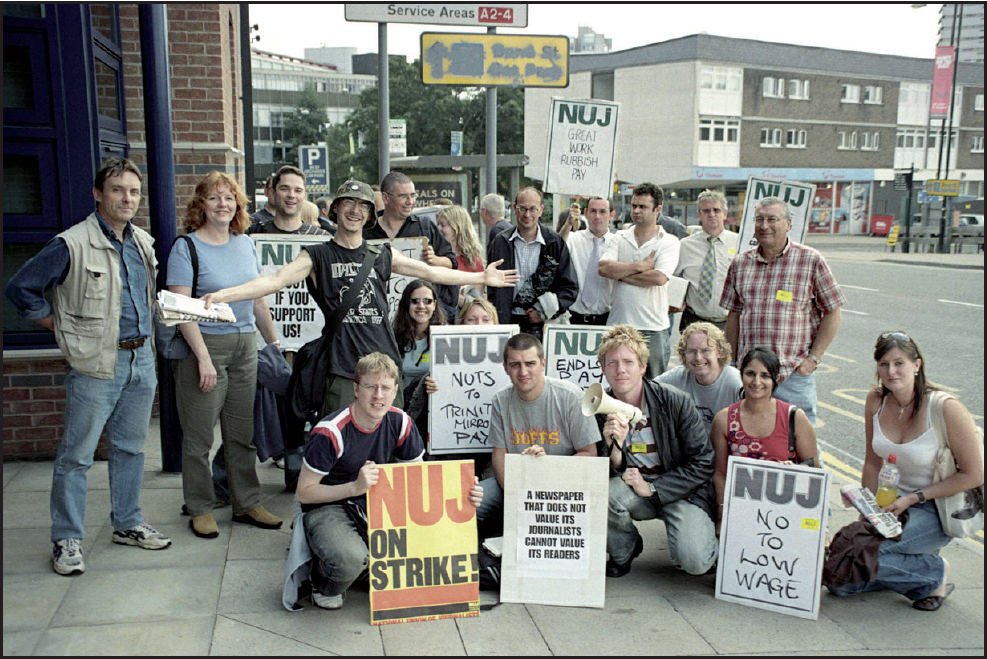
Striking journalists at the Coventry Telegraph, photo by S. O’Neill (Click to enlarge: opens in new window)
MEDIA ORGANISATIONS are first and foremost businesses. Whatever chief executives of media companies may say about providing news and serving the public interest, the first thing the vast majority of them are obliged to provide, is a high return for their major shareholders.
With some exceptions, newspapers and media outlets do not exist to report the news or act as public watchdogs, they exist to make money just like any other business. How far they defend the public’s interests or report news is guided overwhelmingly by their need to succeed as a business.
The main means of making money for newspapers, TV, radio and now online media is advertising. Until the recession began, media companies worldwide were raking it in, with colossal rates of return on fairly limited investment.
Even with the advance of the ‘online revolution’ shaking up many sectors, advertising poured huge sums into the media. In 2007, advertising spend across all media in the UK totalled £19.4 billion. This, along with new technology and a decimation of journalists’ and ancillary staff jobs, led to newspaper conglomerates achieving 20% or higher rates of return on investment, compared to 5% for businesses like Tesco.
This prospect of hyper-profits made media bosses feel immune to the threat of new media or the prospect of advertising revenue dropping in any future recession. But the economic downturn came, finding media companies with no alternative business plan to deal with a cataclysmic drop in advertising revenue and falling sales and audiences.
Quality decline
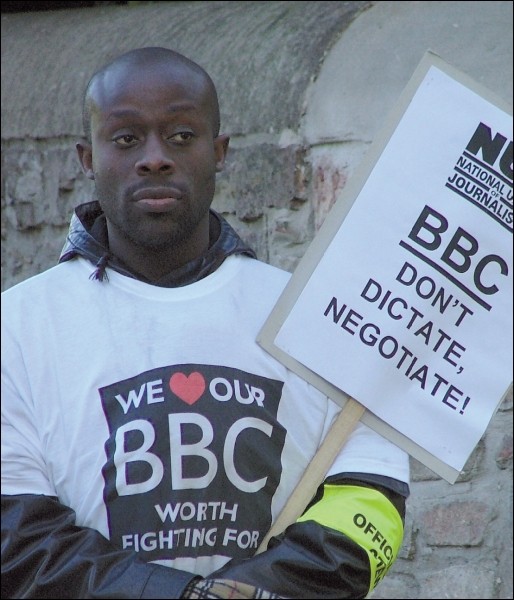
Cardiff BBC strikers, photo by Socialist Party Wales (Click to enlarge: opens in new window)
Readers, listeners and viewers were increasingly disenchanted at a product clearly declining in quality after years of media bosses slashing staff numbers and believing that journalists don’t need to get out of the office to obtain news. Nick Davies accurately and vividly described much of the result as “churnalism” in his book Flat Earth News.
It is no exaggeration to say that the media in Britain is experiencing crisis and turmoil. Media owners have no thought-out policy for the future, except to snipe at each other and to slash jobs and costs.
Despite the flowering of new sources of news and information online, power and influence in the media still remains in the hands of those with the most financial resources. Veteran investigative journalist John Pilger says 50 multinational companies controlled the world’s media in 1983, by 2004 this had reduced to six. Pilger said: “The ‘new global media’ is less diverse than ever before”.
Britain is not immune to monopolisation. From the mid-1990s to 1997, 77% of the regional press changed ownership but this reinforced a monopoly position: just four companies controlled three-quarters of all Britain’s regional papers. In national papers and broadcast companies, four companies control 80% of the printed output.
Despite the perceived rise of “citizen journalism” and the supposed “democratisation” of news through the internet, with much more material obtained from new, non-traditional journalistic sources, news was still a monopoly business.
New media
The online revolution has changed the sources where people obtain their news markedly in recent years. Despite examples of the internet giving ordinary people a route to disseminate news – such as in Iran in 2009 – online news, like its traditional counterparts, is still overwhelmingly dominated by the media’s big players.
But these media giants have not yet found a way to make online news pay. In general, only specialist niche ‘publications’ and blog sites make money from online news and information. Media corporations originally saw online news as an adjunct to their traditional news outlets. But, people quickly thought ‘why go to the front of the shop and pay for something, when you go round the back and get it for free’.
Recently Johnston Press, owner of many big UK regional newspapers, dropped after just a few months the experimental pay walls it implemented on some of its local papers. It had erected barriers on six weekly newspaper websites last November. Many people saw the trial, which charged readers £5 a quarter to access web content, as a test to assess whether pay walls could be implemented on flagship titles such as The Scotsman and Yorkshire Post. But, inside sources claim, the number of subscribers paying to access stories on the website of some of their papers was in the low double figures.
Another problem for the Murdochs and other print barons is that the BBC already provides an extensive, highly professional online service for free – hence the ferocious campaign of James Murdoch and right-wing newspaper owners about the BBC’s dominance. But the other problem for big media companies is that they are trying to provide an online news service on the cheap. After years of cutting journalist numbers and editorial resources, they now have too few staff to provide a simultaneous print news service and what is effectively a broadcast information service online.
As ITV’s experience shows, private-sector firms have no intention of providing the same quality of service using the same level of resources as the BBC. Instead, they want the BBC removed, or downsized to the point of ineffectiveness, so they can have an unfettered stranglehold on local online news provision, and make greater profits from their dominance of the sector.
Big bad auntie?
By far the biggest online presence is the BBC, which provoked Rupert and James Murdoch to call for an end to the BBC’s “monopoly” and for a reduction in the BBC’s online services. Local newspaper owners also want the BBC to be ‘scaled back’ in the nations and regions, to allow them greater opportunity to develop micro-local news websites.
The Newspaper Publishers Association wants the BBC banned from developing phone apps, just as they opposed BBC plans for ultra-local video news services. Others simply want the television licence fee axed; they believe there is no case for any public subsidy. However, this is all plain hypocrisy from these media organisations. Murdoch’s Sky business shows no sign of giving up its ‘monopoly’ over satellite broadcasting – particularly of sport – even when instructed to.
The commercial regional newspaper proprietors say the ‘market’ needs a level playing field. However, the newspapers’ problems are much more to do with the collapse in advertising revenues following the banking crisis and their own mismanagement over a number of years.
Many big newspaper companies enjoy a virtual monopoly of print and online news provision in most of Britain’s major towns and cities. And, because of cost cutting, the quality of news and service they provide is nowhere near that provided by the BBC.
Yet, in response to these attacks, the BBC currently proposes making £600 million worth of ‘savings’, including closing 6Music and the Asian Network, halving its number of website pages, reducing staffing by 25%, and sharing more programmes across local radio. It is also conducting a review of its publications, specifically magazines, probably leading to outsourcing and offshoring.
The BBC has no less money than it did before, but is making these cuts purely in response to other media owners’ sniping and political pressure from both Labour and Tories. Its bosses hope that taking action now will head off criticism from politicians and commercial rivals. The BBC already spends large sums in the private sector, spending £1.3 billion externally with third-party suppliers (excluding spend on independent producers).
But all these attempts will only increase the appetite of the commercial sector media barons to demand more. Commercial rivals like Ten Alps want a quarter of BBC web activity to be outsourced to the private sector, and commercial radio bosses want Radio 1 to be privatised.
The BBC hopes to show politicians that if they self-harm there is no need to cut BBC funding. Yet, the Conservatives said before the election that they would still freeze the licence fee and then reduce it, and Labour and Lib Dems both say the BBC is too dominant.
Socialists would not defend the BBC uncritically. Much of its news service is dominated by the same pro-big business and establishment values as the rest of the media while its senior executives and ‘stars’ earn high pay that is far removed from the reality of most journalists and working people.
However, the BBC should be critically defended as a public-service broadcaster, because the alternative is a media where news becomes the mouthpiece solely of the Murdochs and the Berlusconis.
Forms of ownership
The National Union of Journalists (NUJ) has initiated an urgent discussion on new forms of media ownership. The union insists, correctly, that the provision of quality news nationally and locally is still needed. But the media moguls feel that providing that service doesn’t fit in with their business plans, which is making hundreds of journalists redundant and threatening thousands more, while still maximising their advertising revenue.
The last Labour government stepped in to save the banks, but it did not view media organisations as providing an important enough service in society, locally and nationally, to be worthy of similar support.
The NUJ has also raised the idea of “creating a level playing field in the media”, and advocates a system of levies on the profits of internet media giants such as Google, O2 or Virgin Media, which could be used to fund local TV news in the regions and to help rebuild the regional newspaper sector as it emerges from recession.
But socialists realise that there can never be a “level playing field” while big business dominates the ownership and control of news and entertainment.
In some cases, where papers are closing down or have been closed down, and the government has refused to intervene, the NUJ and socialists have supported genuine initiatives aimed at keeping papers alive in communities – like the community based, ’employee owned’ West Highland Free Press – or initiatives like the local news networks being explored in Wales and elsewhere.
In some quarters, the question of some kind of state support for media organisations is being discussed and is winning backing at local level.
Socialists would not argue for public money to be thrown at failing media companies who would take state cash while still providing news on the cheap.
And the Socialist Party has always demanded that companies who lay off workers should be told to open their books. If it can be shown that these companies are not viable enough to keep all their staff, then they should be taken out of the hands of the media tycoons and be taken into public ownership and handed over to the media workers themselves to run.
This should not be nationalisation as carried out with the banks and other large organisations in the past. It should instead be nationalisation under democratic workers’ control and management.
But socialists would not call for a state monopoly of the news. Instead, the resources of media companies – particularly printing and broadcast facilities – should be utilised for the benefit of all sections of society, by allowing all groups in society (except racists and fascists) access to media facilities based on the level of support that each group has.
Service
Most journalists want to provide a service to their communities, holding politicians, business owners and government bodies to account. Nationalisation of the resources used to produce newspapers and other media should be seen as handing the media back to the community. It would allow journalists greater freedom to investigate and report without fear of offending political or commercial interests.
Even where jobs are not immediately threatened, socialists argue for nationalisation of the major media resources and facilities, so that they can be used for the benefit of all in society.
Such public ownership could guarantee the resources to have quality newspapers in every major town at least, with good working conditions and pay. Workers’ control of the resources available would be necessary to ensure editorial independence and balance.
Capitalism is a system of recurring crisis, causing suffering and hardship for millions and cannot guarantee a stable and decent life for working people. So the taking of control of our news out of the media profiteers’ hands and replacing it with a more independent media, is part of the fight for a democratic socialist society.