

Judy Beishon
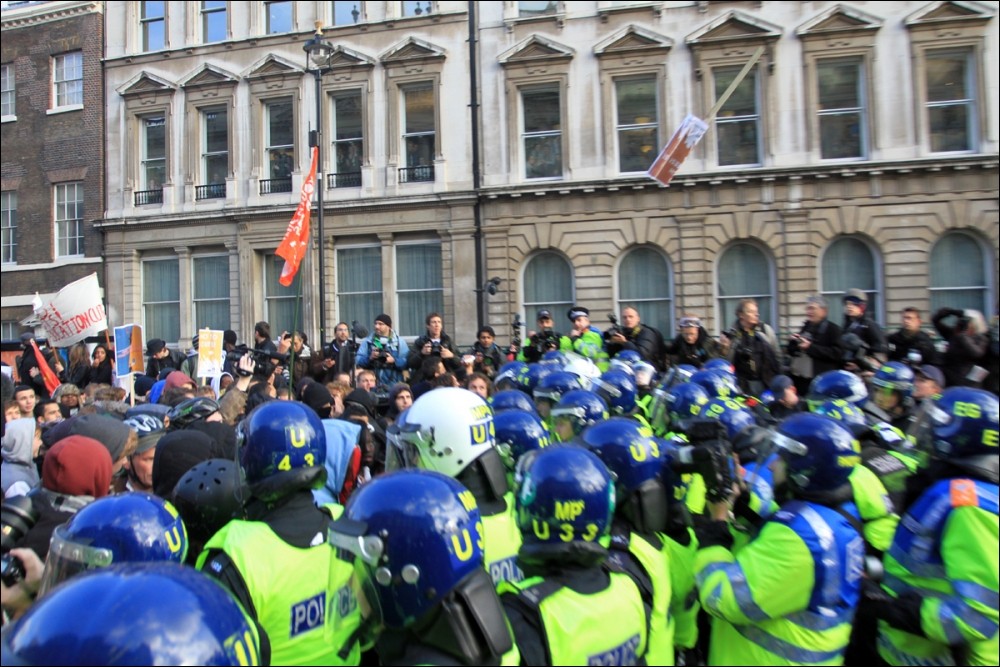
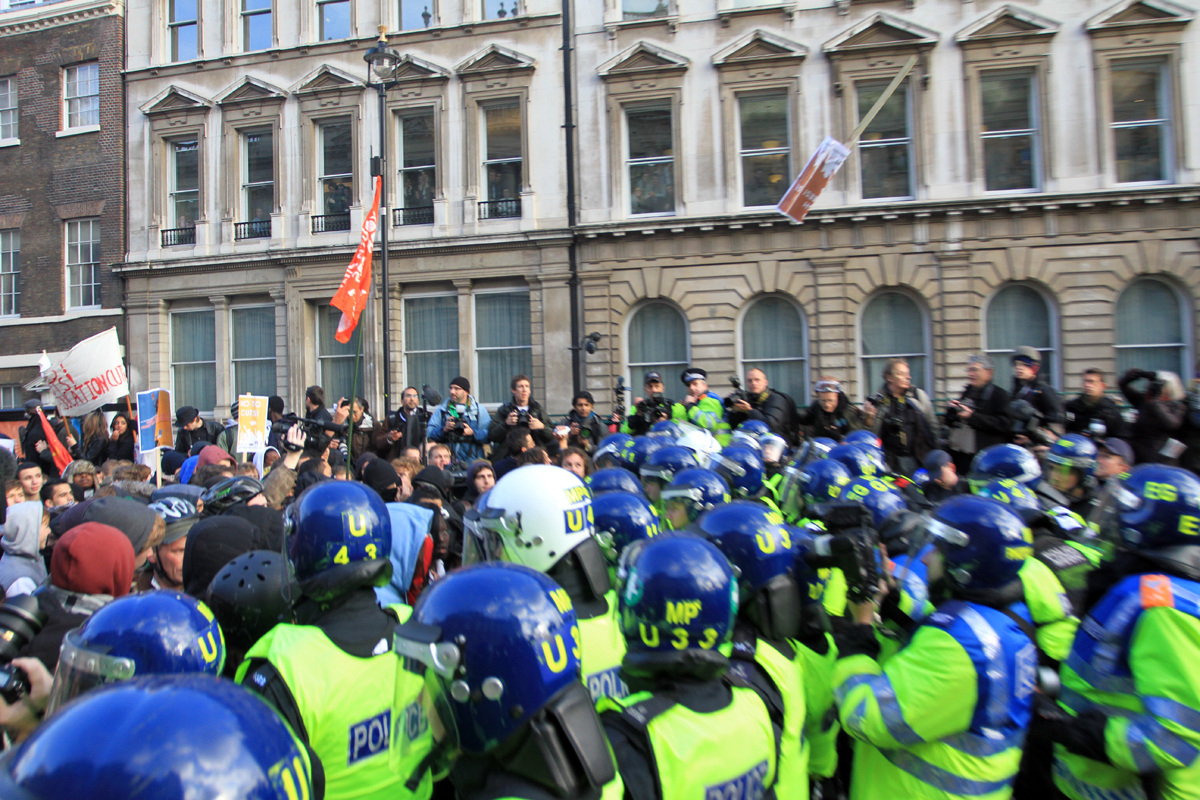
Police on student demonstration – hundreds of protesters have been injured by police violence, photo Senan (Click to enlarge: opens in new window)
What is happening to the democratic and civil liberties won over generations by working class people? In the name of fighting terrorism, laws that infringe on basic rights and freedoms have been introduced across the Western world and elsewhere.
In Britain, the present government and previous Labour ones have used some of the repressive methods of totalitarian states, such as lengthy detention without trial and the banning of demonstrations.
Anti-trade union laws brought in by Tory prime minister Margaret Thatcher mean that many strikes can be declared illegal and a succession of laws reducing other democratic rights have been processed thick and fast in recent years.
Protesters cannot demonstrate outside parliament without special permission, in many areas they have been stopped and searched. Sometimes they are prevented from demonstrating; at other times they have been kettled for hours, and have often faced brutality from the police.
Surveillance has been stepped up, not just by massive use of CCTV but also through spying on internet social networks – with prosecutions sometimes following when someone has merely written something subsequently construed as ‘plotting’ or ‘threatening’.
In addition, the basic right to campaign – essential for democracy – is being eroded, with numerous cases of street stalls or even just leafleting being banned.
Public sites for displaying campaign posters without charge are virtually non-existent and it is normal for meeting rooms for hire to be either forbidden to campaigners or priced out of their reach.
The lists in this feature include some examples of attacks faced by protesters today, but many more could be given and the lists themselves are not complete.
How the right to demonstrate is eroded:
- Banning demonstrations. The police can impose many types of restriction on marches and demonstrations and even ban them completely in any area for up to three months if the Home Secretary agrees (and district council, if outside London).
When the racist English Defence League (EDL) planned to march in Tower Hamlets in East London in September, the Home Secretary ratified a ban on all marches not just in Tower Hamlets but in four neighbouring boroughs and in the City of London too, for 30 days. However, the police in practice allowed the EDL to march – although not in Tower Hamlets – and the ban was mainly used against the much larger anti-EDL forces. - Exclusion zones. Unauthorised protests are banned within one kilometre of Parliament Square in London.
- Kettling (containment). This was first used in 2001 on 3,000 protesters at Oxford Circus in London, who were held for seven hours without food, drink and toilets. After protesters (led by Lois Austin) lost their case in the British courts against the police regarding that day, it is now being judged in the European Court of Human Rights.
In 2009, protesters at a carnival-type climate change protest, part of an anti-G20 day of action, were kettled and hit with police riot shields. The Guardian reported that a police chief accepted that the protest was peaceful but decided to contain it “to avoid potentially violent people joining it”! Two of the protesters took the police to court and in April 2011 a judge ruled that the police had not acted lawfully. But the London Met police vowed to continue to use kettling all the same.
Student demonstrators were kettled on 24 November in London last year for nine hours in freezing conditions, including many below the age of 16, and again on further demonstrations elsewhere. The High Court has rejected a challenge to the kettling on 24 November.
- Pens. Police routinely pre-arrange the setting up of metal fences to pen protesters into a small designated area while they are demonstrating – not as intolerable as kettling but still unnecessary, an expectation of ‘trouble’ and an infringement of democratic rights.
- Police brutality. Entirely peaceful demonstrators can find themselves being charged by riot police, or trying to avoid police horses or dogs. The government has recently discussed whether water cannon, plastic bullets and curfews should be employed in the future.
There are regular reports of deaths at the hands of the police, including those of Ian Tomlinson who was passing through the 2009 anti-G20 demo and Mark Duggan in Tottenham in August. In eight days of August there were three deaths in different areas of the country in incidences where stun guns or pepper spray were used by police – not on protesters in these cases, but how can protesters surrounded by police feel safe having heard of these fatalities?
- Intimidation and harassment. Last year two protesters, Kevin Gillan and Pennie Quinton, won a European Court of Human Rights judgement against the way that they, among others, were subjected to lengthy stop and search harassment by police which had prevented them from demonstrating against an arms fair in 2003. Last December a 12 year old boy was hauled out of class in school by police after they had seen on Facebook that he was organising a protest outside David Cameron’s constituency office against the closure of his youth club.
- Charging money to demonstrate. In 2008 school students at St Georges High School in Salford were charged £2,500 by their council for demonstrating against the closure of their school. When they and their school refused to pay, the council deducted most of the money from the school’s budget!
This is not an isolated case. For instance the National Shop Stewards Network was told by Camden council that it would have to pay nearly £2,000 for a road to be closed in order for its march on 11 September to go ahead. And the Youth Fight for Jobs Jarrow marchers were told by South Tyneside council to pay £2,500 for a road to be closed for their march this month.
Both of these charges were rescinded after objections and campaigning.
Fair trials, free speech, free movement:
- The right to innocence unless proved guilty has been effectively removed for people detained without trial – at present for up to 14 days – or subjected to control orders, now called ‘terrorist, prevention and investigation measures’ (TPIMs), such as those that impose ‘house arrest’ or electronic tagging. Some victims of these are not even told what the charges are against them. Breach of TPIMs is a criminal offence.
- Civil orders (including ASBOs) can also be imposed on a person who has not been found guilty of any offence and breaching them is a criminal offence. They can ban people from certain activities or areas; be given to someone merely ‘suspected’ of gang involvement; to parents for lack of control over their children; to someone for wearing certain items of clothing; and for many other non-crimes.
- Non-jury trials were introduced for some criminal justice system cases.
- Legal aid is being cut massively, reducing access to advice and representation.
- Following the riots prison sentences are being dealt out that are out of proportion to the offences committed, to deter others.
- Prosecutions have been pursued simply for saying or writing something that has been construed as plotting, encouraging or glorifying a potentially violent act.
- Surveillance cameras film protesters and everybody – we are the most monitored population in western Europe, with millions of CCTV cameras in use.
- ‘Mosquito’ devices have been installed in some areas that emit a high pitched unpleasant sound only heard by young people, to deter them from congregating.
What the Socialist Party says:
Ten years after 9/11, former Labour leader Tony Blair has said that the terrorist threat is bigger and deeper than ever. Yet this threat was used by him to justify vast swathes of ‘anti-terror’ legislation, despite the criminal justice system already having adequate powers for arresting suspected terrorists and putting them on trial.
The government arsenal of ‘anti-terror’ legislation does not make our communities safer, and its frequent use on innocent people and non-terrorists increases alienation and anger. Also, it will be used against organised workers’ struggles, which are essential to counter the conditions that lead to crime and terrorism.
Working class youth – especially black and Asian youth – have suffered a disproportionate amount of police harassment, an issue that contributed to the anger that broke out in August. Many of them are also angered when they see the police not adequately investigating crimes that they or others in their communities have been victims of.
A fighting lead from the trade unions against cuts, erosion of democratic rights, and for police accountability, would be a pole of attraction for young people. It would show an alternative path, uniting working class communities in struggle against the attacks on living standards and rights that are by-products of the crisis-ridden, profit-driven capitalist system.
Aftermath of riots
Following years of ‘anti-terror’ legislation, the August riots are now being used to justify further draconian measures, including evictions from social housing and possible docking of benefits.
But as the Socialist Party has explained, the only measures that will prevent more eruptions on the streets are the reversal of savage spending cuts on vital services, together with massive investment into decent jobs, training and housing. More police powers to harass people and use increased brutality will only serve to further alienate those young people who have lashed out in anger and frustration.
Laws against terrorism, serious crime and anti-social behaviour are “routinely used against legitimate protesters”, said campaign organisation Liberty. Underlying the government handing the police, local councils, courts etc, further powers that are being used against protesters is its fear of the class battles that are coming.
The huge onslaught of cuts to jobs, pay, working conditions and services is already fuelling workers’ opposition. This will become an avalanche of mass protest over time as living standards for the majority are being driven down while the rich are insulated by their vast wealth.
Repressive measures against protesters vary from those that obstruct them – such as against campaigning, to those designed to punish them and attempt to scare them away from future protests – such as kettling and heavy sentencing.
The ruling class and right-wing media are deliberately trying to ‘criminalise’ protesters and use people’s genuine fear of crime to discredit protesters by focusing on any damage done to property etc when demonstrations – usually largely peaceful – take place.
Trade unions
The trade union and anti-cuts movement therefore needs to take preparation and well-organised stewarding of demonstrations very seriously, including youth and student demonstrations. Stewards need to help protect participants from potential brutal or punitive actions by the police, guard against the role played by provocateurs and ensure the maximum degree of unity and collective strength – which helps prevent any anger-fuelled counter-productive actions by individuals or groups.
The government has been forced to alter or abandon some of the authoritarian measures that were at its disposal following court judgements that have criticised or condemned them.
For instance in July 2010 it announced that the use of section 44 of the Terrorism Act 2000 to stop and search would be suspended. This followed the European court ruling on the case of Gillan and Quinton (see above) that condemned the section 44 powers for allowing people to be humiliated by being searched in public without the police having any grounds for suspicion.
But welcome as such court victories are, they don’t stop the government from finding other routes to the same ends or sometimes already having other laws they can use for similar ends. The suspension of section 44 didn’t end stop and search, though it did mean that the police were supposed to have ‘reasonable suspicion’ to do it.
Then in March 2011 the Home Secretary simply issued a ‘Remedial Order’ to replace sections 44 to 47 of the Terrorism Act 2000 with a new section, 47a, giving the police stop and search powers that circumvented the ruling of the European court.
A government panel is presently exploring ways that the European Court of Human Rights could be ignored altogether, or at least have its jurisdiction narrowed. This sets in context the ‘Protection of Freedoms Bill’ that is presently going through parliament to amend laws introduced by Labour that the Tories and Lib Dems criticised as going too far against civil liberties.
This Bill includes measures that are widely welcomed, such as destroying most of the DNA profiles that were taken from people who were never convicted, reducing the number of jobs that require Criminal Records checks and ‘regulating’ CCTV usage. But overall, the Bill tinkers with previous legislation rather than radically changing or scrapping it.
Likewise, the government rebranded control orders as a supposedly lighter version, TPIMs (see above), but now wants to further amend them to give the Home Secretary sweeping powers and effectively bring back all the worst aspects of the original orders.
Democratic and civil liberties have been won by working people over generations of struggle and must be vigorously defended. A major working class-led campaign is needed against all the attacks on trade union and democratic rights, including against state brutality, miscarriages of justice and excessive sentencing. Campaigning can include organised mass insistence on the right to have street stalls, demonstrations etc, when these basic activities have been threatened by the authorities.
Most of the trade union and Labour leaders show no sign of leading such a campaign however. The Labour Party when in government created more than 3,000 new criminal offences, with over 440 imprisonable offences created by secondary legislation and not even debated by parliament.
The leadership of the second largest union in the country, Unison, has shown its own level of respect for democratic rights through the way it has witch-hunted, suspended from holding office and expelled socialists, denying them the right to fair hearings.
So an effective mass campaign in defence of our rights will be an urgent task of a new workers’ party when it is built, and of newly elected and existing left trade union leaders.
As well as defence of rights, many more rights are needed. The protective rights that have traditionally been part of the British criminal justice system help towards making sure that trials are fair, but in this class-based capitalist system they certainly don’t guarantee it.
The top echelons of the police and judiciary are not neutral – they are in the same wealthy circles of the ruling class as the multi-millionaire government ministers and they serve the interests of that elite. It will only be when capitalism is completely removed and a socialist society built, that our rights and freedoms can be fully protected and developed onto a higher level.
We say:
- Build a mass campaign in defence of civil and democratic rights! Defend the right to protest
- Scrap the anti-trade union laws, defend the right to strike
- Stop victimisation of protesters by the police and in the courts
- Repeal all the draconian ‘anti-terror’ legislation and stop new repressive powers
- For the election of judges and the right to trial by jury
- For the police to be under the control of, and accountable to, the communities they serve. For trade union rights for the police.
