

The Socialist 4 Oct 2002

Mass Anti-War Demo

Mass Anti-War Demo Says:
  • No to Bush and Blair's War
  • No Blood for Oil
  • Build a Mass Movement to Stop the War Machine
Anti-War Protest - A Defining Moment

What We Think: THE 28 September 'Don't attack Iraq' demonstration was an immense display of opposition to war. 

With up to 400,000 protesters marching through London, this was much bigger than anything that took place in Britain against the Vietnam war in the 1960s and bigger than the sizeable CND demos of the early 1980s. More ...

Unions And New Labour - Time To Make The Break: LABOUR PARTY conference delegates inflicted a humiliating defeat on Blair and the New Labour leadership by voting 2:1 in favour of a review of the Private Finance Initiative (PFI).

Fighting The BNP's Racist Lies

Stoke-on-Trent: THE NEO-Nazi British National Party (BNP) are standing a candidate in the mayoral election in Stoke-on-Trent on 17 October. This has galvanised opposition to the BNP's vile racist propaganda. By Andy Bentley

The Biggest Anti-War Demo In Britain - Ever

A SEA of up to 400,000 protesters flooded into the Embankment, London on 28 September to say 'No' to war against Iraq. More ...

Organise For The Day Of Action On 31 October: Workplaces: "I WILL be raising the 31 October 'Don't Attack Iraq' day of action at my next union branch committee meeting."

Voices From The Demo:I'M AN Iranian. During the Iran/Iraq war Saddam used chemical weapons against us. 


Tube Strike 'Solid'

A 24-HOUR strike by London Underground workers on 24 and 25 September saw only a handful of the 600 drivers crossing picket lines. More ...

Class Warfare On London's Tube: IF THE new upturn in trade union militancy is a reminder of the 1970s then so is the dirty propaganda war, waged against striking workers, by the right-wing press. Bill Johnson, RMT

Che Guevara - Revolutionary Fighter

THIRTY-FIVE years ago the Cuban revolutionary Che Guevara was murdered in the Bolivian jungle by his CIA interrogators. 

PAUL HUNT and DAVE CARR review the life and times of this icon of anti-capitalism and social liberation. More ...

Is Cuba Socialist? AFTER THE 1959 revolution, Fidel Castro's regime overthrew capitalism and landlordism, nationalising industry and the land.

Socialist Success In Sweden

THE SOCIALIST spoke to two of the CWI's (Rättvisepartiet Socialisterna, RS) new councillors, elected on 15 September in the Swedish town of Luleċ.

Washington IMF protests

Fighting War, Poverty And Exploitation: THOUSANDS OF demonstrators staged a spirited march and rally as part of a week of events against the IMF and World Bank in Washington DC this past weekend - despite the arrest of 659 people by police. Alan Jones, New York City


Home  |  The Socialist 4 October 2002  |  Subscribe  |  News 

Join the Socialist Party  |  Donate  |  Bookshop


Anti-War Protest - A Defining Moment

THE 28 September 'Don't attack Iraq' demonstration was an immense display of opposition to war. 

With up to 400,000 protesters marching through London, this was much bigger than anything that took place in Britain against the Vietnam war in the 1960s and bigger than the sizeable CND demos of the early 1980s.

Involving tens of thousands of people, especially young people, who had never marched on a demonstration before, it was reminiscent of recent huge protests in other European countries such as Italy and France.

Coming at a time of renewed industrial militancy, with firefighters, tube and rail workers, local authority workers, teachers and lecturers all taking or preparing to take action over pay and a shift to the left at the top of many unions, this marks a new stage of struggle in Britain.

Opinion polls show that Blair's dossier has had little effect in denting opposition to war against Iraq.

According to an ICM/Guardian poll, 44% disapprove of a military attack compared to 33% in favour. A 'hardcore' of around 40% would oppose war even with a UN resolution. This is an unprecedented level of opposition to war, especially before military action has even begun.

There was a pale reflection of this mood even at Blair's sanitised Labour Party conference, where 40% of delegates voted in favour of a resolution opposing war under any circumstances. The NEC, under pressure, withdrew a resolution which would have left open the question of 'go it alone' action without UN authorisation.

If Blair were to back Bush in unilateral action against Iraq it would create turmoil within the party, leading to a haemorrhaging of party members and even open splits.

An attack on Iraq could unleash a massive explosion in growth in the anti-war movement, which could potentially coalesce with anger against pay, privatisation and other issues affecting working-class people and could even result ultimately in the end of Blair himself.

Day of action

The struggle to provide a political alternative to New Labour's anti working-class, pro-war policies therefore needs to develop alongside a movement against the war.

The Socialist Party's call for a new mass party to unite workers, young people and all those opposed to this current system could gain increasing support.

The 28 September demonstration marked an important stage in the development of a mass anti-war movement. The next immediate step is to build for the 'Don't attack Iraq' day of action on 31 October. In the schools, colleges and universities students should be organising for protests and occupations on that day.

We also need to take the campaign into the workplaces. The rally following the demonstration was addressed by speakers from six national trade unions. The newly elected 'Left' leaders support the anti-war movement and voiced opposition to war at the TUC conference.

They should use their authority to call for protests and stoppages on 31 October which trade union members can build for in the workplaces, making the link between opposition to low pay and the selling off of public services and opposition to war.

The 31 October day of action itself should be used as a springboard for organising wider action, including strike action, in the event of a military attack on Iraq.

Unions And New Labour - Time To Make The Break

LABOUR PARTY conference delegates inflicted a humiliating defeat on Blair and the New Labour leadership by voting 2:1 in favour of a review of the Private Finance Initiative (PFI).

The trade unions cast their votes by a massive margin of 11:1 in favour. Chief Secretary to the Treasury, Paul Boateng, was greeted by heckling and slow hand clapping as he struggled to defend the government's privatisation plans.

This was only the second time that the leadership has been defeated by conference since New Labour was elected in 1997. The last time was in 2000 when delegates voted in favour of restoring the link between pensions and earnings.

"It's unbelievable" said one union delegate quoted in the Financial Times (1 October). "It's like Labour conference in 1968 all over again." But the Labour Party is a very different beast from that of the 1960s, 1970s or 1980s. Then, although ultimately supporting the capitalist system, the Labour leaders could also, under pressure, reflect the concerns of the working class. Now, under Blair, the party has become completely pro-capitalist and democracy is suppressed.

Over PFI, as over pensions, Blair and Brown have stuck two fingers up to conference delegates and to working people. 63% support a review of PFI. 36% think services have worsened under New Labour while only 17% think they have got better.

But Blair has made it quite clear that he will pursue his ideologically driven privatisation agenda regardless. "We've not been bold enough" he said in his conference speech. "It's time to increase the pace of reform, not to mark time."

To try and win the support of the Labour leadership, the union leaders made big retreats from their own conference policies of opposition to PFI. Instead of calling for total opposition they demanded a moratorium and then made a further concession by just calling for a review - but to no avail.

It should be clear by now that the views of working-class people, through their organisations the trade unions, no longer have any influence on New Labour. Instead of using their money to bail out a party that stabs workers in the back, the union leaders should make the break and build a new mass workers' party that can really represent the interests of working-class people.


Home  |  The Socialist 4 October 2002  |  Subscribe  |  News 

Join the Socialist Party  |  Donate  |  Bookshop


Stoke-on-Trent

Fighting The BNP's Racist Lies

THE NEO-Nazi British National Party (BNP) are standing a candidate in the mayoral election in Stoke-on-Trent on 17 October. This has galvanised opposition to the BNP's vile racist propaganda.

Andy Bentley

The North Staffs Campaign against Racism and Fascism (NorSCARF) anti-BNP rally on Sunday 6 October in Stoke is an important step in the area's struggle against racism and fascism.

Stoke has been devastated by job losses as pits, steel production and many pottery factories have disappeared. Along with low wages, the city has some of Britain's worst areas of poverty and poor housing.

The BNP blame asylum seekers for these problems. That's nonsense. It was the bosses of Corus who closed Shelton Steelworks to maximise their own profits. Thatcher's Tory government closed our mines and destroyed much of our manufacturing base.

It's the pottery industry's fat-cat top bosses who sack workers. New Labour has done nothing to prevent this onslaught and now plans to waste £ billions bombing innocent civilians in Iraq.

The BNP rant on with lies about the so-called threat posed by asylum seekers. But these neo-Nazis divert attention away from Labour's policy of handing over our schools, hospitals and other public services to their big-business friends while the bosses continue to sack workers.

However, in Stoke the fight-back is now underway. With the help of Socialist Party members and others, a branch of Youth against Racism in Europe (YRE) has been set up and is recruiting new members.

Members of NorSCARF, the Socialist Party and YRE have been on the streets of Longton, Hanley, Cobridge, Tunstall etc and at Staffs University and Stoke-on-Trent College exposing the BNP's lies and building unity around the demand for decent jobs, homes and services.

Unfortunately, some working people could vote for the BNP as a protest at New Labour's anti-working class policies nationally and locally. Temporarily, some mistakenly see the BNP as an alternative.

The need is clearly becoming urgent to build a new mass workers' party to replace the now openly capitalist New Labour.

This will be achieved by building maximum unity of all working-class people fighting to replace capitalism with a system of democratic planning run to meet everyone's needs, not just providing profits for a privileged few.

This is the only way to remove the poison of racism and fascism completely.


Home  |  The Socialist 4 October 2002  |  Subscribe  |  News 

Join the Socialist Party  |  Donate  |  Bookshop


The Biggest Anti-War Demo In Britain - Ever

A SEA of up to 400,000 protesters flooded into the Embankment, London on 28 September to say 'No' to war against Iraq.

It was the biggest anti-war demonstration in Britain ever. People came from all over. Trade unionists, socialists, Muslims and others came as part of organised groups and contingents.

There were those like the protester who said he hadn't been on a demonstration since the miners' strike of 1984/85 but felt so strongly about war in Iraq that he just had to come and demonstrate.

But tens of thousands had never been on a demonstration before in their lives. School students, college students, university students and young workers who had made their way with friends or even on their own to make their voices heard.

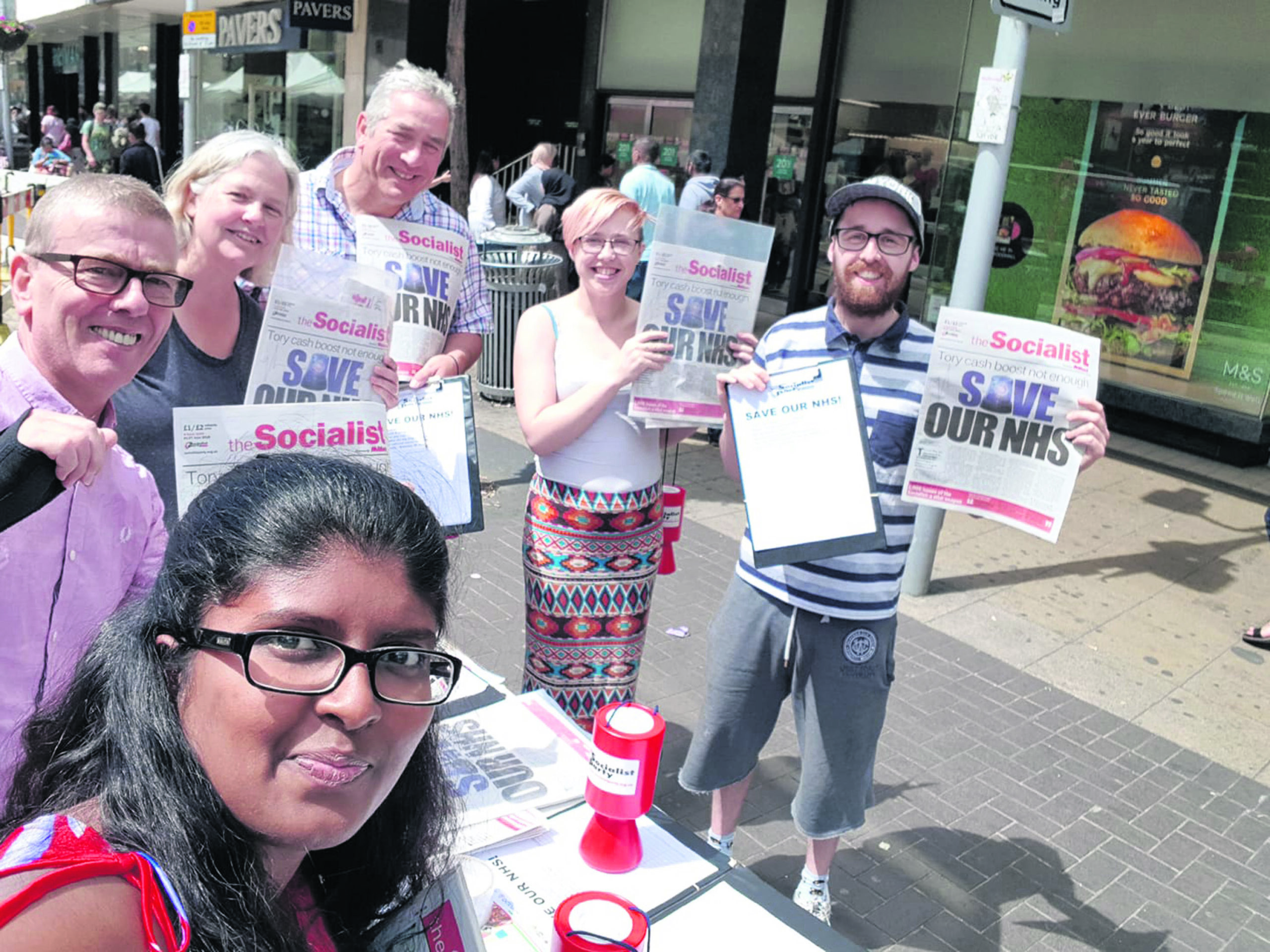
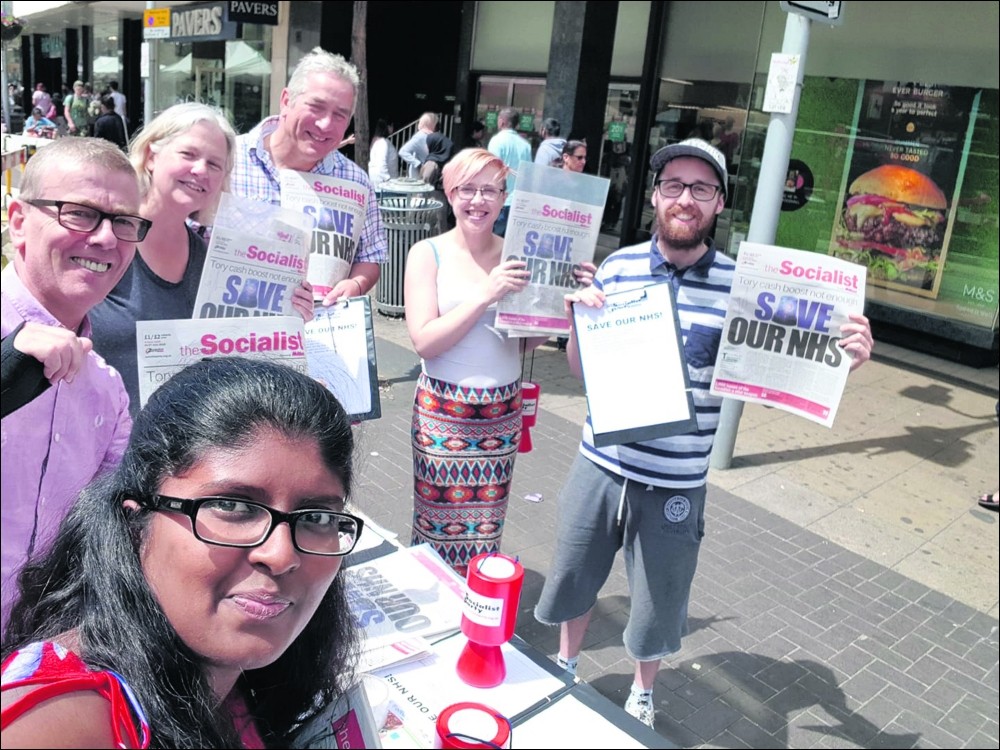
Sellers of The Socialist reported being surrounded by protesters eager to read our leaflets and buy our paper with the slogan "No war for oil"

The demonstration was so enormous that many didn't even get to hear the speakers at the rally in Hyde Park. The speakers included representatives from six national trade unions.

Film director Ken Loach summed up the mood of most of the protesters when he said: "We can't get involved in this war, we can't consider murdering another 100,000 Iraqis simply to pursue America's interest in the oil and their dominance in the region".

Speakers called for a "Don't Attack Iraq" day of action on 31 October. Labour MP George Galloway received the biggest cheer of the day when he called for protests and occupations of schools and colleges on that day.

The 28 September demonstration was a massive show of anti-war feeling. But it was just the beginning. Now we have to go back to our workplaces, schools and colleges and make 31 October a day of action that Blair will never forget.


Organise For The Day Of Action On 31 October

Workplaces

"I WILL be raising the 31 October 'Don't Attack Iraq' day of action at my next union branch committee meeting.

I will be proposing that we organise a lunchtime lobby of the council, linking together the question of defence of public services and war against Iraq.

Members are already angry that Blair is prepared to spend billions on military action while continuing to privatise our services and saying that there isn't enough money to pay public sector workers a decent wage.

This day of action could help build support for wider action if an attack on Iraq takes place."

Brian Blake, Unison regional local government committee executive member and service conditions officer, Ealing Council (personal capacity)

Schools and colleges

"IF YOU'RE at school, college or university why not organise a 'Youth against the war' or 'Students against the war' meeting to plan leafleting, petitioning, publicity stunts and protests against the war and to build for the 31 October day of action.

Organise to get pledges from students who will be prepared to take part in protests, occupations etc on 31 October."

Kieran Roberts, national coordinator Socialist Students

Campaigning material

CONTACT THE Socialist Party for camapigning material for the 31 October Day of Action.

Ring Ken Smith on 020 8988 8778, write to PO Box 24697, London E11 1YD or email campaigns@socialistparty.org.uk

Voices From The Demo

I'M AN Iranian. During the Iran/Iraq war Saddam used chemical weapons against us. My family live in Tehran and my sister has had heart and kidney problems because of the gas. I'm here because we need to get rid of Saddam but the ordinary people of Iraq aren't my enemies. Helen

I FEEL strongly about the war. I think it's all about controlling resources in the Middle East, whilst innocent people are killed. Saddam is a tyrant but the poor people of Iraq have suffered long enough. PCS member from Sheffield

WHAT ATTRACTED me to your table in the first place was the mention of oil, which is the root cause of all the conflict in the Middle East. If it wasn't for oil then the area wouldn't be fought over so much.

The epitome of all that is Mr George Bush and his cabinet - the whole executive branch of the government is all for oil. Steven, San Francisco

I'VE COME down from Derby because I'm opposed to any sort of war but this one is just about what America wants. They have their weapons but they won't let anyone else have any.

But the main reason I'm here is to support the Palestinians who have been suffering for so long. Being Muslim I feel I should speak out for them. Rabiya

I THINK it's disgusting that all this money will be spent on war when it could be used to feed the world. Sunara, Coventry


Home  |  The Socialist 4 October 2002  |  Subscribe  |  News 

Join the Socialist Party  |  Donate  |  Bookshop


Tube Strike 'Solid'

A 24-HOUR strike by London Underground workers on 24 and 25 September saw only a handful of the 600 drivers crossing picket lines. 

No trains could run. London Underground have imposed a 3% pay rise and have refused to go to arbitration. Another 24-hour strike is planned for 1/2 October.

THE PICKET at Stratford tube station in east London was kept up from 4.30am to 9am and restarted from noon. The strike was absolutely solid. No potential scabs showed up, so no one needed to be turned away.

By Manny Thain

Pete and Graham, London Underground drivers and RMT members, were on the picket line at the Jubilee Line depot in Stratford. They explained how the strike was for more pay.

Pete has been working on the Underground for over ten years and in that time has received only two real wage increases.

All the other settlements have merely kept pace with inflation, or have actually fallen below the inflation rate.

Management complain that the drivers and other staff are well paid, especially when compared with other public-sector workers in London. But Pete and Graham said these other public-sector workers are badly paid and should get more - especially nurses and firefighters.

Pay is the issue but anger has been fuelled by other problems. There is constant harassment by management. They've employed a new layer of managers with no experience in the industry, who try to exert bullyboy pressure.

There is pressure to cut corners on safety, like being asked to drive a train with defective brakes, for example.

One driver who has worked on the Underground for over 20 years with an exemplary employment record is being disciplined for the amount of time he has had to take off, due to prostate cancer!

Privatisation hasn't happened because of the resistance put up by the tube workers workers. Privatisation would be a disaster for safety, working conditions and pay.

The government is behind the employers and neither wants a high wage settlement.

The government because it wants to keep public-sector wage deals down and the potential private employers because they don't want to have to pay their other employees comparative rates.

Pete and Graham will both be out on picket lines this week, both believe the action must continue.

They pointed out that relations between the two main rail unions RMT and ASLEF are good on the shopfloor level and have improved since the election of Bob Crow and Mick Rix as leaders.


AN EIGHTEEN year-old station assistant talked to PAULA MITCHELL on the Leytonstone picket line - her first day on the job!

"The human resources manager tried to scare new recruits into going in by saying it would go on our files.

But everyone in my training group said they wouldn't go in. The managers said it was nothing to do with us because we've just started but it's about our pay as well.

When I first saw the pay scales I thought it was a lot of money for the job but after the training I realised it isn't."

Class Warfare On London's Tube

IF THE new upturn in trade union militancy is a reminder of the 1970s then so is the dirty propaganda war, waged against striking workers, by the right-wing press.

Bill Johnson, RMT

In the last 12 months The Rail Maritime and Transport Workers' union (RMT) has been accused of working with Al-Qa'ida, planning a strike on 11 September and intimidating tube-workers who want to go to work.

Tube-workers in both RMT and ASLEF unions have taken two days of strike action over the past two weeks to try to make a belligerent management negotiate on pay.

Underground management won't negotiate because they have contractually agreed with the private firms taking over the Underground's infrastructure (through the PPP scheme) that the pay of staff remaining with London Underground Limited (LUL) won't increase above 'the market rate'.

The private firms have demanded this veto so as their own staff won't be encouraged by LUL settlements to seek significant pay rises of their own.

Management are determined to tame the unions ready for privatisation, where over 2,000 workers' jobs are to transfer to private contractors. Their refusal to go to arbitration breaks with the established practice of recent years.

This has been accompanied by threats of disciplinary action against striking workers and management propaganda attacking RMT General Secretary, Bob Crow, faxed to stations. Recognising this Bob Crow has called on activists to 'clear the decks' for this crucial fight.

RMT activists will take up this fight. Crow is right to see the dispute as an attack on future of the unions on London Underground. But despite this the leaders of both RMT and ASLEF are trying to keep the disputes over pay and privatisation separate.

Many union members see privatisation as an even more important issue than pay and cannot understand why we are not continuing our fight against PPP as part of our strike action.

If management are forced to move on pay the unions should push home the advantage and demand a halt to PPP before calling off action. It was management who raised the stakes and politicised this dispute - the unions must respond in kind.


Home  |  The Socialist 4 October 2002  |  Subscribe  |  News 

Join the Socialist Party  |  Donate  |  Bookshop


THIRTY-FIVE years ago the Cuban revolutionary Che Guevara was murdered in the Bolivian jungle by his CIA interrogators. 

PAUL HUNT and DAVE CARR review the life and times of this icon of anti-capitalism and social liberation.

Che Guevara - Revolutionary Fighter

"SHOOT, COWARD, you are only going to kill a man." According to legend, these were the last words of Che Guevara, just before his execution at the hands of the Bolivian army, who were in league with the CIA, on October 9, 1967, aged 39.

Thirty-five years after his death, Che lives on in the minds of young people struggling and fighting against the same inequalities that he dedicated his life to getting rid of - poverty, racism, and ultimately capitalism and imperialism.

Ironically, capitalist companies, seeing the popularity of Guevara, use his image to sell products.

But who was Che Guevara and more importantly, what lessons can we learn from his life in order to fight for and achieve the socialist world that he and other revolutionaries gave so much for?

Ernesto Guevara (only later did he pick up the nickname 'Che') was born in 1928, in Argentina, into a middle class background. Throughout his life he suffered a crippling level of asthma.

Che developed a keen interest in literature and philosophy, and his time at University studying medicine allowed him to broaden his horizons even more, where according to his own accounts he read Marx and Engels. At this stage he wasn't a member of any political grouping, but was known as a radical, although he apparently had no ambitions other than to be a doctor.

On a motorbike he travelled through many countries of Latin America witnessing at first hand the devastating effects that capitalism was having on the vast majority of the population - the excruciating poverty, lack of education and the generally dire state of peoples lives.

Cuban Revolution

UNDOUBTEDLY THE piece of history most closely associated with Che Guevara is the victorious Cuban revolution of 1959. But how did the wandering Argentinian get involved with the Cuban struggle against US imperialism?

It was another adventure, that took him to Bolivia and Guatemala, that made a lasting impression on his life and changed his direction to that of a self-sacrificing revolutionary fighter.

In Guatemala, a left-wing government led by Jacobo Arbenz was carrying out policies that were benefiting the poor and the working class. In 1952 the Arbenz government nationalised the United Fruit Company, a US multinational company that had bled the country dry. This was a measure too far for US imperialism and the CIA plotted to bring down Arbenz.

Amongst the revolutionaries and political activists that had been drawn to Guatemala to witness the struggle against imperialism were Cuban exiles who were involved in the struggle against the US-backed Batista government. But in 1954, with CIA help, Castillo Armas overthrew the Arbenz government, forcing Che and other left-wingers into hiding or exile. From here Che ended up in Mexico, where he would meet Fidel Castro in 1955.

His experiences in travelling Latin America, witnessing the dreadful poverty, and seeing first hand the destructive role of US imperialism and its stooges, compelled him to become not just a witness to great events but to actively involve himself in the struggle.

July 26 Movement

Che joined a group called the 'July 26th movement' which was led in part by Fidel Castro, and had the aim of removing Batista from the government. But after the overthrow of Batista, what should happen then? What sort of regime should take the place of the hated Batista?

By this time Che was a committed socialist, but remained a minority in this movement, many of the participants were intellectuals and students whose programme for a 'democratic' Cuba didn't go beyond the bounds of capitalism. This included Castro.

On 2 December 1956 this small, badly organised group of 82 fighters, including Che, landed in Cuba and launched a guerrilla war against the hated Batista regime.

After several setbacks, this guerilla force gained more and more support amongst the peasants, and coupled with the brewing anger amongst the urban working class, it meant that the Batista regime was drawing to an end.

In the struggle between the US-backed government and the rebels, Che stood out as a disciplined, determined and courageous fighter. Despite the effects of his dilapidating asthma condition he showed himself to be a principled leader who the other rebels admired and looked up to, and he was given command of his own column.

"Che's overall maxim was to lead by example, never to ask those under his command to do what he would not undertake himself.....he also refused all privileges." (Symbol of Struggle, Tony Saunois, p31)

Class forces

MEANWHILE THE debates raged within the July 26th movement between the liberal democratic elements and the more radical socialist leaders such as Che and Raul Castro, Fidel's brother and a young Communist. Who would lead the movement? What role would the urban working class play in relation to the rural guerrilla fighters and the peasantry? Should there be an alliance (popular front) with the liberal capitalists such as the Autentico and Ortodox parties?

The July 26th movement was initiated by Fidel Castro rather than the Cuban Communist Party (PSP). The Movement took its name from the date in 1953 of a failed assualt on the Moncada military barracks in Santiago, Cuba. The PSP denounced this attack as a "bourgeois putsch".

In fact the Cuban Communist Party (PSP), which had previously supported Batista as a 'progressive capitalist', still promoted a popular front policy of submerging the workers' movement with the national capitalist class in an 'anti-imperialist struggle'.

This 'two-stages' policy (first a democratic-capitalist society, second, at a later stage, a socialist struggle), which proved to be so disastrous to the workers' movement in Germany and Spain in the 1930s, relegated the PSP to playing a minor role in the unfolding Cuban revolution.

US imperialism was becoming increasingly worried with the situation and feared that Batista would be removed by a movement hostile to US dominance in the region. Before the revolution of 1959, Cuba was something of a 'rich boys' playground' for rich US businessmen, complete with casinos, prostitution and drug dens. It was also a key economic market for the US, especially in sugar. As a victim of imperialism, Cuba suffered widespread unemployment and general deprivation amongst the majority of the population.

Reaction defeated

ON 1-2 January 1959 after just two years of fighting, the rebels poured into the major cities. Che himself arrived in Havana where the workers had staged a successful general strike to mark the fall of the hated Batista regime.

Despite attempts by imperialism to destroy the new 'socialist' Cuba, (including the Bay of Pigs fiasco in April 1961 when an armed invasion of US-backed Cuban mercenaries was repulsed), they failed to dislodge Castro and the new regime.

Although Castro had come to power speaking of a "humanist" national revolution which was neither "capitalist" nor "communist" the revoltuion developed through a series of blows and counter-blows between US imperialism and the Cuban regime backed by the poor masses.

As a counterweight to oppose imperialism, the Cuban regime increasingly became drawn into the orbit of the Soviet Union and took more and more decisive measures against capitalism.

Eventually, the revolution in Cuba swept away landlordism and capitalism, establishing a planned, nationalised economy. It was on this basis that Cuba took huge strides forward which had been impossible under capitalism.

Illiteracy, commonplace under the old regime, was eradicated; education and health care were made freely available to all. Life expectancy increased rapidly and the Cuban masses made major social gains.

Che was against privileges and bureaucracy and did his share of manual labour amongst the workers in agriculture. Compare this to the Stalinist bureaucrats of the Soviet Union and Eastern Europe, who drove limousines and enjoyed huge privileges.

Despite the material gains of the masses through the revolution, we are not uncritical of the Cuban regime unlike some on the Left. Although there existed a plan of production, a nationalised economy and capitalism had been snuffed out, society was controlled by a layer of Communist Party officials, although the scale of their privileges didn't match that of the bureaucracy in the Soviet Union.

"Che reacted with hostility to what he saw in the Soviet Union. On one visit, invited to dinner in the apartment of a government official, he ate his meal on the finest imported French porcelain. During the dinner he turned to his host and sarcastically quipped: "So the proletariat here eats off French porcelain, eh?" (Symbol of Struggle, p52)

While a system of workers' democracy was present in Russia after the revolution of October 1917, (until the isolation of the revolution and the rise of Stalinism extinguished it) the system in Cuba was different due to several factors.

"There was undoubtedly an element of workers' control in the factories in the first period of the revolution and every neighbourhood and street had a 'committee for the defence of the revolution'. ...But at the same time the masses had no control or management of the state machine." (Cuba, Socialism & Democracy, Peter Taaffe, p105)

Unlike the Russian Revolution of 1917, the predominant force in Cuba was the peasantry that had been led by the guerrillas, the working class had played a secondary role. The other major factor was the absence of a mass revolutionary workers' party armed with a socialist programme, which would introduce a system of workers' democracy.

Flawed socialism

IN BOLIVIA, 1967, Che attempted to organise another 'Cuba', but failing to base his movement on the country's working class and failing to win any real support amongst the peasantry, the mission was really doomed from start to finish. With the help of the CIA, the Bolivian military captured Che, and eventually shot him - much to the delight of the capitalist class in Latin America and internationally.

Che's socialism was flawed because of his underestimation of the role of the working class in changing society. This was partly a reflection of his class background and because he was not an active member of any organisation in the workers' movement.

He was also heavily influenced by earlier nationalist movements led by people such as Simon Bolivar in the 19th century and the peasant armies of Zapata and Pancho Villa during the 1910-18 Mexican Revolution. These struggles took place in a period when the workers' movement was in its infancy. He failed to appreciate the central role of the working class in leading the 1917 Russian Revolution insisting instead on the primacy of the peasantry engaged in guerrilla struggle.

But as Marx pointed out, the peasantry are a class in themselves but not a class for themselves. This lack of a clear class consciousness means they can act as a revolutionary but also a reactionary class. While some will align themselves with the working class others will aspire to becoming small capitalist producers.

Yet Che dismissed the working class as the leading revolutionary force in Cuban society. "It is no secret that the strength of the revolutionary movement was primarily among the peasants, and secondarily among the working class... Cuba, like all underdeveloped countries, does not have a powerful proletariat", he said in June 1960. This despite the fact that the Cuban working class in 1959 was far greater than the Russian working class was in 1917, in percentage terms.

Che was a revolutionary but without a worked out Marxist programme which led to his wrong approach toward building revolutionary forces and, ultimately, his death.

He died a revolutionary hero and, rightly, hundreds of thousands if not millions of people look to him as a symbol of struggle against imperialism.

We will learn the lessons of Che's heroic life, the need to base the struggle on the working class and for a mass party of workers and poor, and carry out the task that Che dedicated his whole life to - the victory of the socialist revolution.


Is Cuba Socialist?

AFTER THE 1959 revolution, Fidel Castro's regime overthrew capitalism and landlordism, nationalising industry and the land. This was not part of a conscious socialist strategy but a response to the movement of the masses and a riposte to the counter-revolutionary pressures of big business and US imperialism - who retaliated to a government tax on sugar companies by imposing an economic blockade which lasts to this day.

In 1960 Castro declared Cuba "socialist". In fact Cuba was run by a bureaucratic caste as in the Soviet Union - a military/police state resting on a bureaucratically planned economy. Those elements of workers' democracy which existed in the factories and neighbourhoods were short-lived.

Without workers' democratic control and management of a planned economy, gross distortions in the supply and demand of goods and services (regulated under capitalism through the brutal mechanism of the market), inevitably occur. Ultimately, these distortions caused a massive wastage of resources and economic stagnation leading to the collapse of the Soviet Union and the states of eastern Europe.

And without political accountability, in a situation of economic shortages, inevitably the ruling caste from their position in the state apparatus draw higher salaries, enjoy better housing and many other privileges.

Working class gains

But despite bureaucratic mismanagement and a US-imposed blockade, the planned economy has meant big gains for the working class, especially in the field of health and welfare.

There is much in Cuba today that compares favourably with the situation facing workers and poor people in the capitalist world, especially in neighbouring central America and the Caribbean.

With 7,000 GPs there is one family doctor for every 500-700 people in Cuba compared to 1,800-2,000 in Britain. Average life expectancy before 1959 was 48 years for men and 54 years for women. Now male life expectancy is 74 (the same as in the UK) and for women 76 (79 in the UK). Infant mortality is 7.1 deaths per 100,000 live births, similar to Britain.

However, the ending of heavily subsidised oil imports in the early 1990s following the collapse of the Soviet Union, devastated the Cuban economy. This has been partly offset by striking a favourable oil importation deal following the visit in October 2000 of Venezuela's 'radical' president, Victor Chavez.

Nonetheless, the shortage of goods and spare parts has created a black economy. Moreover, Fidel Castro's regime has been forced to open up the ailing economy to foreign tourism, resulting in the development of a parallel 'dollar' economy.

This 'tourist apartheid' has exacerbated the growing inequalities between those engaged in the dollar economy and other Cuban workers. Prostitution, largely eradicated after the revolution, has reappeared and crime is also growing.

Cuba at a crossroads

At some stage, the contradictions between this nascent capitalist economy and the faltering state-owned economy will lead to the restoration of capitalism similar to what occurred in Eastern Europe and the former Soviet Union in the 1990s - unless the limitations of 'socialism in one country' are overcome through an international socialist revolution.

If not, the island economy will be slowly throttled by pressure of the capitalist world economy and US imperialism. As US Vice-President Dick Cheney declared: "I don't think there is any prospect for lifting those sanctions as long as Fidel Castro is out there."

What is needed is the democratic control of Cuba by the working class.

A programme for workers' democracy requires an end to one-party rule and free elections for parties who accept the planned economy. It also means trade unions independent of state control.

What exists in Cuba today is not a 'healthy' socialist society but a 'hybrid' whose transition to a workers' democracy or regression back to capitalism will be determined by the struggles of the working class internationally.

With the onset of the world capitalist crisis, a renewed wave of successful socialist revolutions throughout Latin America would regenerate the Cuban revolution.


Home  |  The Socialist 4 October 2002  |  Subscribe  |  News 

Join the Socialist Party  |  Donate  |  Bookshop


Socialist Success In Sweden

THE SOCIALIST spoke to two of the CWI's (Rättvisepartiet Socialisterna, RS) new councillors, elected on 15 September in the Swedish town of Luleċ.

Liv Gustavsson Rhodin, 21, unemployed:

How was the election campaign?

Intensive, but also fun. We've all learnt a lot.

What's the first thing RS is going to do in the council?

One of the things we've discussed is to demand more money for education, to reinstate the youth support staff and stop closures. At the same time Jonas and I speak on this in the city council, school students and parents will be demonstrating outside.

In the election campaign the party's candidates won a lot of respect for your firm, principled defence of workers' rights. Where does your determination come from?

Probably because I'm convinced that struggle is inevitable, against oppression and suffering in the world, a struggle which must ultimately do away with capitalism. You get a lot of confidence and feel very encouraged when you get so much support from workers in the health service for example.

Jonas BrŠnnberg, 27, is also district chairman for RS in Luleċ:

Are you satisfied with the election campaign?

Yes! All the other parties have been forced to confess that we had the best campaign. We ran rings round the other parties as far as the number of election workers was concerned. One example was on polling day when our ten newest recruits stood for a combined 90 hours at polling stations.

What kind of reactions have you met?

We're congratulated by people in the streets coming up to us saying, "you fought well". Some are anxious too, after all the betrayals by other parties. They tell us we've got to stand for what we said we would.

It's emerged that you're not the first member of your family to sit in the council in Luleċ, actually the fourth...

Yes, my father, grandfather and great-grandfather all sat in the council for the Communist Party (Left Party's forerunner). They weren't bureaucrats, they led struggles from the council chamber. My grandfather built the electricians' union into one of the most militant unions in northern Sweden.

What happens next?

We're going to continue with what we've been doing, that is, campaign against cuts in services. During the election campaign it was clear to us just how angry the mood is among health service workers with their wages and conditions. This is something we'll pay more attention to.


Home  |  The Socialist 4 October 2002  |  Subscribe  |  News 

Join the Socialist Party  |  Donate  |  Bookshop


Washington IMF protests

Fighting War, Poverty And Exploitation

THOUSANDS OF demonstrators staged a spirited march and rally as part of a week of events against the IMF and World Bank in Washington DC this past weekend - despite the arrest of 659 people by police.

Alan Jones, New York City

While the rally was not as large as previous anti-globalisation events, the threat of disruptive protests as well as the slumping global economy led the IMF and World Bank officials to shorten the meeting from nearly a week (of parties and schmoozing for the global financial elite) to two days.

The issue of war against Iraq, the plight of the poor across the globe and the refusal of capitalism to deal with the global AIDS crisis were at the forefront of the rally with slogans such as "Quarantine corporate greed" being popular among the demonstrators.

Activists demanded poor country debt relief, the end of structural adjustment programs and more transparent decision-making at the World Bank and the IMF.

A separate Global AIDS March converged with the group near the lenders' headquarters mid-afternoon.

Those wearing stickers saying: "IMF - cancel poor country debt, fight AIDS", mingled with others wearing bumper-stickers on their clothes that said simply: "Do not bomb Iraq".

Even the Washington Post had to admit on 30 September: "It is significant that due to the anaemic growth, economic crises and stubbornly high poverty rates in a number of countries that pursued IMF and World Bank-backed programmes, a sense of disillusionment is spreading with the 'Washington consensus', the package of policies long touted by US policymakers and international lenders as keys to prosperity for the world's poor. The main elements of the consensus include policies aimed at curbing inflation, opening markets, dismantling government controls and privatising state enterprises."

As protesters denounced the global economic regime, IMF and World Bank leaders agreed Saturday to pursue new ways of "resolving" the spreading financial crises, including a groundbreaking bankruptcy court process for insolvent governments. This is not particularly encouraging for the advocates of global capitalism.

Despite the massive propaganda drive of the Bush administration for war against Iraq as part of the 'war on terrorism', and the failure of the organisers of the rally to link the issue of war against Iraq to the struggle against globalisation, the indications are that the anti-globalisation/anti-capitalist mood among a section of young people and workers will continue to exist in the US. They will be further radicalised by the prospect of war against Iraq, economic crisis and the threat of mass unemployment.

Members of Socialist Alternative from New York, Boston and Oberlin participated in the rally raising the need for socialist ideas and a programme to fight against war, poverty and exploitation. We sold over 400 newspapers.

There are already rallies and demonstrations planned against Wall Street and corruption and against war in New York and San Francisco in October.


Home  |  The Socialist 4 October 2002  |  Subscribe  |  News 

Join the Socialist Party  |  Donate  |  Bookshop
