

The Socialist 8 December 2000

Health Crisis Deepens

Health Crisis Deepens NEW LABOUR claims to have spent billions on solving the crisis in the NHS. In particular, it says it's spent £150 million to deal with coming winter pressures. But still there's talk of yet another winter crisis. Why?
End the Transport Chaos The headline in the Independent 1 December: “Government seizes control of railways” wouldn't have been out of place in an April Fool's Day paper. All the government was doing was to set up an emergency task force, headed by Lord Macdonald, to help the privatised industry recover from its self-inflicted wounds.

Build Unity to Stop Hackney Cuts

HACKNEY'S COMMUNITY Conference on Sunday 3 December was an excellent opportunity to develop the campaign against the council attacks on jobs and services.

Fight Global Capitalism

Representatives of the Committee for a Workers' International (CWI - the Socialist International organisation to which the Socialist Party is affiliated) recently met to discuss developments in the capitalist world economy, the political struggles of the working class, and the prospects for socialism. Per Ollson, of the CWI's international secretariat, summarises the main issues and conclusions. Followed by Building the CWI

Nice conference: Shame about the treaty

THE FRENCH Riviera is the venue for the European Union (EU) intergovernmental conference on 7/8 December. In Britain, the talks will provoke more media hysteria, and more voter indifference.
Israeli Government: One Big disaster SINCE TAKING power a year-and a half ago in a landslide victory, Barak's government has been one massive disaster.


[Top of Page] [Home] [News] [The Socialist]


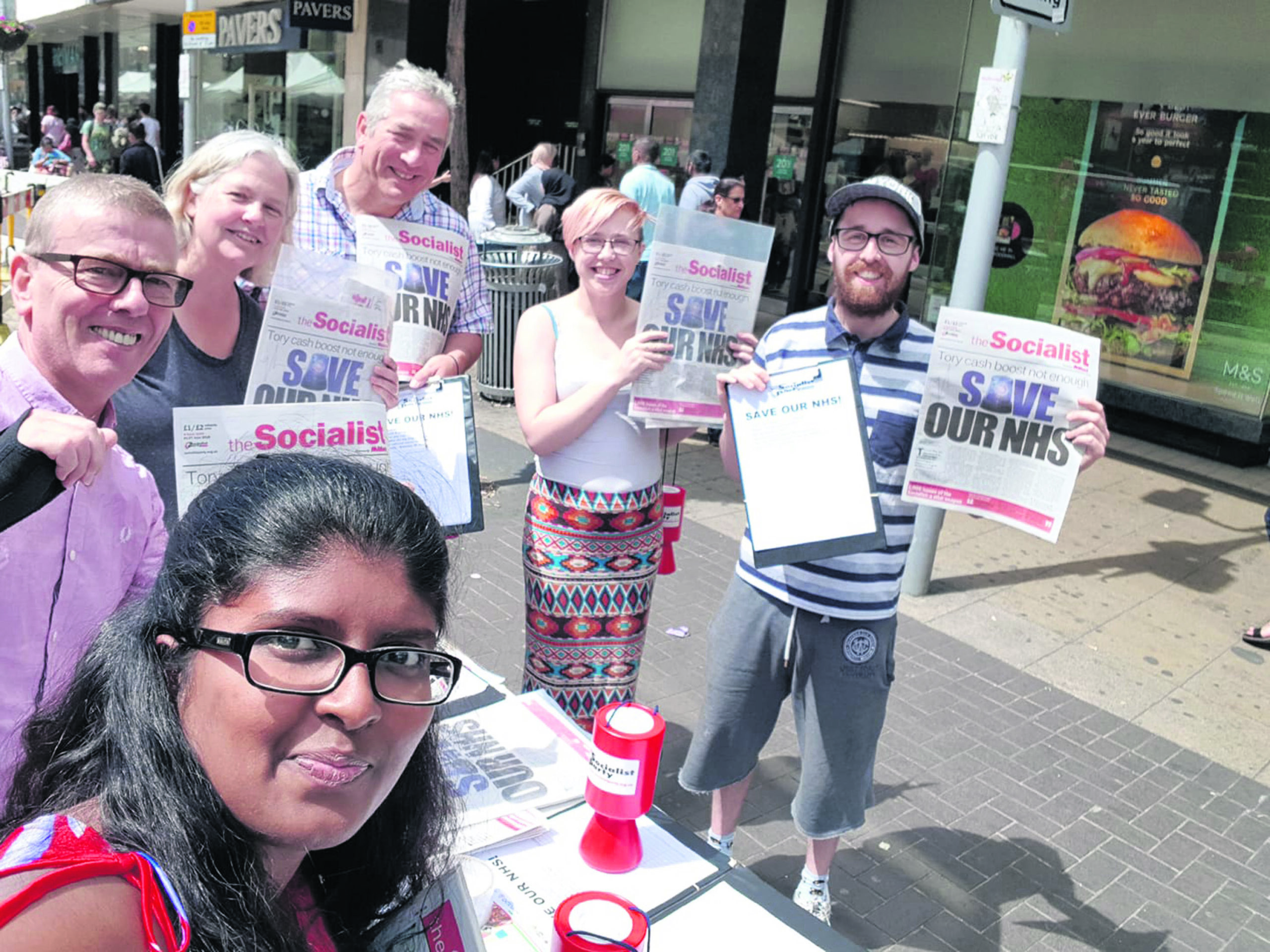
Health Crisis Deepens

NEW LABOUR claims to have spent billions on solving the crisis in the NHS.  In particular, it says it's spent £150 million to deal with coming winter pressures. But still there's talk of yet another winter crisis.  Why?

There's no physical shortage of beds - the government has purchased thousands of extra beds and they claim the hospital space is there too.

The shocking truth is there isn't enough staff to attend to the patients who would occupy these beds.

The lack of nurses stems from the appalling low pay and conditions they have endured in the NHS for decades.  Still the government shows no real signs of tackling that problem.

It's quite prepared to waste £20 million out of its allocated £150 million on deals with the parasitic private sector to provide emergency beds.

The root cause of the NHS crisis is the, a decent pay rise.

Last year the UK Central Council for Nursing government will not give lower-paid healthworkers, including ancillary, clerical and nursing staff said over 5,000 nursing jobs vanished overseas - 33% higher than in 1999 and the highest figure for ten years.  The number of mid-wives fell by 600 in one year.

New Labour talk of bringing nurses back in to the profession but State Enrolled Nurses who left the NHS before 1990 and now want to return are charged £2,000 for retraining by some NHS trusts.

Student nurses are leaving in droves because of only being paid £2.60 an hour and facing intolerable accommodation problems.

Blair nearly admitted this week that the billions extra Labour earmarked for the NHS won't avert a winter crisis.  That's because the money is going down a privatisation plug-hole rather than in to the pockets of the healthworkers who keep the NHS alive.

A sure start to ending the NHS winter crisis is to stop NHS privatisation, stop subsidising private sector healthcare and pay up for the healthworkers.


[Top of Page] [Home] [News] [The Socialist]


End the Transport Chaos

The headline in the Independent 1 December: “Government seizes control of  railways” wouldn't have been out of place in an April Fool's Day paper.

All the government was doing was to set up an emergency task force, headed by Lord Macdonald, to help the privatised industry recover from its self-inflicted wounds.

Yet all that's happened is an announcement that at least half the speed restrictions will remain in force beyond February 2001.

Confusion caused by the new speed restrictions has led more signals to be passed at danger than previously.  Railtrack's record on repairs has got even worse.

They checked and declared safe a defective track near Glasgow then just a week later, there was a derailment on that very stretch.

The profit motive has ended the safety culture on the track.  Railtrack runs the Safety and Standards Directorate and has a cosy relationships with private train operating companies and contractors, who seemingly ignore safety standards if they're inconvenient.

All the privatised rail system's attempts to resolve the difficulties have pushed nearly a third of its passengers on to the roads, which has 12 times the fatalities of the rail system.

Some rail companies and their defenders in the capitalist press say that it costs so much more to get such improvements as the Advanced Train Protection system (£15 minion per life saved), compared with implementing transport department guidelines on road safety, that it's hardly worth it.

In other words they're pleading to be allowed to carry on gathering profits from an unsafe system.

Even Sir Steve Robson, the Treasury mandarin who masterminded rail privatisation, has admitted that the network was broken into too many different entities and the system was geared too much towards “train operating companies cutting costs and too little on customer service”.

Sir Steve is now resigning his £110,000-a-year job to go windsurfing.


[Top of Page] [Home] [News] [The Socialist]


Build Unity to Stop Hackney Cuts

HACKNEY'S COMMUNITY Conference on Sunday 3 December was an excellent opportunity to develop the campaign against the council attacks on jobs and services.


Chris Newby


Five hundred voluntary organisations in Hackney were sent a leaflet about the conference.

However, it seems that the Council for Voluntary Services, frightened by the potential of a successful conference, made attempts to stop organisations attending.

The marvellous 6 November protests show the potential for developing this campaign to stop the cuts and win more funding to improve services and conditions in Hackney.

The critical issue is how to develop a strong democratic united campaign that reaches every estate, every workplace and every community organisation in Hackney.

This conference was initiated by Hackney UNISON, following a resolution moved by Socialist Party member Brian Debus, UNISON Branch Chair.

One of the aims of the conference was to bring unions and service users together in a co-ordinated campaign against cuts and, to this end, to democratically elect a committee with representatives from all the participating organisations.

A campaign organised in this manner could really begin to develop mass support throughout Hackney.

However, incredibly, some people at the conference, most notably the Socialist Workers Party (SWP), seemed determined to undemocratically prevent this issue being discussed and to stop a vote being taken on it.

They argued that the Fightback organisation initiated and dominated by the SWP should be the only community organisation to fight this campaign.

An attempt by the SWP to insist community organisations fight these cuts exclusively under the banner of Fightback could undermine the necessary unity to win this campaign.

Socialist Party members were also shouted down by SWP members when they tried to raise the idea of community candidates based on an anti-cuts programme for forthcoming council elections and by-elections.

While Socialist Party members and the London Socialist Alliance (LSA) will obviously contest elections, it would be wrong to insist that genuine activists from the tenants' associations and community groups need to stand under the LSA banner.

Whilst some good initiatives came from this conference (many of which were raised by the Socialist Party), particularly about supporting the union's one-day strike planned for 18 December a big opportunity to fully develop this struggle within the community was lost.

It's vital that every effort is made to ensure the strike on 18 December is a huge success, through visiting every workplace to prepare for a complete shut-down of the borough.

A very successful Socialist Party public meeting in Hackney heard Sam Dias, our victorious candidate in Pepys ward, Lewisham give full support to the campaign against the council attacks.

A UNISON shop steward at a Hackney school gave horrific examples of how the deterioration was a real danger to the safety of pupils, teachers and other workers.  A successful appeal raised £175.


[Top of Page] [Home] [News] [The Socialist]


Representatives of the Committee for a Workers' International (CWI - the Socialist International organisation to which the Socialist Party is affiliated) recently met to discuss developments in the capitalist world economy, the political struggles of the working class, and the prospects for socialism. Per Ollson, of the CWI's international secretariat, summarises the main issues and conclusions.


Fight Global Capitalism

For workers unity and world Socialism

A NEW pattern has been established over the last 15 years.  An upturn, or recovery in the economy, no longer generates a general improvement in the living conditions of working people.  Little of the new wealth enjoyed by the rich 'trickles down' to the poorest sections of the population.

In countries like Britain and the US people are working longer hours with increased stress.  Low pay with minimal job security and workplace rights is increasingly the norm.

In addition, severe cuts in public spending on health, welfare services and pensions have generated widespread feelings of alienation, anxiety and uncertainty.

The established parties are becoming mere “election machines”, run by rich cliques and PR firms and slavishly pursuing a big business agenda.  This has undermined the 'democratic legitimacy' of capitalist and governments and deepened the crisis in the political system.


With the economic boom bypassing a majority of workers and an unprecedented widening in

the wealth gap, a new anti-corporate mood has developed.

In the US, a new generation of radical youth has started to become active in a struggle against 'corporate America" and the effects of global capitalism, the multinational companies’ use of sweatshops and a rotten political system.  The 'Battle of Seattle' in November 1999, involving organised labour and youth, was a turning point in that respect.  And it was this anti-capitalist constituency that overwhelmingly supported the radical candidate Ralph Nader, who received

2.7 millions votes (3%) in the recent presidential election.


Towards a 'hard landing'?


THE PRESENT level of industrial overcapacity, the speculative bubble in the US financial markets, combined with huge corporate and personal debts, all point towards a new and severe crisis of global capitalism.

US capitalism has acted as 'a buyer of last resort' and a safe haven for foreign capital but is now paying the ultimate price: a stock market that is heavily over-valued and an unsustainable consumer boom causing massive indebtedness.


The new hi-tech economy is going from dot.com to dot.bomb. In this meltdown, the Nasdaq (index of hi-tech shares) has lost 50% of its value since March.

The slowing of job growth, profit warnings, rising oil prices, stagnant factory output, and the beginning of a credit crunch (lending drying up) compelled the chief economist of Morgan Stanley Dean Witter to issue the following warning: "Remain on maximum alert for a global hard landing in the first half of 2001".

In November, Argentina came close to an economic collapse that could have caused a global financial meltdown.  If the government goes ahead and implements the draconian spending cuts proposed by the International Monetary Fund (IMF) the country could be plunged into turmoil and mass upheavals, similar to what occurred in Ecuador and Bolivia earlier this year.


A race against time


THE STRUGGLE to defend the world's ecosystems and stop environmental destruction is an essential part of our fight against the capitalist market.

Despite many conferences and warnings about global warming issued by scientists, little has been done to reduce the release of greenhouse gases causing global warming.

The recent fiasco in the Hague shows that the fate of the planet's future can neither be left in the hands of the capitalist politicians and bureaucrats nor in the hands of international institutions controlled by the major imperialist powers.

No global task could be more pressing than to turn the current wasteful and polluting way of production into ecologically responsible, sustainable production.  This task cannot be accomplished without the overthrow of capitalism and the establishment of a democratic socialist plan for the global economy.


International socialism


CAPITALISM IS a global, class-based system of exploitation.  International solidarity, joint actions and campaigns and, above all, building an international socialist organisation that can unite the working class and the oppressed people across the globe, are prerequisites for a successful struggle against the bosses and capitalist politicians.

Only the working class, united as a collective force and in alliance with other oppressed sections, can take society forward.

The establishment of a democratic socialist society is the first step towards a classless society that will lift humankind out of the realm of necessity and into the realm of freedom.

There is no lack of resources, wealth, knowledge or technology. As the United Nations concluded in 1998: "It is estimated that the additional cost of achieving and maintaining universal access to basic education for all, basic health care for all, reproductive health care for all women, adequate food for all and safe water and sanitation for all is roughly US $40 billion a year...This is the less than 4% of the combined wealth of the 225 richest people."


Working-class struggle


ARE THE CWI not old fashioned to talk about mass action, and the role of the working class in the era of computers and the Internet?  When everything needed seems to be a "click" away, and you are linked up with the whole world.  Even some on the Left have been lost in cyberspace'.

'Virtual power' can neither replace the active participation of workers and poor people in struggle, nor can a computer network act as a substitute for fighting, democratic socialist organisations.

Global capitalism has globalised the struggle.  A small group of workers can bring a country's economy to a halt, as the recent European-wide fuel tax protests showed by blockading oil and petrol supplies.

The ending of Milosevic's regime in Yugoslavia was a graphic illustration of the decisive role of the working class in a revolutionary process.  It was the miners strike at the Kolubara coal mine, Serbia's biggest mine, together with strike action from other Serbian workers, which broke the police ranks.  With the police going over to the workers and youth, Milosevic’s days were numbered.


Socialist planning


THE MULTINATIONALS use new technology to try to calculate exactly how much the market can absorb.  But this 'planning' is restricted to one company or one sector of the economy and the interests of its big shareholders.

It is planning to overcome the anarchy of the market, which, of course, is doomed to end in a failure, because the market and consumption (workers cannot buy back all the goods produced) always tends to fall behind the expansion of production in capitalism, causing recessions and slumps.

Nevertheless, if a multinational company can draw up a plan, in their interests, why could not a workers' government draw up a plan that serves the needs of working people?

What is needed is to separate the means of production from their present parasitic owners and to organise society in accordance with a democratic, rational plan.  Then it will be possible, in a relatively short period of time, to raise the standard of living for all people in the world.  And with a drastic cut in working hours people can start to build a new society based on human solidarity.

The resources for the ending of poverty, inequality and social deprivation exist on an international plane, not in one country alone.  A socialist victory in one country has to be spread to other countries; otherwise it would not be possible to move towards socialism.

That is why there is no more important task today than building a new mass socialist International.

The struggle against global capitalism will shape and decide the future of the new millennium, That is why the Committee for a Workers' International (CWI) sums up its aims as: "Fight global capitalism - For workers' unity and world socialism".


[Top of Page] [Home] [News] [The Socialist]


Building the CWI

“The True Threat from globalisation”

WORKING CLASS People and youth lack a political voice.  The task posed is therefore to rebuild the workers' movement on socialist lines, to lay the basis for the formation of new mass parties of the working class and youth.  At the same time, we are working to win members to our own parties and groups, and to win support for the ideas, programme and method of revolutionary socialism, i.e. Marxism.  The two tasks are complementary.

The CWI brings together socialist activists from 35 different countries on all continents.  The CWI is the international socialist organisation to which the Socialist Party is affiliated.

Though still a small force, the CWI has a record of struggle.  Members of the Democratic Socialist Movement, the CWI section in Nigeria, played an important role in the ten days of mass protest against fuel prices in June and were in the leadership in the general strike in Lagos, the capital.  This strike, for the implementation of a minimum wage, spread to other parts of the country.

The republic of Ireland is the only country in the European Union that does not charge households for water.  The Socialist Party, the Irish section of the CWI, was instrumental in organising the mass campaign that defeated the water charges in the late 1990s.

Youth Against Racism in Europe (YRE), formed by members of the CWI, are in the forefront in the fight against racism and fascism across Europe.  In February this year, the YRE and others organised a 15,000-strong school strike against Haider and the right-wing government in Austria.

10,000 marched took part in a demonstration in October, initiated by the YRE and the Socialist Alternative (CWI), to close down the headquarters of the Nazis (NPD) in Berlin.

The Socialist Party (CWI) in Australia played a prominent role in the very successful S11 mobilisation against the World Economic Forum in Melbourne.

The party was able to organise a 500-strong high school strike against the gathering of representatives of global capitalism, and to involve trade unions, particularly construction workers, in the protests.

In grudging recognition, the pro-capitalist Australian Herald newspaper (28 August) described the CWI as "the true threat from globalisation."


THE COMMITTEE for a Workers' International (CWI) is the socialist organisation to which the Socialist Party is affiliated. The CWI is organised in 35 countries and works to unite the working class and oppressed peoples against global capitalism and to fight for a socialist world. For more details including CWI publications write to: CWI, PO Box 3688, London E11 1YE. email cwi@worldsoc.co.uk Website: www.socialistworld.net


[Top of Page] [Home] [News] [The Socialist]


Nice conference: Shame about the treaty

THE FRENCH Riviera is the venue for the European Union (EU) intergovernmental conference on 7/8 December.  In Britain, the talks will provoke more media hysteria, and more voter indifference.

Manny Thain

The summit aims to draw up a Nice treaty, an extension of the treaty of Amsterdam (1997).  One of the key themes will be the enlargement of the EU to incorporate a number of Central and Eastern European states, along with Cyprus and Malta.  Turkey is also knocking on the door.

If enlargement goes ahead, the EU would be transformed.  The influx of new member states will dramatically increase the overall poverty rate of the EU.  About 17 % of the EU's population is poor, ranging from 9.4% in Denmark to 33.3% in Portugal.  Poverty ranges from 30% in Slovenia to 92% in Latvia.

David Piachaud asked in The Guardian (1 December): "Will the candidates ever catch up?  Getting to the EU average by 2015 would require sustained levels of growth in the front-running states of between 5% and 9% every year - rates which far in excess of any achieved over a sustained period by any European nation ever."

The effective exclusion of these countries from agricultural and other subsidies will exacerbate the gap in living standards between Western and Eastern Europe.

The ruling class of Western' Europe is picking the choicest morsels from the former Eastern bloc, looting these states of their industrial, natural and human resources.

The myth of EU 'free movement of labour' will be shattered.  A handpicked minority of technicians and skilled workers may be welcomed.  But thousands of poverty-stricken Central and Eastern European peoples will not be permitted to move freely.

With 15 states aiming to join, the EU's structures and representation will have to be reorganised.  The present system gives disproportionate weight to the smaller states.  The big players, however, are still able to dominate proceedings.  Nice is about them ensuring that they do not lose control.

The EU may have failed to establish a dynamic single currency, but is unrivalled in its ability to coin phrases.  French president, Jacques Chirac, sparked much consternation about a 'two-speed' Europe: that a core group in Europe would press on with the European project and leave the other states behind, particularly those on the, margins such as Britain.

All the states now agree, even though no one changed their position.  A 'two-speed' Europe has become 'enhanced co-operation'.

So, not only are Europe's states co-operating like there's no tomorrow, but that co-operation is enhanced.  Now the British government says, "Two speeds, but not two tiers".  Glad that's cleared up!


A bosses' Europe


THE SERIOUS side is that the EU is and always will be an exclusive club run in the interests of the EU's ruling classes – a bosses' Europe.  All the treaties, agreements and summits promote a big-business agenda: the 'liberalisation' of trade, economic and monetary union, cuts in social provision, and racist immigration laws.  Rules and deregulations - all geared to the needs of the multinational corporations.

The Nice summit plans to launch a new charter of fundamental rights.  This will be a statement of the EU's commitment to human rights, but will not be part of the treaty.

Although not legally binding, the British delegation was instrumental in removing any references to the right to strike and protection against unjustified dismissal.

When EU leaders meet they will do so in the face of tens of thousands of demonstrators protesting at their anti-working class measures.

The Committee for a Workers' International contingent will be pushing the need to build a socialist alternative to greed-based, profit-driven capitalism.

A genuine European Union of working-class people democratically planning the organisation of the economy and society - will only be possible if workers take control of society.

An international movement of working-class people could ensure that a continent could be built free from wage slavery, racism and discrimination - a socialist Europe based on human solidarity.


[Top of Page] [Home] [News] [The Socialist]


As the Israeli-Palestinian conflict deepens and the death toll nears 300, Israel's Prime Minister Ehud Barak has called fresh elections for next year. Meanwhile, US President Bill Clinton, fearing an new regional war, is again offering new peace talks to end the conflict. Mandy Rabin, Maavak Sozialisti (CWI, Israel), reports on the crisis facing the Israels ruling class and capitalism.


Israeli Government:

One Big disaster

SINCE TAKING power a year-and a half ago in a landslide victory, Barak's government has been one massive disaster.

In his election campaign, he raised massive hopes among workers and youth.  He promised to jump-start the economy, to provide free education from kindergarten to university, to create 300,000 new jobs in order to defeat unemployment, to end religious coercion, to withdraw Israeli troops from Lebanon as part of a peace deal with Syria, and to reach a comprehensive, lasting peace with the Palestinians.

Barak has not fulfilled even one of his promises.  Instead, his government has made cuts in health and education spending has cut unemployment benefit, and has made dirty deals with the ultra-orthodox parties, providing funding for religious institutions in return for political support.


After a hasty, ill-planned retreat under fire from Lebanon, the Oslo peace process now lies in ruins, with Israel in the midst of a bloody and protracted war against the Palestinians.

It is no wonder that Barak's government has been such a disappointment and disaster – capitalism is incapable of solving the crisis of unemployment, in education, welfare, security and peace in Israel.

Moreover, ten years of attacks on workers by consecutive governments has led to yawning gaps between rich and poor and the alienation of Jewish workers from the state.  This has made it increasingly difficult for the capitalist class to maintain their rule through a stable government based on one of the two main capitalist parties - Labour and Likud.

As disgruntled Israeli workers began to look around for an alternative to the two parties which had betrayed them, dozens of smaller parties have mushroomed, at the expense of the two establishment parties, forcing the ruling party to govern by means of unstable coalitions.

The ruling class sought to solve this problem, and provide for stable government by introducing a new, two-vote system – one vote for prime minister, one vote for the party in the Knesset – in order to strengthen the prime minister's rule.


Electoral system


BUT NOT solving the fundamental causes of political instability – poverty and unemployment – this new, two-vote system has simply exacerbated the problem: under the new electoral system, both Netanyahu and now Barak have been forced to rely on broad coalitions of small parties with diverse ideologies, in order to rule, and both were forced early elections.

Ehud Barak's dolly mixture coalition, including both ultra orthodox and secular parties, and parties favouring a peace agreement with the Palestinians, as well as those representing the hard-line settlers, was unmanageable.

Initially, each party demanded funding for its sector in return for political support, and as the government became increasingly unpopular, especially as a result of its attacks on workers and youth, so the coalition parties began to jump ship.

For many months now, Barak has been limping forward with a lame duck government that has minority support in the Knesset and is hated by a large section of workers and youth.

Barak announced new elections in order to pre-empt a vote of no confidence in the government, which was due to take place a couple of hours later, that would have anyway toppled the government and prompted new elections.

The two-vote system has been a disaster for the ruling class, making it even more difficult for them to form a stable government.  They will make every effort to abolish the two-vote system before the coming elections and return to the old system of one vote only, for the party.

Barak is so hated, that many workers want to vote for Netanyahu (if he returns to politics), if only to get revenge on Barak.  But Israel is a fast-moving, turbulent country, and a lot could happen between now and next year’s elections.

More in The Socialist


Top of Page] [Home] [News] [The Socialist]
