


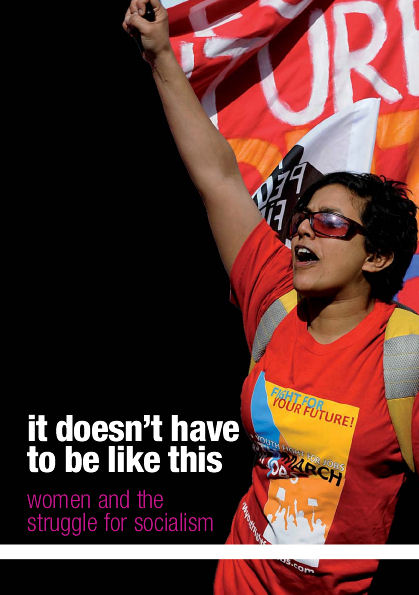
Buy Women and the Struggle for Socialism (Click to enlarge: opens in new window)
Christine Thomas, author of the new book ‘It doesn’t have to be like this – Women and the Struggle for Socialism’ spoke to Sarah Wrack about why such a book was necessary.
Christine was the Socialist Party’s national women’s organiser from 1994 to 2006. She has written extensively on the question of women’s oppression for the Socialist newspaper and the Socialist Party’s theoretical magazine Socialism Today.
What made you decide to write the book?
Over the last ten years or so a lot of books have been written saying that women have reached equality or that equality is just around the corner.
A lot of women seemed to be doing jobs that previously had been thought of as ‘just for men’, girls seemed to be doing better in exams than boys, young women’s expectations about their futures were higher, they were more confident about their sexuality.
All of those things together were giving the false impression that it would be possible to achieve equality. Unfortunately there was a need to challenge this idea that within the capitalist system it is possible for discrimination and oppression to be completely ended and for women to have complete equality.
Why do you not think women can achieve equality through a slow process of reforms?
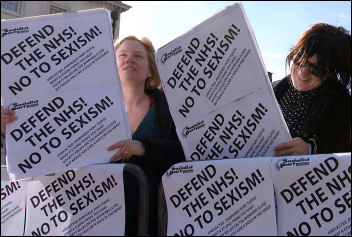
Protest outside the House of Lords against Tory Lord Mancroft who called nurses “grubby, drunken and promiscuous…an accurate reflection of many young women in Britain today”, photo Paul Mattsson
Well the current economic crisis has revealed that it isn’t possible. Capitalism is a system that is organically in crisis and the capitalists will always try and increase their profits at the expense of working class people.
When economic attacks take place, women tend to be particularly hard hit. The big cuts that are now being prepared – the almost decimation of the public sector – will hit women particularly hard because they work more in the public sector.
And of course women also rely on the facilities, services and benefits that the public sector provides or funds – childcare, housing benefit, the NHS etc, enabling women to go out to work and have a bit of economic independence.
When those services are attacked, because women even now still have most of the responsibility for looking after the family, they are particularly affected.
The book starts by looking right back to hunter-gatherer societies. Why do you think that’s relevant to look at today?
Some people say that women have always been oppressed and that there has always been inequality between men and women and therefore there always will be. Look at all the books that are written about men and women’s brains being wired differently.
I think it’s important to be able to look back over 99% of human history when there wasn’t systematic discrimination and oppression against women. Men and women sometimes had different roles but those were equally valued and roles were very flexible.
If we can see that there was a time in history when women weren’t oppressed we can see that it is possible to struggle for a system where they won’t be oppressed in the future.
In the book, you talk about the conditions that women in particular faced during the industrial revolution in Britain. Do you think a similar process is happening in the neocolonial world now?
Yes, that was something that really struck me as I was writing the book. There’s such a big similarity between the two – the terrible exploitation that women in those countries are facing is very similar to the exploitation that women faced here during the industrial revolution.
What effects do you think that will have on movements for women’s rights in neocolonial countries?
Obviously it’s a negative in terms of the terrible conditions these women have to work in – the fact they face sexual harassment in the workplace, sometimes can’t even go to the toilet, that they can get quite serious diseases because of their working conditions.
But on the other hand the fact that they are actually together in the workplace means that there is the potential for collective struggle and that is a positive effect. It can have an effect on the aspirations of those women. It has already led to some big struggles and I think it will do more so in the future.
What is meant by ‘new sexism’?
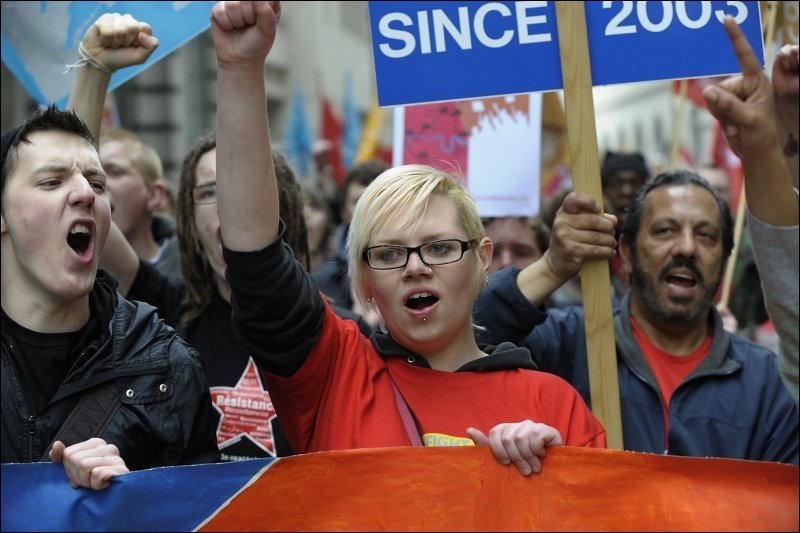
Young women are likely to be at the centre of the coming struggles against cuts, photo Paul Mattsson (Click to enlarge: opens in new window)
New sexism is often used to describe the fact that things, which in the past would not have been considered acceptable and that women’s movements have fought against (for example naked women being used in advertising), are now considered acceptable.
The fact that more women have jobs, that girls are doing better at school, that they feel more confident about their sexuality are all thought to mean it’s not sexism in the way that it was in the past. It’s a ‘bit of a laugh’ or its tongue in cheek or empowering and therefore we should accept it. The same in colleges, things like beauty pageants are not sexism, they’re just a bit of a laugh.
But of course they are sexism because the discrimination against women in society has not disappeared. It’s still there. And those kinds of things reinforce the idea that women are second class, inferior, just bodies and not thinking human beings.
And so although we have to be aware that there have been big changes in society and in people’s attitudes, that kind of sexism needs to be challenged just as it was in the past.
And why do you think it is that some people now see that behaviour as acceptable?
I think it is partly because attitudes to sex have changed, which on the one side is a positive thing. Even some young women accept those things because perhaps they feel confident about their sexuality and they think its ok without seeing how it undermines women more generally. I can understand that.
But I think it’s also that there haven’t recently been many big collective struggles in the workplaces or in society generally nor political organisations with a mass base advocating this way of fighting back.
Therefore the idea that you can challenge these things hasn’t been in a lot of people’s consciousness. Perhaps they feel that they’re on their own. Perhaps they would like to do something about it but they don’t feel that they can because they feel that it’s just them as an individual that has to deal with these issues.
You say ‘it is not the individual nature of the person in power or their sex which is important – what matters is which class interests they represent’. What do you mean by that?
Some feminists argue that if we didn’t have men in positions of power, if women were in those positions, then things would be different because women are less aggressive or more collaborative.
But it’s not a question of gender but whose interests, which class interests, people represent. Many female politicians enter government and end up cutting money for things that could help women like refuges or council housing; they end up attacking them because of the logic of the capitalist system.
Why do you think that movements for women’s rights have tended to parallel generalised big social movements?
It’s not necessarily the case that women’s movements will only take place when there are industrial struggles but obviously when there are collective struggles (and particularly successful ones), that will have an impact on other sections in society.
So I think there is a link between the two and historically women’s movements have tended to take place when there are big movements taking place in society generally.
You’re very clear of the dangers of separating the struggle of women from that of working class men. But some people would question how women can be expected to fight for liberation side by side with the people that they see as oppressing them?
On their own, women will not be able to change this system because it needs the majority of working class people to be actively and consciously involved in changing it. But that doesn’t mean that we would accept sexism on the part of men, I think it’s important that sexism is opposed wherever it occurs. But we have to work towards the maximum unity of men and women if we’re actually going to really achieve the liberation of women.
You say ‘economic and social class can make a huge difference to how women experience oppression.’ What do you mean by that?
Domestic violence is a good example of that. There are many reasons why women stay in violent relationships or find it difficult to leave and some of those will be emotional.
But there are also many economic reasons as well because you have to have somewhere to go if you want to leave. And if a refuge is being cut, that is going to limit your options. If you have money and economic independence, then that might make it easier. If you haven’t and are on a low wage then it can make things much more difficult.
The same is true of abortion rights. Everybody theoretically has access to abortion but in America for example, if you live in an area where there isn’t an abortion clinic, then it’s very difficult for you. But if you have money, you can travel to another area.
So how would you respond to the argument you often hear that class can’t be the most important element of movements for women’s rights because all women are subject to things like sexism, domestic violence and rape?
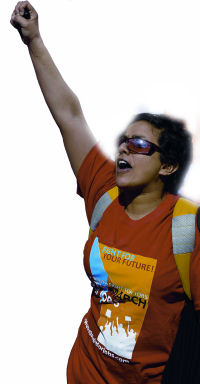
Youth Fight for Jobs demonstration 2009
It’s true that all women can experience those problems but they are all linked to class society because this is a society which is based on inequality, not just of wealth but of power as well.
It’s a society that has based itself on the oppression of women, particularly within the family but also within society generally.
Questions like domestic violence are linked to power and control and traditional ideas that men should have control over women within relationships. They’re quite deeply ingrained in society, obviously there have been important advances but nevertheless those ideas still exist. They are rooted in class society and class society helps to perpetuate those ideas as well.
The solution you put forward for that is an end to class society and for socialism. How do you think that would actually change things for women?
Obviously economically it would make a huge difference. If we were able to plan production in society and we were able to decide democratically where resources were to be allocated then it would be possible for people to have a decent wage that would enable them to have economic independence. It would enable us to have decent childcare and other public services.
It would also not just be an economic question because the ideas and values of society are reflected in personal relations.
We live in a society which is based on inequality, hierarchies, power and control and that is reflected in the way that people relate to each other. If we lived in a society which was based on equality, cooperation and planning that would reflect itself in people’s personal relationships as well.
I’m not saying that if we get rid of capitalism and replace it with socialism then over night everything will be ok because some people will still have some of the old ideas of the previous society, but it will lay the basis for those ideas to disappear.
A whole section of the book is devoted to what happened in Russia. Why is that example important for the women’s movement to look to today?
Well there are a lot of myths about what happened in Russia, particularly since the collapse of Stalinism 20 years ago. That chapter was to explain what really happened in Russia, to explain that the Russian revolution made a huge difference to women’s lives, even in a very backward country.
Those gains were undermined because the revolution was isolated, because there weren’t successful revolutions in the advanced countries like Germany and Britain and this led to the rise of Stalinism, which undermined the gains women made. It’s to show that it is possible and it will be possible in a socialist society to radically change women’s lives.
You also refer a few times to the Campaign Against Domestic Violence. Why do you think that campaign was so important and what did it achieve?
Domestic violence is obviously a huge issue; one in four women will experience it at some point in their lives. I think the campaign was important because it didn’t just highlight the question of domestic violence – it was important to raise awareness and say that women didn’t have to put up with it and that they could actually do something about it.
But it also put forward practical points about what women could do. For example what was needed to be achieved for women to have economic independence – more spending on refuges, more building of council housing and better childcare.
And it orientated to the trade unions, which, with all their faults, organise around seven million workers in this country. Therefore they are a collective force that can potentially fight for change.
And it was very important that as a result of that campaign, virtually every national trade union in the country had a policy on the question of domestic violence.
But it’s an ongoing campaign because, so long as we have this system, domestic violence is going to continue.
What do you think will be the biggest issues facing women over the next few years?
The economic crisis and its aftermath is now the main threat to women’s rights in the workplace and in wider society. In particular, the bloodbath that’s being prepared in the public sector. There will be no let-up in the attacks unless we organise and resist, in the workplaces and in the communities.
We have to fight every individual attack – job cuts, privatisation, worsening conditions, closure of services – while placing these in the wider context of a capitalist system that is rotten and flawed and needs to be overturned.
We need a workplace, social and political struggle. That means building and strengthening organisations that will be capable of waging those struggles – the trade unions, social and community organisations, a new political party that will represent the interests of all working people and campaign on issues of particular concern to women.
I’ve no doubt that women will be in the front line of those struggles – our rights are under attack from every angle and we have the most to gain from fighting back.
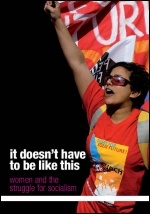
Women and the Struggle for Socialism
Click here to buy a copy of It doesn’t have to be like this – Women and the Struggle for Socialism by Christine Thomas
