

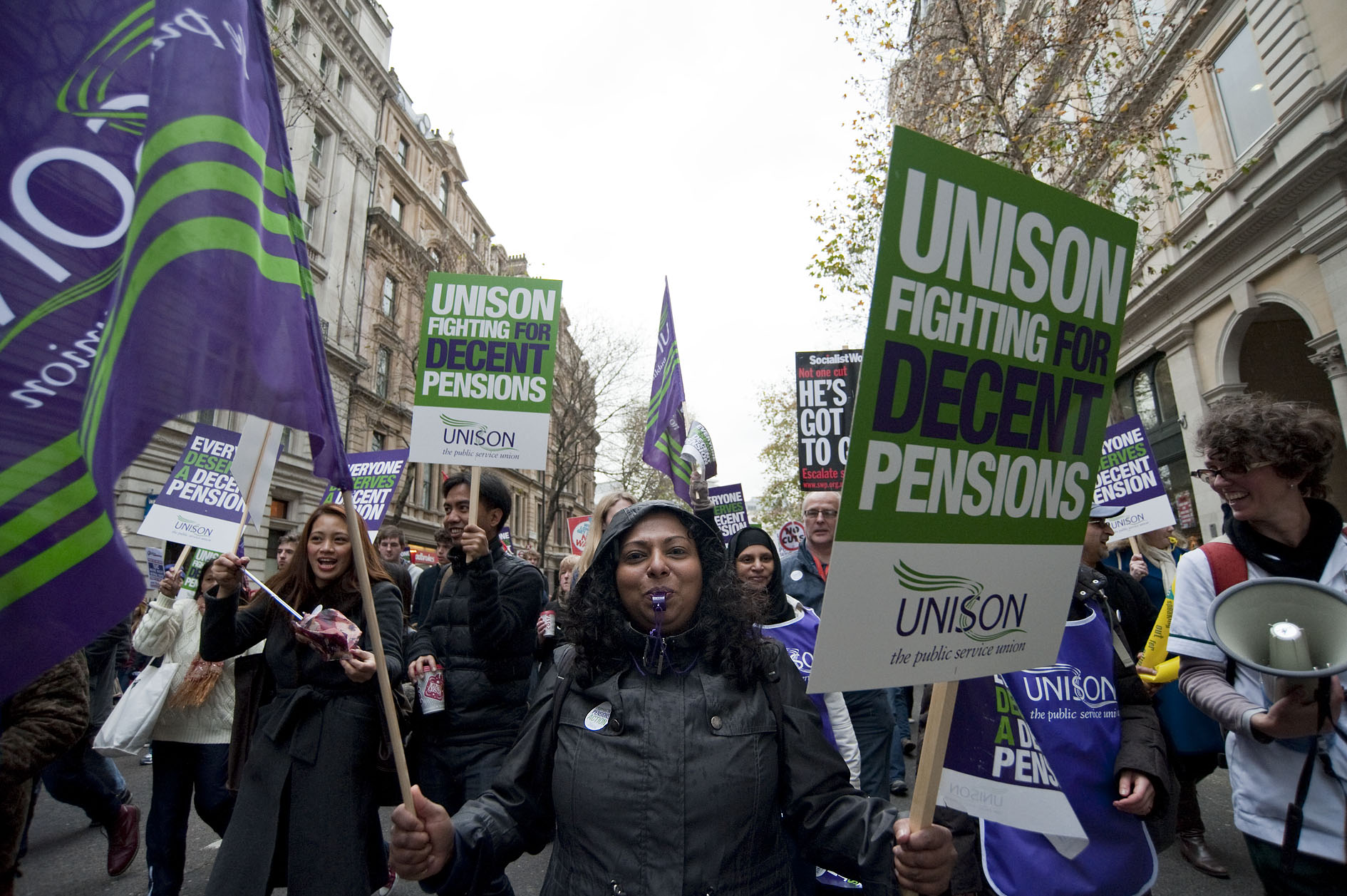
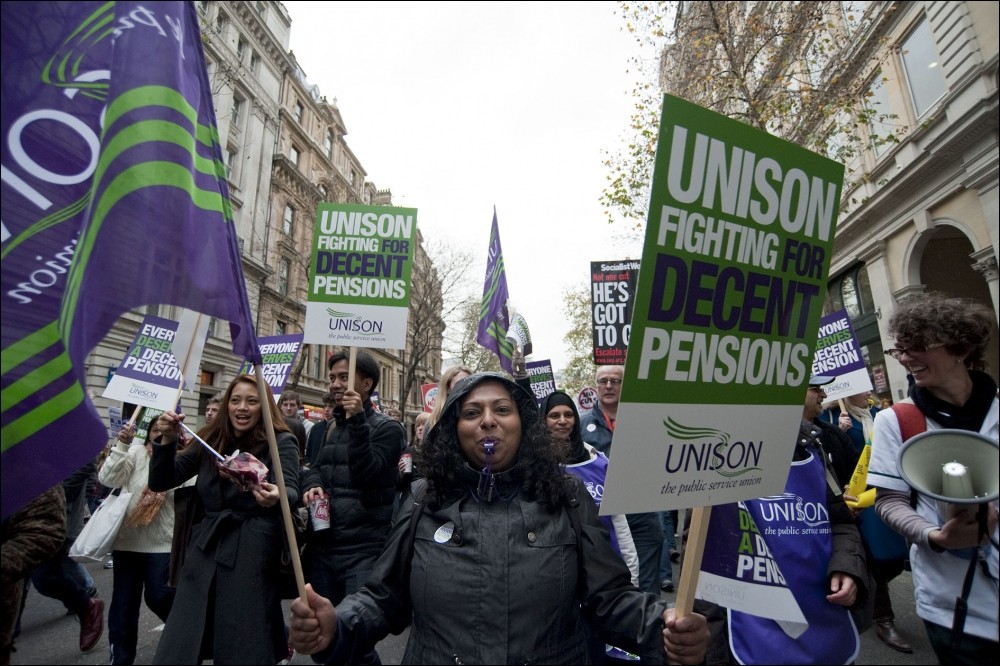
N30 – Millions strike back at Con-Dem government on 30 November 2011, photo Paul Mattsson (Click to enlarge: opens in new window)
Following the strike of two million public-sector workers in November, the fight to safeguard pensions hangs in the balance.
Pitted against savage Con-Dem austerity is an angry and determined working class. Yet the leaders of some key unions and the TUC are doing all they can to sell-out the struggle.
The role of left-wing unions, and rank-and-file bodies such as the National Shop Stewards Network, could not be more important. HANNAH SELL reports on this crucial stage of the battle.
IN 2011 THE British working class joined the ranks of world revolt against austerity. The year was peppered with historic events: the largest specifically working-class demonstration in British history on 26 March, 750,000 public-sector workers striking over pensions on 30 June (J30), and the magnificent two-million-strong 30 November strike (N30).
Public backing for these events was overwhelming. On N30, a series of polls showed majority support for the strike: the BBC showed 61%, the Guardian 79%, the right-wing Daily Mail an incredible 90%.
N30 also profoundly shook the government, with prime minister, David Cameron, having to retreat within 24 hours from calling it a “damp squib” to admitting it was “a big strike”.
However, if 2011 showed the strengths of the workers’ movement in Britain it also graphically demonstrated its weaknesses.
Following N30, the struggle against the attacks on pensions hangs in the balance, with the leadership of Unison, the biggest public-sector union, breaking the united front and accepting the government’s rotten proposals.
Virtually everything – for local government and health workers – had been on offer before N30, when it was rejected by Unison.
Yet it is now being hailed as a breakthrough by the union’s general secretary, Dave Prentis, backed to the hilt by Brendan Barber and the leadership of the TUC.
In fact, no central talks with government on pensions have even taken place since 2 November. The negotiations which led to this supposed breakthrough have been scheme-specific, discussing small details, not the broad parameters of public-sector workers’ pensions.
Despite this, given cover by the TUC leadership, before Christmas the government triumphantly announced that every union, apart from PCS civil servants, had signed up to its ‘heads of agreement’ on pensions.
Since then, the leadership of the TUC has moved might and main to try to turn the government’s words into reality.
At the same time, thousands of trade union activists have been working to keep their unions in the fight.
Finely poised
THE FINAL OUTCOME of this battle has not yet been decided, but the attempt to strangle the pensions dispute in the dark, without trade union members realising what was happening, has already been decisively defeated.
The National Shop Stewards Network (NSSN) has played an important role in this, not least by initiating a lobby of the TUC meeting which discussed the deal on 19 December.
Even before Christmas, the reality was very different from that put forward by the government. Alongside PCS’s rejection of the proposals, the leaders of the education unions, NUT, NASUWT and UCU, had not accepted it, along with the prison officers’ union (POA), other civil service unions (FDA, Prospect), and the Northern Irish Public Sector Alliance.
Since Christmas, the NUT and NASUWT have gone further and rejected the proposals, as have the local government and health executives of the Unite general union.
Trade unions representing around a million workers have so far refused to accept it. The Unison leadership agreed the offer against widespread opposition.
But the Scottish Unison health committee has formally rejected it and, at the North West Unison local government meeting, only one of the 100 people present spoke in support of the leadership’s position.
However, the leadership of Unison, leaning on a lay bureaucracy at local level, is muddying the waters, desperately trying to disguise the fact that no significant concessions have been won.
Meanwhile, the government has, as the Lib-Dem chief secretary to the treasury, Danny Alexander, put it, achieved all its “savings goals”.
To try and conceal their capitulation, Prentis and co keep asserting that strikes on pensions could be held later on during these negotiations if needs be.
This is true, but not on any of the key issues. Signing the heads of agreement means agreeing to the appalling terms of the current proposals on retirement age, career average schemes, accrual rates, the switch from calculations based on the retail price index to the consumer price index, and other issues.
In addition, breaking the united front with other public-sector unions would make it more difficult for future Unison strike action on pensions to win.
The consequences of defeat… or victory
IF PRENTIS, BARBER and co succeed in derailing the pensions struggle it will be a bitter defeat for the workers’ movement.
Comparisons are already been drawn with Black Friday in April 1921, when the leaders of the railway and transport unions broke the triple alliance and left the miners isolated.
Indeed, a defeat of the pensions struggle would be another black day with serious consequences, not only for public-sector workers’ pensions but also for the working class as a whole.
It would embolden the capitalist class and its representatives in government to escalate its austerity onslaught against the working class.
It would also encourage the government to seriously consider taking further measures against the rights of workers to organise in trade unions, targeting the most militant unions, notably PCS.
This has already been mooted. During the parliamentary debate following Alexander’s December announcement on pensions, three Tory MPs and a Scottish National Party MP demanded to know what action would be taken against the PCS by the government and called for cuts to trade union facility time and the imposition of minimum turnouts in strike ballots. Alexander responded favourably to them all.
Another consequence could be that some of those who have looked to the unions and the working class to defeat the cuts could, temporarily and in frustration, turn to other roads.
If more riots take place in 2012, following what would be perceived as a defeat for ‘union power’, the two would not be unconnected.
Nonetheless, a defeat on pensions would mean losing the first battle, not the war. Even after Black Friday, the working class regrouped.
Five years later we saw the greatest strike in Britain’s history, the magnificent 1926 general strike.
The profound nature of the capitalist crisis, and the resulting savagery of the government’s austerity measures, mean that general strikes of a similar character can be posed in the not-too-distant future regardless of the outcome of the current battle.
In the short term, explosive struggles will take place, not least against the second round of local authority cuts in the coming months.
On the other hand, a victory on pensions would have an enormous effect by increasing the confidence of the working class.
And a retreat on pensions would immeasurably damage the government, and could even lead to its fall. This is not because such a retreat would cost the government significant amounts of money.
On the contrary, the sums are relatively small. The largest savings to be made – from the NHS pension scheme – are only £530 million in the first year.
This is about the same amount as the government lost from its u-turn over privatising forests.
However, in 2011, pensions were the frontline between the organised working class and the government.
If the Con-Dems retreat on this it will be a body blow to them. It is vital, therefore, that trade unionists do all they can to force their leaders to maintain the united front and to set the date for the next 24-hour co-ordinated strike, involving all the public-sector unions that have rejected the proposals.
This task is urgent as the government is planning to impose a pensions deal from the start of April.
Pressure from below
TRADE UNIONISTS WILL be drawing conclusions about the role being played by Prentis, Barber and the rightwing of the movement.
Britain has entered an era of bitter class battles, as the capitalist class attempts to solve the crisis in its system via a savage assault on workers’ living conditions.
Under the impact of events, the different trends in the labour movement are beginning to be laid bare.
In the frontline are the militant trade unions led by socialists, including PCS – in which the Socialist Party plays an important role – and also the rail and transport workers’ union, RMT.
At the other pole are the right-wing unions, epitomised by the leadership of Unison. These trade union leaders have no confidence in the possibility of fighting to defend their members’ interests.
They were dragged, kicking and screaming, into supporting co-ordinated strike action. They opposed the J30 strike on pensions.
The day after, an anonymous trade union leader told the Guardian that the strike had been “a tactical error”, adding: “PCS was warned that this was the wrong time and could backfire. A lot of other unions will feel frustrated with the PCS. Most unions will say today hasn’t helped”.
At the Unison service group meetings after the strike, Prentis argued against taking part in any co-ordinated action with the PCS.
However, it was the very success of J30, and the resulting campaign by Unison members to take part in the next strike, which brought N30 about.
Right-wing union leaders were forced to support N30 because they were squeezed between the pressure from their members for action and the intransigence of the government.
It is true that the government showered Prentis with praise. On 13 November, Tory cabinet minister, Francis Maude, called him a “very formidable, skilled, experienced negotiator who is going to drive a hard bargain and rightly. We appreciate that”.
The Financial Times correctly concluded: “Mr Maude plainly believes that Mr Prentis is a man with whom he can do business [but] has nothing but contempt for Mark Serwotka”.
However, while the government was happy to stroke Prentis’s ego, they were not prepared to give Unison members any concessions that would allow Prentis to avoid taking strike action over pensions.
Unlike the leadership of New Labour, even the most right-wing union leaders are susceptible to pressure from their members, whose dues ultimately pay their salaries.
Particularly in the run up to Unison conference, Prentis made speeches which made him sound like a militant trade unionist, declaring that the struggle against pensions “won’t be the miners’ strike. We are going to win”.
He added that “one day of industrial action won’t change anyone’s mind in government”, and that rolling strikes would be needed “over an indefinite period”.
In the face of an unyielding government, the leadership of Unison had no choice but to strike – and to strike in co-ordination with the other unions, including PCS.
Con-Dem onslaught intensifies
N30 WAS ONE of those days in history which have a profound effect on all those who participated. A new generation of workers took strike action for the first time.
Many hundreds of thousands marched in some of the biggest demonstrations their local town, or even village, had ever seen.
In Bristol, over 20,000 marched, more than 30,000 in Manchester. In smaller towns there were large demonstrations: 2,000 in Bournemouth, 4,000 in Torquay, 1,200 in Birkenhead, 1,000 in Hastings, 1,200 in Warrington. The list goes on. Public-sector workers tasted their own power.
The government was shaken by the power of the strike, but it did not retreat. It relied on one crucial weakness of the movement to try and defeat it – the cowardice of many of its leaders, who were also terrified by the movement they had called forth.
The autumn spending review, announced by the chancellor George Osborne on 29 November, was greeted with banner headlines in the press: ‘Osborne Strikes First’.
It was a deliberate attempt to cow trade unionists, above all their leaders. The message was that the capitalist crisis means there is no alternative to unending misery for the working class, that it is useless to fight back because you cannot win.
The spending review announced a series of further attacks. The number of public-sector jobs to be cut was raised by 300,000 to 710,000, and a two-year 1% cap on public-sector pay increases was announced.
The already eye-watering £81 billion-worth of cuts to the public sector was to be increased by £30 billion.
This was combined with a serious threat to the rights of the working class to organise in defence of its rights, along with the breakup of national pay bargaining and ending TUPE (rules which guarantee the pay and conditions of workers whose jobs are privatised). Cameron then stepped up the threat to trade unionists’ facility time.
Right-wing trade union leaders capitulated before this onslaught. The real reasons for their attitude to the pensions deal is that they believe that the government will force an even worse deal on them if they do not give in now.
This was crudely summed up by the statement on 19 December of Christine McAnea, Unison’s head of health, that “this was always a damage limitation exercise”.
Hence the Unison leadership’s repeated pleading with trade unionists that this is the government’s ‘final offer’ – as if any employer ever puts forward an offer by declaring, ‘this isn’t our final offer; if you keep fighting we might give more’!
There is a comparison between the government’s approach today and that of David Lloyd George, prime minister in 1919, when he said to the union leaders threatening to strike: “If you carry out your threat and strike you will defeat us. But if you do so, have you weighed up the consequences?”
He added that, if they beat the government, they would have to be prepared to take power and run society.
The reaction of right-wing miners’ leader, Robert Smillie, was: “From that moment on we were beaten and we knew we were”.
Rejecting the logic of the market
TODAY, THE IDEA of the working class taking power is not yet in the consciousness of broad sections of the working class, and is inconceivable to right-wing union leaders.
Their lack of any political and economic alternative to the government’s policies is an important aspect of their cowardice.
New Labour, the party that the biggest public-sector trade unions continue to fund, and whose capitalist leadership Barber, Prentis and co back to the hilt, would quake at the idea of coming to power as a result of a mass movement of the working class.
New Labour is wedded to the market, and has repeatedly made clear it would also carry out massive cuts, including in public-sector workers’ pensions, if it was in government.
Such is the scale of the attacks that the working class will be forced to struggle against the Con-Dems cuts even without a clear alternative.
Nonetheless, one of the most urgent tasks for the workers’ movement is for it to develop its own mass political voice, which stands against all cuts and puts a socialist alternative.
It is no coincidence that, in the main, it is socialist trade union leaders who have refused to accept the rotten pensions proposals.
In the last 30 years, the majority of trade union leaders have moved far to the right, bowing more than ever before to the ‘logic of the market’.
However, today and for the foreseeable future, that means taking away all the hard-won gains made by working-class people.
The capitalists and their political representatives can be forced to retreat on pensions, but only if they meet a determined mass movement which does not accept the logic of their system and puts forward an alternative to endless austerity.
It is far from excluded that N30 alone would have been enough to force the government to retreat on pensions, provided that the leaders had been clear that this was only a beginning and that, if the government did not retreat, they would quickly call another 24-hour public-sector strike followed, if necessary, by 48-hour action including the involvement of private-sector workers.
Building fighting democratic unions
BREAKING THE UNITED front on pensions will lead, inevitably, not only to anger but to confusion and some demoralisation among a layer of Unison activists and other workers.
These feelings will be intensified because the leadership of Unison has not fought a battle on any of the other attacks faced by their members, including massive job losses and wide-scale privatisation.
Some workers will leave Unison in disgust to join another union, or drop out of union membership. One of the reasons Prentis may get away with this in the short term is because, at this stage, most of the fresh layers who have participated in the strikes are not active in the union structures, which are not infrequently little more than shells.
In some cases, therefore, union members’ initial reaction may be to walk away and look for other means of fighting back.
Nonetheless, Prentis will be punished by Unison members for his role. It is already clear that significant numbers of workers will set out to try and reverse the decision on pensions and to change their union leaderships.
The campaign to demand a special Unison Local Government conference to discuss the deal can gain real momentum in the coming weeks. If Unison in local government are forced by the members to throw out the deal then strike action should be re-activated. This could be reflected in other Service Groups in Unison.
It will be enormously fuelled if further co-ordinated action takes place by a significant number of unions still participating in the fight.
The importance of, and the potential to succeed in, building rank-and-file organisations within the trade unions, campaigning for fighting, democratic unions, is at its highest level in decades.
The conference on 7 January, hosted by PCS Left Unity and bringing together over 500 trade union militants from across the public sector, demonstrated that potential, and also the importance of co-ordinating such bodies across the union movement.
The pressure created by that conference contributed to Unite local government standing firm on pensions.
The committee set up at the conference can now play a crucial role in co-ordinating the action of the unions that do hold the line.
Three years after the 1921 defeat, the Communist Party began to build the Minority Movement, a powerful rank-and-file trade union organisation.
At its height, it represented almost one million of the most militant workers in Britain. Today, the NSSN has begun to group the most militant workplace representatives around it.
Over the last 18 months, the NSSN has been able to act as an effective lever to help bring about the 26 March demonstration and the N30 strike, and has played a vital role in lobbying the TUC to demand the pensions struggle continues.
Whatever the outcome of the current stage of that struggle, there will be many tens of thousands of public-sector workers who can be won to the NSSN, as well as to the left organisations in the different unions, and to conduct a serious battle for fighting, democratic trade unions.
This is essential preparation for the gigantic battles that will be take place over the coming years.
