

Lenin and the Russian workers’ movement 1885-1898
 |
|
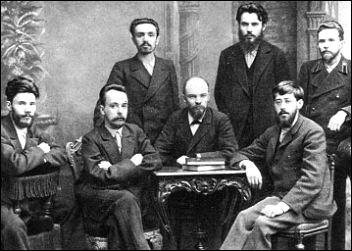
the St petersburg ‘League of struggle for the emancipation of the working class’. Seated centre is VI Lenin |
NINETY YEARS ago the Russian workers removed capitalism and began building the world’s first workers’ government. Today, academic historians, wedded to capitalism, often present this revolution as a coup or an isolated “mistake”.
Hugh Caffrey
In reality, the revolution grew out of the very basis of Russian society. The Bolshevik Party and the working class that carried it out, developed through preceding political struggles, including the 1905 revolution. 1905 too grew out of past battles, especially the mass strikes around 1885-87 and 1895-97.
 |
|
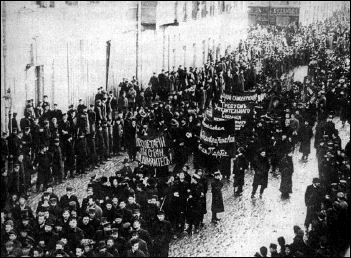
A workers’ demonstration during the 1905 Russian revolution |
During the late 19th century, Russia rapidly industrialised under the influence of foreign finance and industry. Demanding labour from the impoverished countryside, the new factories received it and, by increased competition which put out of business yet more poor farmers and small handicraftsmen, speeded up the migration to the cities.
Between 1863 and 1897 an average of 200,000 people moved from the countryside to the cities every year. While the total population increased by half, the urban population doubled.
Oppression
The bosses made fortunes while the masses starved in sweatshops. The Tsarist absolute monarchy banned all strikes, meetings and protests and violently crushed workers actions.
There are many comparisons with China today, including the conditions of the workers. Addressing Thorntons factory textile workers in 1895, the revolutionary socialist VI Lenin exclaimed:
Latterly the weavers have… sold the last of their clothes and used up the last coppers they earned by their hellish labour at a time when their benefactors the Thorntons, were adding millions to the millions they already had. To crown it all, ever-new victims of the employers’ avarice have been thrown out on the streets… Workers of the spinning sheds… almost two-thirds of your number have already been dismissed, and your better earnings have been purchased at the cost of the starvation of your own spinners who have been thrown out of work… Workers of the new dyeing department! Twelve rubles a month, all told, is what you now earn at the cost of 14 hours daily work, saturated from head to foot with the murderous fumes of dyes!
Strike-wave
New arrivals from the villages often turned to God, the bottle or dreams of the farm. But for workers longer in the cities, study circles and the class struggle held greater appeal. Big strikes took place during the 1870s, with 188 disputes recorded. This figure nearly trebled in the 1880s.
During 1885-87 as the economy expanded, unemployed workers returned to work and mass strikes broke out among Moscow’s textile workers. They demanded an end to the bosses’ trick of imposing fines for everything and thereby driving down wages.
In January 1885, 8,000 strikers at the Morozov plant drew up a list of demands and presented them to the factory inspector. In 1886 there appears a lull in strikes but they resurged in 1887, with 51 recorded strikes involving nearly 18,000 workers.
In the industrial south, coal miners struck against the fines system. A series of short small strikes prepared the way for a massive miners’ walk-out in 1887 demanding higher wages. Rejecting the company’s offer of a small wage increase, they called out the rest of the pits and marched to the company offices.
Conceding all demands then and there, company bosses the next day dismissed workers who took strike action and called in the mounted police – the Cossacks. However, after the textile strike, as Lenin records:
The terrified government conceded their demands and hastened to issue a law regulating fines… The government imagined… it would immediately satisfy the workers and make them forget their common workers’ cause, their struggle against the factory owners.
Wishful thinking! Lenin’s Explanation of the Law on Fines exposed the law as full of loopholes, “a concession” won through struggle, and the fines system itself as “a product of capitalism”. This pamphlet went to press as a second strike movement exploded.
After the economic uncertainty of 1889-94, the economy grew rapidly and continuously. Development of the steel industry and militant steel workers in the south spurred on the miners, while the textiles workers of St Petersburg and Moscow gained confidence to act in their interests.
Strikes took place through the summer and autumn of 1895.
In November, 500 weavers at Thorntons walked out against bad conditions and attempts to drive down wages. In spring 1896 strikes broke out on a much bigger scale, with 30,000 textiles workers demanding shorter working hours.
In May, a two-week strike demanded paid leave for the national holidays around the Tsar’s coronation and limits on the working day.
All of a sudden, says Lenin, all the devices of the police burst like soap bubbles, and the government itself was compelled to speak out openly of the fact that the workers were engaged in a struggle against the factory owners.
What, then, has made it talk this time? The fact is that this time the socialists have assisted the workers, have helped them to explain their case, to spread the news about it everywhere, both among the workers and among the public, to formulate the workers’ demands exactly, to show everybody how dishonest the government is, and what brute violence it employs… the rightless position of Russian citizens and the arbitrary and brutal conduct of a government which fawns on the capitalists.
In the south, steel workers were increasingly angry about low wages and terrible conditions. A worker was stabbed to death by a company security guard and this incident boiled over into a mass strike and riot.
Socialist leaflets had urged workers to adopt a programme of demands and use the weapon of the peaceful mass strike as most effective. But the bosses’ thugs, and peasant traditions of the violent uprising, led instead to days of rioting.
The League
Russian Marxists at this time were organised in ‘The League of Struggle for the Emancipation of the Working Class’. They used every method to approach the workers. One legal avenue was Sunday education classes at which:
Vladimir Ilyich [Lenin] read Marx’s Capital to the workers and explained it to them. He devoted the second half of the lesson to questioning the workers about their work and conditions of labour, showing them the bearing which their life had on the whole structure of society, and telling them in what way the existing order could be changed.
Going directly to the factories, the League distributed simple literature explaining the fines law, strikes, industrial courts, and economic demands for struggle. The Thorntons strike was led by the League who produced leaflets publicising the workers’ demands.
After the strike, Lenin’s To the Working Men and Women of the Thornton Factory outlined six demands on pay, contracts, fines and lodgings. The League’s paper dealt with a variety of issues. One edition in 1895 included articles on the Sunday education classes, the life and ideas of Engels, and reports of strikes in other cities. 3,000 copies of Lenin’s Explanation of the Law on Fines found their way across St Petersburg and to at least a dozen more major cities.
Isolated and penniless, the St Petersburg strikers were forced back to work. Sizeable disputes continued elsewhere during 1898 but, with a slowing economy, strikes halved the following year and fell further during the 1900 recession.
Earlier, Tsarism was forced to make concessions. In 1897 a law limiting the working day and establishing holidays was passed. While showing how full of holes this law was, Lenin pointed to its real significance, in:
being a forced concession by the government, in its having been won from the police by the united and class-conscious workers. The promulgation of this law shows the success of the working-class movement in Russia; it shows what tremendous power lies in the class conscious and staunch demand of the working masses. The new law… necessarily and inevitably gives a fresh impetus to the Russian working-class movement. (emphases in original).
Revolution
Despite the downturn after 1897, the Marxists continued to develop their programme and organisation until the situation opened up again around the 1903 general strike. Tsarism was forced to legalise some trade unions (at first, only state-controlled devices) which rapidly gained in militancy, and strikes increased. Russia’s Marxists regained their footing and the Bolshevik organisation began to grow as the 1905 revolution approached.
Workers’ movements of this period represented the first flexing of their industrial muscle, testing their strength against Tsarism, and drawing their own conclusions about the necessary forms of struggle.
Marxism played an important role in crystallising this process. Out of this process grew the Boslshevik Party and a revolutionary working class which in 1905 shook Tsarism to its foundations, and whose roar echoed across the world.
Sources:
Peasant and Proletarian, Johnson.
Lenin and the Revolutionary Party, Le Blanc.
Collected Works Volume Two, VI Lenin.
1905, Trotsky.
Workers, strikes and pogroms, Wynn.
