

The free market brings fire, flood and famine
Socialist planning needed
 |
|
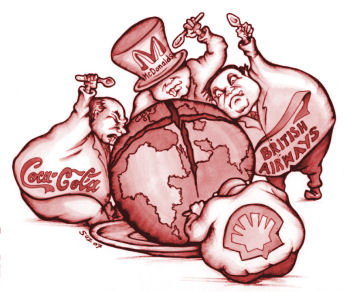
Big Business eats the planet. Cartoon by Suz’ |
Floods have affected 250 million people across the breadth of Africa, in south Asia and Mexico this year. The world is seeing more frequent, erratic and extreme weather events. There were 120 such disasters annually in the 1980s, according to a new report by Oxfam. Now there are as many as 500 every year. (Climate Alarm, Oxfam, 25 November 2007)
At its November conference, the Intergovernmental Panel on Climate Change (IPCC) warned of “abrupt and irreversible changes” in the Earth’s climate. Four billion people could be affected by flooding by 2020, due to rising ocean waters.
Yet the IPCC also points out that annual spending of less than 1% of world gross domestic product would be enough to stop global warming. At first glance, all that appears to be lacking is the political will of the major capitalist governments. But, as Pete Mason shows, behind their semi-paralysis lies the philosophy and the chaos of the ‘free market’.
Take the 387 bus from Barking, in London’s East End, and from the top deck you can see two wind turbines rising in the distance, as you pass the Thames Road industrial estate. Compared to the surrounding industrial wasteland on the Thames river flood plain, the slender wind turbines are no eyesore.
On the contrary, wind turbines represent a hope for the future. They represent clean energy and a future solution to global warming. Threatened by flooding, the future of the 160,000 ill-advised houses built on the flood plain as part of the Thames Gateway ‘regeneration’ will depend on such a solution. Each wind turbine gracefully and quietly generates nearly four megawatts of electricity.
But these particular wind turbines power Ford’s Dagenham Diesel Centre. Ford’s “only wind-powered plant in the world” builds diesel powered cars, which contribute to global warming.
Capitalist contradictions
The Ford plant demonstrates perfectly the hypocrisy and the contradictions in capitalism today. Over the last two centuries, capitalism has developed technologies which could give every person on the planet a carbon neutral, good quality of life.
Windmill technology has been around for centuries, and the first electric generator was built in 1832. The first solar cell was built in 1883. Electric transport began in 1835, with a small electric railway, and about the same time the first electric car was produced. There are now few technical barriers to constructing a pollution free, carbon-neutral society based on these simple technologies and other similar ones.
If Ford can produce cars using wind power, why has every sizeable industrial estate not got enough wind turbines to drive its production processes so that power stations, the biggest contributors to global warming, can be closed down?
Although the wind supplies free energy, the answer, of course, is initial costs. Few individual capitalists will erode their profits by investing in renewable energy, fearing the collapse of their shares, a shareholder revolt, or the loss of markets to more avaricious competitors.
In the same way, capitalist governments defend their home industries against competition abroad. The US defends its industries against competition from China. The blind play of market forces is incapable of solving the problem of global warming.
Ford’s green mask attempts to hide the central role of “Fordism”, in all its forms, in the destruction of the planet. A hundred years ago, Ford became a symbol of the consumer society, continually bringing out new models.
Today, instead of possessing good quality items for life, the ‘consumer’ goes through a continual cycle of purchasing new and sparkling but relatively poor quality goods, with ‘planned obsolescence’ built in, which soon ends up as scrap.
While nearly half the world’s population struggle to live on $2 dollars a day, the capitalist ‘consumer society’ devastates the earth’s resources at a frantically accelerating pace, consuming many lifetimes’ worth of goods per person. This wasteful manufacturing produces vast amounts of greenhouse gasses and other pollutants, and consumes enormous amounts of energy, produced by greenhouse gas emitting power stations.
Socialists must struggle to successfully transform society and save the planet, ending this immense wastefulness. A future socialist society will be able to make high quality goods that are available to all and can be treasured for generations.
It is argued that renewable technologies like wind turbines and solar panels take materials and energy to build. This is true, but the energy to build them can be supplied by renewable energy itself, and the materials are absolutely minimal compared to the savings.
Similarly the pessimists and naysayers tell us that making hydrogen cells to power carbon neutral cars takes a lot of energy, as if this is some kind of unsolvable conundrum – but you can manufacture hydrogen using power supplied by wind turbines, solar power, and other renewable means, and it should have been done a long time ago.
In addition, the technology, with proper investment, will rapidly become far more efficient. Every roofed building can become its own power station, using solar panels whose efficiency has quadrupled over the last 30 years with little major investment.
The Revenge of Gaia
British scientist James Lovelock criticises the lack of urgency in IPCC reports: “Sadly, even the most pessimistic of the climate prophets of the IPCC panel do not appear to have noticed how rapidly the climate is changing.” (The Guardian, 29 October).
Lovelock was founder of the Gaia theory in the 1960s hippy era. He showed that the Earth exists in a finely tuned symbiotic balance. Two billion years ago, the Earth was perhaps just the right distance from the sun for life to flourish. The sun has got warmer since then. Put the Earth sufficiently out of balance, if greenhouse gasses build up and create global warming, and perhaps the Earth could become like Venus, roasting at 480 degrees. The Earth, Lovelock supposes, will now take its revenge for the exploitation it has suffered.
It is wrong to gamble on the assumption that the Earth will pause on the path to a Venusian hell without major human intervention to prevent it, something the IPCC now concedes. Rajendra Pachauri, a scientist and economist who heads the IPCC, claims, “If there’s no action before 2012, that’s too late. What we do in the next two to three years will determine our future. This is the defining moment.”
The Earth’s vengeance has begun with fire, floods, drought and famine. Global warming is exposing the failings of the neo-liberal, pro-capitalist philosophy of the powerful western governments to their own working class.
More and more, workers and youth will demand a national and indeed an international plan. But weak capitalist governments will only react very partially, in a hesitant and feeble way, with half-baked government-funded schemes and insufficient legislation.
Arguing that we should take the world’s resources and its governments out of the hands of the capitalist class, socialists will get an increasing echo for the ideas of common ownership and control of the land, banks and large scale means of production by the workers and rural poor of the world.
Redressing the imbalance
Only in this way can the many available technical solutions be implemented immediately and fully, ending the paralysis of capitalist governments, and mobilising the human resources of the whole planet in the great transformation which is now urgently required.
Nationalised, under workers’ control and management, Ford’s car production could be transformed to use renewable energy in all its plants, producing environmentally friendly cars or vehicles for public transport.
A socialist society could put massive resources into scientific research to improve and develop existing and new technologies, with the urgent aim of making all production and transport carbon neutral. Power stations would be turned off as wind, solar and other energies were rapidly implemented across the world. Oil and gas flares burning across the globe would be extinguished as oil production ceased. The destruction of rainforests would end.
At the same time, during such a transformation, the workers and rural poor of the world will not hesitate to redress the imbalance of the necessities of life in their favour.
Fire
Fire was threatening expensive Malibu homes again in late November, a reminder of the worst ever fire storms in California. In late October, nearly 3,000 structures, including over 2,000 homes, were burnt to the ground in California. More than half a million people fled and a few died in the fires. Flames reached 200 feet in the air. A fire describing a semicircle as large as Greater London and another covering an area the size of Birmingham swept through California. The worst US drought in living memory continues to dry the brush and trees. Now a dehydrated Australia faces its summer with the same threat.
Floods
The August floods in Gloucestershire may be just a foretaste of the kind of inundations likely to devastate urban areas in the UK. Capital cities such as London and New York will be threatened in the future with the fate of New Orleans, which flooded in the hurricane of 2005.
While the IPCC was warning of more frequent and more severe cyclones, more than 3,400 people died in the floods in Bangladesh, after the worst cyclone for a decade. Many more, without clean water or food, may die. These areas have already suffered enormous losses due in part at least to the effects of climate change.
Most big cities are situated by rivers or the sea, within one metre of current sea level, and a few cities already shelter behind barriers like London’s Thames Barrier. The IPCC has been heavily criticised for its predictions of sea level rises of just 1.4 metres by the end of the century.
The rise could be five metres or more. There may be a “fast feedback effect” which could lead to the rapid disintegration of the Earth’s ice sheets. The sudden and unexpected opening of the North West Passage, due to a loss of 20% of the Arctic circle ice in two years, gives support to this possibility.
The current IPCC report acknowledges that there is no known upper limit to the amount that sea waters might rise this century, since in addition to the possible catastrophic collapse of the Greenland ice sheet, which would raise the oceans by eight metres, the West Antarctic ice sheet might break up, meaning a further five metres rise. How likely and how soon these events will occur is currently unknown.
Drought and famine
“Diminished supplies of fresh water might prove a far more serious problem than slowly rising seas” reports the New York Times magazine. (October 21, 2007) “Global food crisis looms as climate change and fuel shortages bite” says The Guardian (3 November 2007).
Drought, although not a long-term concern here in the UK, is nevertheless currently the western world’s most serious threat, partly because it is not yet clear to anyone how millions of people in the US and Australia will find water over the next year or two, or even in the next few months, and partly because of the catastrophic effect this year’s severe water shortages has had on crops – the first indication of the equally serious threat of famine. Although the unpredictable climate may suddenly bring vast quantities of water to affected regions (parts of Australia may get more rain for the next twelve months, but the USA less), the general trends, as predicted by climate models, suggest that the affected areas of the USA and Australia will get drier.
One million people in Adelaide face an uncertain summer as the Murray River, which provides their drinking water, is “dying” and threatens to become undrinkable. “Whatever happened to the Howard government’s $10 billion water ‘plan’ to save the Murray-Darling rivers systems?” asked the Sydney Morning Herald rhetorically (10 November 2007). The Murray-Darling basin produces 40% of Australia’s food. Wheat and barley production was down 61% as a result of the drought.
Just as the fires were burning California, CNN reported that five million people in Atlanta, Georgia, had three months of water left. Georgia declared a state of emergency. But the power stations in Georgia use 68 percent of all surface water, the Atlanta Journal-Constitution (AJC) newspaper revealed (18 November 2007).
The states of Georgia, Alabama and Florida are in a “tri-state war” over water rights, where “most electricity is produced by Atlanta-based Southern Co, the nation’s second-largest utility holding company with $14.3 billion in annual revenue.” With its enormous political clout, the AJC reported, Southern Co’s needs come before the overall needs of the states.
Yet another reason to swiftly convert to renewable energy. Nationalised, some of Southern Co’s billions of dollars of assets and revenue could be used to immediately install solar panels in millions of homes and other buildings. Together with a few other measures, Southern Co’s power stations would be made redundant, leading to a reduction of greenhouse gas emissions and more drinking water for Atlanta. The power station workers could be re-trained to make and install renewable energy equipment.
But now, the sound of the drilling of water wells is said to echo through the Atlanta suburbs. Thirty-six states will face water shortages within five years according to the US government and the era will soon be passed when turning on the tap provides water in many states in the interior of the USA. The police hand out on-the-spot fines of $1,000 for washing your car or watering the grass in the Northern half of Georgia.
On Wednesday 24 October, residents of Orme, in Tennessee, found the taps had run dry. Now water is brought in by truck, at a great cost, and the taps are turned on by the mayor for three hours each night. The Mormons have delivered 23,000 emergency bottles of water to Monteagle, whose 1,200 residents get their water by the truckload also. If it doesn’t rain soon, “the people who are selling it to us are going to have to stop. When that happens, we’re going to be in a serious situation,” the City Recorder Joy Sturtevant said. ABC news asked ‘Will Atlanta be next?’ Visions of mass migrations of millions, loss of industry and civil unrest have been raised. This will be accompanied by changes in political consciousness.
