


 |
|
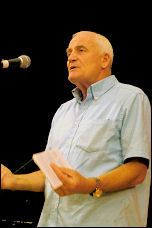
Tony Mulhearn, speaking at Socialist Party congress 2007, photo Paul Mattsson |
CLAUSE IV, part 4, the ‘socialist’ clause of the Labour Party’s constitution enshrining public ownership of industry and finance, was adopted at a party conference in 1918. Under Tony Blair’s leadership it was jettisoned to make way for the New Labour party in 1995.
Socialist Party member Tony Mulhearn, a former councillor and chairman of the Liverpool District Labour Party in the 1980s, explains its significance.
“To secure for the workers by hand or by brain the full fruits of their industry and the most equitable distribution thereof that may be possible upon the basis of the common ownership of the means of production, distribution and exchange, and the best obtainable system of popular administration and control of each industry of service.” Clause IV, part 4.
IT IS supremely ironic that the ninetieth anniversary of the adoption of Clause 4 should fall during a period of turmoil for capitalism, exemplified by catastrophic wars and crises on the stock markets of the world, with the 1931 Wall Street crash daily being used as a reference point by capitalist commentators.
It takes a mighty leap of the imagination to reconcile Clause 4 with the character of today’s New Labour willingly trapped as it is in the remorseless grip of neo-liberalism.
At Labour’s 1994 conference, after becoming leader, Tony Blair announced his intention to dump Clause 4, to the delight of the establishment.
The new clause, adopted in 1995, reads: “… We work for: a dynamic economy, serving the public interest, in which the enterprise of the market and the rigour of competition are joined with the forces of partnership and co-operation to produce the wealth the nation needs and the opportunity for all to work and prosper, with a thriving public sector and high quality services, where those undertakings essential to the common good are either owned by the public or accountable to them.”
With privateers being sold the most lucrative slices of the public sector at knock-down prices, even the genuflection to ‘a thriving public sector’ has proved to be a mirage created by the Blair/Brown project. The great national rip-off was graphically symbolised by the sale of QuinetiQ, the MoD research facility, to a private equity company.
The senior civil servants who recommended the deal to Gordon Brown who then imprudently approved it, made an 18,000% profit on the shares they had purchased. The riches being privately trousered through the Private Finance Initiative (PFI) device has been well recorded elsewhere in The Socialist.
Nationalisation
This puppy-like eagerness to please the class of the filthy rich was further encapsulated by a recent Guardian headline: ‘Brown takes lead role in battle to avoid [Northern] Rock nationalisation.’ Brown and Co, released from the checks and balances of rank and file democratic control were scampering to please their capitalist masters.
To slavishly kow-tow to the free market coterie with which they surround themselves, Brown’s right wing bunker, in initially embracing Goldman Sachs’ recommendation not to nationalise, even defied the more sober capitalist commentators.
The Observer, for instance, supported nationalisation as being ‘crisper’ in defending the taxpayers’ interests. Even LibDem’s Vince Cable, celebrated for his one-liners, supported nationalisation, albeit until the Rock is profitable enough to return to the private sector.
New Labour’s phobia of appearing, however remotely, pro-public own-ership has placed the government in the bizarre position of being attacked by the right wing of the Tory Party as being responsible for the anarchy of the capitalist system that the Tories historically represent.
Nick Robinson of the BBC, reflecting on the manoeuvres of Blair to jettison Clause 4, had this to say: “…the vote (in favour of ditching Clause 4) wasn’t of North Korean proportions. It was roughly two-thirds for and one-third against. It was, in many ways, the symbolic end of a decade-long struggle to re-position Labour begun by Neil Kinnock.”
So, even though Blair had appealed to the Party members over the heads of the activists, at that stage (1995), after years of driving socialists out of the Party, there was still a residue of Party members who were loyal to the socialist aspirations enshrined in Clause 4. That residue has long since melted away.
Marx
Blair’s intention to ditch Clause 4 was not only greeted with glee by the media at home but also abroad.
The New York Times for instance was overjoyed. “Tony Blair took full command of the Labour Party today,” it wrote, “charting a course that would eliminate the last traces of Karl Marx and move the party unabashedly to the centre, where Britain’s middle class resides. Abandoned will be Labour’s image as a leftist, union-dominated party.”
Joyfully it went on: “At another point Mr Blair declared ‘A belief in society. Working together. Solidarity. Cooperation. Partnership. These are our words. This is my socialism. It is not the Socialism of Marx or state control’.”
The capitalists loved this gibberish, as the threat to their wealth and privilege was (as they saw it) finally interred.
Class struggle, revolution and the Labour Party
The socialist Clause 4 was drafted by Sidney Webb and George Bernard Shaw and adopted by the Labour Party conference held in Nottingham in 1918.
Since then it has been denounced by ultra-lefts as being a fig-leaf disguising the capitalist character of the Labour Party, or denounced by the right wing, more recently by Jack Straw, who argued that New Labour should not be shackled by the sentiments of ‘middle-class dilettantes’. Both points of view completely fail to understand the reason for its adoption at that point in history.
The opening decades of the 20th century had seen an enormous growth in working-class empowerment. The organisation of unskilled workers known as ‘new unionism’ had seen a mighty development of trade unionism.
Political voice
The trauma of the Taff Vale judgment which upheld a huge fine on the railworkers’ union, pushed the trade unions into forming the Labour Representation Committee in 1900, later to become the Labour Party, reflecting the recognition that an independent political force in Parliament was vital to defend workers’ interests.
While at that stage the trade union leaders embraced ‘Labourism’ (the term was interchangeable with ‘reformism’), industrial militancy was on the march. Between 1911 and 1914 the big battalions of the working class, the Transport Workers Federation (the forerunner of the TGWU), the railwaymen and the miners had taken strike action.
The great general strike of 1911 in Liverpool shook the ruling class to its foundations. Starting with the firemen and seamen, it spread to the dockers, carters and railwaymen. The docks were closed and food could only be moved with armed escorts.
In a city hitherto riven by sectarian conflict, Protestant dockers and Catholic carters marched hand-in-hand. Strike leader Tom Mann declared that sectarian animosities had melted into class solidarity. The strike reached its climax on ‘Bloody Sunday’ 13 August, when 100,000 people rallying on St. George’s Plateau were charged by police. Two hundred were injured and one policeman died. That same evening two workers, one Catholic and one Protestant, were shot dead in Vauxhall Road. The Lord Mayor informed the Home Office that ‘a revolution was in progress,’ Churchill despatched two gunboats to the Mersey.
Locomotive of history
Revolutionary socialist Leon Trotsky said that war is the locomotive of history. The mood for social change among the British working class was fuelled by the austere conditions at home and the slaughter taking place on the Western Front.
The Russian revolution of 1917, with its formation of workers’ councils and nationalisation of the means of production, and the opening of peace talks led by Trotsky at Brest Litovsk, acted as a beacon to the international working class. By 1918 throughout Europe the old monarchies were falling as the kings abdicated under pressure of the mass movement of the working class.
These factors gave enormous impetus to the growing discontent among the workers in Britain. The growth of the shop stewards’ movement in defence of wages and conditions undermined the status of the conservative trade union leaders who had worked hand in glove with the employers throughout the Great War.
Wages were falling behind prices. The Joint Board of the TUC, the General Federation of Trade Unions and the Labour Party had agreed to an industrial truce to support the war effort. As always, such a truce between capital and labour proved to be one-sided. The coal-owners moved to reduce holidays and called for the suspension of the eight-hour day Act.
The miners struck for a 20% wage increase and, such was their key role in war production, they won. The coal-owners, later described by a cabinet minister as the most ignorant group of men in Britain, were assuaged by incredibly having their profits guaranteed by the government. A foreshadowing of the Northern Rock fiasco 90 years later.
On Clydeside, Scotland, reflecting the disaffection of the rank and file with the official leadership of the engineering unions, the shop stewards movement took a great leap forward. In 1915, 8,000 engineers struck for two pence an hour.
The Clyde Workers’ Committee was formed with Marxist John MacLean elected as its chairman. Trade union membership increased threefold. The only way the Amalgamated Society of Engineers’ leadership could retain control of the union was by rejecting the cap on wages proposed by the Treasury Agreement.
In Sheffield a shop stewards’ committee set up by the District Committee of the Amalgamated Society of Engineers had called out 10,000 workers to protest the enlistment of a skilled engineer into the armed forces. Recognising the challenge to the official leadership that the shop stewards’ committees posed, they were later integrated into the official union structure.
The aspirations of the working class inspired by the events in Russia were expressed at a conference in Leeds on 3 June 1917, called by the United Socialist Council and attended by 1,500 delegates. Such was the level of socialist fervour and hope, it was even attended by Ramsey MacDonald and Philip Snowden, the future class traitors who joined with the Tories as leaders of the 1931 National Government.
The conference adopted a resolution that called upon the constituent bodies of the Labour movement to establish councils of workers and soldiers’ delegates for initiating and co-ordinating working class activity, and to work strenuously for a peace made by the peoples of the various countries. It also called for the complete political and economic emancipation of international labour.
Later, the national conference of the Metal Engineering and Shipbuilding Committees met and announced its support for the Bolshevik revolution and called on the government to accept the Soviets’ peace terms.
1918 watershed
The historic 1918 Labour Party conference, pushed to the left by these tumultuous events, adopted Clause 4. In addition, the conference called for a minimum wage, a 48-hour week, a million houses to be built within two years with capital supplied free of interest by the government, a publicly owned and integrated transport system, a wealth tax and a vast increase in public services.
It called for full employment which Sidney Webb, the drafter of Clause 4, revealing his reformist outlook, said could be achieved by “nothing more revolutionary” than a programme of public works.
However, the call for workers’ councils in every area of Britain was ignored and, while declarations about the inefficiency and anarchy of capitalism were supported, no method for overcoming the resistance of the capitalist class was discussed, let alone agreed.
Nevertheless, the decision by Labour to formally adopt a distinct ideology, separate and apart from the general objective to ameliorate the conditions of workers under capitalism, marked a great step forward.
1945-1951 Labour progress – and the stolen election
After losing the general election in 1959, right wing Labour Party leader Hugh Gaitskell, reflecting the triumphalism and distortions of the capitalist press, advanced the argument that public opposition to nationalisation had led to the party’s defeat. He therefore proposed to amend Clause 4 to remove reference to public ownership.
He conveniently overlooked the fact that in 1945 Labour scored a landslide victory on a programme of sweeping nationalisation and that between 1945 and 1951 Labour never lost a by-election.
In addition, when defeated by the Tories in 1951, Labour received the highest popular vote in history: 13,948,605, 48.8% of the vote, higher even that in 1945. It was the ‘first past the post’ system that allowed the Tories, with 1% less, to steal the election; then, profiting from the post-war economic boom, they clung to office until 1964.
The Labour party’s rank and file, in a mass campaign in the constituencies and party and trade union branches, fought the attack on Clause 4. Such was the determination to defend the socialist aspirations of the Party, not only was Gaitskell compelled to retreat, it was also agreed to include Clause 4 on Labour Party membership cards.
The mechanisms that facilitated such a campaign have long been ruthlessly dismantled, root and branch, by New Labour, so rendering the accountability of the leadership non-existent.
Support for nationalisation
In 1918 nationalisation was seen by many voters as akin to modernisation – the nationalisation of the railways, coal and steel was a widely supported policy, for instance, in that it would have ended the plethora of uncoordinated and competing companies.
In December 1944 the Labour Party adopted a policy of public ownership and won a clear endorsement for their policies – the destruction of the ‘evil giants of want, squalor, disease, ignorance and unemployment’ – in the post-war election victory of 1945.
Amazing as it may seem today, reflecting mass pressure, one of the strongest supporters of nationalisation was Herbert Morrison who had experience of uniting London’s buses and underground train system into a centralised system in the 1930s.
Further nationalisations swiftly followed: civil aviation in 1946 and telecommunications in 1947, along with the creation of the National Coal Board which was responsible for supplying 90% of the UK’s energy needs. 1948 saw the establishment of the NHS and the nationalisation of railways, canals, road haulage and electricity. By 1951 the iron, steel and gas industries had also been brought into public ownership.
Many of these industries had been starved of investment and run down under private ownership. For instance the shares in the coal industry couldn’t be given away prior to nationalisation.
Opposition to nationalisation in this period was muted as the strategists of capitalism recognised the frail state of their system. Their fear of nationalisation was subordinate to the need to rebuild their system, and they liked the idea of tax payers’ money being used to nurse the industries back to profitability before taking them back.
The road to privatisation
The monetarist policies of right wing Labour prime minister James Callaghan paved the way for the election of the Thatcher government in 1979. She proceeded to sell off the public industries to the capitalists who had eagerly waited for decades for this moment.
Under the slogan of “getting the state off our backs,” Thatcher, replacing the state with her ‘fat cat’ friends, chopped up and flogged off at knock-down prices public utilities that had been developed by a generation of working class taxpayers.
After 18 years of attacking workers, while treating their friends with tender loving care, and mired in sleaze, the Tories were spewed out of office and replaced with New Labour.
Blair had tapped into the enormous revulsion which the workers felt for the Tories.
However, the initial illusions in New Labour have been replaced with feelings of abject betrayal. Workers are aghast at the grotesque spectacle of a Labour government fattening the private sector like force-fed battery chickens.
Bureaucratic or socialist nationalisation?
Socialist Party members have never harboured illusions in the method of management and control of the nationalised industries. They were run bureaucratically, sometimes with a trade union ‘baron’ joining capitalist executives on the governing boards. Tony Benn summed it up when he famously declared at the 1982 Labour Party conference: “Nationalisation plus Lord Robens (the then right-wing Labour chairman of the Coal Board) doesn’t equal socialism.”
However, from a socialist perspective, taking vital industries out of the hands of privateers is a step forward. It allows public accountability to be brought to bear on the method and purpose of running those industries, and it raises questions of democratic management and control of each industry or service.
The private looting, fragmentation and subsequent chaos that privatisation has caused have once again placed the aspirations expressed in Clause 4 firmly back on the agenda. It is the job of the Socialist Party and the Campaign for a New Workers’ Party that it has initiated, to help mobilise the level of support that the celebrated Clause attracted in 1918.
