

…and publication of Marx and Engels’ Communist Manifesto
“The proletarians have nothing to lose but their chains. They have a world to win.” This ringing battle cry was issued 160 years ago by Karl Marx and Friedrich Engels in their Communist Manifesto.
Marx and Engels were commissioned to write this manifesto in 1847 as the programme of the Communist League, the first attempt to build an international workers’ organisation.
Christian Bunke looks at the conditions which existed in Germany when the Communist Manifesto was published. The Communist League adopted the slogan “Proletarians of all countries unite!” and 1848 saw revolutionary movements across Europe.
 |
|
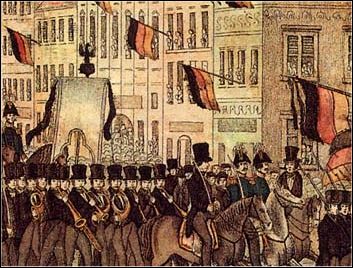
1848 Revolution in Berlin |
TRUE TO its internationalist spirit, the Communist Manifesto was published first in German and French and then rapidly in English, Italian, Flemish and Danish.
Marx was not good at sticking to deadlines and in the end the Communist League had to send ambassadors to collect the manuscript. When it eventually saw the light of day in February 1848, it was born into a year of European convulsions and revolutions.
In 1848 the working class in Germany made up only 5% of the population. Germany, at that time, was mainly an idea, an objective with German speakers living in a number of mainly feudal and agricultural mini-states.
Numerous Germans migrated to industrially more developed countries such as France and especially Britain at the time, in search of work and better living conditions. There they formed organisations, like the German workers’ educational union in London, which at one point had 1,000 members.
This was just one aspect of the first cycle of capitalist globalisation. That this ‘globalisation’ formed an integral part of capitalist development was explained in the Communist Manifesto and developed later by Lenin in Imperialism – the highest stage of capitalism.
In the Manifesto’s first chapter, ‘Bourgeois and proletarians’, Marx and Engels describe how the ‘discovery’ of America and the rounding of the Cape in 1488, and the opening of new markets in areas like east India and China gave a boost to technological and industrial development and therefore to the revolutionary element in the old feudal society: the bourgeoisie or capitalists.
Among the most important technological developments of the industrial revolution was the steam engine, making large scale industry possible. The development of modern transport techniques, especially the railways, navigation, and modern communication technology, developed the modern world market. The bourgeoisie, the owners of the big financial institutions and factories, “shaped the planet after its own image” as Marx and Engels put it.
The modern forms of production, large scale industries etc, gave rise to the modern working class. The mass of the population was now forced to work in order to earn a living, and could “only find work as long as their labour increases capital. These labourers, who must sell themselves piecemeal, are a commodity, like every other article of commerce” and are therefore exposed to the volatility and competition of the market.
Contradictions
Marx and Engels show how the working class is always at war with the ruling class, one way or the other. However, the capitalists always want the working class to fight their battles, whether against old feudal landowners and absolutist monarchs, or against rival capitalists. But mobilising workers this way is dangerous for the capitalists, as any such mobilisation would also put workers’ demands on the agenda.
Only weeks after the Communist Manifesto was published, revolutionary movements swept Europe. They were sparked off by the 1848 February revolution in France, which overthrew King Louis Philippe and established a republic. Especially in Paris, working-class people were at the forefront of this revolution, fighting on the barricades, red flag in hand.
One part of the Manifesto forms a polemic against various other ‘socialist’ trends of the time. Some of them imagined a return to a glorified version of old feudal times. Others called for the setting up of isolated communes without overthrowing the system itself. There were incorrect ideas that free trade could be for the benefit of the working class, who would be enslaved by the free trade capitalists. Others lamented the ills of capitalist society but spoke against workers taking their own independent action.
Marx and Engels refuted all these ideas. They saw the working class as the crucial section in society that was able to overthrow the capitalist system and, for the first time in human history, run society in the interest of the majority, not of a tiny elite.
Struggle spreads
Events in Paris were followed by other revolutionary movements, including in Germany where a failed harvest led to mass starvation and hunger revolts. The local weaving industry, still organised along craft lines, was under threat from the more efficient industrialised British textile industry.
Essentially, the development of the steam engine in Britain put German craft industries out of business, as advanced industries in other countries prospered. Globalisation strikes again! There was a drastic rise in the cost of living, especially food costs.
German capitalism was held back from developing because the country was split up into numerous feudal states, each with their own tax system and currency. There was also no main national, central, capital city emerging, like London in England or Paris in France. This meant that the industrialists remained scattered and disorganised as a class until the 1840s, when under the impact of technological advancement, the situation began to change.
In that sense, the development of a central state under capitalist control as described in the Communist Manifesto was still only a faint idea in the Germany of the 1840s.
There had already been the first foreshadowings of workers’ revolts before 1848, even in Germany. In 1844, the Silesian weavers rose up against the poverty of their working and living conditions and proceeded to burn down the houses of their employers. Their uprising was cruelly put down by the military. It is seen as the first workers’ uprising in Germany.
When the 1848 February revolution developed in France, it sparked off revolutionary movements all over Europe; in Poland, Italy, Austria and Germany as well. Berlin was one of the first centres of the German revolution. In 1848, it was one of the more developed cities in Germany, with a relatively strong industrial capitalist class, and a working class.
 |
|
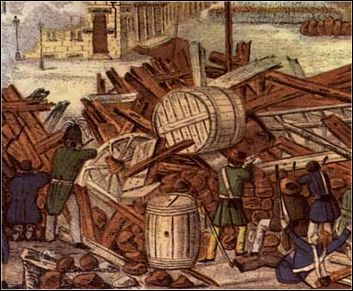
Street battles in Germany in 1848 |
On 18 March, the masses, having been provoked by the military, rose into action. Hundreds died in the ensuing combat but eventually the military had to retreat. The Berlin workers were at the forefront of the fighting. In order to prevent his removal, the king had to publicly salute the fallen barricade fighters.
In the Communist Manifesto Marx and Engels describe the rise of the bourgeoisie as a historical process. “The [written] history of all hitherto existing society is the history of class struggles” they write.
“Freeman and slave, patrician and plebeian, lord and serf, guildmaster and journeyman, in a word oppressor and oppressed, stood in constant opposition to one another, carried on an uninterrupted, now hidden, now open fight, a fight that each time ended, either in a revolutionary reconstitution of society at large, or in the common ruin of the contending classes.”
The word in brackets, ‘written’, was subsequently added by Engels to take into account the long period of ‘primitive communist’ human history, which was without division into classes.
The rise of the capitalist class out of the old feudal society concentrated property and political power into the hands of the few to an extent previously unknown. The nation states, with national governments, equipped with national bureaucracies, police forces and armies are the result of the centralisation of property into the hands of the capitalists: “One nation, one government, one national class-interest, one frontier and one customs-tariff.” The modern state is the executive committee of the bourgeoisie.
The Berlin capitalists watching from the sidelines began to worry. Although they too needed a German nation state for their purposes, they saw the danger of a ‘French disease’ developing on German streets. They found themselves in a quagmire. On the one hand, they could not rid themselves of feudalism without the help of the masses; on the other they already saw their own interests in direct opposition to those of the working class.
Frustrated
It was this contradiction that eventually led to the defeat of the German revolution. A so-called ‘constituent assembly’ met from March onwards in Frankfurt, back then a small provincial town, rather than the big financial city and international transport hub it is today. This made it difficult for the masses to put any pressure whatsoever on this assembly.
The main body of delegates, coming from most German-speaking states including Prussia and Austria, to this assembly consisted of professors, lawyers and other elements of the professional middle class. During the course of the revolution, this body debated a lot but decided very little and enforced even less.
Workers’ interests were not heard, although the assembly received, among others, petitions from workers demanding the introduction of a minimum wage, a maximum working day, the right to form trade unions, the introduction of a progressive income tax, free libraries etc.
When the masses rose elsewhere in Germany to fight against feudalism, this body stood by impotently. It never became what Marx and Engels said was needed at the time, a central command for organising the German revolution.
In the end, aided by the assembly’s inaction, capitalist fear of socialist revolution and the inexperience and relatively small size of the German working class, feudalism was able to reorganise and to defeat the German revolution.
The German capitalists never managed to unite the country themselves. They needed a military leader, Bismarck, to do it for them and against the will of some sections of the German capitalists, eventually bringing about a German capitalist monarchic empire after the Franco-German war 1871-72.
The Communist Manifesto emphasises the need for the working class to have its own revolutionary party. Such a party would “have no interests separate and apart from those of the proletariat as a whole… The communists are distinguished from the other working-class parties by this only: One, in the national struggles of the proletarians of the different countries, they point out and bring to the front the common interests of the entire proletariat, independently of all nationality. Two, in the various stages of development which the struggle of the working class against the bourgeoisie has to pass through, they always and everywhere represent the interests of the movement as a whole.”
Activists with ideas
Karl Marx wrote that the workers “must do the utmost for their final victory by clarifying in their minds as to what their class interests are, by taking up their position as an independent party as soon as possible and by not allowing themselves to be seduced for a single moment by the hypocritical phrases of the democratic petty bourgeois into refraining from the independent organisation of the party of the proletariat. Their battle-cry must be: The revolution in permanence.”
Marx and Engels both participated in the German revolution, as commentors through the pages of the radical paper Neue Rheinische Zeitung, and as active participants. Engels was a combatant during one of the uprisings in Baden.
The ten point programme from the Communist Manifesto was distributed in an adapted form as a leaflet, although many revolutionaries only got to read it years after the revolution, when in exile. After the defeat of the revolution, Marx, Engels and their associates were put on trial and eventually had to leave the country.
Today in building the Campaign for a New Workers’ Party the Socialist Party in England and Wales recognises that the task for working people to develop their own political organisations, both to represent themselves and to be a centre for organisation and discussion, is as urgent today as it was when the Communist Manifesto was written.
‘The philosophers have only interpreted the world, in various ways. The point, however, is to change it.’ Theses on Feuerbach
The Manifesto’s most important conclusion is the role that the working class will play in ending capitalism. Marx and Engels point to the social nature of production, where workers labour together, in factories and workplaces, with similar conditions.
These conditions are made more similar and increasingly monotonous by the continuous drive to introduce machinery and technology.
This means that the working class “alone is a really revolutionary class” and “the proletarian movement is the self-conscious independent movement of the immense majority”.
The Manifesto’s first section ends with the famous words: “What the bourgeoisie therefore produces, above all are its own gravediggers. Its fall and the victory of the proletariat are equally inevitable”.
The Manifesto is above all a call to political action.
As workers today face constant attacks on their living standards and the economies of the major industrial countries head towards a synchronised world recession, the Communist Manifesto is becoming more relevant than ever.
Read it!
The Communist Manifesto
by Karl Marx and Frederick Engels
£2.50 + 10% p&p
Available from
