

Editorial
24 April strikes – a step forward in the pay battle
 |
|
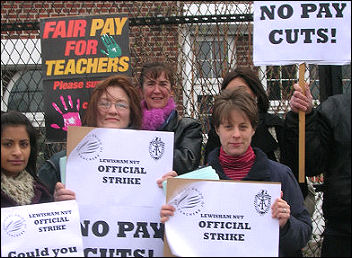
Merlin school teachers on their picket line, photo Martin Powell-Davies |
THE NATIONAL Union of Teachers (NUT) was the first public-sector union to decide to take strike action on Thursday 24 April over the government’s pay limit policy, and now nearly 400,000 public-sector workers are due to strike on that day. This will be the biggest joint action of the public-sector unions for decades.
The NUT has called out its 230,000 members after they rejected a pay award of 2.45% for this year as part of a three-year package that represents direct cuts in their pay packets. The Public and Commercial Services union (PCS) is calling out 100,000 of its members from ten separate parts of the civil service, from the Department for Work and Pensions to the Home Office, over pay “offers” that range from 0% to 2%.
30,000 Further Education college lecturers from the University and College Union (UCU) are also taking action on 24 April, as part of their campaign to bring pay “up to that of school teachers” (it is 30% behind teachers at the moment and growing further apart year on year).
In addition, Birmingham council workers are striking for two days on 23 and 24 April as part of their ongoing opposition to the council’s plans to introduce equal pay by cutting – by up to £15,000 – the wages of many of the workers. Over 40,000 workers are affected.
What is common about all these developments is the extreme anger that is felt by public-sector workers over the treatment they receive at the hands of their bosses and the New Labour government. It is clear that the mood exists for a 24 hour strike of the entire public sector, if only it were to be called by the union leaders.
In the words of the Financial Times, a “much bigger threat” than the 24 April action is looming from 1.5 million local council workers who are in the process of being consulted over a similar three-year deal to that of the teachers. The recommendation from the union leaders is to reject the offer.
In the NHS, one million health workers have been “offered” a three-year deal as well. With almost indecent haste, the leaders of Unison and the Royal College of Nursing, who between them represent two thirds of the workforce, have ‘welcomed’ the offer, which in reality is a wage cut. With ‘leaders’ like this, you might very well ask who needs enemies.
An added twist to this year’s wage rounds (40% of all wage agreements are due in April) is the deepening crisis in the economy. The growth of unemployment and the fall in the income of working people and therefore tax payments to the treasury, are already affecting the government budget.
In the private sector, according to Income Data Services, wage increases are on average around 4%. But this is not expected to continue into the recession itself. Financial commentators refer here to the possibility of wage cuts and forcing more full-time workers onto part-time contracts as the markets for goods and services fall. This way they expect that unemployment will be kept down, though the effect on workers’ living standards as a whole will be the same; that is, they will be squeezed.
So private-sector workers will soon have to turn to the example being set by sections of the public-sector workforce and take action to defend their living standards.
The present anger over wages is not new, but far too often in the past this anger has not been cashed in on. On the contrary, the union leaders have strived might and main to hold back the movement. But this year, a significant number of them know that they dare not hold it back any longer, without at least on the surface giving voice to the anger.
It has been the massive increase in prices that has added grist to this particular mill. Gas prices have recently gone up by nearly 13%, electricity by nearly 8%, petrol by 20.5% and food by 7.4%. In the face of this, the union leaders are having to respond, because of strong pressure from below.
The PCS has tried hard to put pressure on the other public-sector unions to act with the PCS against the pay limit, and are continuing this pressure. They are preparing to call on the TUC at the end of April general council meeting to name a date for a day of action on pay. At the same time they are striving to involve as many of the unions as possible in bilateral talks to coordinate plans.
Unfortunately, the biggest public-sector union, Unison, continues to ignore these requests from the PCS. It was this attitude that meant, for example, that Unison members in local government lost out in the 2005 agreement over pensions and ended up with something far worse.
Unison members should demand that their leaders take seriously the request for joint action before it is too late.
24 April will be of significance in the battle to defend workers’ wages, but only if it is seen as the beginning of a determined fight and not just as a means of letting off steam. Unions like the PCS, RMT and POA have shown the way in being prepared to take action when necessary; DWP workers in the PCS – as mentioned on the front page – have now struck on 21 days in less than four years in defence of their conditions. New fighting forces, such as the teachers – who will be taking national strike action for the first time for 21 years – are beginning to come into play this time.
The movement for spreading and co-ordinating the strikes has to be built in the unions and in the workplaces over the next few weeks and months. The call for a 24-hour public sector strike is urgent. There is much at stake.
Stop press
THE HEALTH conference of public-sector union Unison narrowly voted for the Health Service Group Executive (SGE) motion to go to consultative ballot on the three-year deal of below inflation pay awards. The majority was just under 13,000 (approximately two large branches).
However, unlike the previous year it has been stated that branches and regions will be able to campaign for and against the offer. This is because the SGE was defeated when a resolution on learning the lessons of the 2007 health campaign submitted by the Eastern regional health committee was passed.
Unfortunately a left motion calling for a rejection of the pay offer and a ballot for industrial action on pay was lost.
