

FORTY YEARS ago this month, France was gripped by a revolutionary fever. Within days of a one-day general strike being called in solidarity with protesting students, ten million workers were on strike. They occupied their factories, offices and depots.
They held meetings, set up action committees, organised some production and distribution of essentials, cleaned machinery, sang the Internationale and discussed the future. They were getting the feeling that they had the strength to change their world.
To mark this anniversary, Clare Doyle outlines some of the features and lessons of that titanic movement.
AT LAST they would see off a bullying president and his truncheon wielding ‘forces of order’ who had been injuring and arresting students by the hundreds.
At last, in the new society being born, students would be able to choose what and how to study and who to associate with, including at night time! Car workers would no longer be spending eight to ten hours a day at their machines, policed by armed company thugs. Train and bus drivers would have control over their shift patterns and plenty of time to rest, read and discuss… even to get involved in running their industry and society itself.
The women workers of Galleries La Fayette would be able to go to work without dressing up like models and models would be able to decide when and where to take their clothes off! Farmers would discuss with workers and city-dwellers the best way of producing and distributing their products and would look forward to assistance from a sympathetic government with the buying of seed and equipment. At last cooperatives would be run on truly cooperative principles!
Architects, who joined the general strike by 20 May, would stop designing prestige office buildings for big companies in favour of good quality homes, schools, community centres and sports facilities for workers and their families. Footballers, film-makers, magistrates, bargemen, all stopped work.
No-one could imagine the bosses – many now locked up in their offices or fleeing across borders – ever again making the big decisions. Even magistrates were debating whether they would have any role to play in the future society being ushered in. School students joined in the struggle of students and teachers for a totally different education system – without testing, measuring and making people conform. Journalists of the printed and spoken word fought for total freedom of expression. Doctors, nurses and patients planned how a new health service would be run.
ONE OF the most powerful governments in a developed capitalist economy was powerless! It could not rely on its army, police and navy. Its head of state looked as helpless as a beached whale. How did this extraordinary state of affairs come about? How did it end, and could it happen again – in France or any other country?
The post second world war boom had had dramatic effects in France. Rapid industrialisation had drawn millions of agricultural workers from the land and immigrant workers from France’s ex-colonies of North Africa and Vietnam. But, as in neighbouring Italy, these new workers were not only crammed into vast factories turning out fridges, cars, planes, washing machines and televisions. They were living in conditions more akin to the 19th than the 20th century – immigrants in mass dormitories, Parisians in slums without toilets.
Just as the French bourgeoisie had feared, they had created a working class which could become their gravedigger. Workers wanted to see some benefits from the sacrifices they were making. Also the era of full employment was ending; unemployment was beginning to threaten livelihoods, especially of the young.
Students, moving into battle in March and April 1968, were no longer prepared to tolerate the stuffy, over-regulated and over-crowded universities, let alone the prospect of being pushed out of university after the first year or graduating and not getting a job.
When Nanterre university was closed and the Sorbonne was occupied in solidarity, the Gaullist state forces moved in with full battle orders to clear the occupation and ‘break heads’ if resistance was given.
 |
|
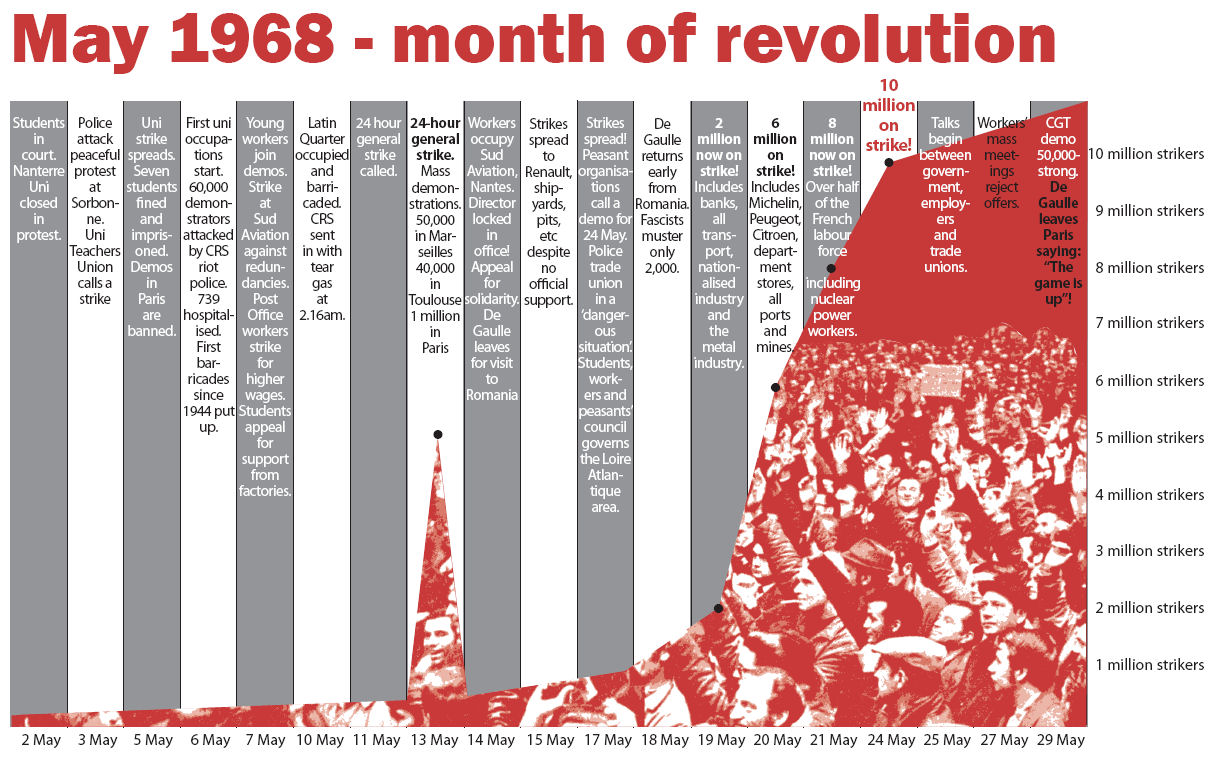
Click to enlarge – France 1968 growth of strike action to 10 million |
By 6 May, 60,000 demonstrators came under attack from the CRS riot police and 739 were hospitalised. Scenes of police brutality transmitted live on television angered workers across the country. If the students were treated like this, what was in store for them?
When the reluctant trade union leaders called a one-day strike on 13 May, workers on the mass demonstrations countrywide felt their potential strength. Over five million came out and one million marched in Paris. But they did not want to just leave things there and go back to ‘normal’ .
The leaders of the strongest workers’ party in France at the time – the Communist Party (CP) – did not want a political movement, let alone a revolution. This would would have inspired workers in the ‘communist’ Soviet Union, Eastern Europe and elsewhere to take the economy and society out of the hands of the Stalinist bureaucracies.
They hoped, as many trade union leaders have done before and since, that a one-day strike would release enough steam to prevent further action. But the young workers of the major factories thought otherwise!
Without any further call to action from above, they spontaneously followed an example set by the Sud Aviation workers. The day after the national stoppage, the latter had returned to their factory to occupy it, lock up their boss, organise an action committee and go to neighbouring factories and workplaces to spread the idea.
The great revolutionary strike picked up momentum like a gigantic wave. If just a few hundred were on strike on Tuesday 14 May, by the weekend two million were out – in transport, health, education, post offices, shipyards, theatres… . By the 20th, six million were out and by Friday 24th, ten million!
Strikes spread
MINES AND ports were closed. Electricity and gas workers and bakers stopped work. Funerals, weddings, golf and tennis tournaments, horse-racing, the state lottery, were all called off. Everyone was discussing their own futures and how the great movement would end. Red flags were flying everywhere.
Even the CP leaders were temporarily carried away by the mood. Initially they had labelled the students as rabble, much as de Gaulle had done and as Nicolas Sarkozy would do nearly 40 years later when referring to the youth of the ‘Banlieus’.
As the revolutionary mood swept the country (and across its borders), CP secretary Waldeck Rochet spoke in parliament of the question of ‘power’ and the need for “nationalisation of the monopolies that dominate key sectors of the economy”.
Calls for the linking up of elected action committees on a national basis to pursue the revolutionary struggle were correctly made by the Trotskyists of the International Communist Party (predecessors of today’s Ligue Communiste Révolutionnaire – LCR).
The situation was fast becoming a ‘text-book’ revolutionary situation, as the London Evening Standard put it. On 27 May, the Standard carried a headline: “The General decides to quit”. On the 30th it declared: “France has no effective government” and on the 31st that: “The strikes have assumed a strictly political and insurrectionary character”!
But the CP leaders rapidly reverted to type. In spite of their glorification of the Russian Revolution and the Bolsheviks, they did not want to do anything like lead a revolutionary overthrow of the Gaullist regime and of capitalism.
The Trotskyists, on the other hand, with no more than 1,000 members, would have liked nothing more! But having turned away from the working class of Europe in the period immediately before this revolutionary upheaval, they had difficulty establishing their credentials with the French working class as it moved into action.
An additional problem was the long-standing efforts of the CP defenders of the Stalinist Soviet Union to inoculate the revolutionary workers of France against the Trotskyist ideas of workers’ democracy and genuine socialism.
Many of the necessary factors for a revolution in the heart of modern Europe were there in May 1968. The French ruling class was split and ineffective. Neither repression nor concession seemed capable of saving them. The middle class was not just supporting the workers’ great strike but was involved in the movement.
Police were striking, sailors mutinying and conscript soldiers declaring their unwillingness to be used against their brothers in the strike movement. The working class had moved in their millions, solidly and without fear. They had made irrelevant the institutions of parliament and even the presidency with all its bonapartist powers. De Gaulle could not make a broadcast or carry out a referendum without the workers’ say-so.
Metaphorically speaking, it would only have taken a pea-shooter to dispose of capitalist rule and institute a revolutionary workers’ government. The forces of the old state would, of course, have been mobilised and would have to have been dealt with by an armed working class or revolutionary workers’ militia.
A revolutionary party acting correctly would have prepared for this, drawing up a strategy for victory – including linking up democratically elected workers’ councils, to form a national body capable of seeing through the formation of a workers’ government.
But the CP leaders were more concerned with ending the movement than building it. Like the leaders of the British 1926 general strike, the French CP leaders insisted that the 1968 strike was not even political! After the May ‘events’, the CP typically said the army had been too strong for the workers to defeat it.
But not only had soldiers spontaneously been siding with the workers’ cause, but reaction had not dared to rear its ugly head, so powerful was the movement and so strong the socialist sentiments expressed at every student meeting and workers’ demonstration.
A few fascists on the streets on 18 May had failed to get a mass response and had gone home with their tails between their legs. The revolutionary action of the workers had forged unity – between students and workers, men and women, immigrants and non-immigrants, blue and white collar workers and agricultural and industrial workers.
The general strike had developed from below, with no call to action from the trade union leaders after 13 May. When, on 27 May, the trade union leaders emerged from talks with the government and the bosses, having won huge economic concessions, workers in factory after factory rejected them. These reforms did not answer their more fundamental and long-term desire – conscious or unconscious – for the economy, politics and society to be run by them.
In fact, it is precisely to make articulate the inchoate strivings of workers for another world, a socialist world, that a revolutionary party is required.
Workers were beginning to look for alternatives to their traditional ‘leaders’, as the 50,000 strong Charlety stadium meeting on 27 May, organised by the LCR and other left groups, demonstrated.
Leadership essential
IF A clear revolutionary leadership had been forged in the white heat of the events, a call for unity in action against the common enemy could have been made at the Charlety meeting as well as in the factories and on the mass demonstrations, for the transformation of the elected workers’ and students’ councils from organs of struggle into organs of government.
But tragically there was no revolutionary party, with mass support, capable of leading a successful transfer of power from the small dominant capitalist class in society, to the majority – the working class. The moment for replacing Gaullist capitalism with a dynamic socialist government and spreading revolution across Europe came and went.
De Gaulle, however, was taking no chances. He fled the country to go to Baden Baden in Germany – the home of the French troops – possibly never to return. He had seen the workers rejecting the generous reforms that the threat of revolution had wrung out of the bosses and their paralysed government.
But within 24 hours he had a deal with the reactionary generals on the Rhine and could see that neither the Communist Party nor any other was up to the task of removing him and his class from power.
Drawing reassurance from the pusillanimity of the French workers’ leaders, de Gaulle returned to Paris. He announced the dissolution of the assembly, new elections, a campaign against communism and the banning of Trotskyist and other ‘far-left’ organisations and papers.
Workers were told – by the government and their union leaders – to go back to normal work and concentrate on the elections. Many sections of workers held out for days, some for weeks, reluctant to give up their new status as masters in the workplace. Riot police were sent in to break up occupations and evict workers.
Now that the movement was ebbing, they executed orders to the letter. Some deaths – of students and young workers – resulted. Government and bosses alike, with their confidence restored, wreaked vengeance on those who had brought them so close to extinction. Many workers were victimised.
The elections on 23 and 30 June gave the Gaullists an extra million votes, while the Communists and Socialists lost more than a million between them. The Trotskyists mistakenly recommended voting ‘blank’, not recognising the changed realities of the situation.
The chance for successful mass, extra-parliamentary action to end capitalist rule was over for the time being. Instead of taking a bold stand and confronting the old order, the Communists presented themselves as the party best placed for restoring it! They should have promoted the idea of an ordered and harmonious society through public ownership and socialist planning, in contrast to the chaos and cruel anarchy of capitalism.
De Gaulle was the ‘law and order expert’ though he had temporarily been brought low. Now, that he was back in the saddle, some of the scared and dissappointed middle layers and some workers would give their vote to the ‘expert’! But in spite of the apparent restoration, even strengthening of the Gaullist regime, the figurehead never regained his previous authority. He was mortally wounded.
When, in 1969, he finally put his distorted idea of democratic participation to a vote in a referendum, it was rejected. Within days he resigned, almost exactly a year after the beginning of the 1968 events.
Within three years Mitterrand’s Socialist Party was founded and in 1981 received a massive 55% of the votes. The Communist Party, though it grew in numbers as an immediate result of the politicisation of ’68, never recovered its standing amongst workers and intellectuals. This was underscored later in 1968 when ‘Soviet’ troops went in to crush the movement for democracy in Czechoslovakia.
New ‘1968’ needed
SINCE THE fall of the Berlin Wall, the French CP has shed all pretences of being a real anti-capitalist force. It has joined the ‘Socialist’ Party at national and local level to carry through neoliberal ‘reforms’. In the recent municipal elections, any successes of the CP were due more to the anti-Sarkozy mood than any turn towards CP policies.
Is the political and industrial landscape so changed today that a new ‘France 1968’ is ruled out? Well, when Sarkozy – as he has done – talks of the need to eliminate the spirit of ’68, then it obviously still worries him.
The prospect of such a development clearly still haunts the bosses and politicians of France and neighbouring countries every time they see workers spoiling for a fight.
This would not be the case if the ghost had truly been laid to rest! Sarkozy is now the least popular head of state since the war; Lycée students in struggle at present have carried placards reminding him of the humiliation of de Gaulle in ’68, pasting Sarkozy’s face on posters from that time.
Was it an insurrection? Yes, at least the beginnings of one. Could it have succeeded? Only if a party had been in place with a clear programme for taking power. And that would have taken time and skill to develop.
It is salutory to see that a relatively small party, the PSU (Unified Socialist Party), which put forward semi-revolutionary ideas during the events did experience rapid growth in support as workers moved towards revolution. It was a false argument of the CP that the working class was not ‘ready’ for revolution – in 1968, in 1936 or any time!
As Trotsky explained, it is the active involvement of ‘the party’ in the struggles of the working class that develops both the party itself and the political consciousness of the working class in a truly dialectical way.
In other countries in 1968, where students were involved in campus and street protests in vast numbers, they were not joined by workers in the same way. In France the workers’ slow-burning resentment against authority was fuelled not only by the bosses’ daily exploitation and the growth, even during a boom, of unemployment and inflation, but also by the dictatorial methods and arrogance of the 20th century Bonaparte, de Gaulle.
That particular combination of factors will not reappear in an exact replica but the ‘threat’ of new ’68s remains. Now, with deep recession in view internationally, we can expect the capitalists’ media to try even harder to keep the real lessons of May 68 from view.
There has already been a spate of reminiscences from ageing intellectuals about the ‘mid-summer madness’ that gripped them for a brief moment in their youth. They have ‘come to their senses’ and now deny that revolution was possible, let alone desirable.
Lessons for future
SOCIALISTS INTERNATIONALLY must retell the story as it was – the greatest general strike in history, that brought capitalism to its knees. A strike that showed that socialism can be ushered in relatively peacefully, once the idea has gripped every layer in society.
Going over these great events can help prepare a whole generation for the new and bigger strike battles that lie ahead in France and internationally. It can give great confidence to those engaged in the vital task of building new mass workers’ parties and in fighting for socialist policies that will finish with capitalism once and for all.