

The government’s proposal to extend the period the police can hold suspects without charge to 42 days, will be presented to parliament in the next few weeks. This will be among the fifth set of ‘anti-terror’ laws introduced in the last seven years.
Few people would oppose measures that would genuinely help to prevent attacks like the 7/7 bombings in London. But ANNA LUCAS explains that, far from being a step in the right direction, these new laws, and other ‘anti-crime’ measures over recent years, amount to a major and unjustified attack on our democratic rights.
Increasing pre-charge detention is just one of a plethora of authoritarian laws introduced by New Labour. Their stated aim is to stop terrorism, but will such laws serve that purpose? Also, are they just aimed at terrorism and if not, who else is perceived as an enemy?
Is it, for example, MP for Tooting Sadiq Khan, who had his conversations with a constituent in prison recorded by the secret services? Or the thousands of anti-capitalist and anti-weapons protesters who have been stopped and searched under anti-terror legislation? And are ‘mistakes’ like the shooting of Jean Charles de Menezes by anti-terrorism police, a ‘necessary evil’ in the ‘war on terror’?
These incidents are not just one-offs carried out by over zealous police officers or sections of the security forces, but are part of a deliberate strengthening of the state apparatus, where the fight against terrorism is acting as a cover to crack down on civil liberties and democratic rights.
The democratic rights that we have, such as the right to assembly, to have parties, trade unions, workers’ papers, fair trial etc, were won through labour movement struggle.
Some of these have been eroded in the recent period however, and terrorism has been used as a pretext by the government to curtail and cancel various rights. If the police, courts etc get away with repressive, undemocratic methods for alleged terrorists, they will use the same methods with more and more suspects, resulting in more miscarriages of justice.
Unfortunately most of the trade union leaders today have gone along with this, even curtailing rights within the trade unions themselves.
Denial of rights
The new “counter-terrorism” bill contains proposals that deny the due process rights of suspects (presumption of innocence, legal aid, a fair trial etc). It also contains the proposal to increase detention without charge to 42 days. This has already been increased to 28 days. Initially the government wanted to extend it to 90 but were defeated when it came to the vote.
Even the director of public prosecutions opposes an extension and has called for a “culture of legislative restraint” and avoidance of responses that are “fear driven and inappropriate”. It is rumoured that nearly half of New Labour MPs have serious concerns about this new bill and that only 36% of all MPs will vote for it.
To try to prevent another defeat and the further weakening of Gordon Brown’s leadership, the government are offering compromises over the powers they need to invoke 42-day detention, like declaring an exceptional need such as the aftermath of an atrocity, authorisation by parliament and judicial review of the use of the power.
In actual fact the police already have the power to increase pre-charge detention under emergency measures in the Civil Contingencies Act 2004. This allows for a temporary extension of the period for questioning, subject to parliamentary and judicial oversight. So the police do not need any more powers if there is a genuine emergency.
Britain already has a longer pre-charge holding time than any other country in western Europe. The country with the second longest is Turkey where parliamentary democracy remains fragile and the military has a major influence, but even there the police can only hold suspects for a maximum of seven and a half days.
Without any further changes in the law, there are young men in prison, mainly Muslims, not because they have been found guilty of any crime, but because secret ‘evidence’ has been supplied against them by the police to a court and the authorities have deemed it necessary to lock them up. Those detained were not told what the evidence against them is.
In July 2006, five Muslim men were jailed for downloading Islamist material from the internet. Their case was subsequently overturned at the court of appeal, but not before they had spent 18 months in prison.
New Labour is guilty at an international level too of flexing their authoritarian muscles. They are knee deep in allegations about colluding with the US government in the act of ‘rendition’ (removal of suspects from one country to another). British airports and aircraft have been used to transport terror suspects out of the country they are in, to detention centres elsewhere, where they have been interrogated and in some cases tortured by US and other security services.
Some would say that we are living under a surveillance state in Britain. We are the most monitored population in western Europe with 4.2 million CCTV cameras. Each one of us can be caught on camera up to 300 times a day. There is no accountability or control over who uses or has access to the data collected from these cameras.
It’s true that there is a fear of crime generally within the population and a perception that CCTV cameras can help prevent it. But as a senior Scotland Yard police officer has recently stated, CCTV does not have a significant impact on crime prevention. Studies have shown that improved street lighting can have a much greater effect.
There are also other attacks on our right to privacy. This government has an obsession with centrally controlled national databases that hold personal information. There is more private information stored on people in Britain than anywhere else.
The loss of child benefit discs containing the personal information – including bank account details – of 25 million people, which went missing on their way to national auditors last year, illustrated that our right to keep our personal information confidential is being breached.
Outcry
The loss of these discs caused the biggest outcry, but there have been 14 other serious breaches of security regarding centrally controlled databases. Civil service cuts were the main reason lying behind the loss of so much sensitive information. Staff cuts, privatisation and other cost-reducing measures in public services all put our privacy at risk.
More and more these centralised databases are controlled and serviced by private companies, and can often be viewed by hundreds of people. The NHS database is a case in point. A private IT multinational company runs it, which means that our personal information has been privatised. 300,000 people will have access to this database.
Doctors are up in arms that so many people can view information about their patients. In the past only a very few health professionals would have had access to it. Storing personal health details in this way could be very serious if computers are hacked into, or information is leaked. In some cases lives could be wrecked if confidentiality is breached and information misused.
Britain also has the biggest DNA database in the world (proportionate to population size), containing the DNA of over 4 million people. According to the organisation Liberty, the database “is alleged to contain more than 100,000 DNA samples taken from children who have never been charged or convicted with any crime”.
The ultimate in control freakery is the plan to bring in ID cards. Not only are they potentially a huge infringement of our right to privacy, but they could cost a whopping £19 billion to implement, say researchers at the London School of Economics. We are told that ID cards will help in the fight against terrorism, but ID cards in Spain did not prevent the Madrid bombings. Nor would they have prevented the terrorist attacks on the London underground, because the men who carried out those attacks were British citizens.
According to the Home Office, 265 government departments and 44,000 private-sector organisations will use the national ID cards database to verify people’s identity. We are told that a national commissioner will provide oversight. But he or she will have no power over the police, intelligence and security services. This is particularly an issue for trade unionists and political activists whose movements at times of strikes, mass struggles and protests will, if this scheme is implemented, be more easily monitored by state forces.
The trade unions need to demand ‘mass scrutiny’ over how our personal information is stored, who has access to it and what it is used for. The multinational IT firms running these databases should stay out of public services; the control and ownership of systems holding vast amounts of personal information must return to the public sector.
In a recent YouGov poll, only 17% of people said they trust the authorities to keep their personal details completely confidential, while 57% believe the UK has become a ‘surveillance state’. New Labour also takes first prize when it comes to other reactionary laws, like those that aim to shackle the trade unions. They have kept and enforced most of the Tory anti-trade union legislation which has hampered trade union struggle for the last twenty years.
 |
|
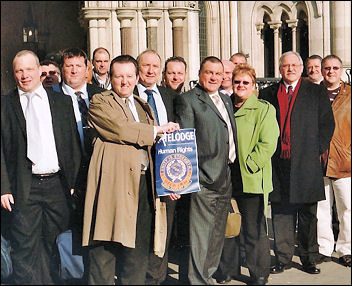
Prison Officers Association protest outside the Royal Court of Justice, joined by Brian Caton, POA general secretary, photo Keith Dickinson |
After the prisoner officers’ strike last August, the government intervened to ban them from striking again and this came into force on 14 May 2008. This led to the Prison Officers Association taking the case for their right to strike to the High Court and launching a campaign on this issue. New Labour also wants to ban strikes in the emergency services.
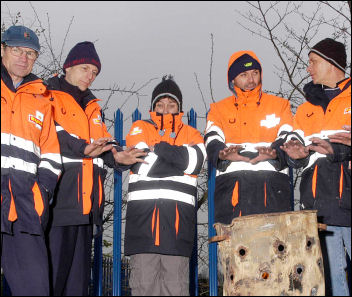
However, the anti-trade union laws are not worth the paper they are written on when the working class acts decisively. The postal workers’ official strike last year also led to unofficial action, which meant they trampled all over these reactionary laws and the post office bosses were unable to enforce them even though they threatened to go to court.
The right to protest
 |
|
The CWU postal strike 2007 – postal workers trampled on the anti-trade union laws |
Increasingly, legislation supposedly aimed at fighting terrorism, serious crime and anti-social behaviour has been used against trade unionists, anti-capitalists, demonstrators and as a tool to crack down on protest and free speech. Protesters are regularly stopped and searched by police under section 44 of the Serious Organised Crime and Police Act 2000. The police have got away with using tactics like ‘containment’ on demonstrations, which means surrounding protesters with rows of police and not allowing them to move, sometimes for hours.
This tactic was ruled legal in the courts and the Human Rights Act deemed not relevant, when used against the May Day 2001 protesters. The High Court judgement on this case even equated anti-capitalists with those who carried out the attack on the twin towers in New York. This is part of a deliberate campaign by the ruling class to criminalise demonstrators.
The way anti-terror legislation has been used not against terrorists, but as happened at Fairford military base, against sixteen-year old peace protesters, is a warning to the labour movement. So are the clauses in anti-terror legislation with offences such as ‘glorification’ and ‘encouragement’ of terrorism, which can potentially make a criminal of someone who may be completely against terrorism, but who supports the right of an oppressed people to armed resistance against imperialist war or occupation.
It was reported last week that a 15-year-old is facing prosecution for holding a placard on a peaceful anti-scientology demonstration saying that “scientology is not religion, it is a dangerous cult”. This threat to the young protester was on the basis that the Public Order Act prohibits signs that are threatening, abusive or insulting.
The new Counter-Terrorism Bill could allow further attacks on anti-war protest and free speech, with a clause that makes an offence of ‘seeking or communicating information about the armed forces that could be useful to terrorism’. This could mean ex-soldiers who speak out after serving in Iraq or Afghanistan are breaking the law.
We don’t live in a police state, although the power is there to dissolve parliament and declare martial law if deemed necessary by the ‘executive’ – the inner core of the cabinet, top civil service and military. But these measures strengthen the state under the cover of fighting terrorism, and the powers-that-be have the legislation in place to try to counter workers who are taking action or protesting against attacks on working conditions, pay and jobs, or any measures of the government.
Trade unions must forcefully campaign for the right to protest, and the right to free speech and association. Ultimately, it is the working class and its organisations that repressive legislation is and will be, aimed at. The police have a myriad of functions in our society, but when workers’ struggles and greater class conflicts arise, they are not ultimately a neutral force, but are used to serve the interests of the ruling class.
The increase in harassment of ethnic minorities like that which is aimed at the Muslim community at the moment, doesn’t stop terrorism, but does whip up racism and divide the working class. As will the moves to increase police ‘stop and search’ powers by the home secretary Jacqui Smith, which will feed the alienation and anger that can lead some young people in the direction of reactionary, right wing political Islam.
Racism in the police has contributed for decades towards harassment and victimisation of black and Asian people, including long before 9/11 and the bombings in London.
Protect us?
So how can we have faith in the police to protect us from terrorism and to behave fairly and without prejudice when it comes to dealing with terror suspects from minority ethnic communities? How can we believe them when they accuse someone of being a terrorist and lock them up in Belmarsh prison while saying that no one can see the evidence?
We cannot leave it to a wing and a prayer that suspects will go before a fair judge. 70% of judges went to public school and almost all are firmly ensconced in the capitalist ‘old boy’ network and committed to upholding the capitalist system and all its injustices.
At the same time as defending democratic rights, the fears people have about crime and terrorism need to be addressed. Community organisations and trade unions need to monitor and put pressure on Local Authorities and Police Authorities, like the London Police Authority, to influence police policy. There should be elected police committees to act as a check on the police and provide democratic accountability.
In the years ahead, as well as waging struggles to defend living standards, trade unions will also have to struggle to defend democratic rights and reclaim the rights that have been whittled away in recent years.
At a national level there needs to be a mass campaign against the new raft of draconian laws, against the current injustice of those fitted up by the police and the judiciary on terrorism charges and in defence of all aspects of our civil liberties. A new workers’ party, when it is built, could give a political voice and leadership to such a campaign.
Socialists need to bring back into working class organisations the debate about the state and in whose interests, in the final analysis, it acts. Ultimately, the present state machine, which is steeped in prejudice and is an instrument used by the capitalist class to maintain this unjust and unequal society, needs to be removed and a new way of running society put in its place.
This requires a socialist transformation, i.e. public ownership of the commanding heights of the economy and democratic socialist planning to meet the needs of the overwhelming majority. This would need to go hand in hand with a new way of running society with democracy at every level.
The Socialist says:
- Charge or release! Reduce, not extend, the pre-charge holding time.
- For terror suspects to see the evidence against them and to know what they have been charged with.
- The repeal of all the new draconian ‘anti-terror’ laws.
- No to the surveillance state.
- Public ownership and control, and adequate resourcing, of national databases concerning health, education, benefits, motoring and all other basic services.
- Defend the right to protest.
- For the repeal of the anti-trade union laws. Defend the right to strike.
- For a mass campaign in defence of civil and democratic rights.
