

New struggles lie ahead
 |
|
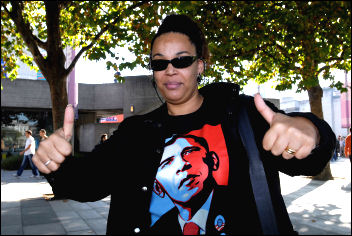
US president Barack Obama supporters, photo Paul Mattsson |
The overwhelming victory for Barack Obama in the US Presidential elections and the major gains scored by the Democrats in the Senate and House of Representatives represent a turning point for the USA. At the time of writing it appears Obama has won over 52.3% of the popular vote and more than 62 million votes. The massive increase in turnout – which at the time of writing is estimated to have reached 64% – the dramatic increase in registration and votes from Afro-Americans, Latinos and young people represent a crushing condemnation of Bush and the neo-cons as well as a generalised, if inchoate demand for ‘change’ amongst the mass of the US population.
Tony Saunois (CWI)
In the run up to the election opinion polls indicated that over 90% of the population thought that Bush was doing a “poor job” and 80% considered the country to be on the wrong track.
The backlash against the Bush regime and the effects of the economic crisis has produced a mass politicisation in the USA reflected in this election. The huge Obama rallies during the election attended by tens of thousands, with over 250,000 turning out in the early hours of the morning for his victory rally in Chicago, indicate the massive polarisation and high expectations which have developed during the campaign.
While at the time of writing the final results are not yet tallied, it is clear that Obama has scored a massive victory amongst important sections of the population. Amongst young voters Obama was leading by 69% to 31% for McCain. Amongst new first time voters, Obama won 69% to 30%. The only age group Obama was behind in was the over 60s.
Throughout the campaign the question of race has been featured as an important issue which it is, especially in the USA due to its racist history. While racism still exists, Obama’s victory was possible because it cut across ethnic and racial divisions. Unsurprisingly, an estimated 95% of Afro-Americans voted for him. Amongst Latinos, 63% supported him. While amongst whites he won a minority 43%. This does not tell the entire story as amongst working class whites the figures appear to be more evenly split.
 |
|
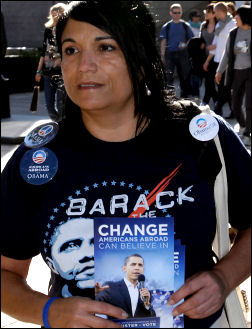
US president Barack Obama supporters, photo Paul Mattsson |
McCain’s support was drawn overwhelmingly from small towns and rural areas while Obama won 71% of the vote in the big cities and 59% in the smaller cities and 50% in the suburbs.
In this election the decisive factor we saw was the massive class polarisation which has taken place in US society in recent years. Although the vote for Obama and the Democratic Party, which remains a capitalist party, is not a conscious class vote it does indicate the gulf which has opened up and the bitter hatred that has developed towards the rich – especially the bankers and financiers. The running sore of the Iraq war remains an important issue but as the economic crisis has unfolded it has taken precedence in the minds of people. Consequently in some polls 10% considered Iraq as the major issue. This represented an important change which has taken place during recent months. However, Iraq will remain an important question for people and the Obama Presidency.
Throughout the election campaign tens of thousands of people have been drawn into campaigning work for Obama. In the US and Europe, capitalist commentators have argued that campaigning activity and activists were a thing of the past. TV ads and the media were all that is needed for politics in the modern era they claimed. Both the capitalist Republican and Democrat parties have been election machines with few activists on the ground in the real sense. However, the mobilisation of tens of thousands into activity during this campaign illustrates how people can rapidly be drawn into active politics when they perceive a real struggle to defend their interests is at stake. It is striking how rapidly these layers were drawn into activity for Obama. While TV ads etc, were used by Obama, it is significant that mass meetings, workplace meetings, canvassing and the use of blogs and the web were a major feature of this campaign. This has important lessons for the US and other countries for the future when a new genuine left or workers’ party develops.
It is estimated that between 120 and 130 million will have voted in this election making it proportionally the highest turnout since women were given the vote in the US in1920. For hours people queued to cast their votes, in scenes reminiscent of the first post apartheid election in South Africa. For Afro-Americans, especially, Obama’s victory has been as significant as Evo Morales victory was for the indigenous peoples of Bolivia.
Another important feature in the election and during the economic crisis has been that the question of ‘socialism’ has been put back into the political debate in the USA for the first time in decades. Ironically this was done by the neo-con Republican right, including in the Congress. They first raised it when the bail out package was announced. Then Obama was accused of being a ‘socialist’ and even a ‘communist’ by the Republicans. Neither Obama nor the Democrats are socialists and they both defend capitalism. However, events and the Republican right, have inadvertently put the question of socialism back on the table for discussion. Unfortunately, there was not a strong left or working people’s party which could then capitalise on this. However, as capitalism continues to decline it will re-introduce the issue for debate and discussion about the way forward in the coming months and years amongst workers and young people as the effects of the crisis hit home.
Obama’s victory represents a further ideological defeat for the neo-cons and has aroused enormous enthusiasm not only in the USA but internationally. The people of Western Europe, and especially Asia, Africa, and Latin America in particular look to this victory with high hopes and expectations.
The crucial issue following Obama’s election victory is what policies his new administration will introduce? Will his programme and policies be able to satisfy the hopes and expectations which have been aroused amongst millions following his victory?
Obama will take power against the background of the worst economic crisis since the 1930s. It is already having a devastating effect on the lives of millions throughout the US. Internationally, US imperialism remains bogged down in two major wars – Iraq and Afghanistan.
The demand for change and reform could compel Obama to introduce some reforms for example in health care and assistance to those threatened with eviction from their homes following the financial meltdown. Those who voted for him will also demand that he takes steps to withdraw troops from Iraq. If he fails to do this, then the massive hope and expectations in him could rapidly evaporate. Yet, even the introduction of some temporary concessions will not be sufficient to resolve the devastating crisis which is unfolding. A genuine mass programme of public works, in the face of a deepening recession and mass unemployment, will be needed. There must be a struggle to demand no evictions from their homes of those who cannot afford mortgage repayments.
Bush rejected a bail-out to the motor industry. Thereby condemning thousands of workers and their families to suffer the misery of unemployment. Rather than a bail- out for the directors of major companies threatened with bankruptcy, they should be nationalised with compensation paid to small share-holders on the basis of proven need and put under democratic workers’ control and management. These and other demands will need to be fought for by working people and those who voted for Obama, to fight the effects of the recession.
The deepening economic crisis of capitalism will not allow Obama to satisfy the demands and needs of those who voted for him. He is not coming to power at the same stage of the economic cycle as Franklin D Roosevelt did in the 1930s. Roosevelt assumed the presidency in 1933 and introduced the ‘New Deal’ just as the slump following the 1929 crash was at its lowest point and the economy then began to pull out of it. The ‘New Deal’ introduced some minimal measures which were utilised by the trade unions. Yet it was a question of “advertised reforms” and did not mean lasting significant gains for the mass of the working class.
Yet Obama is coming to power at the beginning of the onset of the recession.
Significantly, during his victory rally Obama appealed for all Americans – rich and poor, Republican and Democrat to stand together. Yet how is it possible to have ‘class unity’ between rich and poor just at the time the capitalists are trying to unload the burden of the crisis onto working people and their families? A ‘rainbow’ administration, including Republicans like Colin Powell is also being considered.
Moreover, in international policy Obama has made clear that the disastrous military intervention in Afghanistan will be stepped up with the threat of further incursions into Pakistan. Democratic Congressmen are also demanding that Britain step up its intervention into Afghanistan. This will not prevent the inevitable defeat of US forces in such catastrophic foreign interventions.
This election opens a new era of struggle in the USA. One that will pose the need to build a new political party that will fight to defend working people and challenge capitalism. One that will offer a real socialist alternative to capitalism.
