


Electoral deadlock: all capitalist parties ‘losers’
Peter Taaffe, Socialist Party general secretary
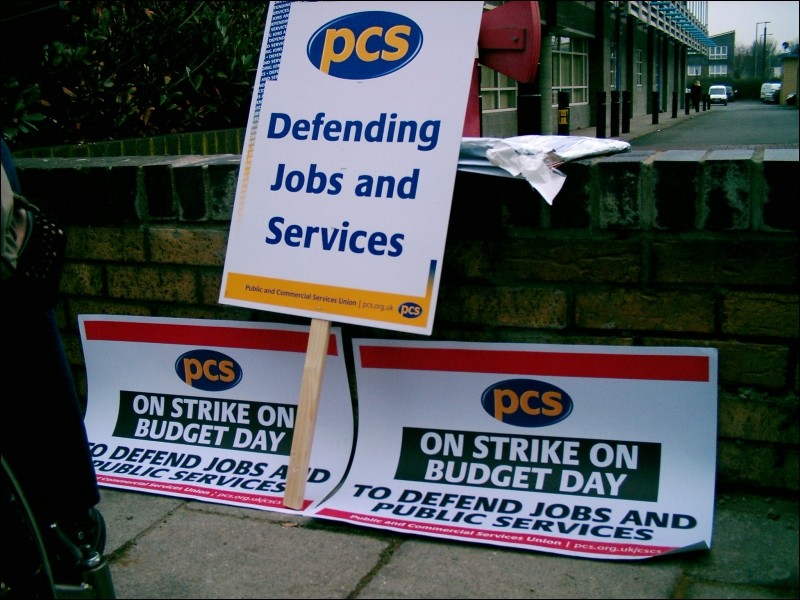
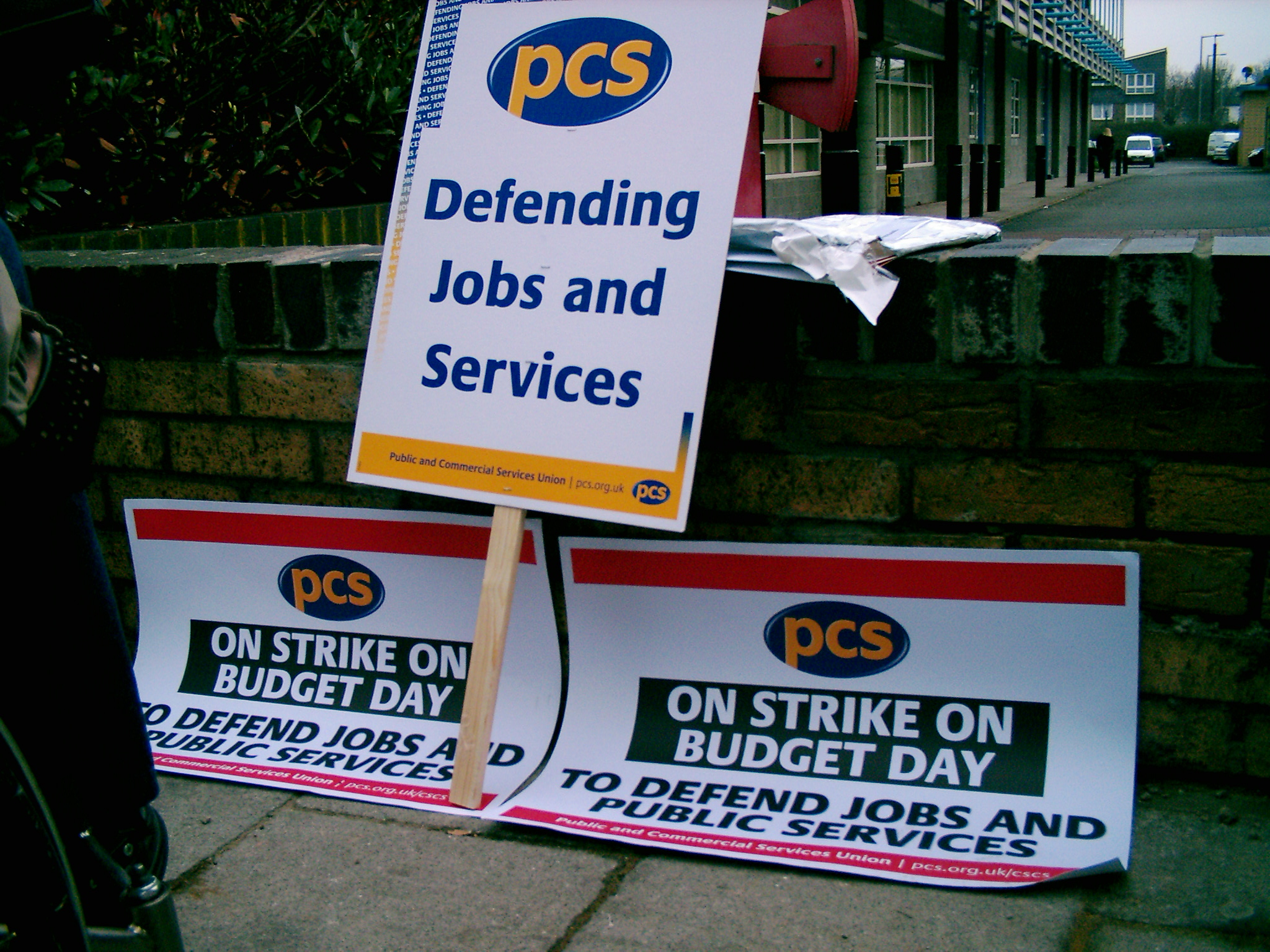
Battles against cuts expected sooner or later (Click to enlarge: opens in new window)
In the issue of The Socialist immediately before the general election, we wrote: “The British electoral system – famed throughout the world for ensuring ‘stability’ – now acts like a disordered slot machine with the outcome highly uncertain.” (29 April)
The day after the election, Jonathan Freedland wrote in the Guardian: “The mother of parliaments was showing her age as election day turned into the morning after.
“In the early hours, as the uncertainty of the election result deepened, every aspect of the antique British political system seemed to be creaking under the strain.”
This is, if anything, an understatement. No victors have emerged but, on the contrary, the three major capitalist parties – the Tories, New Labour and the Liberal Democrats – are all, in one way or another, ‘losers’.
True, the Tories, as we go to press, have 306 seats [1 left undeclared] and have added two million more to their share of the ‘popular vote’ (of the overall total).
They are in the lead. But this total falls well short of a majority to allow David Cameron to rule alone. Moreover, the increase in popular vote is largely the result of an increased turnout, by 4%, compared to the 2005 general election.
And it is far short of the ‘spectacular’ victory that Cameron promised his rich supporters (who filled out the Tory election coffers to the tune of £18m), who are prematurely salivating at the rich rewards which will come from governmental power.
It also falls well short of what was promised in the polls – oscillating between 38-40% – at the beginning of the election campaign.
On the Tory blogosphere, there is already virulent criticism of Cameron for not being able to capitalise on the evident weakness of Gordon Brown’s government, presiding over the worst economic crisis since the 1930s.
Knives
Nick Clegg, leader of the Liberal Democrats, after the first ‘presidential’ leaders’ debate, appeared to be walking on water.
Some Liberal Democrats dreamt of him and their party actually coming out as overall winners, but now presides over a big setback, in terms of seats at least.
Compared to 2005, the Lib Dem share of the popular vote increased by 840,000. On the other hand, New Labour’s authority to continue its rule has been severely dented. We pointed out, also in advance: “A significant reduction in New Labour’s vote would, in all probability, lead to an undermining of any ‘legitimacy’ to rule alone.” New Labour has lost approximately a million votes since the previous election.
This would have been a lot greater but for an instinctive rallying – a dramatic expression of ‘lesser evilism’ – of hundreds of thousands, perhaps millions, of workers.
They were not going to vote, or were not prepared to support New Labour because of its anti-working class policies of the last 13 years.
Brutal cuts
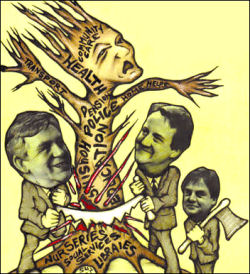
Cuts cartoon by Suz
But, as the election proceeded, they were alarmed, if not terrified, at what was in store for them if the brutal cuts programme of Cameron was to prevail.
In Scotland, with the memories and the scars of Thatcherism still fresh, Labour’s vote actually went up.
The Tories were once more reduced to a capitalist sect with just one seat! This pattern was repeated in some of the important urban areas, such as Liverpool and parts of London.
It reflects a class polarisation in a distorted form, and foreshadows what is going to happen in the workplaces and offices as the capitalist parties attempt to implement their ‘austerity programme’.
Undoubtedly, the dramatic events of Greece in the days before the election, with workers in an immense general strike besieging the Greek parliament, must also have exercised a powerful effect on the outlook of many British workers.
This was expressed in a late rallying against the Tories. Greece will come to Britain, but could come much quicker and just as brutally if a Cameron government is installed.
Rush to the polls

Greek workers take to the streets
This must have motivated many workers who rushed to the polls at the end of election day. However, some were not able to vote because of the collapse of the creaking electoral arrangements. This was a consequence of cuts, an unpreparedness for an increased turnout – albeit of just 4% compared to the previous election – which resulted in some of the polling stations running out of ballot papers!
A ‘disorderly’ outcome of the election – from the point of view of all of the main party leaders and big business – has torpedoed the capitalists’ wish for a ‘stable government’ that could proceed quickly to slash the government deficit and, with it, the living standards of the British people.
It is a ‘hung’ parliament – not the anodyne ‘balanced’ one beloved of TV commentators – that is the result of the election.
And any of a number of outcomes is possible in the unseemly horse trading now unfolding between the party leaders.
Brown hopes that the Liberal Democrats will be drawn into a form of coalition with New Labour with the promise of a change in the electoral system from first-past-the-post towards ‘proportional representation’ dangled before Clegg and the Liberal Democrats.
Clegg
Clegg, however, has stuck to his mantra during the election that the ‘first chance’ to form a government must go to the biggest party in terms of seats – Cameron’s Tories.
Brown has politely complied with this, even urging civil servants to facilitate negotiations between the Liberal Democrats and the Tories.
This is in the expectation that those negotiations will break down, with the major stumbling block being the Tories’ unwillingness to contemplate PR, up to now.
However, Cameron will come under ferocious pressure from different wings of the Tory party on this crucial question.
One section of the Tories, the fundamentalist pro-market wing and, probably, from the euro-sceptic wing as well, will vehemently oppose the Tories climbing into bed with Clegg on the PR issue.
Fear
They fear that, with such an electoral arrangement, the prospects of a future ‘centre-right’ Tory government will be ruled out as New Labour and the Liberal Democrats are locked in the permanent embrace of a ‘progressive’ alliance in government.
Another wing of the Tory party probably recognises that the days of British ‘exceptionalism’, together with its ‘unique’ first-past-the-post electoral system, has been undermined and its efficacy has therefore declined in proportion to the undermining of Britain’s former economic primacy in the world.
It is time, therefore, to ‘join the rest of the world’ and embrace an electoral system which at least ensures that different combinations of capitalist parties are able to rule effectively.
It is not at all certain which of these wings will win out in these ‘negotiations’. But the tussle could evolve over days and even weeks, and may not even be resolved by the time it comes to vote on the composition or the combination of parties in the government when parliament reassembles in a couple of weeks time.
The very minimum, it seems, to ensure Lib Dem cooperation is a referendum on a form of proportional representation.
Liberal breakthrough?
Without this, the big ‘breakthrough’ that Clegg seemed to offer to the Liberal Democrats in the election will not come to fruition.
The expected breakthrough of the Liberal Democrats floundered for the reasons that we described prior to the election: “The Lib Dems have momentarily become a focus for this mood [for change] but such is the present effervescence, almost ‘organic instability’, in society that within a matter of days or weeks this mood could ebb away once more.” This is what actually happened as the fear of the Cameron Tories grew, motivated by hostility to Brown holding onto power, while support for New Labour ebbed away.
Moreover, the targeting in the TV debates, both by Brown and Cameron, of the Lib Dems’ support of an ‘amnesty’ for immigrants probably further eroded their previously impressive advance in the polls.
The issue of immigration was also a massive underlying issue in this campaign. The BNP – despite the welcome defeat of Griffin in Barking (and of all the BNP councillors) – this far-right outfit still received a regrettable half-a-million votes overall in the general election.
Moreover, the victorious New Labour MP in Barking – the millionaire Margaret Hodge – locked in to the New Labour pro-capitalist programme, will not be able to keep the BNP at bay forever.
Only a clear socialist challenge to the system in the form of a new, socialist mass workers’ party is ultimately capable of offering a serious challenge to the BNP.
Brown
Brown, on the other hand, still hopes that the New Labour ‘project’ – severely holed below the water line – can be kept afloat in a new government with power shared with Clegg and the Liberal Democrats.
It is not excluded that, if the negotiations with the Tories break down, New Labour will be able to persuade the Liberal Democrats to jump aboard.
The programme of such a coalition government has been spelt out by those, like Peter Hain, who are energetically pursuing the Liberal Democrats to enter such a coalition, either by taking part in the government, or by supporting the government through their votes in the House of Commons.
One complication to such an arrangement is that, even with the support of the Liberal Democrats, such a government may not be able to command a majority vote in the House of Commons without relying on the minority parties from Northern Ireland, Scotland and Wales.
This is possible, but only at the expense of significant concessions – the promise of not carrying through a significant reduction in public-sector spending in Northern Ireland or in the central government grants going to Wales and Scotland.
Handful of bond ‘raiders’
Such a government would not be favoured by the ‘market’, the handful of bond ‘raiders’ who are presently attempting to hold the Greek government to ransom.
If they succeed in their attack on Greek debt, they will prepare a similar assault on Portugal and Spain.
British ‘sovereign debt’ could also be a ‘target’ if the axe is not taken to public expenditure. The way to answer this blackmail is not by bending the knee to these corporate bandits but to take away from them the power to hold governments and whole peoples to ransom.
Not only should the banks be nationalised under democratic workers’ control and management, but a state monopoly of foreign trade should be introduced.
The market, as Joe Higgins, the CWI MEP in the European parliament, has pointed out is, in effect, 20 bond dealers, including those like George Soros – who brought the pound to its knees at the time of the exit from the European Exchange Rate Mechanism in 1992 – Rogers in the US and similar financial gangsters.
Socialist confederation
To eliminate their power would mean the working class of Europe coming together in a socialist confederation on a European scale.
To realise such far-reaching measures, however, would require the creation of a new left pole of attraction in Britain and on a European scale.
The Trade Unionist and Socialist Coalition (TUSC) attempted to begin to lay the basis for the emergence of such a force.
However, it did not have the time to establish a clear national presence before the election commenced.
At the same time, any new left force would still have been squeezed by the class polarisation – in a distorted sense – between the major parties.
Trade Unionist and Socialist Coalition
The results for TUSC are modest (see General election results 2010: TUSC stands for socialism and prepares for the battles ahead). But many – far more than those who voted for TUSC – expressed appreciation and support for the literature, and the speeches in hustings of TUSC candidates.
Yet, fearing the return of the Tories, they felt they could not vote for TUSC at this stage. ‘You can come into your own after the election if the parties are forced to accede to a form of PR,’ was the reaction of some who, nevertheless, were voting Labour to bar the way to the Tories.
No matter what the combination of parties is, the underlying objective situation in Britain will compel those who remain within the framework of capitalism to carry out brutal attacks on the living standards of the working class.
Cameron has indicated that, if he forms the majority in a government then, in all probability, he will ‘go easy’ in the first period in office, hoping to emulate Harold Wilson in 1974 – who was also in a minority, initially.
When a more favourable opening occurred, Wilson went back for a mandate and received it in the form of a majority government.
Ultimately, however, nothing can disguise what the Tories have in store for the British people. They have given us a little taste in many councils they rule, such as Hammersmith and Fulham, where disabled people, the homeless and old – including a 90-year-old woman who had home help withdrawn – have been disgracefully attacked.
Economists, like Hamish McRae of the Independent, who are at one with the Tories on cuts, say that the British people must swallow ‘Greek medicine’.
In his column, he openly speaks about that country as the ‘canary in the mine’. If the capitalist rich are allowed to get away with savaging the conditions of the Greek people, then next in line will be Portugal, Spain, Ireland and Britain.
Cost
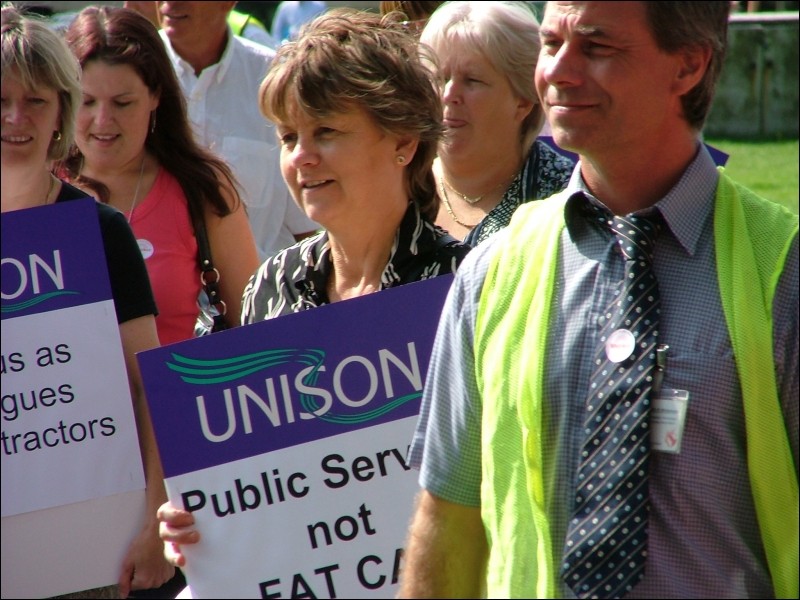
Swansea Unison workers protest against cuts and privatisation in Wales, photo Swansea Socialist Party (Click to enlarge: opens in new window)
He warns that the cost of government borrowing, in the form of bonds or gilts, will spiral and, with it, the state debt.
He openly declares that ‘faster spending cuts’ will now be demanded of any government that is in power.
This will help to compound the misery of the four million children who are still living in poverty in Britain.
It will add to the 8.5% – a total of 2.5 million – unemployed. In a rare admission, Mervyn King, governor of the Bank of England, said that this election was “a good one to lose”.
He added that those who carry through the ‘necessary cuts’ will be “out of office for a generation” as a result.
A £50bn cut in the budget deficit of £163bn simply means half of NHS spending disappearing! The British people have been warned.
This election was an interregnum. The trade union and labour movement in other countries has been brought to its feet by the attacks of governments – as we have seen in the drama unfolding in Greece.
Similarly, the working-class people in Britain will respond with anger and action, particularly if they are given a lead from the trade union movement as a whole to stop the capitalist juggernaut wrecking the lives of millions.
- Don’t allow any government to divide the young against the older generation. All sections of working-class people and the middle class are under attack.
- Fight for every job and force the bosses to pay for a crisis of their making.
- Link the mass struggle that will unfold in the next period with the idea of replacing capitalism with a democratic socialist plan of production.
Why is it that millions are on the scrapheap of unemployment and 30% of industry – so-called ‘idle capacity’ – is not being used at present? It is because of a system that is based on the production of profit for the few – the millionaire and billionaire capitalist owners of industry – and not production for social need.
- Eliminate the threat of the far-right by offering a real material vision to working people, including a massive house-building programme, opposition to the privatisation of the state sector.
- For the public-sector unions to organise a mass demonstration pledging to confront and defeat any government that is trying to make the working class pay for this crisis.
