

Twenty years since Section 28
Fighting homophobia
 |
|
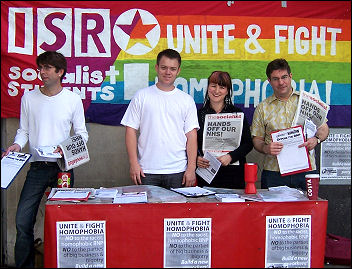
Socialist Party members campaigning at Pride, photo Chris Newby |
This year is the twentieth anniversary of the infamous Section 28, an openly anti-gay law pushed through by Thatcher’s Tory government. This had unexpected consequences for the Tories, when lesbian, gay, bisexual and transgender (LGBT) people fought back.
Greg Randall, Convenor of the LGBT socialist group
Section 28 banned local authorities from “intentionally promoting homosexuality” or recognising lesbian and gay relationships as “a pretended family relationship”.
In the mid 1980s there was a campaign in most of the capitalist press against the LGBT community, linked to the emerging HIV/AIDS crisis. Stories appeared in the papers claiming that gay men in particular were a threat to public health. This had support from sections of the establishment.
The Tories used homophobic propaganda in their 1987 election campaign. Their aim was to use prejudice to undermine support for left Labour councils, such as Liverpool that had taken a stand to defend council services and opposed racism, sexism and homophobia. Disgracefully, the right wing of the Labour Party echoed and even inspired tabloid and Tory smears.
The Sun made a big deal of the Inner London Education Authority having a book, Jenny Lives with Eric and Martin in its resources library to help children whose parents were in gay relationships. The manufactured outrage against this innocuous book, which had only been taken out of the library once, was the claimed inspiration for Section 28.
In fact, on re-election in 1987, Thatcher had introduced the Local Government Act 1988 imposing “compulsory tendering” to privatise council services and sack local government workers. Section 28 was added to the Act to divert attention from these attacks. The tiny sums being spent by councils on, for example, lesbian and gay centres were condemned as a waste of taxpayers’ money.
Militant, the predecessor of The Socialist, described Section 28 as an “edict of indoctrination… [The Tories] are deliberately pandering to the confusion and fear, intolerance and prejudice of the most politically backward in an effort to cement their support” (Militant 883, 12/02/88).
As is often the case, a reactionary attack created a mass movement. While Labour’s opposition to the proposed law in parliament was weak, LGBT people campaigned against it. In February 1998 20,000 marched in Manchester. Two months later 30,000 marched in London. Lesbian activists invaded the chamber of the House of Lords and the BBC news studio.
Militant supporters involved in the movement remember it as a pivotal moment for the LGBT community. It brought together lesbians and gay men under common attack, forging a new unity. New political and campaigning organisations emerged from the movement. The community was given a new and lasting sense of confidence.
Section 28 led to no prosecutions, but created a climate of self-censorship. LGBT publications were removed from local libraries and teachers were inhibited in challenging homophobic bullying and providing sex education and counselling. Physical attacks were inspired by this anti-gay climate, and included an arson attack on the office of newspaper Capital Gay.
Could an attack such as Section 28 happen again? The campaign led to a growth in the LGBT community’s confidence. Although this was largely diverted along commercialised lines in the 1990s, we remain stronger and more organised. Capitalist politicians would not want a repeat of the movement against Section 28 and radicalisation of a section of society.
Despite this, and the claims of all the establishment parties to be ‘gay friendly’, attacks cannot be ruled out. New Labour was hardly eager to repeal Section 28, waiting until 2003. The Tories voted to retain it. In an economic crisis, with cuts to public services being made, either party could look for scapegoats. Attacks could be less direct than Section 28. After its repeal, Tory Bromley council tried to retain a local version. This type of approach could be imitated by other councils.
The capitalist parties all favour privatising public services, including handing them over to churches and other religious groups. A new Section 28 type law might be implemented in piecemeal form by, for example, church schools refusing to teach school students about gay relationships.
While LGBT communities have made big strides forward since 1988, potential for the use of homophobia by the ruling class and its hired politicians still exists, and for the same reason as it did 20 years ago. Only mass campaigning can defend gains and change society in a socialist direction to remove prejudice.
