

The Socialist Issue 156

May 5th 2000

Take Over Rover

Take Over Rover

TONY BLAIR has said he will “work night and day” to save Rover jobs. This is a turn around from last month when Labour said they were powerless to stop BMW selling the plant to asset-stripping venture capitalists Alchemy.

Oppose Hague’s Asylum Lies

TORY LEADER William Hague is spreading racist lies about refugees. He warned that more supporters of the far-right National Front would take to the streets if New Labour didn’t stop asylum seekers “flooding into the country”.

Police try to take revenge

May Day Protests


OVER 6,000 anti-capitalist protesters gathered in Parliament Square, central London on May Day. Like the J18 and N30 protests before, it was impressive for bringing thousands of people behind an explicitly anti-capitalist demonstration.

Many of the protesters were activists from a wide variety of campaigns and groups. However a large proportion of the protest were young people, many of whom had not been on a demonstration before.

Teachers: Special feature

THE DECISIVE vote at National Union of Teachers (NUT) Conference for a ballot for strike action has been angrily opposed in the press and by the NUT’s right-wing general secretary, Doug McAvoy. Yet, it will have lifted the spirits of teachers around the country who can at last see the union taking a lead to defeat Performance-Related Pay (PRP).
Capitalist restoration and the struggles of the Russian workers Boris Popovkine is a worker activist in the independent miners’ union from Vorkuta, Russia, and a member of the Committee for a Workers’ International.  He is currently speaking to workers’ meetings in Europe.  While in Britain he spoke to The Socialist about the current struggles of the Russian working class.


Top of page     Home page


Take Over Rover

Don’t Subsidise Big Business

TONY BLAIR has said he will “work night and day” to save Rover jobs. This is a turn around from last month when Labour said they were powerless to stop BMW selling the plant to asset-stripping venture capitalists Alchemy.

Now, the collapse of Alchemy’s bid has seen New Labour left with more egg on its face than Anne Widdecombe. BMW, however, warn that the Phoenix bid has until 16 May to finalise a sale or the whole Rover operation will be shut completely.

Why Blair’s dramatic change of heart? Is it because over 100,000 jobs are threatened or because 27 vulnerable Labour seats are close to Longbridge? Is it because Labour is experiencing an electoral meltdown after being discredited by its fiasco of handling the Rover crisis and other matters? Is it because Labour has been shaken by the massive anger that is building up against it because it has done nothing to improve the lives of millions of working-class people, despite its promises at the last election? Or is it because workers are threatening industrial action at Ford if sackings go ahead?

Of course it is all these things which New Labour are now worried about. But Blair and New Labour have made plenty of promises before which they haven’t delivered. Remember their education and health pledges, which they later backtracked on? Remember their pledges to end poverty, which has actually widened under Labour?

After their electoral hammering New Labour can be forced to make concessions, particularly if workers get organised and take action against those capitalist firms threatening redundancies. This is the language of working-class action that Blair and his cronies will sit up and take notice of.

But even if they make concessions and give the cash assistance that Phoenix are hoping for - like the £100 million they recently gave to keep British mines open - that won’t be the end of the matter. These concessions can only be temporary solutions unless workers’ action goes further and forces the government to stop subsidising the bosses and nationalise the car industry and other firms threatening sackings, under workers’ control and management.


* Nationalise. Don’t subsidise the bosses’ profits.

* No transfer of any production capacity from any car plant without workers’ agreement.

* Link up Rover, Ford and other car workers for a one-day strike of the car industry.

* Take the car industry into public ownership with democratic workers’ control and management, with a plan of socially useful production.


More on pages 2 or 3 and 4 of The Socialist


Top of page     Home page


Oppose Hague’s Asylum Lies


TORY LEADER William Hague is spreading racist lies about refugees. He warned that more supporters of the far-right National Front would take to the streets if New Labour didn’t stop asylum seekers “flooding into the country”.

If the National Front and the fascist British National Party get an increased vote in Thursday’s elections, it will be Hague’s responsibility. He’s acting as election agent for the fascists.

Many people have lost their faith in Labour who are likely to get a hammering at the polls. But the Tories aren’t gaining because they can’t disagree with many of Blair’s Tory policies - and their own political ideas are equally discredited.

So the Tories are trying to outflank Labour from the right with racist filth.

Hague calls refugees ‘bogus’ asylum seekers but most new asylum applicants come from ex-Yugoslavia - Kosova, Montenegro and Serbia.

These refugees are fleeing ethnic cleansing and retaliatory killings, following devastating internal strife and wars in which Western governments have played an horrendous role. Many areas of ex-Yugoslavia were devastated by NATO bombs.

Many other asylum-seekers come from areas where wars, conflicts and dictators, (often Western favoured politicians), are threatening the lives of millions.

The Home Office dealt with 11,340 asylum applications last month in a desperate attempt to deal with the backlog of cases.

But an astonishing 81% of people who applied had their applications refused, that’s up from 76% last year.

New Labour also spreads lies about refugees. Home Secretary Straw is implementing his own vicious Asylum and Immigration Act. He wants to kid people that New Labour’s capitalist policies would have created a utopia if not for a few thousand asylum-seekers. That is rubbish!

The pro-big business parties, Tory, New Labour and Lib Dems, are scapegoating the most vulnerable to counter the growing anger at job losses and cuts in public services.

They want us to blame a handful of asylum seekers for the damage caused by their crazy capitalist system.

It’s not asylum-seekers who threaten to close Rover or Ford Dagenham - it’s fat-cat businessmen and politicians who think the value of millionaires’ shares is more important than workers’ jobs.

It’s not asylum-seekers who cut and privatise public services. It’s capitalist politicians, to please their grasping friends in big business and the media. Don’t let them divide and rule us! Fight the real enemy - capitalism’s greed for profits.


§        Defend the right of asylum

§        Scrap the Asylum and Immigration Act and all other racist laws

§        Stand up to racism and fascism

§        Join the fightback against the job-cutters.

§        Build a united community campaign for proper funding of all public services


Top of page     Home page


May Day Protests


Police try to take revenge

OVER 6,000 anti-capitalist protesters gathered in Parliament Square, central London on May Day. Like the J18 and N30 protests before, it was impressive for bringing thousands of people behind an explicitly anti-capitalist demonstration.

Kieran Roberts

Many of the protesters were activists from a wide variety of campaigns and groups. However a large proportion of the protest were young people, many of whom had not been on a demonstration before.

The mood amongst the protesters was almost carnival like, as they soaked up the May Day sunshine, with an enthusiasm amongst many to read and discuss anti-capitalist ideas, including a real openness to socialism.

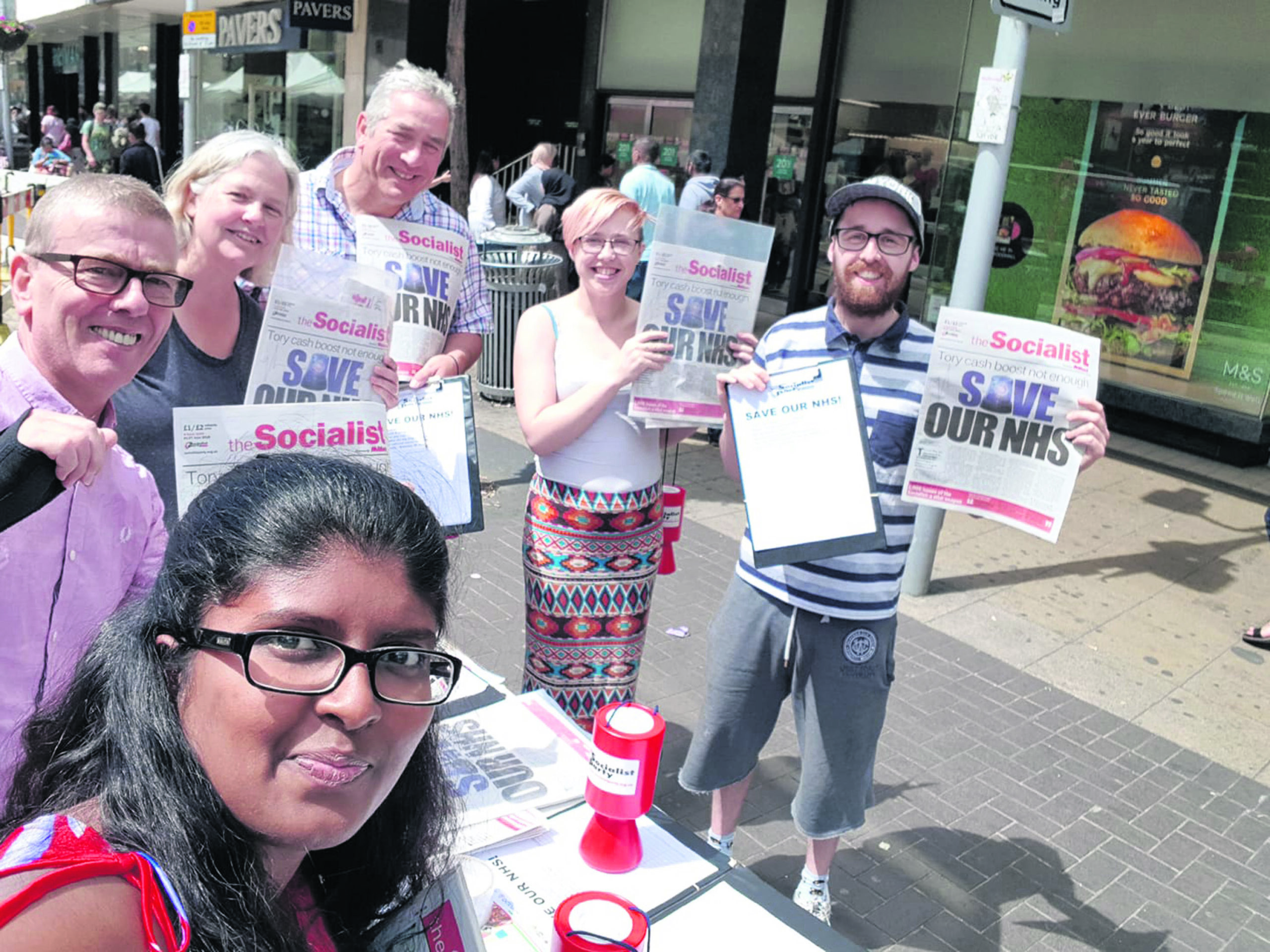
The Socialist Party leaflet produced specially for the day went down extremely well. Many people approached us for a copy of The Socialist and we also sold hundreds of papers and dozens filled in membership applications.

After two hours in Parliament Square the protest moved towards Trafalgar Square, while protesters danced to the rhythm of drumming. While moving down Whitehall, a small handful of people attacked a McDonald’s restaurant in a much publicised but fairly unrepresentative incident.

In Trafalgar Square itself the riot police had already formed lines across the roads leading off the Square. In what was clearly a pre-planned exercise the riot police formed a ring around the protesters after they had entered Trafalgar Square. 

Some protesters were hurt as the police charged and herded protesters into a smaller and smaller area. Some were pushed down steps or hurt as police struck out with batons and riot shields.

The police tactics, clearly planned well before May Day, aimed to deny the protesters the chance from demonstrating in a peaceful way. Tony Blair, who wants to make being a protester a crime through the Terrorism Bill, has accused the protesters of being the ones intent on causing violence.

However, the sheer numbers of police mobilised on May Day and their tactics point to the difficulties that organisers of future ‘anti-capitalist’ protests will have.

The Socialist Party  believes that to take this movement forward links could be forged with those sections of the labour movement engaged in fighting capitalist attacks. For instance car workers at Ford Dagenham and Rover, tube workers fighting privatisation and public-sector workers fighting cuts. We also raise the need for a programme behind which these workers and other layers could be drawn behind the movement.


Top of page     Home page


Protest at Mass Arrests

OVER 100 protesters were arrested during and following May Day’s events. Some people who were not on the demo were arrested on the same day at their homes in Bedford for alleged involvement in the N30 demo.

Overwhelmingly, these arrests will have no connection to any incident and are being used to intimidate people at any future protests.

Protests about the mass arrests to: Metropolitan Police Commissioner, New Scotland Yard, SW1. Fax: 020 7230 2818.


Top of page     Home page


Teachers refuse to cross the

performance pay threshold


THE DECISIVE vote at National Union of Teachers (NUT) Conference for a ballot for strike action has been angrily opposed in the press and by the NUT’s right-wing general secretary, Doug McAvoy. Yet, it will have lifted the spirits of teachers around the country who can at last see the union taking a lead to defeat Performance-Related Pay (PRP).

Martin Powell-Davies

David Blunkett fumed that parents won’t understand why teachers want to strike against a £2,000 pay rise. But they are learning to see through Labour’s spin.

The £2,000 increase will be restricted to those who can show that they are 'good' enough to allow them to pass the government’s new 'threshold'. But all teachers will also be set individual performance targets as part of the new 'performance management' scheme.

These proposals will tear apart teamwork in schools. Even the NUT’s own advice on completing the threshold application form warns teachers not to tell colleagues what they are writing in case they use them for their application instead!

How can you fairly compare different teachers in different schools ? PRP will mean bitter arguments about who has most contributed to exam results and who is going to teach the more challenging classes. It will boil down to payment by results.

Paying teachers according to exam success will fundamentally change the relationship between teacher and pupil. Teachers will be put under pressure, which will be piled onto children. Parents are already beginning to complain about the stressful effects of continual testing and PRP will speed up this treadmill.

Instead of allowing New Labour to set parents against teachers, the unions must build a united campaign against a government that has failed to give schools the resources they need to meet pupils' needs or to pay teachers properly.


Conference debate


TEACHERS ARE overwhelmingly against PRP but it took the conference debate to convince a majority of delegates that the union could do something about stopping it. Days before conference, McAvoy had sent out individual letters to members urging them to apply for the threshold payment.

McAvoy’s sabotage coloured the pre-conference delegates' meetings. Socialist Party members urged delegates to remember the strength of feeling in schools against PRP. That was why a one-day strike ballot next term could still be won. Postponing action could mean confidence seeping away and a victory for the government. These arguments eventually won delegates' support.

The final vote was only taken after a debate strung out over four days because of executive attempts to manoeuvre it off the agenda. Left-wing branches had to urge delegates to curtail debates on other vital issues to make sure the PRP vote was completed.

The successful walkout on Saturday against schools minister Estelle Morris had raised the morale of delegates. Then a number of key speeches helped convince conference to vote for action.

Mary Compton, a delegate from Wales, earned a standing ovation when she spoke of the depth of feeling against PRP even in her rural comprehensive school. She added: “the biggest mistake that our leadership could make is to underestimate the anger and intelligence of our members”.

Ron Haycock from Waltham Forest raised a cheer by saying: “The government wants to pay us by performance. Teachers have been performing miracles for years, so pay all of us".

Peter Bishop, outgoing right-wing executive member, defeated in the recent executive elections by Socialist Party member Julie Lyon-Taylor, tried to say workload was more important to members than pay. From the Left on the executive, Bernard Regan explained that performance management was all about bullying teachers to take on more workload to meet government targets.


Strike action


THE AMENDMENT calling for the strike ballot was won by 100,051 votes to 90,343. It also called for a special salaries conference in November to consider further action.

Doug McAvoy’s supporters railed against national strike action. But John Lockwood from Warwickshire rightly pointed out that if a strike was such an outrageous idea, why had the executive suggested it at last year’s conference, even if they then ignored their own proposal. He added that “there is not one teacher who doesn’t know that the £2,000 is a bribe to try and break our conditions of service”.

Bob Sulatycki, Kensington and Chelsea teacher and Socialist Party member closed the debate. Bob explained how parents could be won over when the damaging effects of PRP were pointed out.

Already 20% of posts in his borough were filled by supply staff and the pressure of PRP would only drive more teachers away. It would do nothing to help recruit younger staff, only experienced teachers were eligible to apply for the threshold.

Bob also warned that strike action would be more popular with teachers and parents than the executive’s supposed alternative of asking teachers to refuse to carry out after-school activities and school journeys.

He concluded by pointing out that the real decision was whether to go for a one-day strike ballot or to put up the white flag. The conference voted decisively not to give in when the final motion was passed by 105,208 votes to 82,114. Now we must win the ballot and go on to defeat the government’s divisive PRP proposals.


McAvoy's response


INSTEAD OF attacking the government’s divisive plans, Doug McAvoy used his closing speech to attack delegates who had voted for a strike ballot. He claimed it would be “dishonest” to heed conference’s instruction to vigorously campaign for a YES vote.

He tried to claim that the vote had been won “not by debate but by the pre-determined political views” of delegates.

Inconveniently for him, the vote on the final motion showed a healthy 23,000 majority for action, considerably more than had originally voted for the amendment calling for a ballot.

McAvoy had a go at whoever had parked the car outside with “Doug” and “Estelle” in the windscreen! In fact, that was the response of Rover workers leafleting the conference. Their struggle had already taught them a thing or two about the role of union leaders!

McAvoy tried to claim that his re-election as general secretary showed that NUT members supported his stand. But the mass of members who voted for him did so because they believed his claim that he was fighting PRP. In reality, he wants to throw in the towel.

Incredibly, McAvoy argued that the campaign to defeat PRP would take “more than one term of government”. Teachers can’t afford to wait that long!

A one-day strike would bring teachers together and give them the confidence to escalate the campaign. It could be used to go out to build support amongst parents.

It’s unclear whether McAvoy will think it’s better for him to delay calling the ballot or to rush it out before local branches have a chance to organise. But local NUT branches need to hold emergency meetings of school reps to build the campaign for a YES vote. Regional and national meetings of School Teachers Opposed to Performance Pay (STOPP) are also planned to help boost the campaign.


Top of page     Home page


 Tackling the propaganda

DAVID AARONOVITCH, a columnist for the Independent, launched a vitriolic attack on the teachers' strike decision. He concentrated on Socialist Party member Bob Sulatycki who closed the conference debate on performance-related pay. "Vengefully (since I don't appreciate threats to my children's education), I fed Mr Sulatycki into my search engine, and found him to be an occasional contributor to Socialism Today, the theoretical journal of no less an organisation than SPEW. Ha ha! Remember them, the Trotskyist Socialist party of England and Wales? No? Oh, never mind."

Aaronovitch would obviously be much better attacking government policies for disrupting his children's education as Bob Sulatycki replies below:


THE SAME old ritual  every Easter - shoddy reporting of NUT Conference. Now it's David Aaronovitch's turn. He's been busy searching his Internet about me. So much less difficult than  phoning to talk in person, when I could have told him "Yes, I have contributed to 'Socialism Today'. So what?"

Vengeance, apparently prompted by my participation in the Performance-Related Pay debate at NUT conference, motivated his  trawl through cyber space. Why no vengeance towards David Blunkett? He's proposing to shut schools for two days, so that teachers learn to appreciate the benefits of his new schemes.

PRP and Performance Management are unfair, bureaucratic and overwhelmingly rejected by teachers. They will lead to a joyless saga of testing and form filling. Teachers will turn from colleagues into competitors, thereby undermining the trust and teamwork on which schools  depend.

Now, obviously, that  is only what teachers believe, and therefore won't cut much ice with Mr Aaronovitch. But many parents are aware that teacher dissatisfaction is leading to a flight from the classroom. Vacancies are at a ten-year high.

Teacher training course applications have plummeted.

Opposition to the Victorian Payment By Results system led to the creation of the NUT 130 years ago. It was a system that took over 30 years to replace. It was universally loathed and reviled by teachers. It created one of the most backward education systems in the then developed world. That is why delegates supported the statement

"If we don't strike on this, what do we strike on?" - a measure of the importance of PRP, not the triviality of strike action.

I hope that NUT members will see through the fog of misrepresentation, and vote against a system which will profoundly damage the job we still want to love, despite all the government's efforts.

This was published in The Independent on 2 May


Top of page     Home page


Boris Popovkine is a worker activist in the independent miners’ union from Vorkuta, Russia, and a member of the Committee for a Workers’ International.  He is currently speaking to workers’ meetings in Europe.  While in Britain he spoke to The Socialist about the current struggles of the Russian working class.


Capitalist restoration and

the struggles of the Russian workers

“AT ABOUT the same time as the USSR broke up the regime passed laws on ‘co-operation’ and ‘privatisation’ opening the doors to the criminalisation and capitalist restoration of Russia.

The new capitalist class developed very quickly on the back of these events. And also very quickly it produced a clash of interests between the working class and the new capitalists. They consciously tried to mould the new trade union movement.

The government put a lot of money into helping the new ‘independent’ miners union. Of course many of us who participated in this trade union, the rank and file, didn’t realise what was going on. We thought the development of new independent unions would provide the opportunity to struggle.

I was one of the founding members of this trade union in my town in Vorkuta. I was elected to the pit committee. And the very first strikes were co-ordinated by those activists who were part of this union.


Rotten leader


THE PRESIDENT of our trade union, Sergeyev, was appointed as a member of President Yeltsin’s council of advisors. At first most of us thought that as he was nearer to the powers that be it would give him more opportunity to stick up for our interests.

However, he turned out to be just as big a bureaucrat as the bureaucrats from the other trade unions. He used the protests organised by our trade union to further his own interests.

For example during the famous ‘railway war’ in 1998 - when the railway lines were cut between Siberia and south Russia - most of the miners thought they were fighting for their own economic and political interests. But, actually it turned out that the action was organised ‘from above’ in order to protest against the increase in prices on railway freight as the new factory directors and owners of the pits were losing big money. Sergeyev organised this railway war simply to help rescind these rail price increases.

The next and most rotten betrayal of the miners is what happened in the summer of 1998. The trade union took the initiative to organise a picket of the White House - the government building in Moscow.

During the course of this picket, which lasted four months (camped on the road), other groups of workers joined in - teachers, metalworkers defence workers, etc. The main demand of this picket was that Yeltsin should resign. But while we were camping out the union president was walking round the corridors of power trying to undermine our action.

On 7 October there was due to be a mass day of action organised by the federation of independent trade unions, which are the former official state trade unions. Before this took place Sergeyev had already reached agreement with the powers that be. He persuaded one of the ruling committees of the trade union, two days before the national day of protest was due to take place, to lift the picket.

Such was the dissatisfaction of the union ranks, Sergeyev was forced to resign as president at the next congress.


New workers’ party


Many Russian miners are now beginning to understand that the current trade unions that exist aren’t capable of solving our problems. Quite a few miners are now beginning to talk about forming a new workers’ party because all the parties in Russia, even the ones that you could call ‘communist’, in reality are pro-capitalist parties.

For example the main Communist Party of the Russian Federation has now got a major part of its programme calling for a mixed economy and the recognition of private ownership of production.


Economic collapse


TODAY THE economic situation in Russia is dire. Factories are shutting or only operating at low levels, agriculture has been devastated, the transport system has broken up. Any government attempts to resurrect the economy fails.

One of the sharpest examples is what happened to the reconstruction of the coal industry where the government asked for credit from the IMF [International Monetary Fund].

The IMF gave the credit but on condition that 70% of Russia’s coal mines should be shut. The credit was supposed to assist unemployed miners move to other cities to get somewhere to live, to get retrained, to get a job. But the bulk of this money was robbed either by the state apparatus or by the leaders of the trade union. In one case unemployed miners were deported from their town about 120 kilometres north of Vorkuta.

Early one evening the miners families that were left in the town were all visited by the police. The police gave them two hours to pack up their belongings. They were told the train was waiting at the station and they were forcibly deported.

Even today there are still 200 of these families living in Vorkuta either with relatives or friends - they have no money to get away.

For these reasons I joined the CWI, because I read the programme and other material which seemed to show the best way forward.”


            More international news every week in The Socialist


Top of page     Home page
