


Editorial of the Socialist issue 1273
“Labour: We’ll nationalise rail in five years”, was the headline of the Daily Mirror welcoming millions into newsagents and corner shops on 25 April. “It’s about time!” will have been the response from a large proportion of those who saw it.
Keir Starmer’s Labour leadership has opened the door to public ownership just a crack. The wreckage of privatisation disaster lies just behind. On the same day as shadow transport secretary Louise Haigh was making her media rounds, bosses at Tata Steel dismissed unions’ proposals to prevent closure of both Port Talbot steel furnaces by September.
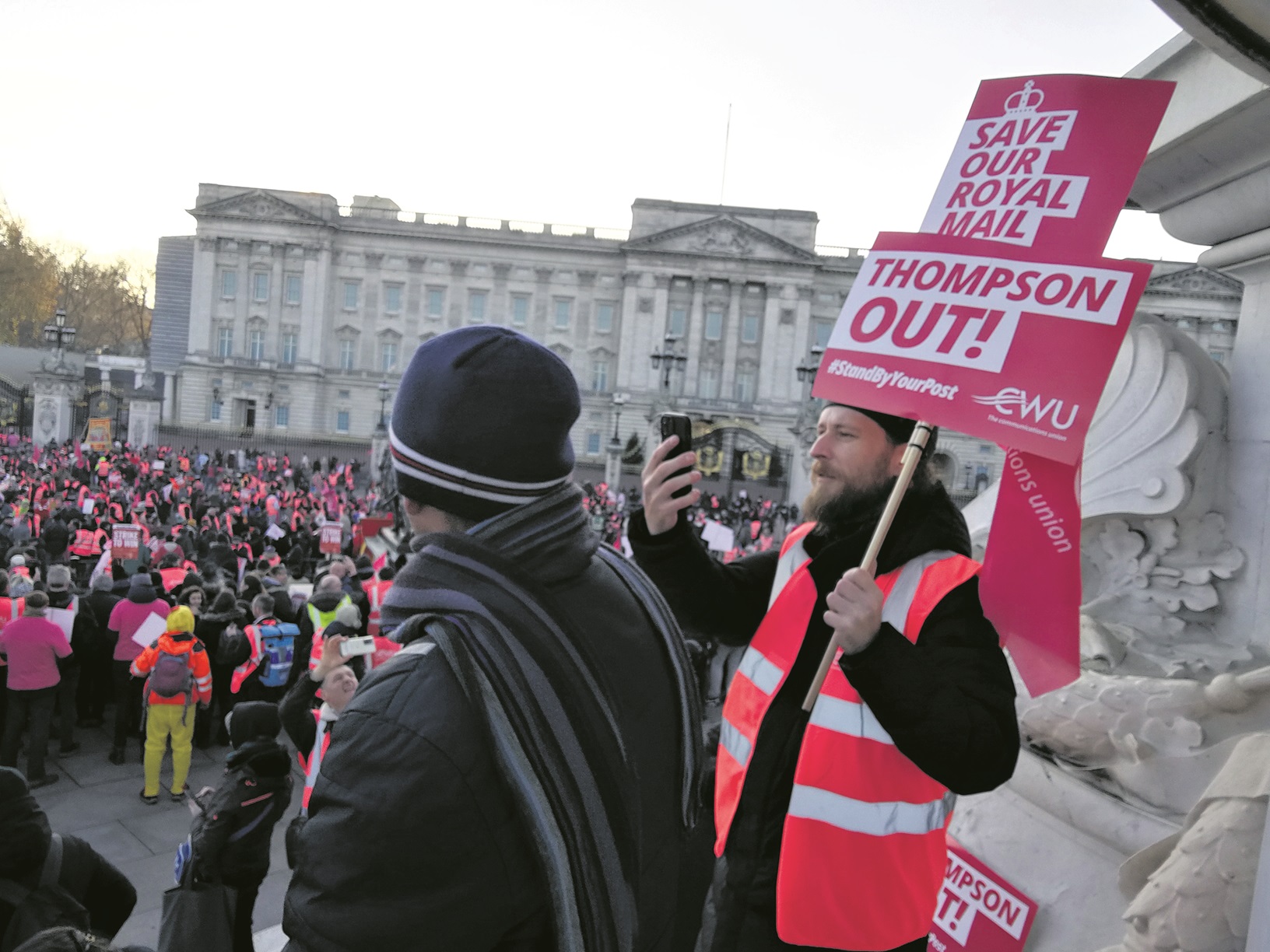
Royal Mail faces a buy-out by a Czech vulture capitalist billionaire and workers face ongoing attacks to terms and conditions, tied up with the undermining of Royal Mail’s Universal Service Obligations.
The trade union leaders should be piling in through the door demanding nationalisation.
Starmer-led government
Starmer could be in Downing Street before the Port Talbot furnaces are closed and Royal Mail is sold. Renationalisation could be decisive in saving thousands of workers’ jobs, pay, terms and conditions.
“We support [Royal Mail] renationalisation and it’s Labour Party Conference policy”, Communication Workers Union (CWU) general secretary Dave Ward told the CWU Postal Industrial Sector Conference, the same day shadow transport secretary Louise Haigh was doing her media rounds. But he then went on to say: “But Labour’s frontbench says there is no money for it. So we need a new model of ownership as a step towards renationalisation”. That’s wrong.
Most CWU members won’t accept that the existing owners – who carried out attacks on trade union representatives during the 2022 strike, with something like 400 suspended from work – deserve a penny, if Royal Mail is brought into public ownership. The Socialist Party would agree: compensation should only be paid on the basis of proven need – to safeguard workers’ pensions or small shareholdings. We don’t need to accept Labour’s argument that ‘there is no money for it’.
And anyway, many trade union activists know from experience that whether there is money or not to meet workers’ demands isn’t a simple mathematical calculation. The strike wave is a case in point. The Tories refused to even meet education union representatives to discuss pay in January 2022, saying there was no money. Several strike days later, a number of them coordinated with other unions, the government increased its pay offer.
The Tory government made concessions under pressure from the working class. A Labour government will face pressure too, including from the expectation of millions that things have got to be better than under the Tories – regardless of how many times and in how many different ways shadow chancellor Rachel Reeves tells us that Labour won’t be spending much money.
These are the arguments that Dave Ward should be stressing, making it clear that nationalisation is possible if it is fought for, not looking for alternatives to it – before Starmer is even in Number Ten.
Nationalising rail?
Labour’s rail renationalisation plans also have serious limitations: it doesn’t include public ownership of rail freight or rolling stock, and the last operator contract to expire won’t do so until October 2032, for example. But that shouldn’t be seen as the end of the matter.
As Mick Lynch, the RMT general secretary, said in response: “This announcement however should be a first step to completely integrating all of our railway into public ownership.” But that’s got to be fought for, including at the ballot box.
Haigh told media that Labour’s plans would not necessarily mean cheaper fares. She also refused to commit to meeting the demands of train drivers in the Aslef union who are striking again on 7-9 May in their long-running dispute. On day one of a Labour government, it would find itself presiding over the eight train operating companies already in public ownership. Aslef leaders should be preparing the members for a battle with a Starmer government to meet the unions’ demands immediately on taking office.
Starmer’s purge of Jeremy Corbyn-supporting MPs and activists from the Labour Party is part of a process of trying to insulate the Labour leadership from working-class pressure – to remove any figure who they fear could be particularly susceptible to it.
Working-class action
But events and class forces can push all sorts to do all sorts of things. In 1971, against the backdrop of developing workers’ militancy, the growing demand for a general strike in opposition to the anti-union Industrial Relations Act, and with workers in the Upper Clyde Shipyards striking and occupying, Rolls Royce was nationalised by a Tory government within a week of its bosses threatening closure.
Socialist Party members are fighting for the trade unions to continue to prosecute their struggles for pay rises and against other attacks, whoever is in government; countering the arguments being made by some trade union leaders against taking action at this stage because of the expectation of a Labour government. On the contrary, the only sure way of compelling an incoming Starmer government to concede to our interests is to prepare for serious action.
As the Socialist goes to press, the result of the North East Mayor election on 2 May is not known. But in that election Jamie Driscoll, barred from Labour candidature by Starmer’s machine and standing as an independent, was endorsed by the RMT.
Why not take the next step and prepare a list of workers’ candidates for the general election, backed by the trade unions? That could include Jeremy Corbyn, who has also won RMT backing to stand as an independent, and others too.
Even just a handful of MPs forming a workers’ bloc in parliament would be a huge source of uncomfortable working-class pressure on a Starmer government. It would act as a lightning rod for all those whose experience of a Labour government in power is leading towards the conclusion that the working class needs its own mass party, with a programme of democratic socialist public ownership that could really break the power of the capitalists over the economy and society.
Fund the Socialist Party general election campaign
The Socialist Party is preparing our general election campaign, with a target of raising £50,000 to contest 30-40 seats – paying the £500 deposit and minimum £750 for an election mailing.
We will be standing: championing the idea of a new mass workers’ party; popularising the idea of nationalisation; bursting the myth that it is unaffordable by calling for compensation only on the basis of proven need; and explaining the need for democratic workers’ control and management.
We will be fighting for a socialist programme, including the nationalisation of the top 150 companies and banks so a democratic plan of production can be drawn up to meet the needs of all and the environment.
- How much can you contribute towards our target?
- Pledges to be made by the end of June, and paid by the end of July
- Email isai@socialistparty.org.uk with your pledge
- Donate: www.socialistparty.org.uk/donate