


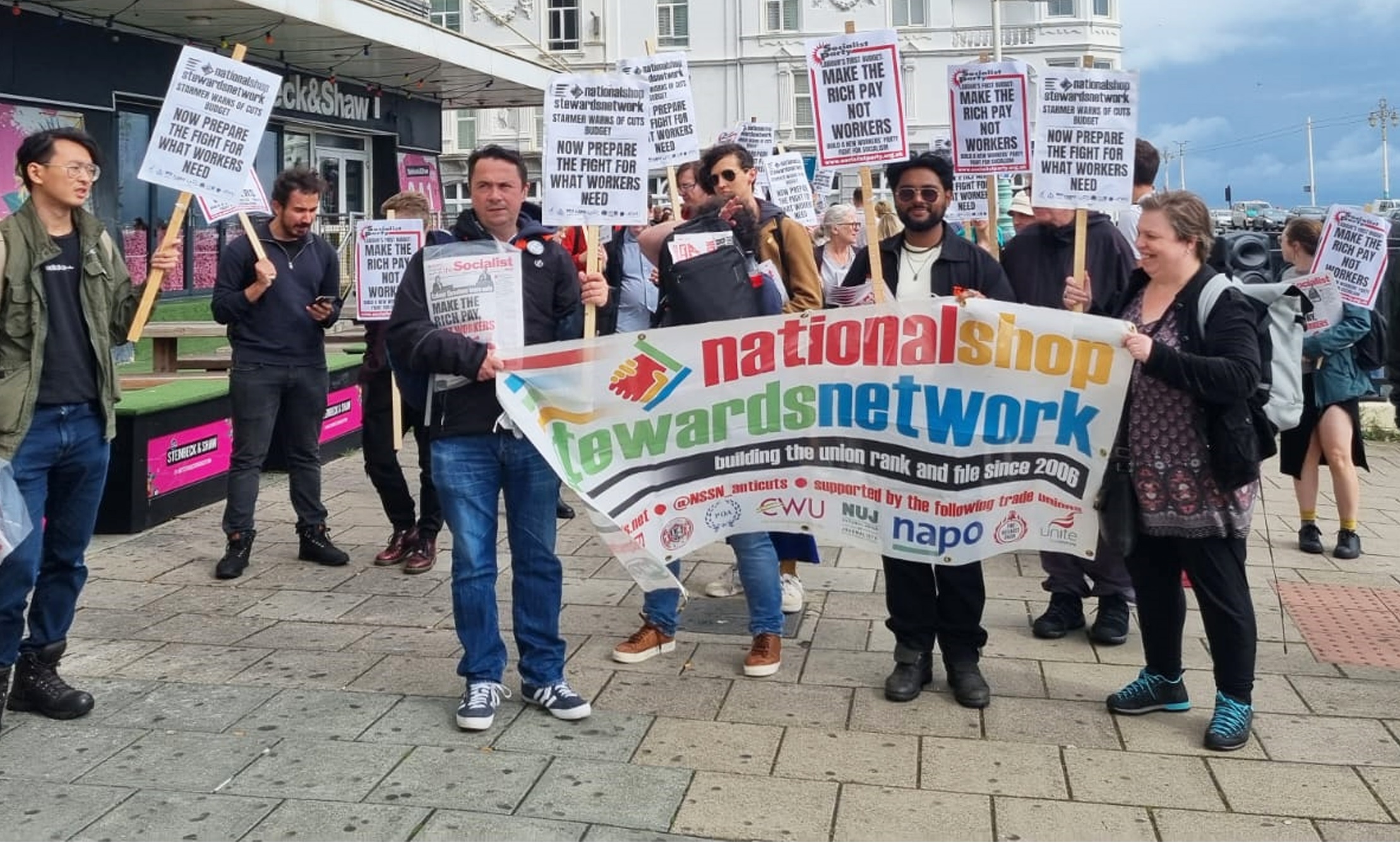
Fight to make the rich pay, not workers!
What should the trade unions do now? This was the key question raised by the National Shop Stewards Network (NSSN) rally and lobby, in which Socialist Party members participated, held as the Trades Union Congress (TUC) gathered for its annual Congress.
As delegates arrived, they were met by a lobby of over 100 trade unionists, from seasoned reps to young workers. They called on the TUC to prepare to fight: Make the rich pay, not the workers!
The lobby was preceded by a rally at which general secretaries, elected national executive members and reps discussed what the trade unions should be doing in this new situation. Matt Webb spoke from Brighton Trades Council to open the rally.
The Tories are defeated – but Starmer’s government will try to make workers pay for the crisis
Rob Williams, NSSN chair, opened the debate
We welcome the defeat of the Tories – the smashing of the most successful bosses’ party in western Europe is a victory for the working class and the trade union movement.
With the Tories gone, there may be some who will ask: ‘So why do we need to lobby the TUC now? Isn’t Labour talking to us? Aren’t they bringing in policies for us?’
We welcome any policy and concession that benefits workers. It is correct to celebrate the promised repeal of some of the most recent Tory anti-union laws. Although the minimum service levels were rendered inoperable by Aslef train drivers’ union, and (Tory prime minister) Sunak was unable to use those laws. But it is essential that unions demand the repeal of all the Tory anti-union legislation, going all the way back to Thatcher.
Some will point to the pay offers to public sector unions, in the range upwards from 5%, as proof that Starmer is listening. While these are above the current rate of inflation, they go nowhere near recovering the vast amount lost during 14 years of savage real-terms pay cuts by the Tories, and pay freezes by New Labour before them. And some are not fully funded and will lead to cuts.
Unions should fight for more, and for all pay increases to be fully funded.
Alongside taking strike action to defend jobs and services, unions should call on Labour councils to refuse to implement cuts, and demand that Starmer and his chancellor Rachel Reeves guarantee full funding.
The most fatal error is to have wishful thinking.
In the strike wave, Starmer wasn’t in the trenches with us, he was sacking shadow cabinet members who joined picket lines. The cut to pensioners’ heating allowance and refusal to lift the two-child benefit cap, and his disgraceful position on Gaza, should caution our movement.
The trailing of Reeves’ autumn budget with warnings of public sector cuts, is a blunt warning to those who will argue that we have to give Starmer more time. We have to prepare for Labour austerity.
The role of the union movement is to state clearly what is, not to prettify the situation. Starmer is in the press saying he might have to make ‘difficult choices’. There are no difficult choices, there are class choices – you’re either with us or against us!
The PCS civil service union has an amendment arguing that if Starmer hasn’t delivered on the key workers’ rights promised in his New Deal for Workers within the first 100 days, a special TUC congress should be called to discuss next steps.
Because of the strike wave and because of the political vacuum, the unions have become a pole of attraction. That’s why its even more necessary that alongside being prepared to take action, the unions also put forward a political programme – a workers’ manifesto, the socialist policies that workers need. For jobs, pay and pensions – and link them to the demands needed to defend workers and their communities, including nationalising the oil and gas companies, Royal Mail and BT, and Tata Steel.
That’s in contrast to the racists trying to exploit the political vacuum. Imagine if the trade unions had implemented the policy passed at TUC congress in 2018 for a ‘Jobs and homes, not racism’ programme.
The defeat of the Tories has ushered in a new period for our movement. But it isn’t the end of our fight, it’s only the beginning.
Prepare to fight now – or in the future?
Steve Gillan, general secretary of the Prison Officers Association, was clear, particularly in relation to the anti-trade union laws: “I’m glad we’ve not got a Tory government, but we’ve got to fight for whatever we want.”
Sarah Woolley, general secretary of the BFAWU bakers’ union, rightly described this as a critical moment after 14 years of austerity. She outlined the demands in the union’s ‘Bakers’ Dozen’ manifesto and said: “Too many people in our movement will want to wait, give them a chance and see what happens. But we’ve not got time to wait. We demand real change. If that means marching outside parliament because the manifesto commitments have not been upheld, we must march outside parliament”. She said: “If the Labour Party doesn’t support the working class, we must treat it like any other party that doesn’t support the working class.”
Ian Lawrence, general secretary of the probation officers union Napo argued that the Labour government could start by going after the unpaid tax of the rich. “We need a rescue package for prisons and probation, and a holistic approach to sentencing. There are too many people in prisons.”
Daniel Kebede, general secretary of the National Education Union, pointed out that the Tories left 4.3 million children in poverty and a schools’ funding crisis that meant crumbling buildings and a recruitment and retention crisis. He highlighted the campaign for universal free school meals and to increase education funding. He said: “We’ll get things, but Starmer’s going to need a push. There’ll be times in the future we have to fight again.”
Train drivers’ union Aslef general secretary Mick Whelan celebrated the defeat of the Tory “bastards”.
While saying that unions will “never be content” and that “we can campaign, we can protest, we can articulate the voices of the people that we represent”, he also said “I’m not too worried about the ‘what if’ moment, because even if we only got 40% of what’s being promised, we’re 40% better than we’ve been in the past.”
While arguing for the need to “bang on the doors for all workers everywhere”, insisting that you can afford to rebuild public services, Mick said: “I don’t expect it overnight, but I do expect it.”
He argued that the New Deal for Working People could be “revolutionary”, a “building block”, from which to “change Labour and its policies”. “We’ve got to build the movement back to where we were in the ’70s and ’80s. If this is a stepping stone towards doing that, I think we’re in the right place.”
From the floor, an RMT member argued that it is correct to put our demands on a Labour government, but we have to build a force prepared to act. That’s not an academic question about what to do in a few years’ time: we’re facing attacks now. BFAWU member Duggie Johnstone emphasised the devastation of austerity and homelessness, calling on the trade union leaders to “Be bold”.
Marion Lloyd, a member of the NEC majority in the PCS civil service union, spoke in a personal capacity – saying “I hope this time next year it will be in an official capacity”.
She argued that this TUC is at a vital stage in taking forward the aspirations of working people. She said “The situation is clear: the austerity we suffered for decades under the Tories isn’t going away.” Starmer and Rachel ‘cutting’ Reeves will act in the interests of British capitalism not working people, and so the role of the trade union movement is crucial. The trade unions have a duty to explain what is possible if we unite around a programme that protects jobs and pay.
“There are two strands of opinion at the top of the trade union movement – those who want to wait and see and hope, and those who want to take the opportunity to build the fight now.” That is the struggle at the top of PCS. “Don’t sow illusions in a government that is intending ruthless austerity”.
Taking on the far right
Sarah Woolley, BFAWU bakers’ union general secretary, argued that, with “people disconnected from politics and not looking to the trade unions”, the riots and votes for Reform “should be of more concern to us right now than what Starmer’s going to do in the first 100 days.”
This point was taken up by April Ashley, Black members’ rep on the Unison NEC, speaking in a personal capacity. April explained that Unison had a motion to the TUC arguing for unions to support anti-racist campaigns and mobilise for demos, but she argued that the unions should go further: the trade unions should be central to the fight. The unions can unite all sections of the working class against the bosses, and need to fight urgently against austerity.
The TUC needs to urgently enact the decision agreed in 2018 of a ‘Jobs and homes, not racism’ campaign – not just leave it as a “nice shiny resolution on the shelf”! Her Unison branch had passed a resolution that the TUC should call a national demo. “Too often the trade unions put the role of fighting racism out to other organisations” instead of playing the central role. “We have to link the fight on social conditions to the fight against racism – that’s how you undermine the far right and racism.”
Trade union rights
While pleased to see the New Deal for Workers, Steve Gillan, general secretary of the Prison Officers Association, said: “We need to get rid of the whole raft of Thatcher’s legislation” – and that includes the ban on prison officers taking action, brought in 30 years ago.
He called on the whole trade union movement to stand with them, not just to vote for their motion but to mount a concerted campaign.
Illustrating why trade union rights are so important, he said: “Prisons are in a terrible state. If we’d had the right to strike, the prisons wouldn’t be in this state”. The POA action in 1994 that led to the ban was about overcrowding – fighting for the “health and safety of our members and those in our care”. Then the prison population was 40,000; now it’s 88,000, with less staff.
How do we organise our political voice?
Hugo Pierre, a member of Unison’s local government service group executive, in a personal capacity, raised the vital question of how, in addition to using our industrial muscle, do we use our political muscle? He argued for a strategy that puts councils under pressure not to make cuts, including standing candidates; and he called for unions to put demands on the independent and suspended Labour MPs (who rebelled against the cap on child benefit) to fight for socialist policies.
Thanking the NSSN for its support for the struggle at Barts Health Trust, Len Hockey, Unite secretary at Barts, described their recent victory over Covid bonus payments and called on “health union leaders to replicate that”. He said that the 5.5% NHS pay award is “totally inadequate. The fight on pay is a fight for the NHS itself”. Endorsing Hugo’s points, he said that Starmer’s stamping on the ‘suspended seven’ is “the voice of the ruling class”.
Housing and Grenfell
Suzanne Muna, Executive member of Unite the Union, speaking as a representative of the Social Housing Action Campaign (SHAC) said “Grenfell shows the extent to which landlords are allowed to gamble with people’s lives”. Rachel Reeves has agreed to let social landlords increase rents by 1% on top of inflation – “It shows who’s side this Labour government is on, and it’s not ours.”
Linda Taaffe, former secretary of the NSSN and long-term housing campaigner, said the Grenfell report is “damning of the whole system – it puts capitalism in the dock”. Saying “We cannot let the survivors struggle on their own” she called for the TUC to meet with them and take action. Kathy Smith, Unite NEC member, reported that the Unite delegation was submitting an emergency motion on Grenfell.
- Grenfell exposes how profit kills: Unions must fight for nationalisation
- Grenfell report: corporations, establishment, and capitalism guilty
- Grenfell: Put the capitalist system in the dock!
