


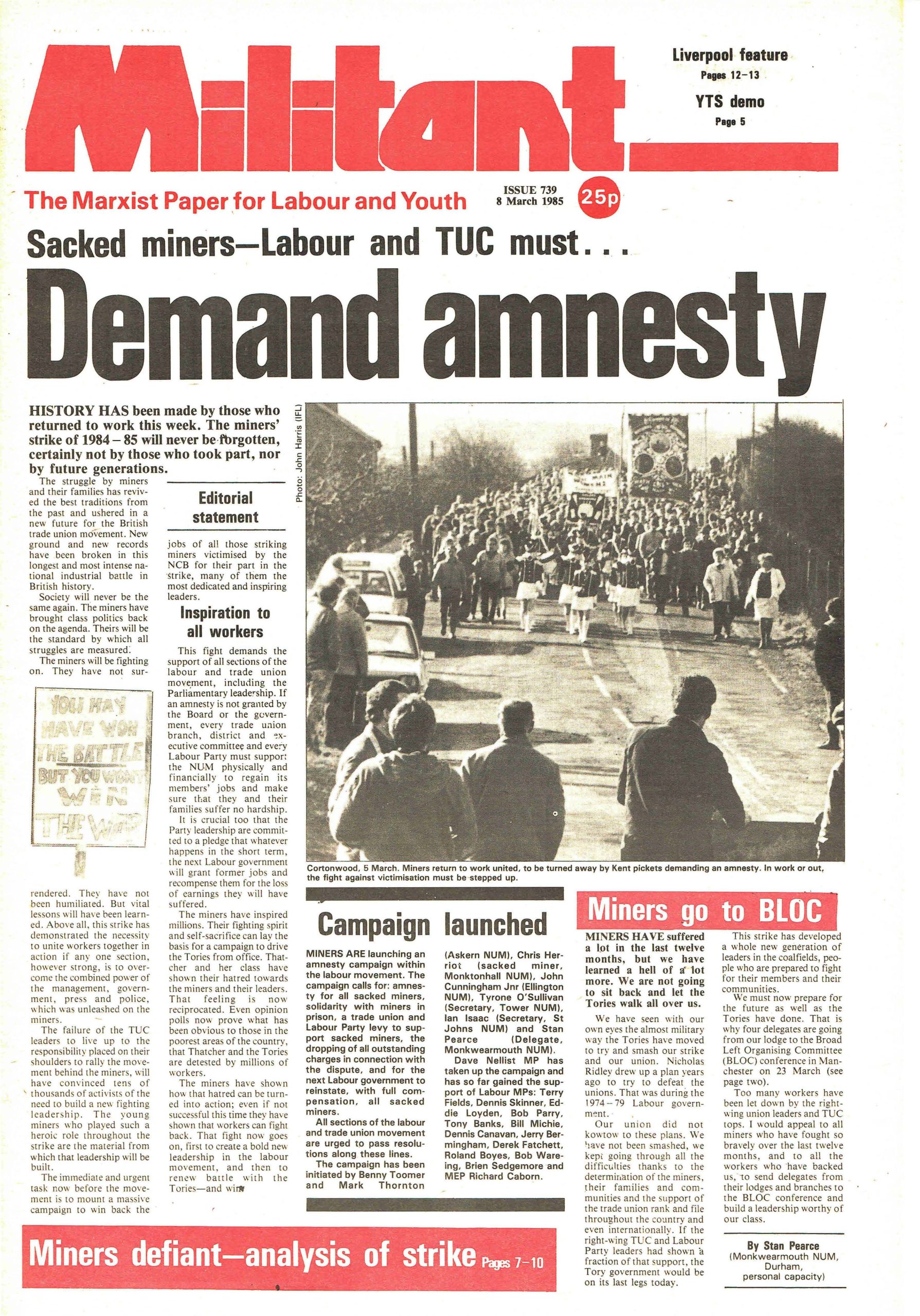
On 3 March 1985, striking miners went back to work after a year-long strike to save pits, jobs and communities. This is how the Militant (forerunner of the Socialist) reported the end of the strike…
“History has been made by those who returned to work this week. The miners’ strike of 1984-85 will never be forgotten, certainly not by those who took part, nor by future generations.
“The struggle by miners and their families has revived the best traditions from the past and ushered in a new future for the British trade union movement. New ground and new records have been broken in this longest and most intense industrial battle in British history.
“Society will never be the same again.”
With these prophetic words on the front page, the Militant marked the end of the heroic miners’ strike, with a headline too about amnesty for sacked miners following the return to work. Inside, Dave Griffiths described the scene in the Staffordshire at Littleton Colliery:
The news, half expected, still came as a shock. Midlands men have been in a minority for many months and felt at first that previously solid areas were panicking.
At Littleton, when it was proposed that they vote to return, no one was prepared to vote. It had to be proposed as: “Do we support our union?” Many felt deep down that without the solid areas giving the strike its strength there would have to be a return.
Both the Littleton and Lea Hall meetings were emotional, with anger, disappointment and defiance. Miners wanted to see the fight through and the thought of leaving men behind really stuck in their throats. Many expressed the feeling that the return was rushed. But the clear message was that the fight goes on. It was on before the strike, during it, and now it’s a different form of battle for a while .
Sat in the Littleton meeting, I looked through the door, opened to let the thick fag smoke out, and I could see the fields behind the strike centre. Fields hard and white with frost, that covered you after 30 minutes picketing when we started 12 months ago. Fields that became brown, then green, then baked dry in the summer, then white for week upon week through winter. Now they were turning green again in the spring sun. But spring 1985 has seen a much changed NUM, though with the same resolution to face the new problems.
Then at six o’clock Tuesday morning the men gathered then marched off to the pit. A few scab lorry drivers copped it as we marched down the road. We reached the pit singing, and chanting support for Arthur Scargill, the scabs were waiting to watch these proud men march in. With many supporters, wives and mothers clapping, cheering and wiping eyes. But on Monday and Tuesday there were no tears of defeat in this area, only tears of pride in our class and of our determination to win .
Support groups sang: “Cannock miners, we’ll support you ever more.” As the men queued, committee man Dave Preece arrived late: “I had to be the last one in.”, but not quite. Because along behind him stood Johnnie McGann – a sacked miner – who had to stand at the gate as his mates went in. A symbol of what has to be won, and what strikers in this area intend to see is done.
The issue of fighting for sacked miners was also on the minds of those returning to work at Houghton near Barnsley as striking miner Andy Flemming told the Militant: “We will keep up the overtime ban and work to rule until those who were sacked are reinstated. As our branch secretary said: ‘We came out as one and we are going back as one – this will go down in history.’”
At Maerdy Colliery in South Wales, a village known as ‘Little Moscow’ due to its reputation for militancy and socialism, miners marched back “with the band playing and banners flying, the miners from Maerdy – which has not seen one scab throughout the 12 month dispute – marched back to work.
“Local people turned out in support, with banners from local support groups and trade unions joining the march. Schoolkids ran out and joined the march at one point. At the entrance to the pit miners stopped and applauded their supporters, who returned the cheers. A rally was held in the pit yard. Many marchers commented that now that the miners were returning to work, not one policeman was in sight, after their mass turnouts throughout the strike.”
And the role of the Militant was acknowledged at Cortonwood Colliery, the proposed closure of which prompted a walkout which eventually led to the national strike in the first place: “John White, a stage loader, has worked in the pits for seven years. Married with two children, life has been very difficult on £13 supplementary benefit plus £13 family allowance. His electricity was cut off for a week. But John thinks the struggle is well worth the hardship. Things have changed in the 12 months Cortonwood have been out. “Before the strike, I’d never met Militant but I saw a local Militant supporter selling the paper with headlines about the strike. The coverage in Militant has been the best throughout. We sell quite a few Militants now regularly with people discussing what’s in the paper. What I like is that Militant puts an alternative.”
- The Socialist has marked the 40th anniversary of the strike throughout the last year. For everything we have said, search ‘miners’ strike’ at socialistparty.org.uk
- A civil war without guns – the lessons of the 1984-85 miners’ strike by Ken Smith, £7. Buy from www.leftbooks.co.uk