

Rob Williams, NSSN Chair
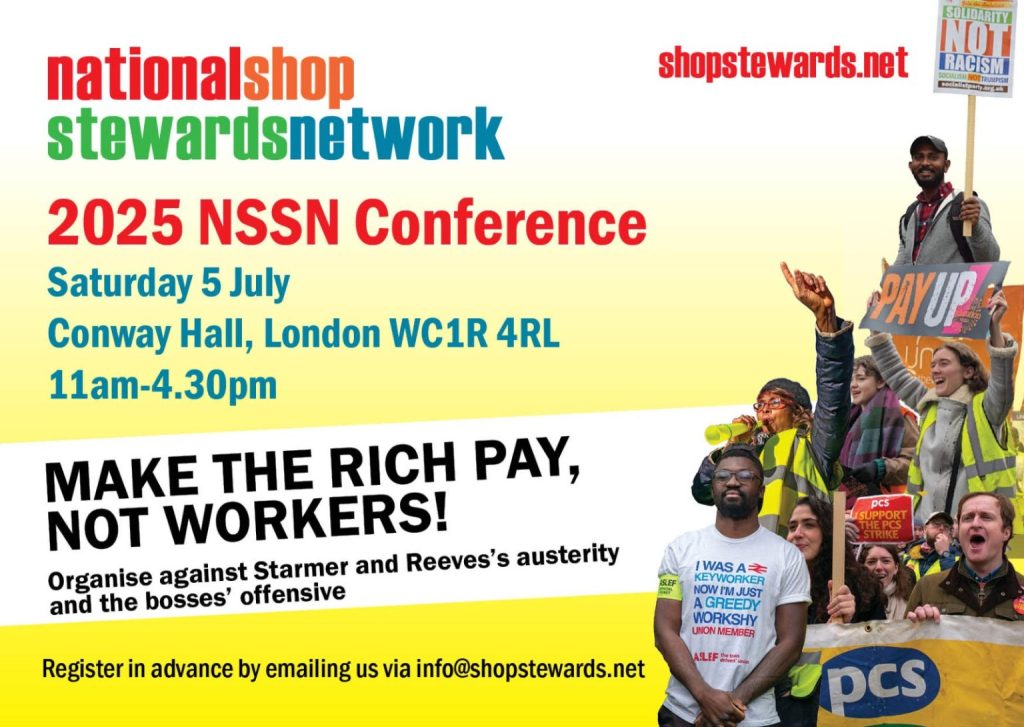
The National Shop Stewards Network (NSSN) conference on 5 July will take place exactly a year since Starmer’s government won the election with a 174 seat majority. So it will be both a balance sheet of Labour’s first 12 months in office and a vital forum for union reps and activists to discuss how to take forward the fight against Keir Starmer and Rachel Reeves’s austerity and the bosses’ offensive. Right now, the Birmingham bin workers are in the front line of that fight, and a discussion on how to build solidarity with their struggle will be a central part of NSSN conference.
On entering Number 10 last July, Starmer promised: “We won as changed Labour, and we will govern as changed Labour.” This echoed the words of Tony Blair in 1997. Starmer is a return to New Labour 1.0 – his ‘changing’ of Labour refers to the repudiation and retreat from the party that was led by Jeremy Corbyn on the most radical pro-worker programme for three decades. Starmer is a pillar of the capitalist establishment and has set out his stall to govern as such, both at home and abroad.
Even before the election, he tail-ended the Tories on Gaza, and with his feet under the Downing Street table, Starmer has embarked on Labour austerity – refusing to lift the two-child benefit cap, cutting the winter fuel allowance, attacking disability benefits, and announcing a £2 billion cut in the civil service, threatening 80,000 jobs. All this while massive pressures build in the NHS, schools, councils and a funding catastrophe unfolds in further and higher education.
When Starmer spoke at last September’s TUC (Trades Union Congress), he tried to schmooze the union leaders with talk of ‘partnership’ – with his government and the ‘good’ employers. The first steps have been taken in education, including the vicious privatised academy chains.
But the disgraceful actions of Starmer and his deputy Angela Rayner, ex-Unison NEC (National Executive Council) member, in backing up the brutal strike-breaking measures of Labour Birmingham City Council against binworkers fighting a massive cut in wages of up to £8,000, show that it’s not partnership that is needed but militant union organisation and action.
And for all the fine words of the New Deal for Workers, now retitled more blatantly as ‘Labour’s plan to make work pay’, loopholes for zero-hour contracts remain, and the Birmingham binworkers know full well that ‘fire and rehire’ is alive and kicking. Also, the undemocratic Tory industrial action 50% ballot thresholds, brought in by David Cameron in 2016, still remain in law, despite Starmer’s huge majority. Any national strike ballots this year in the public sector against Labour’s unfunded pay offers, that will be mostly below RPI inflation and promise cuts, will have to be conducted under this restrictive barrier.
However, the tremendous strike wave of the last three years showed that workers and their unions can overcome such obstacles, including on a national scale. Sunak’s Minimum Service Levels anti-union legislation, attacking the right to strike of the whole union movement, was defeated and rendered inoperable by train drivers’ union Aslef on one rail company, LNER.
Starmer’s election ‘landslide’ wasn’t an endorsement of his pro-business policies. It was ‘a mile-wide and an inch thick’ because workers wanted to smash the hated Tories after 14 years of austerity and the cost-of-living squeeze, not to endure more of the same. The beginning of Labour U-turns is a sign that Starmer is feeling the pressure of the mounting anger of the working class.
However, he is looking over his right shoulder to Reform, shamefully mixing up some measly concessions by copying their anti-migrant rhetoric. It is because of the political vacuum on the left that he isn’t looking over his left shoulder. The workers’ movement must fill that vacuum, both industrially and politically, as the most effective way to unite workers against the racist divide and rule agenda and apply more pressure to Starmer.
This is why it’s essential that union activists discuss how we support the strikes, especially how we build united action across the movement, in the private and public sectors. Resident doctors (previously junior doctors) in the British Medical Association (BMA) are balloting and University and College Union congress has agreed strike votes in further and higher education.
But the bin strike in Birmingham also puts front and central the need for the workers’ movement to debate the need for a political alternative to the pro-business parties – from Labour and the Tories to Reform. As a striking bin worker put it: “If Labour acts like Tories, we treat them as Tories.”
The NSSN conference is a forum for all the debates that face union activists, in addition to learning from the struggles that have taken place and are unfolding.
No to partnership – stand up to Starmer and the bosses – come to NSSN conference!